
Nifty 100 Stocks List 2026 — Complete Index, Top Companies & Sector Weightage
Wed Apr 01 2026

If you want to track India’s large-cap universe in one go, the Nifty 100 stocks list is your starting point. As of March 2026, the Nifty 100 index trades at 23,098 and covers approximately 67% of NSE’s total free-float market capitalisation — making it the most comprehensive large-cap benchmark available to Indian investors.
The Nifty 100 is essentially a combination of the Nifty 50 and the Nifty Next 50. It tracks the top 100 companies by free-float market cap across all major sectors of the Indian economy. Whether you are building a portfolio, evaluating index funds, or comparing your holdings against a benchmark, understanding the Nifty 100 composition is essential.
This article covers the complete Nifty 100 stocks list, top holdings by weightage, sector breakdown, historical performance, and how to invest in the index.
What is the Nifty 100 Index?
Click Here — Get Free Investment Predictions
The Nifty 100 is a diversified large-cap index owned and managed by NSE Indices Limited, a wholly-owned subsidiary of the National Stock Exchange of India. It is calculated using the free-float market capitalisation method, and its base date is January 1, 2003, with a base index value of 1,000.
The index is reviewed semi-annually — on the last trading day of March and September — to reflect changes in market capitalisation. A stock must be listed on NSE, form part of the Nifty 500 universe, and have a minimum six-month trading frequency of 90% to be eligible for inclusion.
Track every Nifty 100 stock, filter by sector, P/E, or fundamentals on the Univest Screener.
Nifty 100 Stocks List — Top Holdings by Weightage (March 2026)
Tap to Access Best Research Pieces on Nifty 100 Companies
| Rank | Company | Ticker | Sector | Weight (%) |
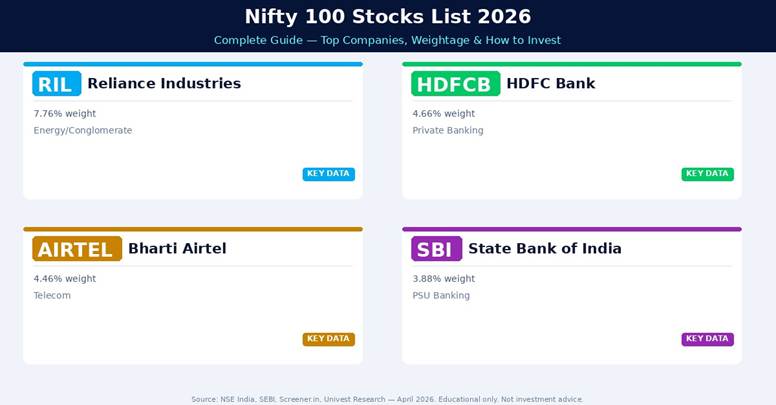
| 1 | Reliance Industries | RELIANCE | Energy / Conglomerate | 7.76% |
| 2 | HDFC Bank | HDFCBANK | Private Banking | 4.66% |
| 3 | Bharti Airtel | BHARTIARTL | Telecom | 4.46% |
| 4 | State Bank of India | SBIN | PSU Banking | 3.88% |
| 5 | ICICI Bank | ICICIBANK | Private Banking | 3.57% |
| 6 | Tata Consultancy Services | TCS | IT Services | 3.51% |
| 7 | Infosys | INFY | IT Services | 2.08% |
| 8 | Bajaj Finance | BAJFINANCE | NBFC | 2.06% |
| 9 | Hindustan Unilever | HINDUNILVR | FMCG | 1.97% |
| 10 | LIC of India | LICI | Insurance | 1.90% |
| 11 | Larsen & Toubro | LT | Infrastructure | 1.87% |
| 12 | Sun Pharma | SUNPHARMA | Pharma | 1.72% |
| 13 | Maruti Suzuki | MARUTI | Automobile | 1.58% |
| 14 | HCL Technologies | HCLTECH | IT Services | 1.50% |
| 15 | Mahindra & Mahindra | M&M | Automobile | 1.50% |
Source: NSE Indices Limited. Weightage as of March 23, 2026. Data from smart-investing.in. Verify on nseindia.com before investing.
Nifty 100 Sector Breakdown
The Nifty 100 is well diversified across 13+ sectors. Financial services (banking + NBFCs + insurance) holds the largest share at approximately 35–38%, reflecting the dominance of HDFC Bank, ICICI Bank, SBI, and Bajaj Finance. Information Technology is the second largest sector at approximately 13–14%, led by TCS and Infosys. Energy and Oil & Gas (primarily Reliance Industries and ONGC) account for roughly 12%.
- Financial Services: 36% (HDFC Bank, ICICI Bank, SBI, Axis Bank, Bajaj Finance, Kotak Bank, LIC)
- Information Technology: 14% (TCS, Infosys, HCL Tech, Wipro, Tech Mahindra)
- Energy / Oil & Gas: 12% (Reliance Industries, ONGC, BPCL, NTPC, Adani Green)
- Consumer Goods / FMCG: 8% (HUL, ITC, Nestle, Marico, Dabur)
- Automobile: 6% (Maruti, M&M, Bajaj Auto, Tata Motors, Eicher Motors)
- Pharma & Healthcare: 5% (Sun Pharma, Dr Reddy’s, Cipla, Divi’s)
- Infrastructure & Capital Goods: 5% (L&T, Siemens, ABB, Adani Ports)
- Metals & Mining: 4% (Tata Steel, JSW Steel, Hindalco, Vedanta)
Nifty 100 vs Nifty 50 — Key Differences
| Parameter | Nifty 50 | Nifty 100 |
| Stocks | 50 companies | 100 companies |
| Coverage | 54% NSE float | 67% NSE float |
| Composition | Top 50 by market cap | Top 50 + Next 50 |
| Risk Profile | Lower volatility | Slightly higher (mid-large) |
| ETF Options | Highest AUM | Growing AUM |
| Rebalancing | Semi-annual | Semi-annual |
The Nifty 100 gives you 50 more mid-large companies than the Nifty 50, offering wider diversification without venturing into mid-cap volatility.
How to Invest in the Nifty 100 Index?
Subscribe to Univest Pro for Premium Research & Stock Picks
You cannot directly buy the Nifty 100 index — but you can invest in it through three primary routes:
- Nifty 100 Index Funds — Multiple AMCs offer Nifty 100 index funds including SBI, ICICI Prudential, Nippon India, and Bandhan. These funds replicate the index composition passively. TER is typically 0.10–0.20% per annum.
- Nifty 100 ETFs — Exchange-traded funds tracking the Nifty 100 are listed on NSE and can be bought like a stock via your demat account. Buy through Univest, Zerodha, or any SEBI-registered broker.
- Direct Stock Portfolio — For HNIs, you can replicate the top 20–30 Nifty 100 stocks manually using the weightage table above. Capital-intensive but gives maximum control.
- Nifty 100-linked PMS — Portfolio Management Services track this index for clients with Rs.50 lakh+ AUM.
Open a free demat account on Univest and start investing in Nifty 100 ETFs at just Rs.6/day —
Benefits of Tracking the Nifty 100
- Diversification: 100 stocks across 13+ sectors gives you India’s full large-cap exposure in one benchmark
- Liquidity: All Nifty 100 stocks are highly liquid with F&O coverage on most names
- Transparency: NSE rebalances semi-annually and publishes composition data on nseindia.com
- Low Cost: Nifty 100 index funds have among the lowest expense ratios in Indian mutual funds (0.10–0.20%)
- Performance Benchmark: Use the Nifty 100 return as a benchmark to assess your portfolio manager’s alpha generation
FAQs — Nifty 100 Stocks List
What is the Nifty 100 index level today?
As of March 23, 2026, the Nifty 100 index level is 23,098. The index is calculated on a real-time basis during market hours (9:15 AM to 3:30 PM IST) and is published live on nseindia.com. It can be tracked via all major stock market apps including Univest.
Which stock has the highest weight in the Nifty 100?
Reliance Industries has the highest weight in the Nifty 100 at 7.76% as of March 2026, followed by HDFC Bank (4.66%), Bharti Airtel (4.46%), State Bank of India (3.88%), and ICICI Bank (3.57%). These top 5 stocks account for approximately 24% of the entire index.
Is the Nifty 100 better than the Nifty 50 for investing?
The Nifty 100 offers broader exposure by including the Nifty Next 50 in addition to the Nifty 50. This gives you access to high-growth large-cap companies that haven’t yet reached the top 50 by market cap — historically, Nifty Next 50 has outperformed Nifty 50 over long periods. For long-term investors with a 5–10 year horizon, the Nifty 100 may offer a better risk-reward balance than the Nifty 50 alone.
How many sectors are in the Nifty 100?
The Nifty 100 covers 13+ major sectors of the Indian economy including Financial Services, IT, Energy, Consumer Goods (FMCG), Automobile, Pharma, Infrastructure, Metals, Telecom, Cement, Power, Media, and Real Estate.
How often is the Nifty 100 rebalanced?
The Nifty 100 index is rebalanced semi-annually by NSE Indices Limited. The cut-off dates for review are the last trading day of January and July each year (effective March and September). Companies that fall below eligibility thresholds are replaced by higher-ranked entrants from the Nifty 500 universe.
Where can I find the complete Nifty 100 stocks list?
The complete Nifty 100 stocks list is available on NSEIndia.com under the Equity Indices section. You can also use the Univest Screener to filter, sort, and analyse all Nifty 100 stocks by P/E, P/B, ROE, sector, and 52-week price performance.
Download the Univest iOS App or Univest Android App for daily stock recommendations and free research.
Disclaimer: Investments in securities are subject to market risk. Please read all related documents carefully before investing. This content is for educational purposes only and does not constitute investment advice or stock recommendations. Past performance is not indicative of future returns. Consult a SEBI-registered financial advisor before making investment decisions.
Recent Article
Multibagger Penny Stocks Below 5 rs in India 2026
Best Multibagger Midcap Stocks in India 2026
Best Tata Penny Stocks in 2026 With High Growth Potential
Top 10 Fundamentally Strong Penny Stocks 2026: for Long-Term Growth
Multibagger Penny Stocks for 2026 for Higher Returns
Debt-Free Penny Stocks in India 2026
Best High Promoter Holding Penny Stock List for 2026
Top 10 Fundamentally Strong Penny Stocks 2026: for Long-Term Growth

Related Posts
SBI Penny Stocks 2026: State Bank Group Low-Price Stocks — Complete Guide
Stock Turnover Ratio Formula — Meaning, Calculation, Interpretation & Examples
Sensex Up 1,500 Points, Nifty 50 in High Momentum Zone as Trump Signals Possible End to Conflict
Why Is Vodafone Idea Share Price Falling? Key Reasons & Share Price Target 2026
Cochin Shipyard Up 15%: Is Something Brewing in Defence Stocks?
