
Why Is Vodafone Idea Share Price Falling? Key Reasons & Share Price Target 2026
Updated: 1 Apr 2026 • 5:57 pm
Posted by:

Click Here — Get Free Investment Predictions from SEBI-Registered Analysts
Vodafone Idea (Vi) share price is falling — and has been falling for years — primarily because the company carries an existential debt burden of approximately Rs.2.1 lakh crore against annual EBITDA of approximately Rs.18,000 crore. This gives a debt/EBITDA ratio of approximately 11-12x — a level that makes equity value recovery extremely difficult without substantial debt relief or equity capital raise. The government's December 2025 AGR dues moratorium (freezing Rs.87,695 crore in dues with repayment deferred to FY32–FY41) provided temporary relief but disappointed investors who had hoped for a more significant write-off.
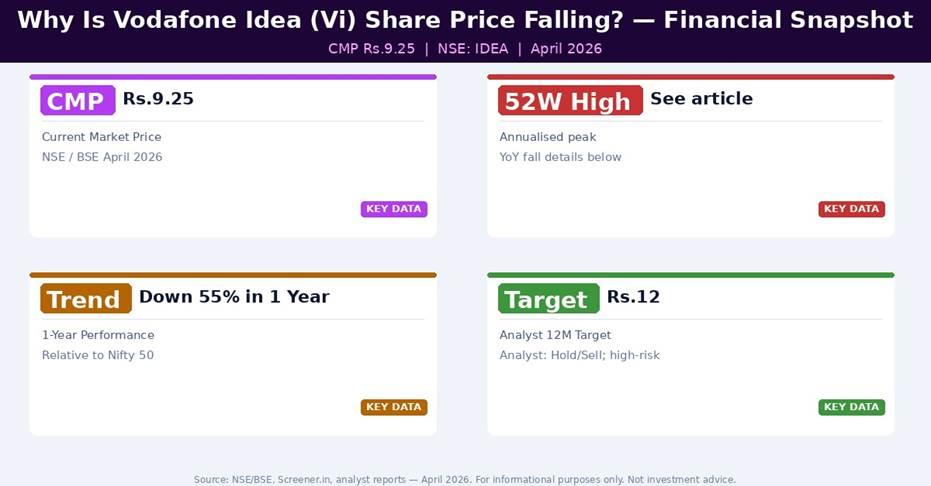
As of April 1, 2026, Vodafone Idea trades around Rs.9.25 on NSE — down approximately 55% over the past year. The 52-week high was approximately Rs.19 (April 2025) and the current price represents one of the most significant sustained declines among large-cap stocks on NSE. The government owns approximately 48.99% of Vi following AGR dues-to-equity conversions.
About Vodafone Idea (Vi)
Vodafone Idea Limited is India's third-largest telecom operator, formed through the merger of Vodafone India and Idea Cellular (part of the Aditya Birla Group) in 2018. The company provides mobile voice, data, and enterprise services to approximately 192.9 million subscribers (Q3 FY26). After years of financial distress, the Indian government acquired a ~48.99% stake through conversion of spectrum and AGR dues into equity — making it the single largest shareholder. The Aditya Birla Group retains approximately 14% while Vodafone PLC's stake has been diluted significantly.
Vodafone Idea (Vi) financial snapshot — debt Rs.2.1 lakh crore, ARPU Rs.155, analyst target range
Why Is Vodafone Idea Share Price Falling? — 6 Key Reasons
Tap to Access Best Research Pieces on Vi at Univest
1. Total Debt of Rs.2.1 Lakh Crore — The Existential Burden
Vodafone Idea's total debt stands at approximately Rs.2.1 lakh crore — comprising approximately Rs.1.19 lakh crore in spectrum dues, Rs.87,695 crore in AGR dues, and additional bank and vendor debt. Against annual EBITDA of approximately Rs.18,000–19,000 crore, this gives a leverage ratio of 11-12x — far above any sustainable threshold. By comparison, Reliance Jio and Bharti Airtel have debt/EBITDA ratios below 1x. Even with the December 2025 AGR moratorium, Vi's debt repayment obligations ramp up sharply from FY29 onwards — Rs.27,000 crore per year — at a time when the company would need to be investing heavily in 5G.
2. Subscriber Losses — Market Share Erosion
Vi's total subscriber base stood at 192.9 million in Q3 FY26 — down 3.8 million quarter-on-quarter. This follows a 1 million net decline in Q2 FY26. The trend reflects customer migration to Reliance Jio and Bharti Airtel due to Vi's inferior 4G network coverage and quality. Since Vi has been under-investing in network capex relative to peers (Rs.9,570 crore in FY25 vs Jio's Rs.46,000 crore and Airtel's Rs.30,000 crore three-year average), the network gap is widening — making subscriber retention increasingly difficult.
3. AGR Relief Disappointed — Market Expected a Write-Off
When the Union Cabinet approved a 5-year moratorium on Vi's AGR dues in December 2025, Vi shares initially rose 6% in anticipation — but then crashed 15% intraday. The reason: investors had positioned for a debt write-off; what they got was a deferral. The Rs.87,695 crore AGR dues were frozen — repayments pushed to FY32-FY41 — but the principal was not reduced. Total debt remained unchanged, and the relief was characterised by analysts as a "timeline extension, not a write-off." The government's maximum annual payment obligation for Vi was set at Rs.124 crore for six years, then Rs.100 crore for four years — a fraction of the deferred AGR amount.
4. Spectrum Dues — The Larger Unresolved Liability
Beyond AGR dues, Vi owes approximately Rs.1.19 lakh crore in spectrum dues — representing 57% of its total debt. Unlike AGR dues, spectrum dues have fewer relief options available because Jio and Airtel have largely repaid their spectrum dues; any relief to Vi would create a political and fairness problem for the telecom regulator. Vi must pay Rs.6,200 crore in spectrum dues in FY27, rising to Rs.16,600 crore in FY28 and Rs.27,000 crore per year from FY29-FY32. These obligations are structured and largely unavoidable.
5. Capital Raise Delay — Network Investment Stalled
Vi's Rs.50,000–55,000 crore capex plan over the next three years — needed to close the 4G and 5G network gap with peers — requires raising Rs.25,000 crore in term debt, with the balance from internal accruals. This debt raise has been repeatedly delayed due to banks' reluctance to lend without clarity on AGR dues and government support. As of Q3 FY26, Vi had spent Rs.6,450 crore of its planned Rs.50,000–55,000 crore capex — well behind schedule. Every quarter of delayed network investment translates to additional subscriber losses.
6. ARPU Gap — Revenue Per User Below Peers
Vi's ARPU (Average Revenue Per User) stood at approximately Rs.155-160 per month in Q3 FY26 — below Jio (approximately Rs.200) and well below Airtel (approximately Rs.245). The ARPU gap reflects Vi's lower-quality subscriber base (more feature phone users, lower data consumption) and its inability to fully participate in the industry tariff hikes of 2024. Any further tariff hike by the industry would benefit Vi, but the magnitude of benefit is smaller than for Jio or Airtel due to its subscriber mix.
Vodafone Idea Financial Performance — Key Metrics
| Metric | Q3 FY26 | Q2 FY26 | YoY / Context |
| Revenue (Rs. crore) | 11,323 | 11,117 | +1.8% QoQ |
| EBITDA (Rs. crore) | 4,817 | 4,600 | Improving sequentially |
| Net Loss (Rs. crore) | -5,286 | -7,176 | Losses narrowing |
| Total Subscribers (million) | 192.9 | 196.7 | -3.8 mn QoQ |
| ARPU (Rs.) | ~155-160 | ~154 | Slowly improving |
| Total Debt (Rs. lakh crore) | ~2.1 | ~2.1 | Unchanged |
| Govt Stake | ~48.99% | — | Post AGR conversion |
Source: Vi Q3 FY26 earnings, HDFC Securities, Business Standard, Motilal Oswal — April 2026.
Monitor Vi's subscriber data and debt metrics on the Univest Screener.
Technical Analysis — Vodafone Idea (Vi) Charts
- CMP: approximately Rs.9.25 — near multi-year lows
- 52-week high: Rs.19 (April 2025); current price is 51% below the high
- Daily trading volumes consistently above 60 crore shares — extreme retail participation
- Key support: Rs.8.00–8.50 (HDFC Securities' recommended stop-loss zone)
- Key resistance: Rs.12.00–12.50 (recent high after AGR moratorium news)
- RSI extremely low — technically oversold, but fundamentally the downtrend reflects debt overhang, not just sentiment
Download the Univest iOS App or Univest Android App to track Vi and its telecom peers in real time.
Vodafone Idea Share Price Target 2026 — Analyst Estimates
Subscribe to Univest Pro for Premium Telecom Sector Research
Short-Term Target (3–6 months)
HDFC Securities has a buy-on-dips recommendation at Rs.8–9 with a 4-quarter target of Rs.12 — implying approximately 25-35% upside from current levels. This is contingent on the debt raise of Rs.25,000 crore completing, providing capex clarity, and ARPU improving through tariff hikes. Short-term range: Rs.8–12 depending on capital raise progress.
12-Month Analyst Consensus
Analyst targets for Vi range from Rs.6 (Sell recommendations citing spectrum dues risk and limited government relief options) to Rs.12 (HDFC Securities, Buy-on-dips). Nuvama maintains Hold at Rs.10.50. Axis Capital is constructive post-AGR moratorium. The median target is approximately Rs.9–11 — minimal upside from current levels at the median, reflecting the near-binary risk profile of this stock.
Long-Term Target (FY28–FY30)
Vi's long-term management targets of tripling cash EBITDA to Rs.30,000 crore by FY29 would, if achieved, reduce debt/EBITDA toward 7x — still high but more manageable. Bull case scenario: Rs.25–40 by 2028-2030 if equity raise succeeds, network investment closes the gap with peers, and subscriber losses reverse. Bear case: equity value approaches zero if debt repayments cannot be met from FY29 onwards.
Will Vodafone Idea Share Price Recover?
Bull Case
The bull case for Vi is: the government, holding 49%, cannot afford to let Vi fail — it would create a duopoly (Jio + Airtel) in a critical national infrastructure sector, leading to higher consumer prices and reduced competition. The AGR moratorium buys time for Vi to raise equity, invest in 4G, recover subscribers, and improve EBITDA to service future debt obligations. If the capital raise of Rs.25,000 crore completes, the stock could re-rate sharply — HDFC Securities sees Rs.12 as a 4-quarter target.
Bear Case
The bear case is starkly simple: Rs.2.1 lakh crore in debt with annual EBITDA of Rs.18-19,000 crore means 11x leverage. Even if EBITDA triples to Rs.55-60,000 crore by FY29 (management's own target), the debt/EBITDA would still be approximately 3.5-4x — better but still high. More likely, EBITDA growth will be constrained by competitive pressure from Jio and Airtel, making the triple-EBITDA target aspirational rather than achievable. If equity value in a restructured scenario is low, existing shareholders get diluted toward zero.
Conclusion
Vodafone Idea's share price is falling because the company faces one of the most severe debt overhangs in Indian corporate history — Rs.2.1 lakh crore in total debt against Rs.18-19,000 crore in annual EBITDA. The government's AGR moratorium in December 2025 was a lifeline but not a solution. Vi's survival depends on completing the Rs.25,000 crore debt raise, investing in 4G network coverage, arresting subscriber losses, and receiving further spectrum relief from the government. This is a high-risk, binary investment — not a core portfolio holding. Investors who are willing to accept total loss of capital in exchange for potential 50-100% recovery upside if Vi executes its turnaround may find current levels speculative-buy territory. Everyone else should stay on the sidelines.
Frequently Asked Questions
Why is Vodafone Idea share price falling?
Vodafone Idea share price is falling due to Rs.2.1 lakh crore in total debt (11-12x annual EBITDA), ongoing subscriber losses of 3.8 million QoQ in Q3 FY26, AGR moratorium providing a deferral but no debt reduction, delayed capital raise for network investment, and ARPU of Rs.155-160 well below peers. The stock has fallen 55% in one year reflecting these existential financial challenges.
What is the Vodafone Idea share price target for 2026?
HDFC Securities has the most bullish 2026 target of Rs.12 (buy-on-dips at Rs.8–9, 4-quarter target). Nuvama maintains Hold at Rs.10.50. Sell recommendations cite Rs.6 as a fair value if spectrum dues relief does not materialise. The wide target range (Rs.6–12) reflects the binary nature of Vi's outlook — outcome depends entirely on debt raise and government support.
Will Vodafone Idea survive?
HDFC Securities assigns approximately 70% probability to Vi's survival and 30% to collapse — reflecting the government's implicit support as a 49% shareholder. The government's interest in maintaining a three-operator telecom market (to prevent a Jio-Airtel duopoly) provides structural support. However, survival is not the same as equity value creation — even if Vi survives, future equity raises will dilute existing shareholders.
Is Vodafone Idea a good buy at Rs.9?
At Rs.9, Vi offers speculative upside to Rs.12 (35% potential) if the capital raise completes. However, it also carries risk of further decline to Rs.5-6 (35-45% potential loss) if the raise fails or spectrum relief is not extended. This is not a buy for conservative or moderate investors. It suits only those who can afford to lose the entire invested amount and understand the difference between a recovery trade and a core holding.
What is Vodafone Idea's total debt?
Vodafone Idea's total debt is approximately Rs.2.1 lakh crore as of Q3 FY26, comprising approximately Rs.1.19 lakh crore in spectrum dues, Rs.87,695 crore in AGR dues (now deferred to FY32-FY41 under the government moratorium), and additional bank and vendor liabilities. This debt burden is the primary reason for the sustained share price decline and the existential financial uncertainty around Vi.
Disclaimer: This article is for informational and educational purposes only and does not constitute investment advice or a stock recommendation. Share prices and analyst targets mentioned are based on publicly available data as of April 2026 and are subject to change. Investing in stocks involves market risk — you may lose part or all of your capital. Always consult a SEBI-registered financial advisor before making investment decisions. Past performance does not guarantee future results.
Also Read
Why is KRBL Share Price Falling? Check Next Share Price Target
Why is Reliance Infrastructures Share Price Falling? Check Next Share Price Target
Why is Mahanagar Gas Share Price Falling? Check Next Share Price Target
Why is Happiest Minds Share Price Falling? Check Next Share Price Target
Recent Articles

1:2 Bonus Share, Strong Dividend History: Samvardhana Motherson Share Price Turns Rs 1.46 Lakh to Rs 5.02 Lakh in 45 Months. Do You Own It?
19 October 2026

IDBI Bank Share Price Delivered Almost No Returns in 20 Years. Can the Fairfax Deal Finally Turn the Stock Around? Experts Weigh In
19 October 2026

Earnings-Led Sell-Off Drags Multibagger CCL Products Share Price to 7-Month Low. Can It Fall Further? Axis Direct Rationale
19 October 2026

Tejas Networks (TEJASNET) Share Price Falls 5.52% to Rs 449
19 October 2026
Note: This blog is for information purpose only. Investments and trading are subject to market risks, read all scheme related documents carefully.
Reviews






Recent Posts
1:2 Bonus Share, Strong Dividend History: Samvardhana Motherson Share Price Turns Rs 1.46 Lakh to Rs 5.02 Lakh in 45 Months. Do You Own It?
IDBI Bank Share Price Delivered Almost No Returns in 20 Years. Can the Fairfax Deal Finally Turn the Stock Around? Experts Weigh In
Earnings-Led Sell-Off Drags Multibagger CCL Products Share Price to 7-Month Low. Can It Fall Further? Axis Direct Rationale
Tejas Networks (TEJASNET) Share Price Falls 5.52% to Rs 449
Dixon Technologies (India) (DIXON) Share Price Fall Streak Extends for Second Straight Session

Uniresearch Global Pvt Ltd
Research Analyst
SEBI Registration Number — INH000013776
Uniresearch is a subsidiary of Univest Communication Technologies Private Limited
Company Address: Registered Address: Ground Floor, Unitech Commercial Tower 2, Block B, Greenwood City, Unit 1-3, Sector 45, Gurugram, Haryana 122003
Write to us : support@univest.in, compliance@univest.in
Verify on SEBI registry →RESEARCH ANALYST
Get SEBI Registered
advice on the stocks
trending today.
Get 3 FREE Trade Ideas

for Startups Accelerator 2024

Trusted by 1Cr Indians

Awarded No.1 by Economic Times