
SBI Penny Stocks 2026: State Bank Group Low-Price Stocks — Complete Guide
Updated: 1 Apr 2026 • 6:35 pm
Posted by:

What Are SBI Penny Stocks?
Click Here — Get Free Investment Predictions from SEBI-Registered Analysts
SBI penny stocks refer to two distinct categories of low-price stocks connected to the State Bank of India. The first category includes stocks of companies in which SBI holds a significant stake — the most prominent being Yes Bank, where SBI is the largest shareholder with 23.99% ownership. The second category includes stocks of SBI's own subsidiaries and associates that trade at low price points. Some investors also use the term loosely to mean "PSU bank penny stocks" — public sector bank shares trading below Rs.100.
SBI itself — trading around Rs.750-900 — is not a penny stock by any definition. But its group companies and stake holdings create several proxy entry points for investors who want exposure to the SBI ecosystem at low price points. This article clarifies exactly which stocks qualify, their current fundamental profile, and the risks involved.
SBI's Major Stake Holdings — The Penny Stock Connection
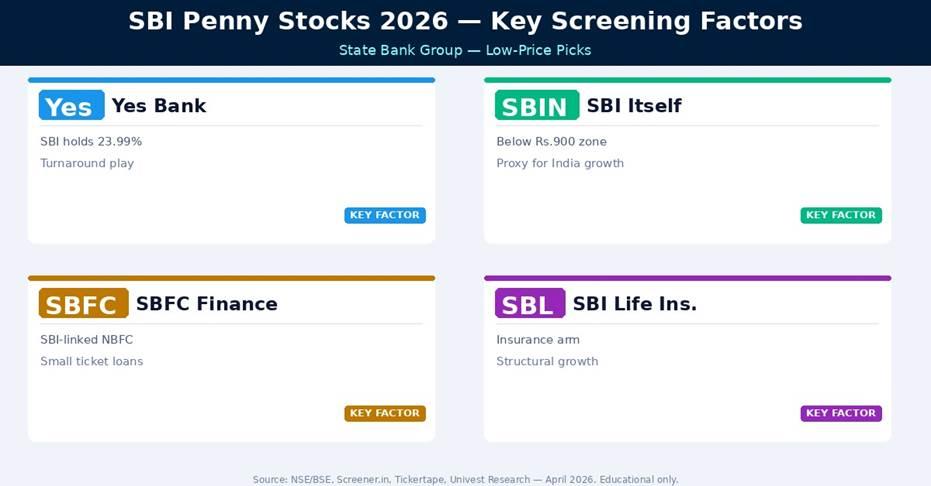
SBI penny stocks — Yes Bank, SBFC Finance, SBI-linked companies and PSU bank low-price proxy plays
Yes Bank — SBI's Largest External Stake (23.99%)
Yes Bank is the most prominent "SBI penny stock." After Yes Bank's near-collapse in March 2020, a SEBI and RBI-coordinated rescue led by SBI brought a consortium of banks together to infuse Rs.10,000 crore, with SBI taking a 49% initial stake (later reduced). As of 2026, SBI holds 23.99% of Yes Bank — making it the single largest shareholder and an implicit guarantor of the bank's stability.
Yes Bank currently trades in the Rs.18-24 range, placing it firmly in penny stock territory for Indian investors. The bank has undergone significant clean-up of its NPA book, rebuilt its CASA ratio, and diversified its loan book away from large corporates toward retail and MSME lending. The question for penny stock investors is whether Yes Bank's operational recovery translates to significant price appreciation.
| Yes Bank Metric | FY25 Data | Trend |
| CMP (approx.) | Rs.18-24 | Recovering from Rs.11 lows |
| SBI Shareholding | 23.99% | Stable — no recent sale |
| GNPA Ratio | ~1.7% | Improving significantly |
| Net Interest Margin | 2.4-2.6% | Below large-bank average |
| Capital Adequacy Ratio | ~16%+ | Well capitalised post-rescue |
Yes Bank data approximate as of early 2026. Verify on BSE/NSE disclosures.
SBFC Finance — The SBI-Linked NBFC
SBFC Finance Limited is a non-banking financial company in which SBI has a meaningful stake. It focuses on small business loans — collateral-backed working capital and machinery finance for MSMEs. Trading in the Rs.80-120 range, SBFC is not a sub-Rs.50 penny stock but qualifies as a low-price small-cap with SBI parentage that many investors classify as part of the SBI group penny stock universe.
PSU Banks Below Rs.100 — The Extended SBI Penny Universe
When investors search for SBI penny stocks, they often also consider other PSU bank stocks trading below Rs.100 that share the same macro tailwinds as SBI — credit growth in India's banking system, government infrastructure spending, and rural credit expansion. These include Indian Overseas Bank, Central Bank of India, UCO Bank, Bank of Maharashtra, and others.
| PSU Bank | Approx. CMP | Govt. Stake | Why Investors Watch |
| Yes Bank | Rs.18-24 | SBI holds 23.99% | SBI backing, NPA cleanup, turnaround |
| Indian Overseas Bank | Rs.45-55 | Govt. ~96% | PSU stability, improving asset quality |
| UCO Bank | Rs.35-50 | Govt. ~95% | Low price, improving NPA trend |
| Central Bank of India | Rs.40-55 | Govt. ~93% | Large PSU, improving profitability |
| Bank of Maharashtra | Rs.50-65 | Govt. ~87% | Consistent profit growth among PSU banks |
| IDBI Bank | Rs.60-80 | LIC+Govt. >94% | Privatisation theme, improving metrics |
Approximate prices as of April 2026. Verify on NSE/BSE before investing.
Should You Invest in SBI Penny Stocks?
The Bull Case for Yes Bank
Yes Bank at Rs.20 represents one of the most watched turnaround plays in Indian banking. The bull case is straightforward: SBI's continued backing provides institutional credibility, the cleaned-up NPA book removes the existential risk that drove the 2020 collapse, and credit growth in India's MSME sector is driving genuine loan book expansion. If Yes Bank's NIM (net interest margin) improves from current 2.4% toward the 3%+ levels of healthy private banks, and if the loan book compounds at 15-20% for 5 years, the stock could see significant re-rating.
The Bear Case for Yes Bank
The bear case is equally well-constructed: Yes Bank's brand damage from the 2020 collapse continues to constrain its ability to attract high-quality corporate clients. NIM at 2.4% is structurally lower than HDFC Bank (4%+) or ICICI Bank (4.5%+), and there is no clear catalyst for rapid improvement. SBI's stake is a double-edged sword — while it provides stability, the market knows SBI will eventually exit, creating an overhang. The path from Rs.20 to Rs.50 requires 5+ years of consistent execution without any major NPA shock.
Risks Common to All SBI-Linked Penny Stocks
- Government ownership creates bureaucratic inertia — PSU banks typically move slower than private banks on technology adoption and risk management, limiting long-term return potential.
- SBI's stake exit risk — when SBI reduces its Yes Bank stake in the future (likely under RBI guidance), it will create selling pressure. The exit price and timeline are unknown.
- Credit cycle risk — a general deterioration in MSME asset quality or a real estate market correction could elevate NPA ratios across all PSU banks simultaneously.
- Low NIMs structurally limit profitability — PSU banks and turnaround banks like Yes Bank have consistently lower NIMs than top-tier private banks, making it difficult to generate ROE above 15%.
How to Invest in SBI Penny Stocks
If you decide to invest in SBI-linked penny stocks after your research, here is the practical approach:
- Open a demat and trading account — you need a SEBI-registered broker with access to NSE and BSE. Low brokerage is important for penny stocks due to their lower transaction amounts. Univest offers brokerage as low as Rs.5 per trade.
- Use SIP-style entries — do not invest the full planned amount at once. Buy in tranches over 3-6 months to average your entry price.
- Set a stop-loss — even for long-term holdings, a stop-loss at 20-25% below your average cost prevents catastrophic loss if the fundamental thesis breaks down.
Download the Univest iOS App or Univest Android App to get real-time alerts on SBI group stocks and PSU bank movements.
Conclusion
SBI penny stocks — primarily Yes Bank (where SBI holds 23.99%), SBFC Finance, and the broader PSU bank universe below Rs.100 — represent a well-defined set of low-price investment opportunities connected to India's largest banking institution. Yes Bank's turnaround is the most watched story in this space, with SBI's backing providing a floor of institutional credibility that purely speculative penny stocks do not have. However, these are not risk-free investments — the path to significant returns requires multi-year execution by management, sustained credit growth, and no major NPA shocks. Invest with a 5-7 year horizon, diversify across 3-4 names, and size positions conservatively.
Frequently Asked Questions
What are the best SBI penny stocks to buy in 2026?
The most closely watched SBI-related penny stocks in 2026 are Yes Bank (where SBI holds 23.99%), Indian Overseas Bank, UCO Bank, Bank of Maharashtra, and Central Bank of India. Yes Bank is the most direct SBI connection. All PSU bank stocks mentioned are turnaround or slow-growth plays — not high-growth compounders. Verify current prices and fundamentals before investing.
Is Yes Bank an SBI penny stock?
Yes Bank trades below Rs.25, making it a penny stock by most Indian definitions (below Rs.50). SBI is its largest shareholder with 23.99% stake following the 2020 bailout-led rescue. So yes, Yes Bank qualifies as the most prominent SBI-linked penny stock. However, SBI does not operate or control Yes Bank's day-to-day management.
Will Yes Bank share price recover to Rs.100?
No one can reliably predict Yes Bank's price target. The bull case for recovery to Rs.100 requires sustained NIM improvement, NPA levels staying below 2%, loan book compounding at 15%+ CAGR for 5 years, and no major credit shock. These are achievable conditions but not guaranteed. Analyst targets for Yes Bank in 2026 range from Rs.22 to Rs.35 on a 12-month horizon. A Rs.100 price requires a multi-year execution story.
Does SBI have penny stocks in its group?
SBI itself does not have direct subsidiaries trading below Rs.50. However, SBI's major equity stakes — particularly its 23.99% in Yes Bank — create an indirect SBI penny stock connection. SBI's own subsidiaries like SBI Life Insurance, SBI Cards, SBI Mutual Fund, and SBI Capital Markets are not penny stocks. The PSU bank category more broadly includes several below-Rs.100 stocks that share the same macro tailwinds as SBI.
Are PSU bank penny stocks safe investments?
PSU bank penny stocks carry the additional backing of government ownership (majority stakes typically 80-95%), which virtually eliminates bankruptcy risk in the short-to-medium term. However, they are not safe in the sense of guaranteed returns. Government ownership creates operational inertia, lower NIMs, slower technology adoption, and periodic political interference in lending decisions. They suit risk-tolerant investors with a 5-7 year horizon who believe in India's public sector banking reform story.
Disclaimer: This article is for informational and educational purposes only and does not constitute investment advice or stock recommendations. Penny stocks carry very high risk including potential total loss of capital. All data sourced from NSE/BSE, Screener.in, Tickertape, and company filings as of April 2026. Past performance does not guarantee future results. Consult a SEBI-registered financial advisor before making any investment decisions.
Recent Articles
Top FII Holding Penny Stocks to Buy in India 2026 With High Growth Opportunities
Best NSE Penny Stocks in India – High Growth Opportunities for Investors
Best Sugar Penny Stocks to Invest in 2026
Reliance Penny Stocks in India | Reliance Penny Stocks List
Best Cement Penny Stocks to Invest in India 2026 for Long-Term Growth
Recent Articles

5 Jewellery Penny Stocks in India Investors Are Tracking for 2027
16 September 2026

5 Consumer Durables Penny Stocks in India Investors Are Tracking for 2027
16 September 2026

5 Logistics Penny Stocks in India Investors Are Tracking for 2027
16 September 2026

5 Leather Penny Stocks in India Investors Are Tracking for 2027
16 September 2026
Note: This blog is for information purpose only. Investments and trading are subject to market risks, read all scheme related documents carefully.
Reviews






Recent Posts
5 Jewellery Penny Stocks in India Investors Are Tracking for 2027
5 Consumer Durables Penny Stocks in India Investors Are Tracking for 2027
5 Logistics Penny Stocks in India Investors Are Tracking for 2027
5 Leather Penny Stocks in India Investors Are Tracking for 2027
5 Aluminium Penny Stocks in India Investors Are Tracking for 2027

Uniresearch Global Pvt Ltd
Research Analyst
SEBI Registration Number — INH000013776
Uniresearch is a subsidiary of Univest Communication Technologies Private Limited
Company Address: Registered Address: Ground Floor, Unitech Commercial Tower 2, Block B, Greenwood City, Unit 1-3, Sector 45, Gurugram, Haryana 122003
Write to us : support@univest.in, compliance@univest.in
Verify on SEBI registry →RESEARCH ANALYST
Get SEBI Registered
advice on the stocks
trending today.
Get 3 FREE Trade Ideas

for Startups Accelerator 2024

Trusted by 1Cr Indians

Awarded No.1 by Economic Times