
Best NBFC Stocks in India 2026: Top Non-Banking Finance Company Stocks
Updated: 8 Apr 2026 • 4:08 pm
Posted by:

India's Non-Banking Financial Companies (NBFCs) have historically been the engines of credit growth in segments that traditional banks underserve — vehicle finance, MSME lending, gold loans, and microfinance. After two difficult years of microfinance stress and rising credit costs, NBFC stocks in India 2026 are approaching a recovery inflection point. The Reserve Bank of India's rate cut cycle — with a 25bps reduction in February 2026 and another expected in April — is improving the funding cost environment for NBFCs, and credit demand from rural India is showing genuine recovery signals.
For investors tracking the best NBFC stocks in India 2026, the key is separating NBFCs that over-expanded into stressed segments like microfinance from those with cleaner, diversified loan books growing at sustainable 18–22% annual rates. The former face another 2–3 quarters of elevated credit costs; the latter are already delivering strong Q4 FY26 earnings.
Key Policy Highlights 2026-27
[Tap to Access Best Research Pieces on Univest]
• RBI rate cut cycle: 25bps cut in Feb 2026; another 25bps expected in April — lowers NBFC funding costs
• Priority sector lending norms relaxed: NBFCs get more flexibility in MSME and agriculture lending
• MFI sector stress: Rs 8,000 crore of microfinance NPA expected in FY26 — sector cleanup ongoing
• Co-lending framework: Banks partnering with NBFCs expands credit access — positive for vehicle and MSME NBFCs
• Digital lending guidelines: RBI framework clarifies rules — reduces regulatory uncertainty for fintech NBFCs
Top Stocks Overview 2026
[Click Here – Get Free Investment Predictions]
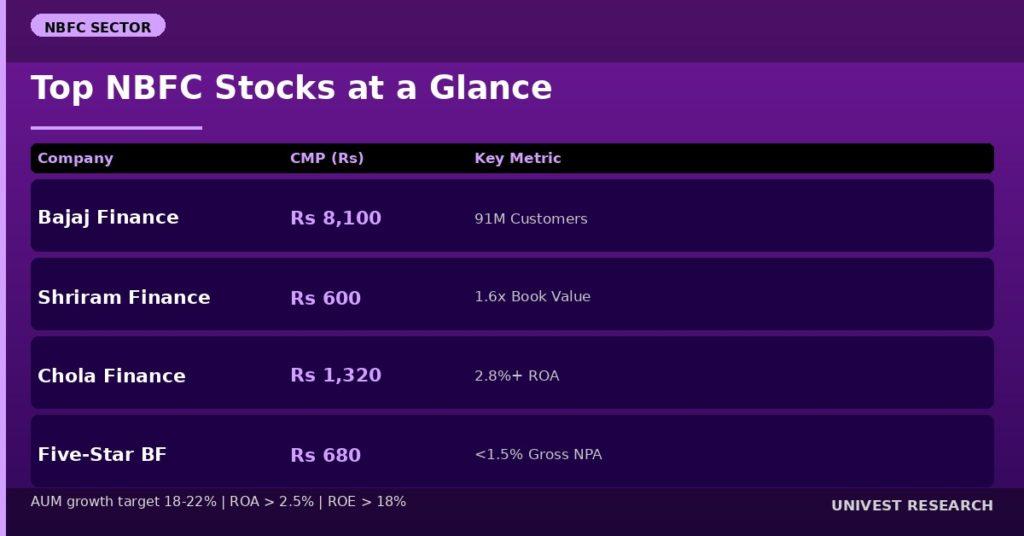
| Company | CMP (Rs) | Market Cap | 52W High | 52W Low |
| Bajaj Finance | 8,100 | Rs 5,01,000 Cr | 9,230 | 6,650 |
| Shriram Finance | 600 | Rs 1,12,700 Cr | 740 | 525 |
| Cholamandalam Finance | 1,320 | Rs 1,09,400 Cr | 1,650 | 1,050 |
| Poonawalla Fincorp | 285 | Rs 22,700 Cr | 500 | 240 |
| IIFL Finance | 380 | Rs 14,500 Cr | 620 | 320 |
| Mas Financial Services | 280 | Rs 2,800 Cr | 420 | 245 |
| Five-Star Business Finance | 680 | Rs 14,700 Cr | 900 | 580 |
Data sourced from NSE/BSE and Screener.in. CMP as of early April 2026. Verify before investing.
Company Analysis
Bajaj Finance — India's Premier Consumer NBFC
Bajaj Finance is the most valued NBFC in India with an AUM of Rs 3.85 lakh crore and 91+ million customer relationships. Its 3.0 app has crossed 51 million users — creating a digital moat that pure-play banks struggle to match. Q3 FY26 PAT was Rs 4,308 crore, with NIM of 9.8%. Q4 FY26 PAT estimates are Rs 4,400–4,700 crore. The company's diversification across consumer, SME, and mortgages has been its key defensive strength during the current microfinance stress cycle.
Shriram Finance — Vehicle Finance Market Leader
Shriram Finance is India's largest vehicle finance NBFC, with Rs 2.45 lakh crore AUM focused on used commercial vehicles, two-wheelers, and SME finance. The commercial vehicle upcycle in FY26–27 is a direct tailwind. Credit costs are expected to normalise from 2.1% to 1.7–1.8% in FY27. At 1.6x book value, the stock is attractively valued relative to its 18–20% ROE potential.
Cholamandalam Finance — Diversified Vehicle and Home Loans
Chola is one of the best-run NBFCs in India, with AUM of Rs 1.65 lakh crore across vehicle finance, home loans, and SME lending. ROA has consistently been above 2.8% — a benchmark most banks don't achieve. The company's entry into home equity and LAP lending is diversifying revenue and extending its runway.
Five-Star Business Finance — MSME Specialist
Five-Star targets self-employed individuals in Tier-2 and Tier-3 cities for property-backed SME loans. Its unique go-to-market — branch officers who personally know borrowers — creates a credit quality advantage that digital lenders cannot replicate easily. Gross NPA is below 1.5%, and ROAE is 17–18%.
Download the Univest iOS App or Univest Android App to get daily stock recommendations and insightful research pieces.
Key Factors to Consider
• RBI rate cut cycle improves funding cost and NIM for well-positioned NBFCs
• Rural credit demand recovery after 2 years of farm income stress
• Vehicle finance cycle in CV upcycle — direct tailwind for Shriram and Chola
• Digital lending scale creating data moats — Bajaj Finance's 91 million database is unmatched
• Co-lending with banks expanding credit reach without balance sheet risk for NBFCs
Risks to Be Aware Of
• Microfinance NPA stress — Rs 8,000 crore sector-wide NPA expected in FY26
• Rate cut pace slower than expected — funding cost benefit delay
• Regulatory changes in digital lending — RBI tightening norms for apps and DSAs
• Competition from banks moving into SME and vehicle finance
• Credit cycle concerns if rural income doesn't recover in Kharif 2026
How to Choose the Right Stocks
• AUM growth: Prefer NBFCs growing AUM at 18–22% — above industry average of 14%
• Asset quality: Gross NPA < 2.5% and credit cost < 2% are healthy thresholds
• NIM stability: NIMs > 8% (for consumer NBFCs) indicate pricing power and portfolio quality
• ROA and ROE: ROA > 2.5% and ROE > 18% are benchmarks for high-quality NBFCs
• Segment exposure: Avoid NBFCs with >20% MFI book exposure until sector stress cycle completes
Discover top stocks with high potential using Univest Screener — filter by sector, market cap, dividend yield, and more.
Frequently Asked Questions (FAQs)
Which is the best NBFC stock to invest in India 2026?
Bajaj Finance remains the top pick for quality-conscious investors — its scale, digital capabilities, and AUM diversification are unmatched. For value investors, Shriram Finance at 1.6x book offers strong upside with the CV cycle turning. Cholamandalam is the best mid-cap NBFC for balanced risk-reward.
Is NBFC sector a good investment in 2026?
The NBFC sector is at a recovery inflection point in 2026. MFI stress is peaking, rate cuts are beginning, and vehicle finance demand is recovering. Selectively, quality NBFCs with clean books offer attractive 15–25% return potential over 12–18 months.
What is the difference between banks and NBFCs for investors?
NBFCs cannot accept demand deposits, which makes them more dependent on market borrowings — creating higher funding cost sensitivity to interest rate cycles. However, NBFCs often serve underserved segments with higher yields and fewer regulatory constraints than banks, resulting in higher NIMs. For investors, this means higher growth potential but also higher credit and funding risk.
How does the RBI rate cut affect NBFC stocks?
RBI rate cuts reduce the cost of external borrowings for NBFCs, directly improving net interest margins. For NBFCs with short asset duration (like auto loans at 2–3 years) and longer liability duration, rate cuts improve spreads faster. Bajaj Finance and Chola are expected to benefit most from the current rate cut cycle.
Disclaimer: Investments in securities are subject to market risk. Please read all related documents before investing. This content is for educational purposes only and does not constitute investment advice. Consult a SEBI-registered financial advisor before making any investment decisions.
Recent Article
Coal India Share Price Target 2026: Analyst Forecasts, Bull & Bear Case
Bharti Airtel Share Price Target 2026: Analyst Forecasts, Bull & Bear Case
State Bank of India Share Price Target 2026: Analyst Forecasts, Bull & Bear Case
Paytm Share Price Target 2026: Analyst Forecasts, Bull & Bear Case
Recent Articles

4 Smallcap Rising Promoter Holding Stocks to Watch for Future Multibagger Potential: Kajaria Ceramics, Paradeep Phosphates, Saregama and Stylam Industries
26 October 2026

4 Smallcap Rs 1,000 Crore Profit Stocks to Watch for Future Multibagger Potential: LIC Housing Finance, Great Eastern Shipping, CESC and South Indian Bank
26 October 2026

4 Smallcap Government Capex Stocks to Watch for Future Multibagger Potential: Kalpataru Projects, Engineers India, RITES and Power Mech
26 October 2026

4 Smallcap Export Stocks to Watch for Future Multibagger Potential: Tata Elxsi, Happy Forgings, CCL Products and Zensar
26 October 2026
Note: This blog is for information purpose only. Investments and trading are subject to market risks, read all scheme related documents carefully.
Reviews






Recent Posts
4 Smallcap Rising Promoter Holding Stocks to Watch for Future Multibagger Potential: Kajaria Ceramics, Paradeep Phosphates, Saregama and Stylam Industries
4 Smallcap Rs 1,000 Crore Profit Stocks to Watch for Future Multibagger Potential: LIC Housing Finance, Great Eastern Shipping, CESC and South Indian Bank
4 Smallcap Government Capex Stocks to Watch for Future Multibagger Potential: Kalpataru Projects, Engineers India, RITES and Power Mech
4 Smallcap Export Stocks to Watch for Future Multibagger Potential: Tata Elxsi, Happy Forgings, CCL Products and Zensar
4 Smallcap Rural Demand Stocks to Watch for Future Multibagger Potential: Force Motors, Sumitomo Chemical, Paradeep Phosphates and Gokul Agro
Popular this week
4 Smallcap China Plus One Stocks to Watch for Future Multibagger Potential: Himadri, Sundram Fasteners, Garware Hi-Tech Films and Avalon Technologies

Uniresearch Global Pvt Ltd
Research Analyst
SEBI Registration Number — INH000013776
Uniresearch is a subsidiary of Univest Communication Technologies Private Limited
Company Address: Registered Address: Ground Floor, Unitech Commercial Tower 2, Block B, Greenwood City, Unit 1-3, Sector 45, Gurugram, Haryana 122003
Write to us : support@univest.in, compliance@univest.in
Verify on SEBI registry →RESEARCH ANALYST
Get SEBI Registered
advice on the stocks
trending today.
Get 3 FREE Trade Ideas

for Startups Accelerator 2024

Trusted by 1Cr Indians

Awarded No.1 by Economic Times