
Paytm Share Price Target 2026: Analyst Forecasts, Bull & Bear Case
Updated: 1 Apr 2026 • 4:07 pm
Posted by:

Paytm (PAYTM) — Share price data and analyst target overview, April 2026
Paytm's recovery story has been one of India's most dramatic stock market narratives in 2025-26. From a low of Rs.290 after the RBI action against Paytm Payments Bank in early 2024, the stock has staged a strong comeback to Rs.820 — a 65% one-year return. The business has restructured, the payments bank crisis is in the past, and GMV is recovering. With analyst targets ranging from Rs.600 to Rs.1,300, Paytm remains one of the most debated stocks on Dalal Street.
As of April 2026, Paytm trades at Rs. 820 with a 52-week range of Rs. 290 to Rs. 1,062. Market capitalisation stands at Rs. 52,400 Cr. The analyst consensus target is Rs. 960, implying ~17% upside to consensus.
Key Share Price Data at a Glance
| Metric | Value | Notes |
| Current Market Price | Rs. 820 | NSE, April 2026 |
| 52-Week High | Rs. 1,062 | Annual peak |
| 52-Week Low | Rs. 290 | Annual trough |
| Market Cap | Rs. 52,400 Cr | As of April 2026 |
| P/E Ratio | N/A (loss-making, nearing profitability) | FY26/FY27 estimate |
| Dividend Yield | Nil | Trailing 12-month |
| 1-Year Return | +65% | vs Nifty 50 |
Source: NSE/BSE, Screener.in, Tickertape — April 2026. Verify before investing.
Why Paytm Is in Focus Right Now
Paytm's Q3 FY26 revenue from operations stabilised at approximately Rs.1,827 crore with a clear path to adjusted EBITDA profitability. The merchant subscriber base — devices deployed at kirana stores, restaurants, and offline retail — has recovered to 11 million+ active merchants. The distribution lending business (personal loans and merchant cash advances) is also recovering through new banking partner relationships that replaced the banned Paytm Payments Bank channel. Management has guided for EBITDA profitability in FY26.
Track live fundamentals and analyst upgrades/downgrades for this stock on Univest Screener.
Paytm Share Price Target 2026 — Analyst Consensus
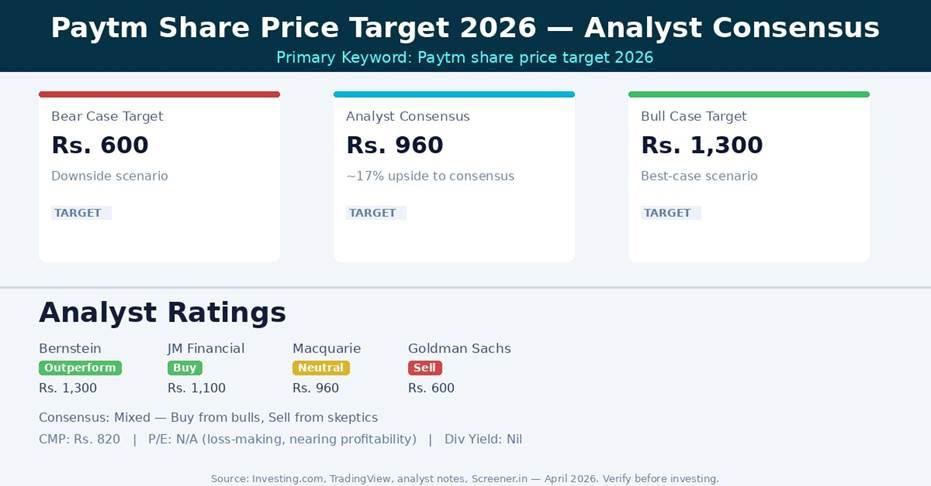
Paytm share price targets — bear case Rs. 600, consensus Rs. 960, bull case Rs. 1,300
The analyst consensus for Paytm share price target 2026 stands at Rs. 960 across mixed — buy from bulls, sell from skeptics. Here is how the targets break down:
| Brokerage | Rating | 12M Target | Scenario |
| Bernstein | Outperform | Rs. 1,300 | Bear/Cautious |
| JM Financial | Buy | Rs. 1,100 | Base Case |
| Macquarie | Neutral | Rs. 960 | Base Case |
| Goldman Sachs | Sell | Rs. 600 | Bull |
| Consensus Average | Mixed | Rs. 960 | ~17% upside to consensus |
Source: Publicly available analyst notes and consensus data — April 2026. Targets are estimates. Not investment advice.
Get free investment predictions and stock recommendations on Univest.
Bull Case — What Would Drive the Stock Higher
Bulls at Bernstein and JM Financial have Rs.1,250-1,300 targets built on Paytm achieving Rs.8,000+ crore annualised GMV run rate, merchant subscriber monetisation through insurance and lending products, and financial services revenue scaling to Rs.800+ crore quarterly. If Paytm demonstrates clean EBITDA profitability for two consecutive quarters, a significant institutional re-entry into the stock becomes likely.
Bear Case — What Could Hold the Stock Back
The RBI action against Paytm Payments Bank was the most serious regulatory intervention in Indian fintech history. Skeptics argue that the core payments business — UPI transactions — is structurally zero-margin and that the financial services revenue is lumpy and at risk from RBI scrutiny of lending partner relationships. At Rs.820, Paytm is valued at approximately 4x trailing revenue — expensive for a company still not delivering net profit.
5 Factors Supporting the Paytm Share Price Outlook
- Merchant ecosystem recovery — 11 million+ active merchants provide a captive distribution base for insurance, lending, and wealth products that have high attach rates
- UPI market share has stabilised — PhonePe and Google Pay dominate UPI volume, but Paytm's offline merchant base provides differentiated monetisation that pure-play UPI apps lack
- Financial services revenue is the key margin driver — each Rs.1 of lending distribution is far more profitable than Rs.1 of payments GMV
- Founder Vijay Shekhar Sharma's continued leadership and stake (approximately 19%) aligns management incentives with shareholders
- Regulatory tail risk is progressively reducing as Paytm establishes clean banking partnerships and demonstrates RBI compliance
5 Key Risks to Watch for Paytm Investors
- Regulatory risk remains the single most important risk — another RBI action targeting Paytm's financial services operations would be existential for the current recovery thesis
- Competition from Jio Financial Services and HDFC Bank's merchant lending programmes directly targets Paytm's most profitable merchant financial services business
- UPI profitability remains elusive — the MDR-zero model means payments GMV growth does not translate to revenue growth, making Paytm structurally dependent on cross-sell for monetisation
- Cash burn — Paytm is still consuming cash at the operating level and needs to reach EBITDA breakeven before the balance sheet becomes comfortable
- Stock is up 65% in one year — much of the recovery thesis may already be priced in at Rs.820, making further upside dependent on earnings delivery
Conclusion
Paytm at Rs.820 is a high-risk, high-reward proposition — not a conventional large-cap holding. The recovery from the RBI crisis is real, the merchant ecosystem is rebuilding, and EBITDA profitability is within reach. For risk-tolerant investors with a 12-18 month view, the Rs.960-1,100 range offers a credible target if financial services revenue scales. For conservative investors, the Rs.600 bear case from Goldman Sachs is a sobering reminder that the regulatory risk never fully disappears for India's most regulated fintech.
This article is for informational and educational purposes only. Investments in securities are subject to market risk. All analyst targets are estimates based on publicly available information and do not constitute investment advice. Consult a SEBI-registered financial advisor before making any investment decisions.
For more share price target analysis, Q4 results previews, and stock research, visit Univest Blogs. Download the Univest iOS App or Univest Android App for live alerts and SEBI-registered research.
Frequently Asked Questions
What is the Paytm share price target for 2026?
The Paytm share price target for 2026, based on analyst consensus, is approximately Rs. 960. The bear case target stands at Rs. 600 and the bull case at Rs. 1,300. These are analyst estimates — actual price performance depends on quarterly earnings, macro conditions, and sector-specific developments.
Is Paytm a good buy at the current price of Rs. 820?
At Rs. 820, Paytm trades at N/A (loss-making, nearing profitability) and offers a dividend yield of Nil. Whether it is a good buy depends on your risk appetite, investment horizon, and portfolio context. The analyst consensus of Mixed — Buy from bulls, Sell from skeptics suggests a broadly positive outlook, but individual investor suitability should be assessed with a SEBI-registered advisor.
What is the Paytm 52-week high and low?
The Paytm 52-week high is Rs. 1,062 and the 52-week low is Rs. 290 as of April 2026. The current price of Rs. 820 places the stock -672% below its 52-week high.
What are analysts saying about Paytm?
Bernstein has a Outperform rating with a target of Rs. 1,300. JM Financial has a Buy rating with a target of Rs. 1,100. Macquarie has a Neutral rating with a target of Rs. 960. Goldman Sachs has a Sell rating with a target of Rs. 600. The overall consensus is Mixed — Buy from bulls, Sell from skeptics. These ratings are based on publicly available analyst reports and are for informational purposes only.
What factors could push Paytm stock higher in 2026?
The key factors supporting a higher Paytm share price in 2026 include: Merchant ecosystem recovery — 11 million+ active merchants provide a captive distribution base for insurance, lending, and wealth products that have high attach rates; UPI market share has stabilised — PhonePe and Google Pay dominate UPI volume, but Paytm's offline merchant base provides differentiated monetisation that pure-play UPI apps lack; Financial services revenue is the key margin driver — each Rs.1 of lending distribution is far more profitable than Rs.1 of payments GMV. These are the primary drivers cited by analysts in their bull case scenarios.
What is the Paytm market capitalisation?
Paytm's market capitalisation as of April 2026 is Rs. 52,400 Cr. This is based on the current share price of Rs. 820 and the total number of outstanding shares listed on the NSE and BSE.
How does Paytm dividend yield compare to peers?
Paytm offers a dividend yield of Nil at the current price — the company does not currently pay a dividend, reinvesting cash flow into growth. For live dividend data and yield comparisons, check the Univest Screener.
Where can I track the Paytm share price live?
You can track Paytm (PAYTM) share price live on the Univest App, which provides real-time NSE/BSE prices, analyst ratings, fundamental screeners, and SEBI-registered research. Download the Univest iOS App or Univest Android App to get started.
Disclaimer: Investment in the share market is subject to risk. This article is for informational and educational purposes only and does not constitute investment advice. Analyst targets and financial data are sourced from publicly available information including NSE/BSE filings, Screener.in, Investing.com, and company investor relations pages. Verify all data before investing. Consult a SEBI-registered advisor before making investment decisions.
Recent Articles
Infosys Q4 Results 2026: Date, Revenue, PAT & Analyst Outlook
Best Agrolife Q4 FY26 Results Preview & Earnings Expectations
Bhansali Engineering Polymers Q4 FY26 Results Preview & Earnings Outlook
Recent Articles

Signet Industries Ltd. Hits Upper Circuit on NSE, 9 October 2026
9 October 2026

Precision Electronics Ltd. Hits Lower Circuit for the 2nd Straight Session on BSE, 9 October 2026
9 October 2026

Globe International Carriers Ltd. Hits Upper Circuit on NSE, 9 October 2026
9 October 2026

Gillette India (GILLETTE) Share Price Falls 2.11% as FMCG Valuation Stands Out
9 October 2026
Note: This blog is for information purpose only. Investments and trading are subject to market risks, read all scheme related documents carefully.
Reviews






Recent Posts
Signet Industries Ltd. Hits Upper Circuit on NSE, 9 October 2026
Precision Electronics Ltd. Hits Lower Circuit for the 2nd Straight Session on BSE, 9 October 2026
Globe International Carriers Ltd. Hits Upper Circuit on NSE, 9 October 2026
Gillette India (GILLETTE) Share Price Falls 2.11% as FMCG Valuation Stands Out
JK Cement (JKCEMENT) Share Price Falls for Second Straight Session
Popular this week
PRARUH TECHNOLOGIES LIMITED Hits Lower Circuit for the 2nd Straight Session on BSE, 9 October 2026

Uniresearch Global Pvt Ltd
Research Analyst
SEBI Registration Number — INH000013776
Uniresearch is a subsidiary of Univest Communication Technologies Private Limited
Company Address: Registered Address: Ground Floor, Unitech Commercial Tower 2, Block B, Greenwood City, Unit 1-3, Sector 45, Gurugram, Haryana 122003
Write to us : support@univest.in, compliance@univest.in
Verify on SEBI registry →RESEARCH ANALYST
Get SEBI Registered
advice on the stocks
trending today.
Get 3 FREE Trade Ideas

for Startups Accelerator 2024

Trusted by 1Cr Indians

Awarded No.1 by Economic Times