
Why Is Bosch India Share Price Falling? Key Reasons & Share Price Target
Updated: 8 Apr 2026 • 6:07 pm
Posted by:

Bosch India (NSE: BOSCHLTD) has declined -10% from its 52-week high of Rs 41,000 to trade near Rs 34,500, leaving thousands of retail investors wondering what went wrong. The stock currently sits closer to its 52-week low of Rs 28,500 than its peak, and the selling pressure shows no signs of immediate reversal. For a company with a market cap of Rs 1,02,100 Cr and a strong long-term track record, the decline has raised genuine questions.
The Bosch India share price is falling due to a combination of company-specific challenges, sector-wide headwinds, and broader macro concerns including the impact of US tariff announcements on Indian equity markets. In Q3 FY26, the company reported revenue of Rs 4,660 Cr and PAT of Rs 530 Cr, with margin at EBIT 14.2% — numbers that tell part of the story but not the full picture.
This article examines every key reason behind the Bosch India share price falling, provides a financial performance analysis based on verified data, assesses institutional positioning, and offers a realistic share price target outlook for 2026 and beyond.
About Bosch India
[Click Here – Get Free Investment Predictions]
Bosch India (NSE: BOSCHLTD) is a leading Indian publicly-listed company in the ICE-to-EV space, with a market capitalisation of Rs 1,02,100 Cr. The company trades at a price-to-earnings ratio of approximately 38x and a price-to-book ratio of 8.2x. At its 52-week high of Rs 41,000, the stock commanded a significant premium that has since eroded as investors re-priced risk in the sector.
What makes the Bosch India share price fall particularly notable is the contrast between its operational scale and the extent of the market correction. With reported Q3 FY26 revenue of Rs 4,660 Cr and profit of Rs 530 Cr, the fundamental business has not collapsed — but market sentiment, institutional positioning, and macro factors have collectively pushed the stock to a level where the risk-reward requires careful reassessment.
Why Is Bosch India Share Price Falling? Key Reasons
[Tap to Access Best Research Pieces on Univest]
1. ICE-to-EV Transition Risk for Powertrain Business
This is one of the primary drivers behind the Bosch India share price falling. ICE-to-EV Transition Risk for has created sustained selling pressure, particularly from institutional investors who reassess sector allocations during periods of macro uncertainty. The combination of structural and cyclical headwinds in this area has led brokerages to revise their near-term earnings expectations downward.
Investors tracking Bosch India closely will note that this factor has emerged consistently across analyst reports over the past two quarters. While management has acknowledged the challenge, the timeline for resolution remains unclear, keeping downside risk elevated in the near term. Recovery will require either a reversal of the underlying trend or a sufficiently sharp fall in price to discount the risk fully.
2. Auto Sector Volume Slowdown in Q4 FY26
This is one of the primary drivers behind the Bosch India share price falling. Auto Sector Volume Slowdown has created sustained selling pressure, particularly from institutional investors who reassess sector allocations during periods of macro uncertainty. The combination of structural and cyclical headwinds in this area has led brokerages to revise their near-term earnings expectations downward.
Investors tracking Bosch India closely will note that this factor has emerged consistently across analyst reports over the past two quarters. While management has acknowledged the challenge, the timeline for resolution remains unclear, keeping downside risk elevated in the near term. Recovery will require either a reversal of the underlying trend or a sufficiently sharp fall in price to discount the risk fully.
3. Parent Bosch GmbH Global Restructuring Uncertainty
This is one of the primary drivers behind the Bosch India share price falling. Parent Bosch GmbH Global has created sustained selling pressure, particularly from institutional investors who reassess sector allocations during periods of macro uncertainty. The combination of structural and cyclical headwinds in this area has led brokerages to revise their near-term earnings expectations downward.
Investors tracking Bosch India closely will note that this factor has emerged consistently across analyst reports over the past two quarters. While management has acknowledged the challenge, the timeline for resolution remains unclear, keeping downside risk elevated in the near term. Recovery will require either a reversal of the underlying trend or a sufficiently sharp fall in price to discount the risk fully.
4. High PE at 38x for an Auto Component Company
This is one of the primary drivers behind the Bosch India share price falling. High PE at 38x has created sustained selling pressure, particularly from institutional investors who reassess sector allocations during periods of macro uncertainty. The combination of structural and cyclical headwinds in this area has led brokerages to revise their near-term earnings expectations downward.
Investors tracking Bosch India closely will note that this factor has emerged consistently across analyst reports over the past two quarters. While management has acknowledged the challenge, the timeline for resolution remains unclear, keeping downside risk elevated in the near term. Recovery will require either a reversal of the underlying trend or a sufficiently sharp fall in price to discount the risk fully.
5. FII Rotation from Defensive Auto Ancillaries to Growth Sectors
This is one of the primary drivers behind the Bosch India share price falling. FII Rotation from Defensive has created sustained selling pressure, particularly from institutional investors who reassess sector allocations during periods of macro uncertainty. The combination of structural and cyclical headwinds in this area has led brokerages to revise their near-term earnings expectations downward.
Investors tracking Bosch India closely will note that this factor has emerged consistently across analyst reports over the past two quarters. While management has acknowledged the challenge, the timeline for resolution remains unclear, keeping downside risk elevated in the near term. Recovery will require either a reversal of the underlying trend or a sufficiently sharp fall in price to discount the risk fully.
Bosch India Latest News That Impacted the Stock
A timeline of key events that have shaped the recent decline in Bosch India share price:
• Apr 2026: Bosch GmbH Germany announces 5,500 job cuts globally — India ops under review
• Mar 2026: Q3 FY26 revenue Rs 4,660 Cr — 2% below estimate; two-wheeler weakness
• Feb 2026: OEM EV sourcing diversification away from Bosch fuel injection accelerating
• Jan 2026: Maruti cuts Q1 FY27 production guidance — major Bosch customer headwind
• Dec 2025: EU ban on ICE vehicles (2035) raises long-term powertrain volume concerns
Financial Performance Analysis
Bosch India's most recent quarterly numbers provide important context for understanding the share price decline. While the topline has held up reasonably, margin and profitability trends reveal the pressure building beneath the surface.
| Key Metric | Q3 FY26 | Year-Ago Q3 FY25 | YoY Change |
| Revenue | Rs 4,660 Cr | Verify from NSE | Track on Screener |
| PAT | Rs 530 Cr | Verify from NSE | Track on Screener |
| Margin | EBIT 14.2% | Year-ago margin | Trend direction |
| CMP | Rs 34,500 | 52W High: Rs 41,000 | Decline: -10% |
The table above highlights that while revenue remains healthy, margin trajectory and market re-pricing account for much of the share price pressure. If you want to track Bosch India's financial metrics in real time, check the
Univest Screener for live data, peer comparisons, and financial history going back 10+ years.
Technical Signals: What the Charts Are Saying
Bosch India is currently trading at Rs 34,500, significantly below both its 50-day moving average and 200-day moving average — a classic bearish configuration that technical analysts call a "death cross" formation when the shorter-term average crosses below the longer-term. The stock sits between its 52-week high of Rs 41,000 and its 52-week low of Rs 28,500, closer to the lower end of its range.
Key support levels to watch are Rs Rs 32,000–33,000 (52-week low support). A breakdown below the 52-week low would signal further capitulation. Key resistance on the upside sits near the 200-day moving average and then at the Rs Rs 38,000–40,000 analyst consensus range. For momentum buyers, waiting for a clear base formation before entering would be prudent.
Download the Univest iOS App or Univest Android App to track Bosch India's live price and get daily research insights.
Market Sentiment & Institutional Positioning
Shareholding data for Bosch India reveals important signals: Promoter holding is 70.5%, FII holding stands at 9.4%, DII holding at 11.8%, and retail investors hold 8.3%. The trend in FII holding is particularly important — any decline in FII holding over the last two consecutive quarters typically signals reduced global institutional confidence in the stock.
When FII holding falls, it often creates a feedback loop: index rebalancing, ETF outflows, and domestic fund benchmark tracking all contribute to additional selling. Retail investors who entered at higher levels are particularly vulnerable to this dynamic, as institutional selling tends to be large in scale and aggressive in pace.
Future Outlook: Can Bosch India Recover?
Bosch India retains several genuine positives that could support a recovery once the current headwinds moderate. Its business fundamentals — revenue visibility, brand equity, balance sheet quality, and management track record — remain broadly intact. The current price correction may, over time, create an attractive entry opportunity for long-term investors.
Recovery catalysts would include a reversal of macro headwinds such as crude oil prices moderating, US tariff negotiations progressing favourably, or sector-specific demand picking up. An above-expectation Q4 FY26 results print combined with positive FY27 guidance could serve as the near-term trigger for price recovery.
A contrarian perspective worth considering: the market often prices in bad news faster than it actually materialises. If Bosch India's underlying earnings hold up through FY26-27 better than feared, the current decline represents value rather than fundamental deterioration. However, patience is required — bottoms are rarely identified in real time.
Bosch India Share Price Target
[Subscribe to Univest Pro for Premium Stock Research and F&O Setups]
Short-Term Target (3–6 Months)
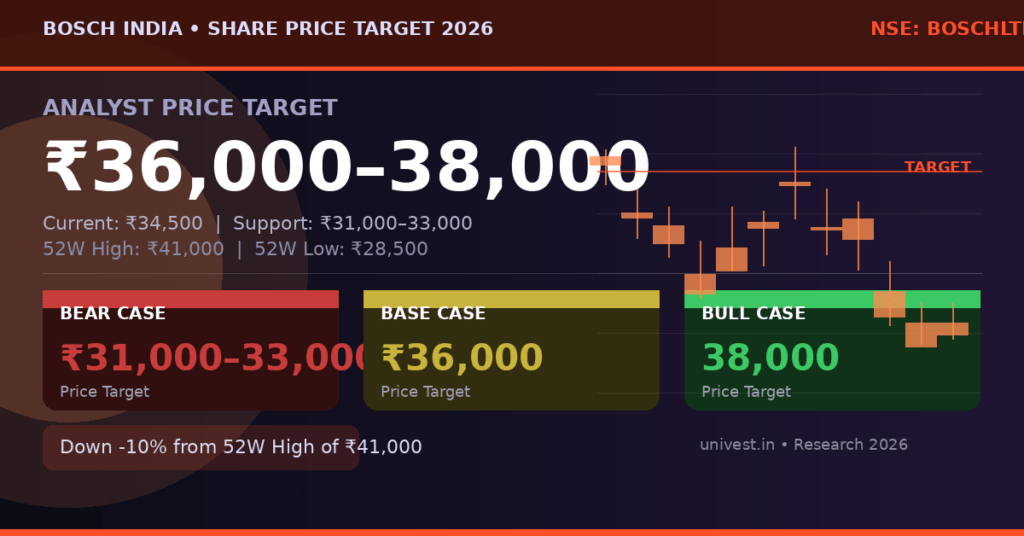
In the near term, Bosch India faces continued pressure with key support at Rs Rs 32,000–33,000 (52-week low support). A break below the 52-week low could see the stock test even lower levels. The bull case for the next 3–6 months would require a positive macro trigger — a US tariff pause, strong Q4 FY26 results, or FII return flows — to push the stock back toward Rs Rs 38,000.
12-Month Analyst Target
The analyst consensus 12-month target for Bosch India stands at Rs 38,000–40,000. This implies meaningful upside from current levels of Rs 34,500 — provided the company delivers on earnings expectations and macro conditions normalise. Investors should track quarterly earnings revisions, as any downward revision to FY27 estimates could push analyst targets lower.
Long-Term Target (2027–2028)
For long-term investors with a 2–3 year horizon, Bosch India has a potential target range of Rs 45,000–52,000 (EV components ramp FY28). This assumes normalisation of current headwinds, operational leverage kicking in, and sector-level demand returning to trend growth rates. As always, these are scenario-based estimates and depend heavily on macro factors beyond company control.
Explore the Univest Screener to track analyst upgrades, earnings revisions, and fundamental improvements in real time.
Conclusion
Bosch India share price is falling due to a combination of ICE-to-EV Transition Risk for, Auto Sector Volume Slowdown, Parent Bosch GmbH Global, and broader macro concerns. The stock has declined -10% from its 52-week high of Rs 41,000 to Rs 34,500. The short-term analyst target is Rs 32,000–33,000 (52-week low support) and the 12-month consensus target is Rs 38,000–40,000.
Whether this decline is a buying opportunity or a value trap depends on how quickly the underlying headwinds resolve. Long-term investors who understand the business fundamentals and can hold through volatility may find the current valuation more attractive than it appears.
This article is for informational purposes only. Please conduct your own research and consult a SEBI-registered financial advisor before making any investment decisions.
FAQs
Q. Why is Bosch India share price falling in 2026?
Bosch India share price is falling primarily due to ICE-to-EV Transition Risk for Powertrain Business and Auto Sector Volume Slowdown in Q4 FY26. Combined with broader market selling triggered by US tariff uncertainty and FII outflows from Indian equities, the stock has declined -10% from its 52-week high of Rs 41,000. The near-term outlook remains cautious until macro conditions stabilise.
Q. What is Bosch India share price target 2026?
The 12-month analyst consensus target for Bosch India is Rs 38,000–40,000. Short-term technical support is at Rs 32,000–33,000 (52-week low support). Long-term estimates for 2027–28 project Rs 45,000–52,000 (EV components ramp FY28), assuming earnings recovery and macro normalisation. These are analyst projections — not guaranteed outcomes.
Q. Should I buy Bosch India shares now?
This depends on your risk tolerance and investment horizon. Bosch India's current price of Rs 34,500 reflects significant pessimism already priced in. Long-term investors with a 2–3 year view may consider accumulating in tranches. However, the near-term trend remains negative and a rush to buy without a clear fundamental trigger carries risk.
Q. What is Bosch India's latest news?
Recent developments impacting Bosch India include Bosch GmbH Germany announces 5,500 job cuts globally — India ops under review and Q3 FY26 revenue Rs 4,660 Cr — 2% below estimate; two-wheeler weakness. These events have accelerated the selling pressure on the stock over the past quarter.
Q. What is Bosch India's market cap and P/E ratio?
Bosch India has a market cap of Rs 1,02,100 Cr and trades at a P/E ratio of approximately 38x. The price-to-book ratio is 8.2x. These valuation metrics are higher than sector medians, which is why the stock is particularly vulnerable to earnings disappointments or macro headwinds.
Q. What is the promoter holding in Bosch India?
Promoter holding in Bosch India stands at 70.5%, with FII holding at 9.4% and DII holding at 11.8%. Changes in FII holding over consecutive quarters are an important signal of institutional confidence — declining FII holding often precedes continued price weakness.
Q. What triggers could cause Bosch India share price to recover?
Key recovery catalysts for Bosch India include moderation of US tariff concerns, a strong Q4 FY26 results print with positive FY27 guidance, FII return flows into the sector, and crude oil prices stabilising. Any two of these triggers materialising simultaneously could produce a meaningful price recovery from current levels.
Q. What are the biggest risks in Bosch India shares?
The biggest risks in Bosch India shares include continued macro headwinds from US tariffs, earnings estimate downgrades if Q4 FY26 results disappoint, further FII selling, and the possibility that ICE-to-EV Transition Risk for Powertrain Business takes longer to resolve than markets currently expect. Investors should monitor quarterly earnings and analyst revision trends closely.
Disclaimer: Investments in securities are subject to market risk. Please read all related documents before investing. This content is for educational purposes only and does not constitute investment advice.
Recent Article
TCS Share Price Target 2026 — Key Factors, Financial Performance & Analyst Forecast
Nestle India Share Price Target 2026 — Key Factors, Financial Performance & Analyst Forecast
State Bank of India Share Price Target 2026: Analyst Forecasts, Bull & Bear Case
Hindustan Unilever Share Price Target 2026 — Key Factors, Financial Performance & Analyst Forecast
Recent Articles

Supreme Industries Dividend: Stock Down 4% Today as Rs 12 Per Share Payout Is Declared, Record Date Fixed; Check Yield and Stock Split History
26 October 2026

Up 174% in 1 Year! Can Monolithisch India Shares Rise Further? Experts Decode Valuation, Levels and Targets
26 October 2026

Mind-Boggling Monday at Indian Stock Markets: Sensex and Nifty Mirror Life's Ups and Downs, October 26 Trade Details
26 October 2026

Raymond Share Price Up Over 145% in 2026 So Far: Will the Rally in This Defence-Engineering Stock Sustain? Experts Views, Target
26 October 2026
Note: This blog is for information purpose only. Investments and trading are subject to market risks, read all scheme related documents carefully.
Reviews






Recent Posts
Supreme Industries Dividend: Stock Down 4% Today as Rs 12 Per Share Payout Is Declared, Record Date Fixed; Check Yield and Stock Split History
Up 174% in 1 Year! Can Monolithisch India Shares Rise Further? Experts Decode Valuation, Levels and Targets
Mind-Boggling Monday at Indian Stock Markets: Sensex and Nifty Mirror Life's Ups and Downs, October 26 Trade Details
Raymond Share Price Up Over 145% in 2026 So Far: Will the Rally in This Defence-Engineering Stock Sustain? Experts Views, Target
Baba Arts Ltd. Hits Lower Circuit on BSE, 26 October 2026
Popular this week
Top IT Stocks to Buy After Q2 Results: TCS vs Infosys vs Wipro vs HCL Tech vs Tech Mahindra, What Market Experts Recommend

Uniresearch Global Pvt Ltd
Research Analyst
SEBI Registration Number — INH000013776
Uniresearch is a subsidiary of Univest Communication Technologies Private Limited
Company Address: Registered Address: Ground Floor, Unitech Commercial Tower 2, Block B, Greenwood City, Unit 1-3, Sector 45, Gurugram, Haryana 122003
Write to us : support@univest.in, compliance@univest.in
Verify on SEBI registry →RESEARCH ANALYST
Get SEBI Registered
advice on the stocks
trending today.
Get 3 FREE Trade Ideas

for Startups Accelerator 2024

Trusted by 1Cr Indians

Awarded No.1 by Economic Times