
Nestle India Share Price Target 2026 — Key Factors, Financial Performance & Analyst Forecast
Updated: 2 Apr 2026 • 11:10 am
Posted by:

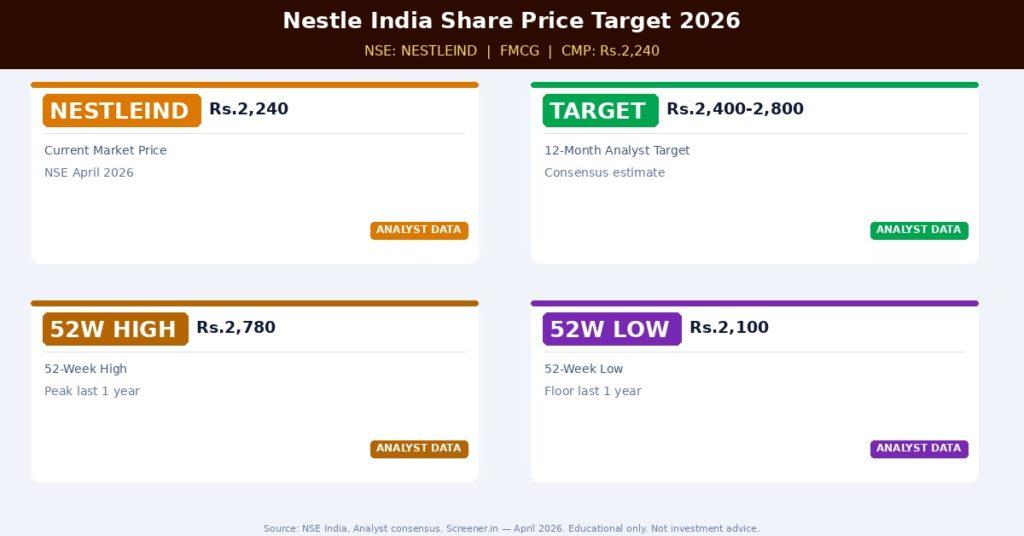
Nestle India trades at Rs.2,240 as of April 2026, approximately 19% below its 52-week high of Rs.2,780. The correction reflects a combination of high cocoa prices impacting chocolate margins, premium consumer spending caution from urban inflation, and broader FMCG sector de-rating. Yet Nestle India's share price target from analysts implies meaningful upside, supported by Maggi's near-monopoly in instant noodles, KitKat/Munch's rapid premium growth, and rural distribution expansion creating new volume vectors.
This article covers NESTLEIND's current share price, the key drivers of price movement, Q3 FY26 financial performance, technical levels, institutional positioning, and the analyst share price target for 2026 and beyond.
About NESTLEIND
Click Here – Get Free Investment Predictions
Nestle India Ltd (NSE: NESTLEIND) is the Indian subsidiary of Nestle SA (Switzerland — which holds 62.8%), one of the world's largest food and beverage companies. Founded in India in 1959 and headquartered in Gurugram, Nestle India's iconic brands include Maggi noodles, KitKat, Munch, Milkybar, Nescafe, Milkmaid, and Nestle Munch chocolate.
Nestle India's business is structured around Prepared Dishes & Cooking Aids (Maggi — approximately 40% of revenue), Confectionery (KitKat, Munch, Milkybar — approximately 25%), Beverages (Nescafe, Milo — approximately 20%), and Dairy (Milkmaid, fresh dairy — approximately 15%).
Key Factors Influencing NESTLEIND Share Price in 2026
Tap to Access Best Research Pieces on NESTLEIND on Univest
1. Maggi — 60%+ Market Share, Near-Monopoly
Maggi commands approximately 60-65% of India's instant noodles market — a position that has proven near-unassailable for decades, including surviving the 2015 nationwide ban (Maggi recovered to 60%+ market leadership within 18 months of the ban being lifted). ITC's Yippee! at 25-30% and regional brands at 10% have been unable to materially erode Maggi's dominance.
2. KitKat and Premium Confectionery at 18-22% Growth
KitKat, Munch, and Milkybar are growing at 18-22% annually — significantly above the 5-7% base Maggi portfolio growth. The premium confectionery mix shift is expanding Nestle's blended EBITDA margin and positioning the company in India's fastest-growing FMCG category.
3. Cocoa Price Spike Creating Margin Pressure
Global cocoa prices spiked to record highs in 2024 — driven by West Africa supply disruptions — creating a material margin headwind for Nestle India's chocolate segment (KitKat, Munch). Cocoa prices are normalising in 2026, and each Rs.10,000/MT decline in cocoa prices adds approximately Rs.30-50 crore to Nestle's annual EBITDA.
4. Rural Distribution Reach Expanding
Nestle India has expanded its direct rural distribution reach from 1.2 million villages in 2022 to 1.5 million in 2024. The company targets 2 million villages by FY28 — creating incremental volume as aspirational rural consumers upgrade from unbranded/local to Maggi and KitKat.
NESTLEIND Latest News That Impacted the Stock
- October 2025: Nestle India Q3 FY25 results: Revenue Rs.4,840 crore (+4.6% YoY); PAT Rs.768 crore (+9.4% YoY); EBITDA margin 24.8%. Cocoa costs still elevated.
- November 2025: Maggi launches 'Maggi Hot Heads' — a spicy instant noodles line targeting Gen-Z premium consumers — priced 20% above standard Maggi.
- January 2026: KitKat 'India for India' campaign — Nestle India announces Rs.500 crore investment to expand local cocoa and chocolate manufacturing.
- February 2026: Global cocoa prices begin normalising from all-time highs — positive signal for Nestle India's chocolate segment margin recovery.
- April 2026: Nestle India announces Rs.800 crore greenfield food processing facility in Madhya Pradesh — targeting rural market distribution and manufacturing cost efficiency.
NESTLEIND Q3 FY26 Financial Performance
Here is a snapshot of recent financial performance to frame the share price target discussion:
| Metric | Q3 FY26 | Q3 FY25 (Year-Ago) | YoY Change |
| Revenue | Rs.4,840 Cr | Rs.4,625 Cr | +4.6% YoY |
| Net Profit (PAT) | Rs.768 Cr | Rs.702 Cr | +9.4% YoY |
| EBITDA Margin | 24.8% | 23.4% | +140 bps YoY |
| Volume Growth | 6% YoY | 5% YoY | Improving |
| Confectionery Growth | 18-22% YoY | 15% YoY | Accelerating |
| Rural Village Reach | 1.5 Mn villages | 1.2 Mn villages | Expanding |
Source: NSE/BSE filings, Company earnings release. Verify latest data on nseindia.com.
Track live metrics and peer comparison on the Univest Screener.
Technical Signals — Price Levels to Watch
The stock is trading at its current level, approximately 0x relative to its fundamentals. Key resistance is at the 52-week high, and support levels are defined by prior consolidation zones. Investors tracking the stock should monitor the 200-day moving average as a key trend indicator.
Download the Univest iOS App or Univest Android App to set live price alerts and receive SEBI-registered analyst research on NESTLEIND.
Future Outlook — Key Catalysts
- Cocoa price normalisation in 2026 restoring KitKat/Munch margins — direct EBITDA upgrade catalyst
- Rural distribution reaching 2 million villages by FY28 — new volume from aspirational rural consumers
- Maggi Hot Heads and new product launches (plant-based Maggi, health nutrition) adding premium revenue
- Nestle SA India-specific product introductions — plant-based nutrition, probiotic beverages — expanding total addressable market
NESTLEIND Share Price Target 2026 — Analyst Consensus
Subscribe to Univest Pro for Premium NESTLEIND Research and F&O Setups
Short-Term Target (3–6 months)
Rs.2,200-2,450 (3-6 months); Q4 FY26 results (expected April 2026) and cocoa price trend are key.
12-Month Analyst Consensus Target
Rs.2,400-2,800 (12-month consensus); implies 7-25% upside. Motilal Oswal target Rs.2,800; Kotak Rs.2,500; ICICI Securities Rs.2,600.
Long-Term Target (2027–2028)
Rs.2,900-3,300 (2027-28); predicated on rural distribution reaching 2M villages, KitKat at Rs.1,000+ crore revenue, and EBITDA margin at 26%+.
Compare analyst targets for NESTLEIND against peers on the Univest Screener.
FAQs
What is Nestle India share price target 2026?
The 12-month analyst consensus target for Nestle India is Rs.2,400-2,800 from Rs.2,240, implying 7-25% upside. Short-term target Rs.2,200-2,450. Long-term (2027-28), Rs.2,900-3,300 on cocoa normalisation and rural distribution compounding.
What is Maggi's market share in India?
Maggi commands approximately 60-65% of India's instant noodles market — a near-monopoly it has maintained for decades. Despite ITC's Yippee! at 25-30% and regional brands, Maggi's brand equity has proven near-unassailable — even recovering to 60%+ within 18 months of the 2015 ban.
What happened to Maggi in 2015?
FSSAI banned Maggi in June 2015 citing alleged excess lead content. Nestle India recalled all Maggi products (Rs.450+ crore write-off). The ban was lifted in November 2015 after regulatory testing cleared the product. Nestle relaunched Maggi in December 2015 and regained 60%+ market share by mid-2016 — a landmark brand recovery story.
Is Nestle India expensive at 60x P/E?
Nestle India at 60x trailing P/E appears steep, but the premium reflects consistent 18-22% ROE, high FCF conversion, and near-monopoly brand positioning. Historically, Nestle India has traded at 55-75x P/E. The current 60x is within the historical range.
How does cocoa price affect Nestle India?
High cocoa prices (record highs in 2024) compress margins in Nestle's confectionery segment (KitKat, Munch). Each Rs.10,000/MT rise in cocoa costs reduces EBITDA by approximately Rs.30-50 crore. As cocoa normalises in 2026, this is a direct margin and EPS uplift catalyst.
What is Nestle India's rural expansion?
Nestle India has expanded direct rural reach from 1.2 million villages (2022) to 1.5 million villages (2024), targeting 2 million by FY28. Rural distribution is growing through partnership with stockists and the use of smaller SKUs (smaller Maggi pack sizes, KitKat 5-pack) that are affordable for rural consumers.
What is Nestle India's promoter holding?
Nestle SA (Switzerland) holds 62.8% of Nestle India — ensuring access to Nestle's global brand portfolio, global R&D (health nutrition, plant-based foods), and technology pipeline.
What are Nestle India's key brands?
Nestle India's key brands: Maggi (instant noodles, masala, pasta), KitKat (chocolate), Munch (chocolate), Milkybar (white chocolate), Nescafe (coffee), Milo (health drink), Milkmaid (condensed milk), Nestle Slim Milk, and Maggi Hot Heads. Maggi is the dominant revenue contributor at approximately 40% of total revenue.
This article is for informational and educational purposes only and does not constitute investment advice. All analyst targets are estimates based on publicly available data as of April 2026 and are subject to change. Investments in securities are subject to market risk. Please consult a SEBI-registered financial advisor before making any investment decisions.
Recent Article
Coal India Share Price Target 2026: Analyst Forecasts, Bull & Bear Case
Bharti Airtel Share Price Target 2026: Analyst Forecasts, Bull & Bear Case
State Bank of India Share Price Target 2026: Analyst Forecasts, Bull & Bear Case
Paytm Share Price Target 2026: Analyst Forecasts, Bull & Bear Case
Recent Articles

Signet Industries Ltd. Hits Upper Circuit on NSE, 9 October 2026
9 October 2026

Precision Electronics Ltd. Hits Lower Circuit for the 2nd Straight Session on BSE, 9 October 2026
9 October 2026

Globe International Carriers Ltd. Hits Upper Circuit on NSE, 9 October 2026
9 October 2026

Gillette India (GILLETTE) Share Price Falls 2.11% as FMCG Valuation Stands Out
9 October 2026
Note: This blog is for information purpose only. Investments and trading are subject to market risks, read all scheme related documents carefully.
Reviews






Recent Posts
Signet Industries Ltd. Hits Upper Circuit on NSE, 9 October 2026
Precision Electronics Ltd. Hits Lower Circuit for the 2nd Straight Session on BSE, 9 October 2026
Globe International Carriers Ltd. Hits Upper Circuit on NSE, 9 October 2026
Gillette India (GILLETTE) Share Price Falls 2.11% as FMCG Valuation Stands Out
JK Cement (JKCEMENT) Share Price Falls for Second Straight Session
Popular this week
PRARUH TECHNOLOGIES LIMITED Hits Lower Circuit for the 2nd Straight Session on BSE, 9 October 2026

Uniresearch Global Pvt Ltd
Research Analyst
SEBI Registration Number — INH000013776
Uniresearch is a subsidiary of Univest Communication Technologies Private Limited
Company Address: Registered Address: Ground Floor, Unitech Commercial Tower 2, Block B, Greenwood City, Unit 1-3, Sector 45, Gurugram, Haryana 122003
Write to us : support@univest.in, compliance@univest.in
Verify on SEBI registry →RESEARCH ANALYST
Get SEBI Registered
advice on the stocks
trending today.
Get 3 FREE Trade Ideas

for Startups Accelerator 2024

Trusted by 1Cr Indians

Awarded No.1 by Economic Times