
US Tariff Impact on Indian Stocks 2026: Sectors, Winners and Losers
Updated: 8 Apr 2026 • 3:56 pm
Posted by:

On April 2, 2026, US President Donald Trump announced a 26% reciprocal tariff on Indian goods — higher than what was applied to most Asian peers, and effective April 9. For Indian equity markets, this was a seismic event. The Nifty 50 fell 5.9% on April 7, the second-largest single-day decline in a decade. Foreign institutional investors sold Rs 22,000 crore in Indian equities in a single week. The question every investor is now asking is: what is the US tariff impact on Indian stocks in 2026, and which sectors are most exposed?
The answer is nuanced. India exports approximately $77 billion worth of goods to the US annually, with pharmaceuticals, IT services, textiles, gems and jewellery, and auto components forming the bulk. While goods-sector companies face direct cost headwinds, IT services — which exports software, not physical goods — is largely insulated from the tariff. Understanding the sector-by-sector impact is essential for repositioning portfolios in the current environment.
Key Policy Highlights 2026-27
[Tap to Access Best Research Pieces on Univest]
• 26% reciprocal tariff on Indian goods effective April 9, 2026 — goods exports of $77 billion impacted
• IT services EXEMPT: Software exports classified as services, not goods — not subject to tariff
• Pharma partially protected: Life-saving drugs face 0% tariff; specialty pharma at risk
• India-US trade deal talks: Both governments in active negotiation — tariff may be reduced
• RBI policy response: Potential rate cuts to support growth if tariff impact hits GDP by 0.5%+
Top Stocks Overview 2026
[Click Here – Get Free Investment Predictions]
| Company | CMP (Rs) | Market Cap | 52W High | 52W Low |
| TCS | 3,250 | Rs 11,80,000 Cr | 4,585 | 3,056 |
| Sun Pharma | 1,780 | Rs 4,27,000 Cr | 2,150 | 1,600 |
| Dixon Technologies | 13,500 | Rs 80,700 Cr | 20,000 | 11,500 |
| Bajaj Auto | 9,500 | Rs 2,74,700 Cr | 12,774 | 8,400 |
| Vardhman Textiles | 380 | Rs 7,800 Cr | 560 | 340 |
| Jubilant FoodWorks | 680 | Rs 44,900 Cr | 820 | 550 |
| Indus Towers | 350 | Rs 95,100 Cr | 460 | 290 |
Data sourced from NSE/BSE and Screener.in. CMP as of early April 2026. Verify before investing.
Company Analysis
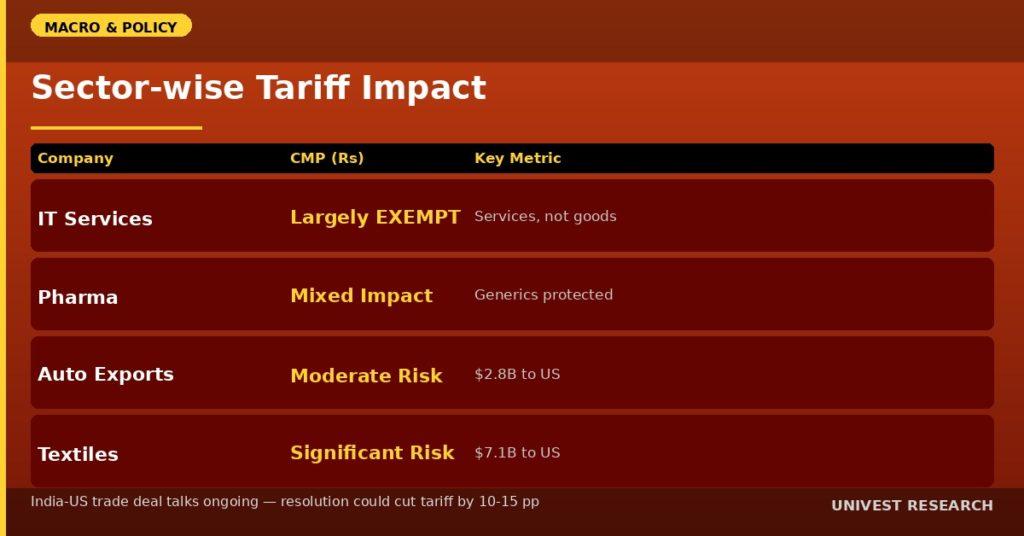
IT Services — Largely Insulated from Tariffs
India's IT services sector exports software, not physical goods. The 26% tariff applies to goods under the US Harmonized Tariff Schedule, not to services. TCS, Infosys, Wipro, HCL Tech, and other IT exporters are therefore NOT directly subject to the tariff. However, indirect headwinds exist: if US GDP slows due to tariff-induced inflation, IT discretionary spending budgets may be cut by US clients. Analysts estimate a 2–3% FY27 revenue growth impact for Tier-1 IT if US GDP falls 0.5%.
Pharmaceuticals — Mixed Impact
Indian pharma exports $8.7 billion annually to the US, covering both generic drugs and active pharmaceutical ingredients. Basic medicines (generics) face lower tariff exposure under healthcare carve-outs, but specialty pharma (branded drugs, biologics) may face 26% duty if not exempted. Sun Pharma's US specialty portfolio (Ilumya, Winlevi) is the key watch item — management has confirmed no product-level exemption yet.
Auto Exports — Moderate Headwind
Indian auto companies export $2.8 billion to the US, primarily auto components and some vehicle types. Bajaj Auto exports 3-wheelers and motorcycles; Tata Motors exports Jaguar Land Rover vehicles (assembled in UK). The 26% tariff adds 6–9% to production cost for US-bound units, which may be partially absorbed or passed through. Impact is manageable but material for export-heavy auto ancillaries.
Textiles — Significant Headwind
India's textile exports to the US were $7.1 billion in FY25. A 26% tariff makes Indian textiles meaningfully less competitive versus Bangladesh (37% tariff) and Vietnam (46% tariff) — a relative advantage. However, the absolute tariff increase adds cost that may force price renegotiation. Companies like Vardhman Textiles, KPR Mill, and Kitex Garments are directly impacted.
Download the Univest iOS App or Univest Android App to get daily stock recommendations and insightful research pieces.
Key Factors to Consider
• Sector differentiation: IT services (exempt) vs goods exporters (26% tariff) is the key split
• India-US trade deal: Progress in negotiations could reduce tariffs by 10–15 percentage points
• Rupee depreciation: Weaker rupee provides 3–5% natural hedge for export-oriented companies
• Cost absorption capacity: High-margin companies (pharma, IT) can absorb tariff better than low-margin textiles
• Domestic demand resilience: Companies with large domestic revenue base are better insulated
Risks to Be Aware Of
• Tariff escalation: If India retaliates, US could impose additional tariffs in response
• Global slowdown: Tariffs cause global GDP deceleration — impacts all Indian exports indirectly
• FII outflows: Tariff uncertainty has accelerated FII selling in Indian equities
• Earnings estimate cuts: Analysts cutting FY27 EPS by 3–8% for affected sectors
• Currency volatility: Rupee at 87 to USD is already at stress levels for importers
How to Choose the Right Stocks
• Export revenue % to US: Prefer companies where US exposure is <20% of total revenue
• Service vs goods: IT services and software companies face no direct tariff impact
• Margin buffer: High-EBITDA companies (>25%) can better absorb tariff costs without earnings damage
• Domestic demand story: Companies growing 60%+ in domestic markets are insulated from tariff
• Trade deal optionality: Companies that benefit from India-US trade deal will see most upside on resolution
Discover top stocks with high potential using Univest Screener — filter by sector, market cap, dividend yield, and more.
Frequently Asked Questions (FAQs)
How does the 26% US tariff affect Indian IT companies?
Indian IT companies are largely unaffected directly because they export services, not goods. Services are not subject to the 26% tariff. Indirect risks exist if US client budgets are cut due to tariff-driven inflation, but analysts estimate the direct earnings impact on TCS, Infosys, and HCL Tech to be minimal at 0–2% of FY27 revenue.
Which Indian stocks will benefit from US tariffs?
Domestic-focused companies — those generating 80%+ revenue in India — benefit relatively, as they are insulated from tariff headwinds while FII selling creates valuation opportunities. Defensive sectors like FMCG, pharma (domestic formulations), and utilities also benefit from the risk-off rotation.
Is this a good time to buy Indian stocks amid US tariffs?
Historically, sharp tariff-driven market corrections have created buying opportunities for long-term investors. The current Nifty 50 correction of 5.9% in one day has brought valuations closer to historical averages. Selective buying in quality domestic-demand driven companies is worth considering, with a 12–24 month horizon.
What is the impact of US tariffs on the Indian pharma sector?
Indian pharma exports $8.7 billion to the US. Generic drugs may receive partial exemptions, but specialty pharma faces 26% tariff risk. Sun Pharma, Dr Reddy's, and Cipla — with diverse US specialty portfolios — are the most watched. Management commentary in Q4 FY26 results will clarify the actual impact per product.
Disclaimer: Investments in securities are subject to market risk. Please read all related documents before investing. This content is for educational purposes only and does not constitute investment advice. Consult a SEBI-registered financial advisor before making any investment decisions.
Recent Articles
Infosys Q4 Results 2026: Date, Revenue, PAT & Analyst Outlook
Best Agrolife Q4 FY26 Results Preview & Earnings Expectations
Bhansali Engineering Polymers Q4 FY26 Results Preview & Earnings Outlook
Recent Articles

Is Pulz Electronics the Best Stock in Its Sector? A Look at the Numbers
22 October 2026

Is D-Link India the Best Stock in Its Sector? A Look at the Numbers
22 October 2026

Is Intec Capital the Best Stock in Its Sector? A Look at the Numbers
22 October 2026

Is Cella Space the Best Stock in Its Sector? A Look at the Numbers
22 October 2026
Note: This blog is for information purpose only. Investments and trading are subject to market risks, read all scheme related documents carefully.
Reviews






Recent Posts
Is Pulz Electronics the Best Stock in Its Sector? A Look at the Numbers
Is D-Link India the Best Stock in Its Sector? A Look at the Numbers
Is Intec Capital the Best Stock in Its Sector? A Look at the Numbers
Is Cella Space the Best Stock in Its Sector? A Look at the Numbers
Is Zeal Global Services the Best Stock in Its Sector? A Look at the Numbers

Uniresearch Global Pvt Ltd
Research Analyst
SEBI Registration Number — INH000013776
Uniresearch is a subsidiary of Univest Communication Technologies Private Limited
Company Address: Registered Address: Ground Floor, Unitech Commercial Tower 2, Block B, Greenwood City, Unit 1-3, Sector 45, Gurugram, Haryana 122003
Write to us : support@univest.in, compliance@univest.in
Verify on SEBI registry →RESEARCH ANALYST
Get SEBI Registered
advice on the stocks
trending today.
Get 3 FREE Trade Ideas

for Startups Accelerator 2024

Trusted by 1Cr Indians

Awarded No.1 by Economic Times