
Systematic Investment Plan (SIP)
Updated: 26 Feb 2026 • 4:36 pm
Posted by:

Investing is not about having a large amount of money; it’s about starting early and staying consistent. Instead of investing a large lump sum, investors should consider a plan that provides a higher return and makes it easy to grow their wealth through regular investments. A Systematic Investment Plan (SIP) fulfils the requirements of all investors who are often confused about where and how to invest their money, by encouraging disciplined investing, reducing the impact of market volatility, and allowing them to avoid worrying about market timing.
The SIP investment plan involves investing a small amount over time rather than a large one-time amount, resulting in a higher return. By taking the Systematic Investment Plan (SIP) route, investors can invest in a time-bound manner without considering price volatility or the power of compounding. This article provides information on the best SIP plan for 3 years, the best SIP plan for long-term investment, and the best SIP plans for 1000 per month.
What is a Systematic Investment Plan (SIP)?
A Systematic Investment Plan (SIP) is an innovative investment approach that enables individuals to invest a fixed amount at regular intervals in mutual funds. The investment is made on a regular, disciplined basis, except during periods of market volatility and other conditions. The Systematic Investment Plan (SIP) facility allows an investor to invest a fixed amount of money at pre-defined intervals in a selected mutual fund scheme. SIP are designed to make investing accessible and manageable, helping investors accumulate wealth gradually. Using SIP allows investors to invest a fixed amount of money at regular intervals, and many long-term SIP plans offer better returns over time.
How does an SIP Work?
When you enroll in a Systematic Investment Plan (SIP), the sum will be automatically deducted from your bank account and reinvested in a fund you select for the best return. Then you will be assigned units for your fund based on its net asset value, and later, any additional units will be added to your account at the market rate. Some of the best SIP plans for long-term investment include HDFC SIP plans, the Axis Bank Systematic Investment plan, and the ICICI Prudential Systematic Investment plan.
Below are the steps on how SIP works:
- Investors select the best SIP plan for long-term investment or a mutual fund that matches their financial goals and risk appetite.
- Investors then determine how much money they want to invest regularly. To choose the best SIP plan for long-term investment, investors can start with amounts as low as ₹500 to ₹1,000, depending on the best return SIP plans.
- Investors must complete the Systematic Investment Plan (SIP) application form with the chosen mutual fund provider. This form includes all the details of the investment amount, frequency, and the selected scheme.
- Once set up, the amount specified in the Systematic Investment Plan (SIP) application form will be automatically debited from their bank account at the specified time intervals and invested in the best SIP plan for long-term investment.
- Investors must regularly review their best SIP plan for long-term investment through the account statements provided by the mutual fund provider. This helps them to track performance and make necessary adjustments.
Rupee Cost Averaging: Meaning
Rupee Cost Averaging is a method of investing a fixed amount at regular intervals, regardless of market conditions. It offers investors the opportunity to benefit if they start investing regularly. It allows investors to purchase more units of mutual funds when prices are low, and some are high, resulting in a lower average cost per unit over time. It plays an essential role in the Systematic Investment Plan (SIP) and ensures consistency by minimising the average acquisition cost. It is more valuable for those beginners who do not have enough time to review the markets closely and lack expertise.
Power of Compounding: Meaning
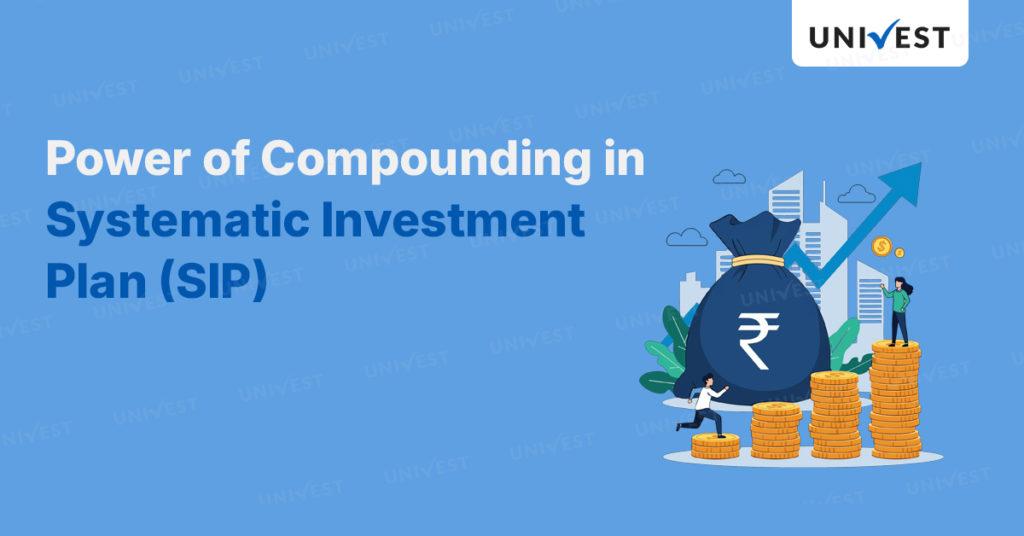
Compounding occurs when the returns or interest generated on the principal amount in the first period are added back to the principal to calculate interest for subsequent periods.
A table that shows the Power of Compounding in a Systematic Investment Plan (SIP)
| No of Years | Invested Amount | Final Value (assuming 12% returns) |
| 1 | ₹12,000 | ₹12,809 |
| 5 | ₹60,000 | ₹82,486 |
| 10 | ₹1,20,000 | ₹2,32,339 |
| 15 | ₹1,80,000 | ₹5,04,576 |
| 20 | ₹2,40,000 | ₹9,99,148 |
The power of compounding is mainly an act of ‘earning interest or interest’, i.e., the money initially invested generates earnings from the initial principal amount & accrued earnings from past compounding periods. There are multiple benefits of compounding, such as higher growth, wealth preservation, and comfortable goal achievement.
What is the Formula for Compounding?
The formula for calculating compound interest:
A = P(1+r/n)^(nt)
Where:
A = the future value of investment, including interest
P= the principal amount (initial investment)
r = the annual interest rate
n= the number of times that interest is compounded per year
t= the number of years the money is invested
This formula is always helpful in calculating the initial principal amount and the accumulated interest over time, which is primarily determined by the frequency of compounding. Investors can also use the power of compounding to calculate the real value of the best SIP plan for long-term investment.
SIP (Systematic Investment Plan) Facility: Frequency & Minimum Investment
| Frequency under SIP (Systematic Investment Plan) Facility | Minimum Installments | Minimum SIP amount |
| Daily | 6 installments | ₹100/- and in multiple of ₹1 |
| Weekly | 6 installments | ₹100/- and in multiple of ₹1 |
| Monthly | 6 installments | ₹100/- and in multiple of ₹1 |
| Yearly | 3 installments | ₹12,000/- and in multiple of ₹1 |
- Daily, weekly, and monthly Systematic Investment Plans (SIPs can start with an investment of just ₹100, making them suitable for beginners.
- Yearly SIPs typically require a higher minimum amount and fewer instalments, which is ideal for long-term investment planning.
- Investors can choose a SIP frequency that aligns with their income cycle to identify the best return SIP plan.
Benefits of the Systematic Investment Plan (SIP)
There are many benefits of the best SIP plan for long-term investment, and investors should know the advantages of the best Systematic Investment Plan (SIP):
Below are the benefits of the Systematic Investment Plan (SIP):
- Systematic Investing: A Systematic Investment Plan (SIP) leads to regular, disciplined investing by committing to fixed investments at regular intervals. This approach helps avoid emotional and impulsive investment decisions, enabling investors to stay invested in the best SIP plan for long-term investment.
- Rupee Cost Averaging encourages SIPs by allowing investors to buy more units when prices are low and fewer units when prices are high. With the short time span, this will lead to a lower average cost per unit, which reduces market volatility.
- Flexibility: A Systematic Investment Plan (SIP) offers flexibility in terms of amount and duration. Investors can start with a small amount and gradually increase their investment as their financial situation improves. The SIP (Systematic Investment Plan) can be started and stopped at the investor's convenience.
- Diversification: SIP (Systematic Investment Plan) allows investors to diversify their investments across different asset classes and securities. By spreading investments across a large number of instruments, such as mutual funds, stocks, or bonds, investors can reduce the risk associated with the best SIP plan for long-term investments.
- Professional Fund Management: SIP (Systematic Investment Plan) mainly provides access to professionally managed mutual funds, where experienced fund managers make investment decisions for investors based on in-depth research and market analysis.
What is an SIP Calculator?
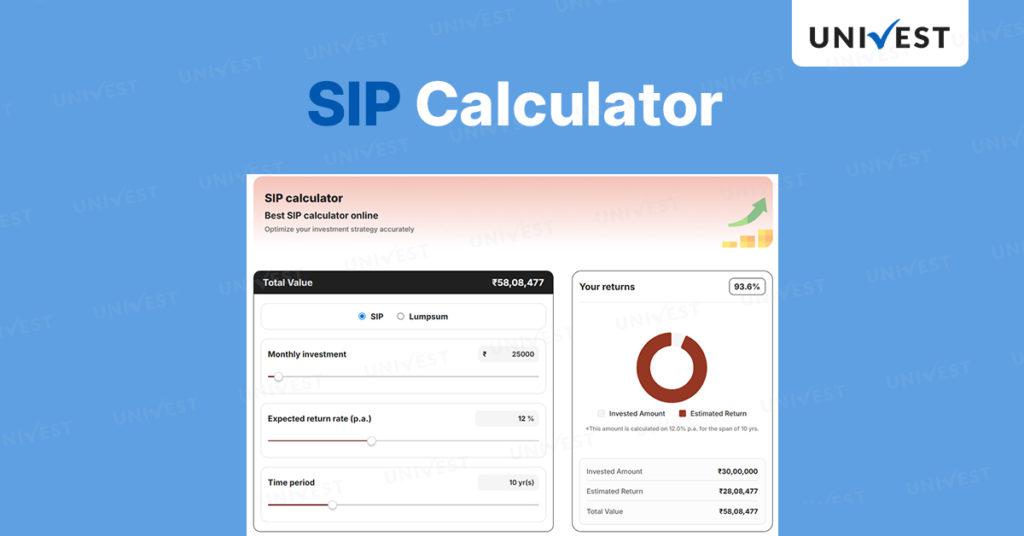
A SIP Calculator is a simple tool that provides an estimate of returns on mutual fund investments made through SIP. Systematic investment plan (SIP) in mutual funds has become one of the most popular investment options for many investors, and these mutual fund SIP calculators provide potential investors with an estimate of their potential returns. However, the actual returns offered by a mutual fund scheme vary depending on various factors. The SIP calculator does not provide clarification for the exit load and expense ratio. This Systematic Investment Plan (SIP) calculator calculates the wealth gain and expected returns for each monthly SIP investment.
How Do You Use It?
Using the SIP calculator is very easy; you need to follow some steps to use it:
- Enter the amount you wish to invest regularly (monthly, quarterly, or annually).
- Input the expected rate of return on your investment.
- Specify the total time (duration) of the investment.
- Once you have filled in these details, hit the ‘calculate button’. The calculator will instantly show the best SIP plans with the highest returns for 1000 per month.
Best SIP Plans for ₹1000 per month
To begin investing in mutual funds, ₹1000 per month is an excellent sum. Let us take a look at some of the best ₹1000 per month SIP plans in India:
| SIP | AUM (₹ in crore) | Annualised Return (3 years) | Annualised Return (5 years) | Annualised Return (10 years) | Expense Ratio |
| HDFC Flexi Cap Direct Plan Growth | 96,294.99 | 22.32 | 22.62 | 16.88 | 0.67 |
| JM Flexi Cap Fund Growth | 5,463.07 | 21.18 | 19.58 | 17.10 | 0.59 |
| Quant Flexi Cap Fund-Growth | 6,699.66 | 16.06 | 21.47 | 18.37 | 0.71 |
| Parag Parikh Flexi Cap Fund Direct-Growth | 1,33,308.62 | 22.01 | 19.87 | 19.36 | 0.63 |
| ICICI Prudential Technology Direct Plan-Growth | 258.10 | 21.91 | 21.30 | 22.45 | 0.59 |
| Edelweiss Large Cap Fund-Growth | 1,455.84 | 17.02 | 14.98 | 14.85 | 0.61 |
| Kotak Opportunities Fund Growth | 30,038.59 | 20.50 | 18.89 | 17.20 | 0.55 |
| Quant Mid Cap Fund Direct Plan-Growth | 8,057.36 | 14.19 | 21.26 | 16.56 | 0.78 |
Best SIP plans for ₹5000 per month.
A Systematic Investment Plan (SIP) lets you invest a fixed amount in mutual funds each month. For example, a SIP of ₹ 5,000 per month for 10 years amounts to an investment of ₹ 6 lakh, which can grow to ₹ 11 lakh at 12% returns. A 5000 SIP for 5 years may turn ₹3 lakh into ₹4 lakh. A 5000 SIP for 20 years can grow to over ₹45 lakh, which makes it useful for goals and investing in the best SIP plan for long-term investment, which helps in the fulfilment of goals like retirement or your child’s education. Investors can consider some of the best SIP plans for long-term investment, such as the HDFC SIP plan, the Axis Bank Systematic Investment plan, and the ICICI Prudential Systematic Investment plan.
Here is the list of the best SIP plans for ₹5000
| Funds | AUM (in ₹) | 3 Year Annualised Returns (in %) | Expense Ratio (in %) |
| HDFC Balanced Advantage Fund Direct | 1,08,205.07 | 18.33 | 0.76 |
| Parag Parikh Flexi Cap Fund Direct | 1,33,308.62 | 22.01 | 0.63 |
| Nippon India Small Cap Fund Direct | 3,705.75 | 56.87 | 0.27 |
SIP (Systematic Investment Plan) Schemes For You
Many Systematic Investment Plan (SIP) schemes provide long-term benefits to investors. To maximise growth potential, investors must consider the best SIP plan for long-term investment. We have discussed the best SIP plans for ₹1000 per month, so choose wisely. Some of the best SIP plans for long-term investment include the HDFC SIP plan, the Axis Bank Systematic Investment plan, and the ICICI Prudential Systematic Investment plan.
Below, we discuss the table of the best SIP (Systematic Investment Plan) schemes:
| SIP | AUM (₹ in crore) | Annualised Return (3 years) | Annualised Return (5 years) | Annualised Return (10 years) | Expense Ratio |
| Bandhan Small Cap Fund Direct-Growth | 18,990.28 | 30.91 | 26.13 | 31.58 | 0.47 |
| Invesco India Mid Cap Fund Direct- Growth | 10,296.36 | 27.59 | 23.61 | 21.10 | 0.54 |
| Motilal Oswal Mid Cap Fund Direct- Growth | 36,880.18 | 25.44 | 27.80 | 22.53 | 0.74 |
| Franklin Build India Fund | 3,035.67 | 26.44 | 25.65 | 20.94 | 0.99 |
| DSP India T.I.G.E.R Fund | 5,323.37 | 24.49 | 26.32 | 16.30 | 0.75 |
| Canara Robeco Infrastructure Fund | 893.68 | 24.46 | 25.75 | 16.80 | 1.02 |
| Quant Infrastructure Fund | 3,079.78 | 15.79 | 25.23 | 16.74 | 0.75 |
| SBI Contra Direct Fund | 49,967.08 | 20.77 | 23.38 | 16.37 | 0.69 |
Goal-Based SIP (Systematic Investment Plan)

Goal-based SIP investment is a strategic approach where an individual aligns their investment with specific financial objectives. Whether it’s buying a house, funding higher education, or planning for retirement, goal-based investing can be an effective strategy. By determining the amount needed and the time horizon for each goal, one can decide how much to invest in the best SIP plan for long-term investment. This method encourages disciplined, regular investing, which may increase the value of your investment over time. It also helps you choose the best SIP (Systematic Investment Plan) for the long term.
Here is a table below of goal-based SIP Investment
| Target Amount | Investment Duration | MF Scheme | Expected returns | Investment amount |
| ₹1 lakh | 2-3 years | Debt Fund | 6-8% | ₹2,500 per month |
| ₹4 lakh | 5 years | Balanced Fund | 10% | ₹5,000 per month |
| ₹25 lakh | 10 years | Equity Fund | 12% | ₹10,000 per month |
| ₹10 lakh | 15 years | Equity Fund | 12% | ₹2,000 per month |
| ₹30 lakh | 20 years | Equity Fund | 12% | ₹3,000 per month |
| ₹1.5 crore | 20 years | Debt Fund | 8% | ₹30 lakh |
Over the years, investors can change the long-term SIP investment amounts for each of their goals. Post-retirement, you should move your investments to a low-risk Fund, such as one that invests in low-risk debt instruments, to minimise risk. The best SIP plan for long-term investment provides the benefits of fixed returns and a secondary source of income through a Systematic Withdrawal Plan. Some of the best SIP plans for long-term investment include the HDFC SIP plan, the Axis Bank Systematic Investment plan, and the ICICI Prudential Systematic Investment plan.
Final Thoughts
We all have different goals in life. Sometimes they present themselves immediately, sometimes over a period of time. For example, when one starts working, they may not have much on their minds besides regular monthly expenses and some impulsive buys. But eventually, goals rise – a bike or car, weekend getaways, international trips, marriage, and so on. Some of the best SIP plans for long-term investment include the HDFC SIP plan, the Axis Bank Systematic Investment plan, and the ICICI Prudential Systematic Investment plan. The Systematic Investment Plan (SIP) offered by Mutual Funds is the easiest way to enter the world of long-term investments.
FAQs
What do you mean by Systematic Investment Plan (SIP)?
Ans. A Systematic Investment Plan (SIP) is an innovative investment approach that enables individuals to invest a fixed amount at regular intervals in mutual funds. The investment is made on a regular, disciplined basis, except during periods of market volatility and other conditions. Systematic Investment Plan (SIP) are designed to make investing accessible and manageable, helping investors accumulate wealth gradually. Using a Systematic Investment Plan (SIP) allows investors to invest a fixed amount of money at regular intervals, and many long-term SIP plans offer better returns over time.
What are the types of Systematic Investment Plan (SIP) available?
Ans. There are different types of Systematic Investment Plan (SIP), which are available in the market, such as
- Set-up or top-up: A set-up or top-up Systematic Investment Plan (SIP), which enables investors to increase the investment amount automatically at specified intervals with a particular amount or percentage.
- Perpetual SIP: A perpetual Systematic Investment Plan (SIP) enables you to keep investing as long as you wish to invest in the best SIP that you wish to, without any end date, and it makes it easier for the best SIP plans of ₹1000 per month.
- Trigger SIP: A trigger Systematic Investment Plan (SIP) that encourages investing at a specific index level, NAV, date, or event.
How much can investors start to invest in a Systematic Investment Plan (SIP)?
Ans. There is no limit to the amount investors can invest in a SIP. The minimum investment amount is ₹500 per month. Some of the best SIP plans for long-term investment include the HDFC SIP plan, the Axis Bank Systematic Investment plan, and the ICICI Prudential Systematic Investment plan.
What are the key considerations for a Systematic Investment Plan (SIP)?
Ans. Some of the key considerations for the Systematic Investment Plan (SIP), such as Long-Term Focus, Risk Tolerance, Review and Rebalance, Understanding Fees, and many more, as Systematic Investment Plan (SIP) are best suited for long-term goals, such as retirement or education funding. A longer investment horizon allows for better capital growth.
How to choose the right Systematic Investment Plan (SIP) to invest in India?
Ans. Starting a Systematic Investment Plan (SIP) is one of the most intelligent investment choices that investors can make. It not only promotes discipline and regular investing, but it also requires some thoughtful planning to maximise its benefits. SIP investments allow individuals to invest systematically without worrying about market fluctuations. The best SIP plan for long-term investment, for consistent wealth creation, and risk mitigation through rupee cost averaging.
Read Our Articles on the Best Stocks
https://univest.in/blogs/sip-vs-mutual-funds
Tech Stocks in India to Invest in 2025 | Tech Sector Stocks
Best Battery Stocks in India to Invest in 2025 | Battery Sector Stocks
Best Shipping Stocks in India to Invest in 2025 | Shipping Sector Stocks
Paint Stocks in India to Invest in 2025 | Paint Sector Stocks
Paper Stocks in India to Invest in 2025 | Paper Sector Stocks
Best Semiconductor Stocks in India 2025
Best Large Cap Stocks in India 2025
Best Cement Stocks To Invest In India
Also Explore
Univest Screeners
Explore Webstories on Univest
Best Time To Buy Dividend Stocks
How RBI Policies Affect Dividend Stocks
Can Dividend Stocks Beat Inflation
What Is The Dividend Aristocrat List
Recent Articles

Is Gujarat Ambuja Exports the Best Stock in Its Sector? A Look at the Numbers
16 October 2026

Is Samvardhana Motherson International the Best Stock in Its Sector? A Look at the Numbers
16 October 2026

Is Nitta Gelatin India the Best Stock in Its Sector? A Look at the Numbers
16 October 2026

Is Fermenta Biotech the Best Stock in Its Sector? A Look at the Numbers
16 October 2026
Note: This blog is for information purpose only. Investments and trading are subject to market risks, read all scheme related documents carefully.
Reviews






Recent Posts
Is Gujarat Ambuja Exports the Best Stock in Its Sector? A Look at the Numbers
Is Samvardhana Motherson International the Best Stock in Its Sector? A Look at the Numbers
Is Nitta Gelatin India the Best Stock in Its Sector? A Look at the Numbers
Is Fermenta Biotech the Best Stock in Its Sector? A Look at the Numbers
Is Kansai Nerolac Paints the Best Stock in Its Sector? A Look at the Numbers
Popular this week
Is WPIL the Best Stock in Its Sector? A Look at the Numbers

Uniresearch Global Pvt Ltd
Research Analyst
SEBI Registration Number — INH000013776
Uniresearch is a subsidiary of Univest Communication Technologies Private Limited
Company Address: Registered Address: Ground Floor, Unitech Commercial Tower 2, Block B, Greenwood City, Unit 1-3, Sector 45, Gurugram, Haryana 122003
Write to us : support@univest.in, compliance@univest.in
Verify on SEBI registry →RESEARCH ANALYST
Get SEBI Registered
advice on the stocks
trending today.
Get 3 FREE Trade Ideas

for Startups Accelerator 2024

Trusted by 1Cr Indians

Awarded No.1 by Economic Times