
Swing Trading Stocks India 2026: Strategy, Best Stocks, and Tips From SEBI Analysts
Updated: 6 Apr 2026 • 6:43 pm
Posted by:

Swing trading stocks in India occupies the sweet spot between intraday trading (hours) and long-term investing (years). A swing trader holds a stock for 3–15 trading days, targeting 5–15% price movement driven by short-term technical setups, sector momentum, or upcoming earnings catalysts. It is increasingly popular among working professionals who cannot monitor markets minute-to-minute but want more active participation than buy-and-hold investing.
India's equity market in 2026 offers exceptional swing trading opportunities — high volatility from West Asia conflict geopolitics, FII flows, and quarterly earnings season creates the price momentum that swing traders thrive on. The Nifty 50 has moved 15%+ in both directions in the first four months of 2026 alone, creating dozens of sector-level swing setups.
This guide covers the swing trading strategy framework, the best characteristics to look for in swing trading stocks in India, specific sector opportunities in 2026, and how SEBI-registered advisory services can enhance your swing trade identification process.
What is Swing Trading? — Framework for Indian Markets
[Click Here – Get Free Investment Predictions on Univest]
Swing trading is a medium-term trading style that captures "swings" — directional price moves within a defined trend — over 3–15 trading days. Unlike intraday trading (same-day entry and exit), swing trades require overnight or multi-day position holding. Unlike long-term investing, swing trades are based primarily on technical analysis of price action, volume, and momentum indicators — not on long-term business fundamentals.
The ideal swing trade setup has three components: a clear directional trend (uptrend for longs, downtrend for shorts), a momentum indicator confirming the trend (MACD, RSI, or ADX), and a defined risk-reward ratio of at least 1:2 (if the stop-loss is Rs 5 below entry, the target should be at least Rs 10 above entry). Entering swing trades without this framework turns disciplined trading into gambling.
Key Market Context for Swing Traders in India 2026
[Tap to Access Best Research Pieces on Univest]
- High Volatility Environment: India VIX above 18 in April 2026 signals elevated near-term volatility — ideal for swing traders who benefit from larger price swings within shorter timeframes.
- Sector Rotation Opportunity: West Asia conflict has driven outperformance in defence, oil & gas, and commodity stocks while IT and FMCG have underperformed. Sector rotation creates natural swing trade setups across market phases.
- Earnings Season (April-May 2026): Q4 FY26 results are declared April through May. Pre-earnings positioning and post-earnings momentum are classic swing trade triggers — particularly for stocks with high short-term analyst consensus divergence.
- FII Flow Patterns: FIIs have been net sellers in Indian equities in Q1 2026 due to West Asia uncertainty. Any stabilisation in crude prices and FII buying reversal creates broad-market swing setups.
- Nifty Support/Resistance: Nifty 50 at 22,200–22,700 represents a key support zone (multiple previous lows). A sustained hold above 22,500 creates bullish swing setups across market-linked sectors.
Best Stocks for Swing Trading in India 2026 — Characteristics
| Characteristic | Why It Matters | Threshold |
| Average Daily Volume | High liquidity = easy entry/exit without slippage | > 5 lakh shares/day |
| Beta | Higher beta = larger swings | > 1.0 (ideally 1.2–1.8) |
| Institutional Coverage | Reduces manipulation risk | Nifty 500 preferred |
| Sector Momentum | Swing trades work best in trending sectors | Sector RSI > 55 |
| RSI (Daily) | Identifies oversold entries | 30–45 for buy setups |
| Promoter Holding | Reduces manipulation risk in hold period | > 45% |
| Distance from 52W High | Identifies recovery potential | 15–40% below 52W high |
5 Best Swing Trading Strategies for Indian Stocks
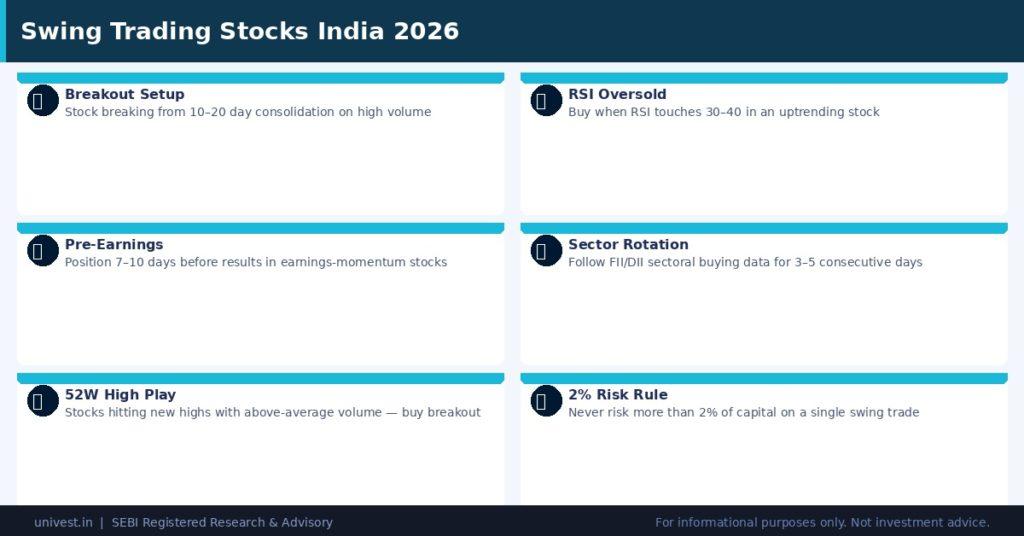
Strategy 1: Breakout from Consolidation (the Most Reliable Swing Setup)
A stock that has been trading in a narrow range (consolidating) for 10–20 trading sessions before breaking out on above-average volume is one of the highest-probability swing trade setups. The consolidation indicates supply-demand equilibrium; the breakout signals that new buyers (often institutions) have started accumulating. Enter on the breakout candle close, set a stop-loss below the consolidation support, and target 1.5–2x the consolidation range as the profit target.
In Indian markets, post-earnings consolidation breakouts and budget-related sector breakouts are particularly powerful. A stock that consolidated after a strong Q3 earnings beat and breaks out before Q4 results often delivers 8–12% in the subsequent 2 weeks.
Strategy 2: RSI Oversold Bounce in Uptrending Stocks
In a stock that is in a clear medium-term uptrend (higher highs and higher lows over 3 months), a pullback to the 30–40 RSI zone represents a swing buying opportunity. The logic: institutional investors who accumulate on longer timeframes use pullbacks to add to positions, creating natural support. Enter when RSI crosses back above 40 from an oversold dip, with a stop-loss below the recent swing low.
This setup works best in large-cap Nifty 50 stocks with strong institutional interest — HDFC Bank, ICICI Bank, Maruti Suzuki, and Reliance Industries show clean RSI oscillation patterns that swing traders actively use.
Strategy 3: Pre-Earnings Positioning (7–10 Days Before Results)
Stocks with strong earnings momentum — where revenue and profit have grown consecutively for 4+ quarters — often see buying interest 7–10 trading days before quarterly results. This "pre-earnings drift" is a well-documented market phenomenon globally and is prominent in Indian markets during the April-May results season. Enter 10 days before the expected results date, target 5–8% pre-results, and exit before the results announcement to avoid the binary event risk.
Strategy 4: Sector Rotation Entry (Following Institutional Money)
When FII or DII data shows heavy buying in a specific sector for 3–5 consecutive days (visible on NSE's FII/DII sectoral data), enter strong stocks within that sector on any intraday pullback. Institutional buying creates sustained sector momentum that can persist for 2–4 weeks. Defence stocks in March 2026 and oil-related stocks in April 2026 following the West Asia conflict demonstrated this pattern clearly.
Strategy 5: 52-Week High Momentum Play
Stocks making new 52-week highs with above-average volume are in strong institutional uptrends. Counterintuitively, buying at 52-week highs — rather than waiting for a pullback — has historically been one of the best-performing strategies in Indian equities. The logic: stocks making new highs are doing so because institutional demand exceeds supply at all previous price levels. Enter on a retest of the breakout level with a tight stop-loss 3–5% below entry.
Screen for high-beta, high-volume swing trade candidates — Check Univest Screener
Swing Trading Stocks India: Best Sectors to Watch in 2026
- Defence & Aerospace: Geopolitical tensions driving 10%+ annual defence capex growth. Bharat Electronics, HAL, Data Patterns, and Paras Defence show strong institutional accumulation and momentum — ideal swing trade sectors.
- Oil & Gas (West Asia Tailwind): Crude above $100 benefits upstream producers (ONGC, Oil India) and gas distributors. Swing trades in energy stocks aligned with crude price momentum have been highly profitable in Q1 2026.
- Banking & NBFC (Q4 Results Recovery): Banking stocks oversold ahead of Q4 FY26 results on NIM compression fears — a rebound-swing setup if NIM recovery exceeds expectations for HDFC Bank and Axis Bank in April-May 2026.
- Specialty Chemicals: India-US trade deal reducing chemical tariffs creates positive near-term catalyst. Companies with direct US export exposure show pre-results positioning opportunity.
- EV & Auto Components: Mahindra & Mahindra's EV launches (BE 6e, XEV 9e) and Tata Motors' Nexon EV momentum create sector swing opportunities in component suppliers and battery material companies.
Download the Univest iOS App or Univest Android App for SEBI-registered positional and swing trade setups with entry, stop-loss, and targets.
5 Risk Management Rules for Swing Trading in India
- Maximum 2% Capital Risk Per Trade: Never risk more than 2% of your total trading capital on a single swing trade. If you have Rs 5 lakh in trading capital, your maximum loss per trade should be Rs 10,000. This prevents any single losing trade from creating an unrecoverable setback to your portfolio.
- Always Use a Stop-Loss — No Exceptions: Set a hard stop-loss at the beginning of every trade, before you enter the position. For swing trades, a 5–8% stop-loss from entry is typical. Never hold a swing trade past your stop-loss hoping for a bounce — this converts a controlled loss into a potentially devastating one.
- Hold Maximum 5–8 Swing Positions Simultaneously: Holding too many swing positions simultaneously reduces your ability to monitor each carefully. 5–8 positions is the practical maximum for an individual trader. Ensure positions are in different sectors to avoid correlation risk.
- Exit Before Earnings on Positions Held Longer Than 7 Days: Earnings announcements create binary events — a stock can gap up or down 10–15% overnight on results. If your swing trade has been profitable for 7+ days and earnings are imminent, take profits rather than risking a gap-down reversal.
- Review Trade Log Weekly: Keep a trading journal — entry price, reason for entry, stop-loss level, actual exit, and outcome. Weekly review of your trade log reveals patterns: which setups work best for your style, which sectors you trade most profitably, and where your behavioral biases are costing you money.
Conclusion
Swing trading stocks in India in 2026 offers genuine profit potential for disciplined traders who apply a systematic setup framework, use strict risk management, and focus on high-liquidity Nifty 500 stocks with sector momentum tailwinds. The best swing trade sectors currently include defence, oil & gas, banking (pre-earnings recovery plays), and specialty chemicals. For investors who want SEBI-registered analyst identification of swing setups with complete entry/stop-loss/target parameters, Univest Pro's positional advisory is specifically designed for this trading style.
Investments in securities are subject to market risk. Please read all related documents carefully before investing. This content is for educational purposes only and does not constitute investment advice. Past performance is not indicative of future results. Consult a SEBI-registered investment advisor before making any investment decision.
Frequently Asked Questions
Q1. What is swing trading in Indian stocks and how is it different from intraday?
Swing trading involves holding stocks for 3–15 trading days to capture medium-term price swings, while intraday trading requires entering and exiting positions within the same trading day. Swing trading suits investors who cannot monitor markets continuously and prefer less operational stress than intraday, while still participating more actively than long-term investors. Swing trades target 5–15% returns per trade over 1–2 weeks.
Q2. What are the best stocks for swing trading in India?
The best swing trading stocks in India have: high average daily volume (> 5 lakh shares), beta above 1.0, clear institutional coverage (Nifty 500 or larger), strong promoter holding (> 45%), and sector momentum tailwinds. In April-May 2026, defence stocks, banking stocks ahead of Q4 results, and energy stocks aligned with crude oil momentum are showing the most attractive swing trade setups. Use the Univest Screener to filter by momentum, volume, and technical signals.
Q3. How much capital do I need to start swing trading in India?
While there is no regulatory minimum, a practical starting capital for swing trading in India is Rs 1–2 lakh. This allows you to hold 5–8 positions simultaneously with Rs 15,000–25,000 per position while keeping risk per trade below 2% of capital. At Rs 50,000 capital, meaningful position sizing becomes difficult without over-concentrating risk in each trade.
Q4. What technical indicators work best for swing trading in India?
For Indian swing trading, the most reliable technical indicators are: RSI (14-period) for identifying oversold entries and overbought exits, MACD for confirming trend direction and momentum, Bollinger Bands for identifying breakout setups from consolidation, and Volume Rate of Change (ROC) for confirming institutional participation in moves. Use the daily chart as the primary timeframe and the weekly chart for trend confirmation.
Q5. How do SEBI-registered advisory services help swing traders?
SEBI-registered advisory services like Univest provide positional/swing trade calls with complete parameters: entry price range, stop-loss level, and target price — typically with a 1:2 to 1:3 risk-reward ratio. This saves the swing trader significant screening and analysis time while ensuring the setup is backed by systematic research. Following these calls also helps traders learn the analytical process behind setup identification over time.
Q6. What is a good risk-reward ratio for swing trades in India?
A minimum risk-reward ratio of 1:2 is recommended for swing trades — meaning for every Rs 5 you risk (stop-loss), you should target at least Rs 10 in profit. Many professional swing traders use 1:3 ratios, which means even if only 40% of trades are profitable, the overall strategy remains profitable. Never take a swing trade with a risk-reward ratio below 1:1.5.
Q7. What is the best time to enter a swing trade in Indian markets?
For Indian equity swing trades, the best entry windows are: (1) first 30 minutes after market open for momentum continuation setups, (2) between 11:30 AM and 1:00 PM for breakout confirmation when early volatility settles, and (3) last 30 minutes for closing-price accumulation by institutional investors. Avoid entering new swing trades in the first 10–15 minutes of market opening, as the initial price discovery is often deceptive.
Q8. Can swing trading replace a full-time income in India?
Swing trading can generate supplemental income for consistently profitable traders, but relying on it as a primary income source requires a large capital base (typically Rs 25 lakh or more), exceptional discipline, and several years of track record. SEBI data shows that the majority of active traders in India are not consistently profitable over 3-year periods. Start swing trading as a supplemental activity with 10–20% of your investment capital, and only scale up after demonstrating consistent profitability over 12+ months.
Recent Article
Coal India Share Price Target 2026: Analyst Forecasts, Bull & Bear Case
Bharti Airtel Share Price Target 2026: Analyst Forecasts, Bull & Bear Case
State Bank of India Share Price Target 2026: Analyst Forecasts, Bull & Bear Case
Paytm Share Price Target 2026: Analyst Forecasts, Bull & Bear Case
Recent Articles

4 Smallcap Rising Promoter Holding Stocks to Watch for Future Multibagger Potential: Kajaria Ceramics, Paradeep Phosphates, Saregama and Stylam Industries
26 October 2026

4 Smallcap Rs 1,000 Crore Profit Stocks to Watch for Future Multibagger Potential: LIC Housing Finance, Great Eastern Shipping, CESC and South Indian Bank
26 October 2026

4 Smallcap Government Capex Stocks to Watch for Future Multibagger Potential: Kalpataru Projects, Engineers India, RITES and Power Mech
26 October 2026

4 Smallcap Export Stocks to Watch for Future Multibagger Potential: Tata Elxsi, Happy Forgings, CCL Products and Zensar
26 October 2026
Note: This blog is for information purpose only. Investments and trading are subject to market risks, read all scheme related documents carefully.
Reviews






Recent Posts
4 Smallcap Rising Promoter Holding Stocks to Watch for Future Multibagger Potential: Kajaria Ceramics, Paradeep Phosphates, Saregama and Stylam Industries
4 Smallcap Rs 1,000 Crore Profit Stocks to Watch for Future Multibagger Potential: LIC Housing Finance, Great Eastern Shipping, CESC and South Indian Bank
4 Smallcap Government Capex Stocks to Watch for Future Multibagger Potential: Kalpataru Projects, Engineers India, RITES and Power Mech
4 Smallcap Export Stocks to Watch for Future Multibagger Potential: Tata Elxsi, Happy Forgings, CCL Products and Zensar
4 Smallcap Rural Demand Stocks to Watch for Future Multibagger Potential: Force Motors, Sumitomo Chemical, Paradeep Phosphates and Gokul Agro
Popular this week
4 Smallcap China Plus One Stocks to Watch for Future Multibagger Potential: Himadri, Sundram Fasteners, Garware Hi-Tech Films and Avalon Technologies

Uniresearch Global Pvt Ltd
Research Analyst
SEBI Registration Number — INH000013776
Uniresearch is a subsidiary of Univest Communication Technologies Private Limited
Company Address: Registered Address: Ground Floor, Unitech Commercial Tower 2, Block B, Greenwood City, Unit 1-3, Sector 45, Gurugram, Haryana 122003
Write to us : support@univest.in, compliance@univest.in
Verify on SEBI registry →RESEARCH ANALYST
Get SEBI Registered
advice on the stocks
trending today.
Get 3 FREE Trade Ideas

for Startups Accelerator 2024

Trusted by 1Cr Indians

Awarded No.1 by Economic Times