
Stock Market Crash 2026: What Should Indian Investors Do Now?
Updated: 8 Apr 2026 • 4:41 pm
Posted by:

The Indian stock market experienced one of its sharpest single-day falls in years on April 7, 2026. The Nifty 50 fell 5.9% and the Sensex dropped 3,939 points — the second-largest single-day decline in a decade — triggered by US President Donald Trump's announcement of a 26% reciprocal tariff on Indian goods. Midcap and smallcap indices fell even harder, with the Nifty Midcap 100 losing 7.2% and the Nifty Smallcap 100 down 8.4%. FIIs sold Rs 22,000 crore in a single week. Retail investor portfolios across India saw 10–20% declines.
If you are wondering what to do during a stock market crash in 2026, the answer depends on your investment horizon, portfolio composition, and financial goals. This article provides a grounded, research-backed framework — not panic-driven advice — to help you make rational decisions in an irrational market environment.
Key Policy Highlights 2026-27
[Tap to Access Best Research Pieces on Univest]
• Nifty 50 fell 5.9% on April 7, 2026 — triggered by US 26% reciprocal tariff on Indian goods
• FII outflows: Rs 22,000 crore in one week — largest weekly outflow since October 2024
• RBI stance: MPC meets April 9 — rate cut of 25bps expected to support growth sentiment
• India-US trade deal: Both governments in active negotiation — tariff resolution could trigger sharp rally
• Historical context: Nifty has recovered 100% of all tariff/macro-driven corrections within 12–18 months
Top Stocks Overview 2026
[Click Here – Get Free Investment Predictions]
| Company | CMP (Rs) | Market Cap | 52W High | 52W Low |
| Nifty 50 ETF (Nippon) | 240 | AUM Rs 22,800 Cr | 298 | 225 |
| HDFC Bank | 731 | Rs 11,55,888 Cr | 1,950 | 727 |
| Sun Pharma | 1,780 | Rs 4,27,000 Cr | 2,150 | 1,600 |
| ITC | 430 | Rs 5,37,500 Cr | 530 | 390 |
| Hindustan Unilever | 2,300 | Rs 5,40,000 Cr | 2,900 | 2,100 |
| Infosys | 1,420 | Rs 5,90,000 Cr | 2,006 | 1,385 |
| Bajaj Finance | 8,100 | Rs 5,01,000 Cr | 9,230 | 6,650 |
Data sourced from NSE/BSE and Screener.in. CMP as of early April 2026. Verify before investing.
Company Analysis
What Causes a Stock Market Crash?
A stock market crash is a sudden and severe decline in equity prices across a broad index, typically 10%+ in a short period. The April 2026 crash was triggered by the US tariff announcement — a macro policy shock that investors had not fully priced in. Other common crash triggers include: RBI/Fed rate shock, banking sector crisis, geopolitical conflict escalation, or systemic credit event. Crashes feel catastrophic in the moment but have historically always been followed by recovery — the question is how long the recovery takes.
What to Do if Your Portfolio Is Down 15–25%
First: do not panic and do not sell. Every major market crash — 2008, 2020, 2022 — that appeared catastrophic in the moment was followed by recovery within 12–18 months for diversified equity portfolios. Second: assess whether your investments are fundamentally sound. If you own quality companies (Nifty 50, large-cap FMCG, pharma, IT), the decline reflects macro fear, not permanent capital loss. Third: if you have cash or fixed income allocated, consider deploying 20–30% into quality stocks at the current discount.
Which Sectors Outperform During a Crash?
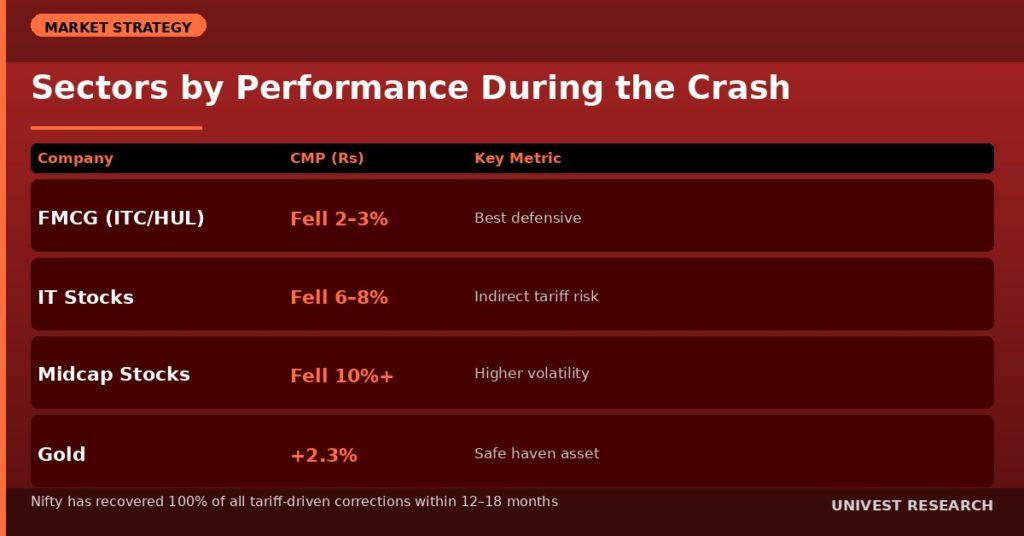
Defensive sectors — FMCG, pharma, and utilities — typically fall less than the market during crashes because their earnings are less cyclical. During the April 2026 crash, FMCG stocks like ITC and HUL fell 2–3%, while IT stocks fell 6–8% and midcaps fell 10%+. Domestic demand-driven companies with minimal export exposure are natural safe havens. Gold (up 2.3% on April 7) and short-duration debt funds also provide portfolio stability during equity crashes.
Should You Increase SIP During a Market Crash?
Yes — increasing your SIP amount during a market crash is one of the most rational investment decisions you can make. When the Nifty falls 10–15%, you are buying the same high-quality companies at a significant discount. Historical data shows that investors who increased SIPs during the COVID-19 crash of March 2020 delivered 3x returns within 2 years. A crash is not a time to pause — it is a time to accelerate systematic investing.
Download the Univest iOS App or Univest Android App to get daily stock recommendations and insightful research pieces.
Key Factors to Consider
• Historical data: Nifty has never failed to recover from a macro-driven correction within 24 months
• Valuation reset: PE ratios have fallen to more attractive levels after the crash
• Domestic demand resilience: Indian GDP growth of 6.4% expected in FY27 — insulates economy from full tariff impact
• RBI rate cuts: Upcoming 25bps cut improves corporate earnings and consumer spending
• India-US trade deal: Resolution of tariff standoff could trigger 10–15% rapid market recovery
Risks to Be Aware Of
• Tariff escalation: If India retaliates or US escalates, another wave of selling is likely
• Global recession: If US GDP contracts sharply, FII outflows from India could intensify
• Earnings downgrades: Q4 FY26 results may be accompanied by conservative FY27 guidance
• Mid and small cap risk: These segments fall harder and take longer to recover — reduce exposure if overweight
• Liquidity risk: In severe crashes, illiquid stocks can fall 30–50% with no buyers at any price
How to Choose the Right Stocks
• Review portfolio quality: Replace speculative mid/small caps with quality large caps if overexposed
• Increase SIP: Use the crash as an opportunity to accelerate systematic investing
• Hold quality: Do not sell high-quality companies in a panic — they recover first
• Add defensives: Increase allocation to FMCG, pharma, and dividend-paying PSUs for stability
• Avoid leverage: Never take loans to invest during a crash — margin calls can be catastrophic
Discover top stocks with high potential using Univest Screener — filter by sector, market cap, dividend yield, and more.
Frequently Asked Questions (FAQs)
Should I sell my stocks during the 2026 market crash?
For most investors, selling during a crash locks in losses permanently. Unless you own companies with genuinely deteriorating fundamentals (not just falling prices), the rational action is to hold and potentially buy more. Historical data shows that investors who sold during the COVID-19 crash of March 2020 missed the subsequent 100% rally within 18 months.
When will the stock market recover in 2026?
The speed of recovery depends on the US-India tariff negotiation outcome. If a trade deal is reached within 3–6 months (which both governments are indicating), markets could recover sharply. Based on historical precedent, macro-shock-driven corrections of 10–15% have typically recovered within 6–12 months. Long-term investors with 5+ year horizons should view the crash as an opportunity.
Which stocks to buy during the 2026 market crash?
Quality large-cap stocks at a discount are the best buys during a crash. HDFC Bank, Infosys, ITC, Sun Pharma, and Bajaj Finance are all trading at attractive valuations relative to their long-term earnings power. Nifty 50 ETFs (like Nippon NIFTYBEES) are the simplest and most diversified option for investors who are uncertain about stock picking.
How much of my portfolio should I invest during a market crash?
Financial planners generally recommend deploying 20–40% of your available dry powder (cash or short-term bonds) in the first wave of a crash, with the remainder held for further opportunistic deployment if markets fall another 10–15%. Trying to time the exact bottom is impossible — staggered deployment over 3–6 months is more practical.
Disclaimer: Investments in securities are subject to market risk. Please read all related documents before investing. This content is for educational purposes only and does not constitute investment advice. Consult a SEBI-registered financial advisor before making any investment decisions.
Recent Articles
Infosys Q4 Results 2026: Date, Revenue, PAT & Analyst Outlook
Best Agrolife Q4 FY26 Results Preview & Earnings Expectations
Bhansali Engineering Polymers Q4 FY26 Results Preview & Earnings Outlook
Recent Articles

Is Pulz Electronics the Best Stock in Its Sector? A Look at the Numbers
22 October 2026

Is D-Link India the Best Stock in Its Sector? A Look at the Numbers
22 October 2026

Is Intec Capital the Best Stock in Its Sector? A Look at the Numbers
22 October 2026

Is Cella Space the Best Stock in Its Sector? A Look at the Numbers
22 October 2026
Note: This blog is for information purpose only. Investments and trading are subject to market risks, read all scheme related documents carefully.
Reviews






Recent Posts
Is Pulz Electronics the Best Stock in Its Sector? A Look at the Numbers
Is D-Link India the Best Stock in Its Sector? A Look at the Numbers
Is Intec Capital the Best Stock in Its Sector? A Look at the Numbers
Is Cella Space the Best Stock in Its Sector? A Look at the Numbers
Is Zeal Global Services the Best Stock in Its Sector? A Look at the Numbers

Uniresearch Global Pvt Ltd
Research Analyst
SEBI Registration Number — INH000013776
Uniresearch is a subsidiary of Univest Communication Technologies Private Limited
Company Address: Registered Address: Ground Floor, Unitech Commercial Tower 2, Block B, Greenwood City, Unit 1-3, Sector 45, Gurugram, Haryana 122003
Write to us : support@univest.in, compliance@univest.in
Verify on SEBI registry →RESEARCH ANALYST
Get SEBI Registered
advice on the stocks
trending today.
Get 3 FREE Trade Ideas

for Startups Accelerator 2024

Trusted by 1Cr Indians

Awarded No.1 by Economic Times