
Potential Multibagger Stocks 2026 — Best Screener Framework & High-Conviction Picks
Updated: 2 Apr 2026 • 6:22 pm
Posted by:

India's stock market is home to thousands of listed companies — but only a small subset have the potential to deliver multibagger returns over the next 3–7 years. Identifying these potential multibagger stocks requires a combination of quantitative screening (financial metrics), qualitative analysis (business model and competitive moat), and sectoral judgment (structural growth vs cyclical noise).
This article provides the complete framework for identifying potential multibagger stocks in India for 2026 — the specific filters to apply, the sectors to focus on, and the qualitative questions to ask before committing capital.
What Are Multibagger Stocks? — Definition
Click Here – Get Free Investment Predictions
Potential multibagger stocks are companies that, based on current financial metrics, business model strength, and sectoral tailwinds, have a credible path to delivering 3-10x returns over a 3-7 year investment horizon. 'Potential' is the operative word — even the most carefully researched pick can fail due to execution, competitive dynamics, or macro factors.
The key to finding potential multibaggers is identifying the P/E re-rating potential alongside earnings growth. A stock that doubles its earnings in 3 years AND sees its P/E expand from 15x to 30x (as institutional discovery occurs) delivers a 4x return. This combination of earnings growth and P/E expansion is the engine of multibagger returns.
Screen for multibagger candidates using SEBI-compliant tools — Univest Screener — filter by ROCE, revenue growth, promoter holding, and more.
Potential Multibagger Stocks — Screening Filters and Interpretation
Tap to Access Best Research Pieces on High-Growth Stocks
| Filter | Threshold | Why It Matters | Interpretation |
| ROCE | Greater than 20% | Capital efficiency — value creation signal | Consistent ROCE>20% = moat exists |
| Revenue CAGR (3Y) | Greater than 20% | Real business growth confirmation | Not a turnaround — a genuine compounder |
| Net Profit CAGR (3Y) | Greater than 20% | Operating leverage materialising | Revenue growth translating to profits |
| D/E Ratio | Less than 0.5 | Financial resilience through downturns | Can grow without constant equity dilution |
| Promoter Holding | Greater than 45% | Alignment of promoter with shareholders | No promoter selling = conviction in growth |
| Institutional Holding | Less than 25% | Undiscovered — price discovery gap exists | Large institutional buying ahead = re-rating |
| PEG Ratio | Less than 1.0 | Growth underpriced at current P/E | Best entry when P/E < growth rate |
| Market Cap | Rs.200-5,000 Cr | Early growth phase — room for 10x | Small enough to deliver 10x as it scales |
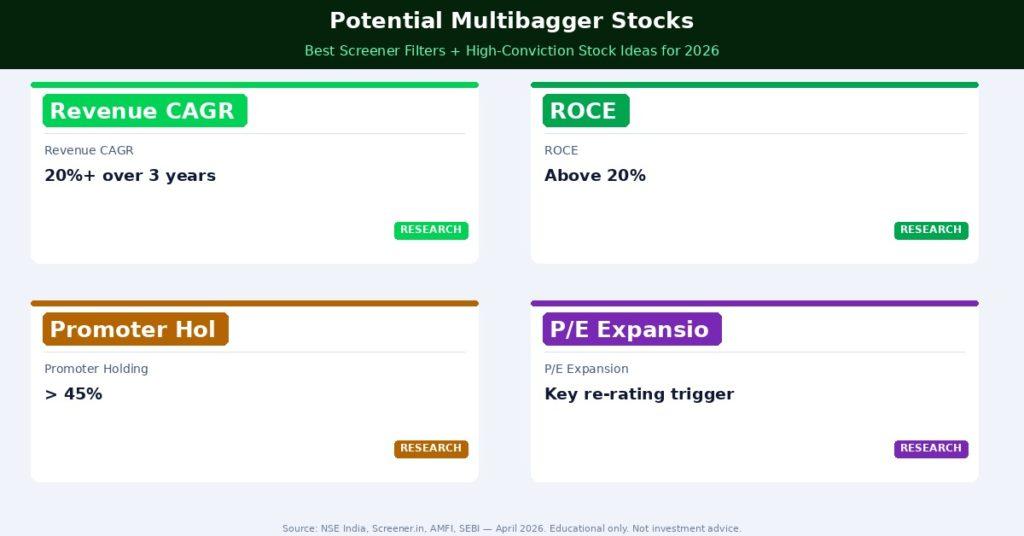
Screening framework for potential multibagger stocks. Each filter eliminates the vast majority of listed companies. Stocks passing all 8 filters are the primary multibagger research candidates. Source: Univest Research.
The PEG Ratio — The Most Underused Multibagger Tool
The PEG (Price/Earnings to Growth) ratio is Peter Lynch's favourite metric for identifying potential multibagger stocks — and one of the most underused tools in Indian retail investing. PEG = P/E ratio ÷ Earnings Growth Rate. A PEG of 1.0 means you are paying one unit of P/E for each unit of growth — fair value. A PEG below 1.0 means growth is underpriced — a strong buy signal for long-term investors.
Example: Company A grows earnings at 25% and trades at P/E of 15x → PEG = 15÷25 = 0.6 (significantly undervalued for growth rate). Company B grows at 15% and trades at P/E of 40x → PEG = 40÷15 = 2.7 (expensive for growth rate). Potential multibagger stocks almost always have PEG below 1 at the time of initial identification.
Sector Tailwind — The Amplifier of Company-Level Growth
Even the best potential multibagger stock in a structurally declining sector will struggle to deliver 10x returns. The sector tailwind acts as a force multiplier — amplifying the company's organic growth with favourable regulatory, capex, and market conditions.
The most powerful sector tailwinds for potential multibagger stocks in India right now are: government defence indigenisation (Rs.6.81 lakh crore budget, Positive Indigenisation List), India's EV adoption (FAME, PLI schemes), specialty chemicals China+1 shift (India gaining export share from China), renewable energy manufacturing (Rs.25 lakh crore investment target by 2030), and digital India (UPI ecosystem, MSME digitisation, SaaS).
Open Market Promoter Buying — The Most Reliable Signal
When promoters (founders/major shareholders) of a company buy additional shares in the open market with their own money — not via ESOPs or rights issues — it is the most reliable leading indicator of a potential multibagger stock. Promoters know their business better than any analyst. When they are willing to pay market price for more shares, they are signalling confidence in the company's future that exceeds even the most optimistic analyst model.
Monitor BSE/NSE 'insider trading' disclosures quarterly. Filter for companies where the promoter/promoter group has been net buyers in the open market for 2+ consecutive quarters while promoter pledging is zero. This combination — accumulation + zero pledging — is one of the rarest and most powerful signals in the Indian stock market.
Key Screening Criteria for Multibagger Stocks
- Revenue CAGR > 20% for 3 years — the growth engine is confirmed and real
- ROCE > 20% — the business model has a genuine competitive advantage
- Net profit growing faster than revenue — operating leverage is materialising
- D/E < 0.5 — can fund growth without excessive equity dilution or leverage
- Promoter holding > 45% with net open market buying in last 2 quarters
- Institutional ownership < 25% — significant institutional buying headroom remains
- PEG ratio < 1.0 — growth is underpriced at current P/E multiple
Apply all these filters instantly — Check Univest Screener for research-backed multibagger picks.
Risks of Investing in Multibagger Stocks
- Quantitative filters miss qualitative risks — always research governance and competitive moat qualitatively
- Promoter buying can slow or stop — monitor insider disclosures every quarter
- Sector tailwinds can reverse — regulatory changes, commodity cycles, or geopolitical events
- PEG ratio can compress further if growth slows — the metric is forward-looking based on historical growth
- Even stocks with perfect screener output can disappoint if management over-promises and under-delivers
Download the Univest iOS App or Univest Android App for SEBI-registered stock research, daily picks, and multibagger screeners.
FAQs
What are the best potential multibagger stocks in India?
Specific recommendations require SEBI-registered advisory. Structurally, sectors with strongest potential multibagger credentials for 2026-2030 are: defence electronics and precision manufacturing, EV components supply chain, specialty chemicals export-oriented, and water infrastructure. Apply the 8-filter framework above on Screener.in to generate your research list.
How do I know if a stock has multibagger potential?
A stock has multibagger potential when: (1) ROCE > 20% consistently, (2) Revenue growing 20%+, (3) Operating in a structural growth sector, (4) Institutional ownership still low (under 25%), (5) Promoter is buying in open market, (6) PEG ratio below 1.0. All 6 conditions together are rare — that's exactly why such stocks are so valuable when found.
What is the difference between multibagger and turnaround stocks?
Multibagger stocks are already performing well — high ROCE, strong growth — but are undervalued due to low discovery. Turnaround stocks are recovering from a period of poor performance — high risk, high reward if the turnaround succeeds. Turnaround investing is significantly harder and riskier. The multibagger framework above focuses on quality compounders, not turnarounds.
Can I use Screener.in to find potential multibagger stocks?
Yes — Screener.in is one of India's best free stock research tools. Create a custom screen with: ROCE > 20% AND Revenue growth > 20% AND Debt to equity < 0.5 AND Promoter holding > 45%. Sort by market cap (ascending) to focus on smaller companies with more room to grow. Cross-reference results with the Univest Screener for additional fundamental context.
What is the minimum investment horizon for potential multibagger stocks?
Minimum 3 years — preferably 5-7 years. Potential multibagger stocks need time to execute their growth plan, attract institutional discovery, and see their P/E multiple expand from 'undiscovered' to 'consensus'. Short-term investors (under 2 years) in multibagger stocks frequently sell before the most significant return materialises.
How many potential multibagger stocks should I own?
A portfolio of 8–15 potential multibagger stocks is optimal. Fewer creates dangerous concentration; more dilutes returns. Each position should be 3–7% of your total equity portfolio. Pair your multibagger portfolio with 60–70% in large-cap, index, or diversified equity funds to ensure your core wealth is protected even if several multibagger bets disappoint.
Disclaimer: Investments in securities are subject to market risks. This article is for educational purposes only and does not constitute investment advice or stock recommendations. The stocks mentioned are for illustrative/research purposes only. Past performance is not indicative of future returns. Please consult a SEBI-registered investment advisor before making any investment decisions.
Recent Article
Coal India Share Price Target 2026: Analyst Forecasts, Bull & Bear Case
Bharti Airtel Share Price Target 2026: Analyst Forecasts, Bull & Bear Case
State Bank of India Share Price Target 2026: Analyst Forecasts, Bull & Bear Case
Paytm Share Price Target 2026: Analyst Forecasts, Bull & Bear Case
Recent Articles

3 Pumps and Valves Specialist, Water Treatment Solutions Provider and Wear-Resistant Castings Producer Stocks With a Strong Future Roadmap: Kirloskar Brothers, Ion Exchange (India) and AIA Engineering
27 October 2026

3 Largest Private Healthcare Group, Affordable Cardiac Care Hospital Group and Ingredients and Formulations Maker Stocks With a Strong Future Roadmap: Apollo Hospitals Enterprise, Narayana Hrudayalaya and Granules India
27 October 2026

3 Electronics Manufacturing Services Company, Defence Shipyard and Oil and Gas Engineering Consultant Stocks With a Strong Future Roadmap: Syrma SGS Technology, Mazagon Dock Shipbuilders and Engineers India
27 October 2026

3 Hospital Network Operator, Respiratory Medicines Leader and Infusion and Catheter Devices Maker Stocks With a Strong Future Roadmap: Fortis Healthcare, Cipla and Poly Medicure
27 October 2026
Note: This blog is for information purpose only. Investments and trading are subject to market risks, read all scheme related documents carefully.
Reviews






Recent Posts
3 Pumps and Valves Specialist, Water Treatment Solutions Provider and Wear-Resistant Castings Producer Stocks With a Strong Future Roadmap: Kirloskar Brothers, Ion Exchange (India) and AIA Engineering
3 Largest Private Healthcare Group, Affordable Cardiac Care Hospital Group and Ingredients and Formulations Maker Stocks With a Strong Future Roadmap: Apollo Hospitals Enterprise, Narayana Hrudayalaya and Granules India
3 Electronics Manufacturing Services Company, Defence Shipyard and Oil and Gas Engineering Consultant Stocks With a Strong Future Roadmap: Syrma SGS Technology, Mazagon Dock Shipbuilders and Engineers India
3 Hospital Network Operator, Respiratory Medicines Leader and Infusion and Catheter Devices Maker Stocks With a Strong Future Roadmap: Fortis Healthcare, Cipla and Poly Medicure
3 US Generics and Branded Medicines Company, Global Generics Maker and Chronic Therapy Brands Company Stocks With a Strong Future Roadmap: Alembic Pharmaceuticals, Dr. Reddy's Laboratories and Eris Lifesciences

Uniresearch Global Pvt Ltd
Research Analyst
SEBI Registration Number — INH000013776
Uniresearch is a subsidiary of Univest Communication Technologies Private Limited
Company Address: Registered Address: Ground Floor, Unitech Commercial Tower 2, Block B, Greenwood City, Unit 1-3, Sector 45, Gurugram, Haryana 122003
Write to us : support@univest.in, compliance@univest.in
Verify on SEBI registry →RESEARCH ANALYST
Get SEBI Registered
advice on the stocks
trending today.
Get 3 FREE Trade Ideas

for Startups Accelerator 2024

Trusted by 1Cr Indians

Awarded No.1 by Economic Times