
Multibagger PSU Stocks 2026 — Best Public Sector Stocks with 3-10x Return Potential
Updated: 2 Apr 2026 • 4:56 pm
Posted by:

Public Sector Undertakings (PSUs) were long considered the 'boring' part of India's stock market — stable but slow, dividend-paying but rarely dynamic, government-owned and therefore bureaucratic. That perception changed dramatically between 2022 and 2024, when a wave of PSU stocks delivered multibagger returns: HAL went from Rs.900 to Rs.5,000+ (5.5x), IRFC from Rs.25 to Rs.225+ (9x), RVNL from Rs.30 to Rs.600+ (20x), and Mazagon Dock from Rs.200 to Rs.3,500+ (17.5x).
The multibagger PSU stock phenomenon was driven by a convergence: massive government capital expenditure (Rs.11.1 lakh crore in FY26 Union Budget), defence indigenisation mandates, renewable energy targets, and a re-rating as investors recognised PSUs as genuine growth stories — not just dividend plays. This article covers the sectors, stocks, and criteria for identifying multibagger PSU stocks in 2026.
What Are Multibagger Stocks? — Definition
Click Here – Get Free Investment Predictions
A PSU (Public Sector Undertaking) is a company where the Government of India or a state government holds more than 51% equity. There are approximately 300+ listed PSUs on NSE/BSE — ranging from banking (SBI, PNB) to energy (NTPC, ONGC, BPCL) to defence (HAL, BEL, Mazagon Dock) to railways (RVNL, IRFC) to mining (Coal India, NMDC).
Multibagger PSU stocks are those PSUs where government capex, policy support, or strategic importance creates earnings growth significantly above the market's expectations — causing a simultaneous rise in earnings AND P/E multiple. The best multibagger PSU stocks are typically in sectors where the government has made multi-decade, non-reversible commitments: defence, power generation, railways, and clean energy.
Screen for multibagger candidates using SEBI-compliant tools — Univest Screener — filter by ROCE, revenue growth, promoter holding, and more.
Multibagger PSU Stocks — Sector, Company, and Investment Thesis
Tap to Access Best Research Pieces on High-Growth Stocks
| PSU Company | Ticker | Sector | Key Catalyst | Dividend Yield | Multibagger Thesis |
| Hindustan Aeronautics Ltd | HAL | Defence Aerospace | Rs.94,000 Cr+ order book | 1.0% | LCA Tejas, military heli + MRO — decades of visibility |
| Bharat Electronics Ltd | BEL | Defence Electronics | Rs.75,000 Cr+ order book | 0.8% | EW systems, radars — 20%+ revenue CAGR target |
| NTPC Limited | NTPC | Power Generation | 60 GW renewable target by 2032 | 2.2% | Thermal + renewable = diversified power giant |
| Power Grid Corporation | POWERGRID | Power Transmission | Rs.1.2L Cr capex FY26-31 | 4.5% | Regulated return + renewable integration tailwind |
| Coal India | COALINDIA | Mining | 5 GW solar target + capacity | 4.5% | Diversification into renewables + consistent FCF |
| ONGC | ONGC | Oil & Gas | New field development + HPCL | 3.5% | Deep-water exploration + subsidiary value |
| NMDC | NMDC | Iron Ore Mining | Rs.3,000 Cr steel plant | 4.0% | Iron ore demand + new Nagarnar steel plant |
| Mazagon Dock Shipbuilders | MAZDOCK | Naval Shipbuilding | Rs.20,000 Cr+ order book | 1.5% | P75I submarines + frigates — 10+ year order pipeline |
Dividend yields and market cap approximate as of April 2026. Order books from latest company disclosures. Source: NSE India, Company filings, Univest Research. Not investment recommendations.
Why PSU Stocks Can Be Multibaggers — The Re-Rating Story
The PSU multibagger story of 2022-24 was driven by three forces: (1) Massive government capex that flowed directly to PSU revenues (railways, defence, power); (2) Profitability improvement as PSUs improved operational efficiency under government pressure for shareholder value; (3) Valuation re-rating from 'PSU discount' (typically 30-50% below private sector peers) to 'PSU premium' as earnings growth became consistent.
The key question for 2026: has the re-rating already happened, or is there more to go? For large PSUs like HAL, BEL, and Mazagon Dock — the re-rating is substantially complete and current valuations are high. For second-tier PSUs in railways, water, and power transmission — the re-rating may still be in early stages.
Defence PSUs — The Highest-Conviction Multibagger PSU Category
Among all PSU categories, defence PSUs have the most compelling multibagger credentials for the next 5–10 years: (1) Order books of 3–10x annual revenue provide extraordinary earnings visibility, (2) Government's Positive Indigenisation List creates captive demand, (3) Export ambitions (Rs.50,000 crore by 2029) add an incremental revenue vector, and (4) Technology moats (certifications, indigenous R&D) create competitive barriers.
BEL's Rs.75,000+ crore order book at approximately 5x its annual revenue provides visibility through FY30. HAL's Rs.94,000+ crore order book stretches visibility through FY32-35. These extraordinary order book coverages — completely unusual for any sector in Indian equities — justify sustained premium valuations.
Power and Energy PSUs — Dividend + Growth Double Play
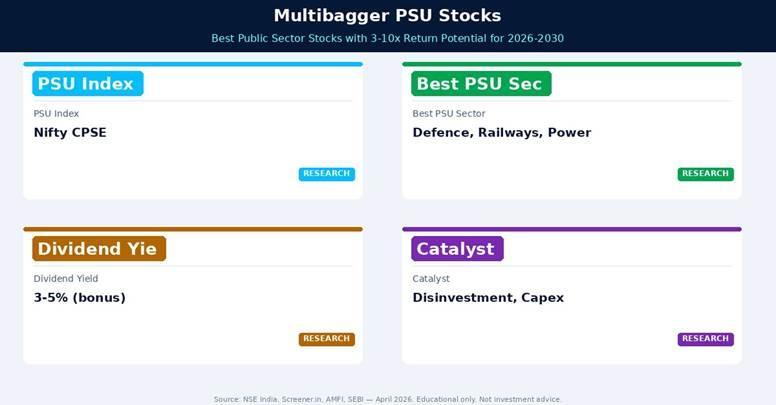
Power sector PSUs (NTPC, Power Grid, NHPC, SJVN) offer an unusual combination: consistent 3–5% dividend yields (attractive in their own right) AND capital appreciation potential from renewable energy expansion. NTPC's 60 GW renewable target by 2032 (from approximately 7.5 GW today) means the company is adding more than its entire current renewable capacity each year for 7 years — an extraordinary growth capex programme.
Power Grid's Rs.1.2 lakh crore five-year capex plan for transmission infrastructure is similarly extraordinary. Each commissioned project adds to the regulated asset base and earns 15.5% regulated RoE — highly predictable earnings that compound the book value year after year.
Key Screening Criteria for Multibagger Stocks
- Order book coverage > 3x annual revenue — critical for defence and capital goods PSUs
- Revenue CAGR above 15% over last 3 years — PSU growth confirming the government capex narrative
- Dividend yield above 2% — PSU income acts as floor while capital appreciation materialises
- Market cap / order book ratio below 3x — entry below 3x order book implies reasonable valuation
- ROCE above 15% for PSUs (lower threshold than private sector due to regulated business models)
- Clear government capex or policy commitment backing the earnings trajectory
- Institutional holding (especially mutual funds) still below 30% — re-rating headroom remains
Apply all these filters instantly — Check Univest Screener for research-backed multibagger picks.
Risks of Investing in Multibagger Stocks
- Disinvestment risk: government selling stake can depress stock price even when business performs well
- Bureaucratic inefficiency can limit operational improvements needed to sustain earnings growth
- Subsidy and government-directed pricing can compress margins in regulated sectors
- Political change can reverse specific sector priorities (defence, energy, railways)
- Valuation risk: many PSUs re-rated significantly in 2022-24 — some may be fully priced
Download the Univest iOS App or Univest Android App for SEBI-registered stock research, daily picks, and multibagger screeners.
FAQs
Which PSU stocks have multibagger potential for 2026-2030?
Based on order book, earnings visibility, and structural tailwinds, defence PSUs (BEL, HAL, Mazagon Dock) and power PSUs (NTPC, Power Grid) have the most credible multibagger credentials. Second-tier opportunities exist in railway PSUs (RVNL, IRCON) and water/infrastructure PSUs that are still in early re-rating phases.
Why did PSU stocks become multibaggers in 2022-24?
The PSU multibagger rally of 2022-24 was driven by: (1) record government capital expenditure (Union Budget FY24 at Rs.10 lakh crore), (2) defence indigenisation mandate creating captive demand for HAL, BEL, Mazagon Dock, (3) railway expansion (Vande Bharat, freight corridor), and (4) P/E re-rating from PSU discount (5-8x) to fair value (15-25x) as earnings growth became consistent.
Are PSU stocks still good investments after 2024 rally?
After the 2022-24 re-rating, large-cap PSUs (HAL, BEL) are no longer cheap — they trade at premium P/E multiples. However, second-tier PSUs in power transmission, railways, and water infrastructure may still be in early re-rating phases. Focus on mid-cap PSUs with order books > 3x revenue, ROCE > 15%, and institutional holding still below 30%.
Do PSU stocks pay dividends?
Yes — PSU stocks are known for consistent dividend payouts. The government mandates PSUs to pay a minimum dividend to support the fiscal position. Power Grid's dividend yield is approximately 4.5%, Coal India approximately 4.5%, ONGC approximately 3.5%, and NTPC approximately 2.2% at current prices. This provides an income floor while capital appreciation materialises.
Is NTPC a multibagger stock?
NTPC has a credible multibagger thesis: the transition from a pure thermal utility to an integrated power company with 60 GW of renewable capacity by 2032 is a structural transformation that could significantly re-rate the stock over 5-7 years. After the 2024-25 correction, NTPC at Rs.330 (versus Rs.448 52-week high) offers a more attractive entry point. However, it has already rallied 120%+ in FY24-25.
What is CPSE index?
CPSE (Central Public Sector Enterprises) Index is a Nifty index comprising the 12 largest and most liquid PSU stocks — including NTPC, ONGC, Coal India, Power Grid, BEL, and BHEL. The Nifty CPSE Index ETF (managed by Nippon India) allows investors to take diversified PSU exposure through a single instrument. The index has delivered exceptional returns during the PSU rally of 2022-24.
Disclaimer: Investments in securities are subject to market risks. This article is for educational purposes only and does not constitute investment advice or stock recommendations. The stocks mentioned are for illustrative/research purposes only. Past performance is not indicative of future returns. Please consult a SEBI-registered investment advisor before making any investment decisions.
Recent Articles:
Why is the Mega Corporation Share Price Falling?
Why is Adani Green Energy Share Price Falling?
Why is JP Power Share Price Falling?
Why is the MRF Share Price Falling?
Recent Articles

4 Smallcap Operating Margin Above 30 Per Cent Stocks to Watch for Future Multibagger Potential: Capri Global, Travel Food Services, Vijaya Diagnostic and Saregama
27 October 2026

4 Midcap Operating Margin Above 30 Per Cent Stocks to Watch for Future Multibagger Potential: MCX, Oberoi Realty, Premier Energies and Hindustan Copper
27 October 2026

4 Largecap Operating Margin Above 30 Per Cent Stocks to Watch for Future Multibagger Potential: Sun Pharma, HAL, Hindustan Zinc and Indian Hotels
27 October 2026

4 Smallcap Dividend Yield Above 2 Per Cent Stocks to Watch for Future Multibagger Potential: CESC, Shipping Corporation, RITES and Gujarat Pipavav
27 October 2026
Note: This blog is for information purpose only. Investments and trading are subject to market risks, read all scheme related documents carefully.
Reviews






Recent Posts
4 Smallcap Operating Margin Above 30 Per Cent Stocks to Watch for Future Multibagger Potential: Capri Global, Travel Food Services, Vijaya Diagnostic and Saregama
4 Midcap Operating Margin Above 30 Per Cent Stocks to Watch for Future Multibagger Potential: MCX, Oberoi Realty, Premier Energies and Hindustan Copper
4 Largecap Operating Margin Above 30 Per Cent Stocks to Watch for Future Multibagger Potential: Sun Pharma, HAL, Hindustan Zinc and Indian Hotels
4 Smallcap Dividend Yield Above 2 Per Cent Stocks to Watch for Future Multibagger Potential: CESC, Shipping Corporation, RITES and Gujarat Pipavav
4 Midcap Dividend Yield Above 2 Per Cent Stocks to Watch for Future Multibagger Potential: Godrej Consumer, Ashok Leyland, NMDC and NALCO
Popular this week
4 Largecap Dividend Yield Above 2 Per Cent Stocks to Watch for Future Multibagger Potential: HDFC Bank, UltraTech Cement, Tech Mahindra and Union Bank

Uniresearch Global Pvt Ltd
Research Analyst
SEBI Registration Number — INH000013776
Uniresearch is a subsidiary of Univest Communication Technologies Private Limited
Company Address: Registered Address: Ground Floor, Unitech Commercial Tower 2, Block B, Greenwood City, Unit 1-3, Sector 45, Gurugram, Haryana 122003
Write to us : support@univest.in, compliance@univest.in
Verify on SEBI registry →RESEARCH ANALYST
Get SEBI Registered
advice on the stocks
trending today.
Get 3 FREE Trade Ideas

for Startups Accelerator 2024

Trusted by 1Cr Indians

Awarded No.1 by Economic Times