
Maruti Suzuki Share Price Target 2026 — Key Factors, Financial Performance & Analyst Forecast
Updated: 2 Apr 2026 • 11:02 am
Posted by:

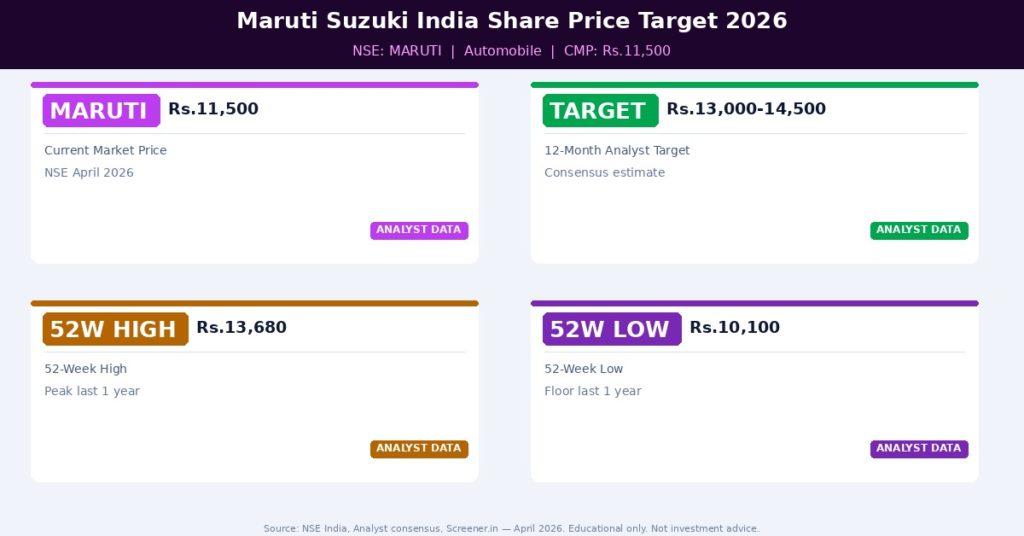
Maruti Suzuki is trading at Rs.11,500 as of April 2026, approximately 16% below its 52-week high of Rs.13,680. India's largest car maker by volume has faced near-term headwinds from SUV market share pressure from Tata, Hyundai, and Kia, and investor anxiety about its EV readiness. Yet Maruti's share price target from analysts implies significant upside, backed by dominant CNG leadership, improving SUV portfolio, strong cash generation, and the upcoming electric SUV launch in FY27.
This article covers MARUTI's current share price, the key drivers of price movement, Q3 FY26 financial performance, technical levels, institutional positioning, and the analyst share price target for 2026 and beyond.
About MARUTI
Click Here – Get Free Investment Predictions
Maruti Suzuki India Ltd (NSE: MARUTI) is India's largest passenger vehicle manufacturer with approximately 41-42% domestic market share — a position it has held for nearly four decades. Founded in 1981 as a government-Suzuki joint venture and headquartered in New Delhi, Maruti Suzuki employs over 37,000 people and has annual capacity of approximately 22.5 lakh vehicles.
Maruti's portfolio spans entry (Alto, S-Presso), hatchback (Swift, Baleno, WagonR), compact SUV (Brezza), mid-size SUV (Grand Vitara), MPV (Ertiga, XL6), compact sedan (Dzire), and adventure (Jimny). Suzuki Motor Corporation (Japan) holds 56.4%, making Maruti access to Suzuki's global R&D, EV platforms, and export network.
Key Factors Influencing MARUTI Share Price in 2026
Tap to Access Best Research Pieces on MARUTI on Univest
1. CNG Segment Dominance — 700K+ Units FY26
Maruti is India's undisputed CNG passenger vehicle leader, selling 700,000+ CNG vehicles in FY26 — approximately 15% of its total volume — with 60%+ CNG segment market share. As CNG remains Rs.40-50 per kg cheaper than petrol on equivalent fuel cost, the economic advantage is significant for value-conscious Indian buyers. CNG penetration is expected to rise to 20-22% of Maruti volumes by FY28.
2. SUV Portfolio Recovery But Still Lagging Peers
After ceding SUV market leadership to Tata, Hyundai, and Kia in 2022-24, Maruti has stabilised with Grand Vitara and Brezza. Q3 FY26 SUV volume grew 12% — a recovery from near-flat earlier in FY26. The upcoming new Dzire (compact sedan refresh) and CX-3 crossover for FY27 add to the product pipeline.
3. EV Launch — YY8 Electric SUV in FY27
Maruti's first electric vehicle — the YY8 (working name), an electric compact SUV — is expected to launch in FY27 in partnership with Suzuki Motor Corporation. Pre-booking data (where available) suggests strong consumer interest. A successful YY8 launch would address the most significant investor concern about Maruti's competitive positioning in the EV era.
4. Export Volume Scaling — Africa and Middle East
Maruti exported approximately 3 lakh vehicles in FY26 — 18.3% growth YoY — with Africa, Latin America, and Middle East as key markets. Suzuki's global distribution network gives Maruti an export infrastructure that no Indian OEM can match, providing a revenue stream independent of domestic cycles.
MARUTI Latest News That Impacted the Stock
- January 2026: Maruti Q3 FY26 results: Revenue Rs.37,348 crore (+6.7% YoY); PAT Rs.3,726 crore (+19.0% YoY). EBITDA margin 11.2% — best in 8 quarters.
- February 2026: Maruti announces new Dzire (5th generation) — targeting the compact sedan segment recovery with CNG and mild-hybrid options.
- March 2026: New Brezza facelift launched — priced competitively to reclaim SUV share from Tata Nexon and Kia Sonet.
- March 2026: Maruti export milestone: cumulative 30 lakh exports in April-December 2025 — a record for the company.
- April 2026: YY8 electric SUV confirmed for Q3 FY27 launch — details revealed at Auto Expo 2026 show. Pre-booking anticipated in June 2026.
MARUTI Q3 FY26 Financial Performance
Here is a snapshot of recent financial performance to frame the share price target discussion:
| Metric | Q3 FY26 | Q3 FY25 (Year-Ago) | YoY Change |
| Revenue | Rs.37,348 Cr | Rs.34,985 Cr | +6.7% YoY |
| Net Profit (PAT) | Rs.3,726 Cr | Rs.3,130 Cr | +19.0% YoY |
| EBITDA Margin | 11.2% | 10.5% | +70 bps YoY |
| SUV Volume Growth | 12% YoY | 5% YoY | Recovery |
| Export Volume | 76,400 units | 64,600 units | +18.3% |
| CNG Volume Share | 15% of total | 11% of total | Growing |
Source: NSE/BSE filings, Company earnings release. Verify latest data on nseindia.com.
Track live metrics and peer comparison on the Univest Screener.
Technical Signals — Price Levels to Watch
The stock is trading at its current level, approximately 0x relative to its fundamentals. Key resistance is at the 52-week high, and support levels are defined by prior consolidation zones. Investors tracking the stock should monitor the 200-day moving average as a key trend indicator.
Download the Univest iOS App or Univest Android App to set live price alerts and receive SEBI-registered analyst research on MARUTI.
Future Outlook — Key Catalysts
- YY8 EV launch in FY27 targeting Rs.15-22 lakh segment — directly competing with Tata Punch EV and Hyundai Creta EV
- CNG volume penetration rising to 20%+ of total volume — driving average selling price and margin expansion
- Export volume reaching 4-5 lakh units by FY28 — revenue diversification beyond domestic cycle
- Strong PAT growth of 19% in Q3 FY26 demonstrates operational leverage as volumes scale and EBITDA margin recovers
MARUTI Share Price Target 2026 — Analyst Consensus
Subscribe to Univest Pro for Premium MARUTI Research and F&O Setups
Short-Term Target (3–6 months)
Rs.11,500-12,500 (3-6 months); Q4 FY26 results (April 2026) and YY8 launch timeline announcement are key near-term catalysts.
12-Month Analyst Consensus Target
Rs.13,000-14,500 (12-month consensus); implies 13-26% upside. Goldman Sachs target Rs.14,500; Motilal Oswal Rs.13,500; ICICI Securities Rs.13,200.
Long-Term Target (2027–2028)
Rs.15,000-18,000 (2027-28); predicated on YY8 EV ramp-up to 5,000+ units/month, 43%+ domestic market share recovery, and export reaching 5 lakh units.
Compare analyst targets for MARUTI against peers on the Univest Screener.
FAQs
What is Maruti Suzuki share price target 2026?
The 12-month analyst consensus target for Maruti Suzuki is Rs.13,000-14,500 from Rs.11,500, implying 13-26% upside. Short-term target Rs.11,500-12,500. Long-term (2027-28), Rs.15,000-18,000 on EV launch and market share recovery.
When is Maruti launching its EV?
Maruti Suzuki's first EV — the YY8 (working name), an electric compact SUV developed with Suzuki Motor Corporation — is expected to launch in Q3 FY27 (October-December 2026). Pre-bookings are anticipated in June 2026. The vehicle is expected to be priced at Rs.15-22 lakh.
What is Maruti's CNG market position?
Maruti is India's largest CNG passenger vehicle manufacturer with 60%+ CNG segment market share. It sold 700,000+ CNG units in FY26 — approximately 15% of total volume across Alto, WagonR, Swift, Baleno, Ertiga, and Dzire CNG variants.
Why did Maruti lose SUV market share?
Maruti was late to the SUV segment — focusing on hatchbacks while Tata, Hyundai, and Kia built strong SUV lineups. Maruti's Grand Vitara (2022) and Brezza refresh were well-received but were playing catch-up. SUV market share is now recovering — Q3 FY26 SUV volumes grew 12% YoY.
What is Maruti EBITDA margin?
Maruti's EBITDA margin was 11.2% in Q3 FY26 — the best in 8 quarters — driven by lower commodity costs, improving CNG and SUV mix, and operating leverage. Management targets 12-13% EBITDA margin by FY27.
What is Maruti's promoter holding?
Suzuki Motor Corporation (Japan) holds 56.4% of Maruti Suzuki India — the single largest shareholder. This high promoter ownership ensures access to Suzuki's global platforms, R&D, and technology (including hybrid and EV) that benefits Maruti's product pipeline significantly.
How does Maruti compare to Tata Motors?
Maruti dominates with 41-42% domestic market share vs Tata's approximately 14%. Maruti has far superior profitability (11.2% EBITDA vs Tata's 5-6% India standalone), stronger CNG franchise, and Suzuki backing. Tata is ahead in EVs (Nexon EV, Punch EV, Curvv EV) but Maruti's YY8 will directly compete from FY27.
What is Maruti's export performance?
Maruti exported approximately 3 lakh vehicles in FY26 — 18.3% growth YoY — with Africa, Latin America, and Middle East as key markets. Total cumulative exports crossed 30 lakh in the April-December 2025 period. The Suzuki global network gives Maruti the largest export infrastructure among Indian OEMs.
This article is for informational and educational purposes only and does not constitute investment advice. All analyst targets are estimates based on publicly available data as of April 2026 and are subject to change. Investments in securities are subject to market risk. Please consult a SEBI-registered financial advisor before making any investment decisions.
Recent Article
Coal India Share Price Target 2026: Analyst Forecasts, Bull & Bear Case
Bharti Airtel Share Price Target 2026: Analyst Forecasts, Bull & Bear Case
State Bank of India Share Price Target 2026: Analyst Forecasts, Bull & Bear Case
Paytm Share Price Target 2026: Analyst Forecasts, Bull & Bear Case
Recent Articles

Tata Consumer Products Shares Jump 7% After Q2 Results: Is This Tata Group Stock a Buy Now? Elara Target, Price Hikes, Valuation and Risks
27 October 2026

Acutaas Chemicals Shares Jump 13% to a Record High After Q2 Profit Rises 71%, Up About 580% in 5 Years: Guidance, Valuation and Risks
27 October 2026

Amazon Stock: Morgan Stanley and UBS Raise Price Targets Ahead of Q3 Results on 29 October, but What Do AWS Margins, Capex and Risks Say?
27 October 2026

Nifty FMCG Index Is Down 22% in 2026: Is Diwali a Buying Opportunity? Valuation, Margin Pressure, Technical Levels and Stocks to Watch
27 October 2026
Note: This blog is for information purpose only. Investments and trading are subject to market risks, read all scheme related documents carefully.
Reviews






Recent Posts
Tata Consumer Products Shares Jump 7% After Q2 Results: Is This Tata Group Stock a Buy Now? Elara Target, Price Hikes, Valuation and Risks
Acutaas Chemicals Shares Jump 13% to a Record High After Q2 Profit Rises 71%, Up About 580% in 5 Years: Guidance, Valuation and Risks
Amazon Stock: Morgan Stanley and UBS Raise Price Targets Ahead of Q3 Results on 29 October, but What Do AWS Margins, Capex and Risks Say?
Nifty FMCG Index Is Down 22% in 2026: Is Diwali a Buying Opportunity? Valuation, Margin Pressure, Technical Levels and Stocks to Watch
Fujiyama Power Systems Shares: Motilal Oswal Sees 36% More Upside With a Rs 500 Target, but Is This Rooftop Solar Stock Still a Buy? Q1 Numbers, Valuation and Risks
Popular this week
Jio Financial Services Share Price Decoded: Reliance Stock Performance Amid Jio Platforms Listing Buzz, Q2 Results, Outlook and Key Levels

Uniresearch Global Pvt Ltd
Research Analyst
SEBI Registration Number — INH000013776
Uniresearch is a subsidiary of Univest Communication Technologies Private Limited
Company Address: Registered Address: Ground Floor, Unitech Commercial Tower 2, Block B, Greenwood City, Unit 1-3, Sector 45, Gurugram, Haryana 122003
Write to us : support@univest.in, compliance@univest.in
Verify on SEBI registry →RESEARCH ANALYST
Get SEBI Registered
advice on the stocks
trending today.
Get 3 FREE Trade Ideas

for Startups Accelerator 2024

Trusted by 1Cr Indians

Awarded No.1 by Economic Times