
IndiGo Share Price Target 2026: Analyst Forecasts, Bull & Bear Case
Updated: 1 Apr 2026 • 4:24 pm
Posted by:

IndiGo (INDIGO) — Share price data and analyst target overview, April 2026
IndiGo remains India's dominant airline with approximately 60% domestic market share, but the stock has effectively gone nowhere in a year — down 2% — as investors weigh strong passenger growth against engine-related grounding issues and jet fuel cost volatility. At Rs.3,900 and a consensus target of Rs.4,500, IndiGo offers 15% upside for investors who believe the Pratt & Whitney engine crisis is now in the rear-view mirror.
As of April 2026, IndiGo trades at Rs. 3,900 with a 52-week range of Rs. 3,040 to Rs. 5,014. Market capitalisation stands at Rs. 1.51 Lakh Cr. The analyst consensus target is Rs. 4,500, implying ~15% to consensus.
Key Share Price Data at a Glance
| Metric | Value | Notes |
| Current Market Price | Rs. 3,900 | NSE, April 2026 |
| 52-Week High | Rs. 5,014 | Annual peak |
| 52-Week Low | Rs. 3,040 | Annual trough |
| Market Cap | Rs. 1.51 Lakh Cr | As of April 2026 |
| P/E Ratio | 22x (FY27E) | FY26/FY27 estimate |
| Dividend Yield | Nil | Trailing 12-month |
| 1-Year Return | -2% | vs Nifty 50 |
Source: NSE/BSE, Screener.in, Tickertape — April 2026. Verify before investing.
Why IndiGo Is in Focus Right Now
India's domestic aviation market is growing 10-12% annually — one of the fastest in the world — and IndiGo is capturing the bulk of that growth. In March 2026, IndiGo shares surged as the market cheered a pause in West Asia conflict (reduced fuel price risk) alongside a planned fleet expansion. The company is actively launching international routes — Dubai, Singapore, London Heathrow — to capture the premium international travel segment that was previously dominated by foreign carriers.
Track live fundamentals and analyst upgrades/downgrades for this stock on Univest Screener.
IndiGo Share Price Target 2026 — Analyst Consensus
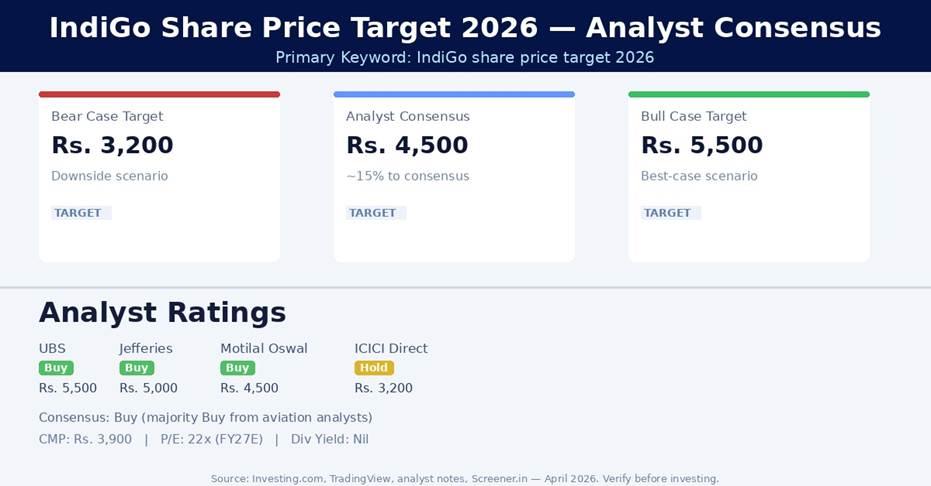
IndiGo share price targets — bear case Rs. 3,200, consensus Rs. 4,500, bull case Rs. 5,500
The analyst consensus for IndiGo share price target 2026 stands at Rs. 4,500 across buy (majority buy from aviation analysts). Here is how the targets break down:
| Brokerage | Rating | 12M Target | Scenario |
| UBS | Buy | Rs. 5,500 | Bear/Cautious |
| Jefferies | Buy | Rs. 5,000 | Base Case |
| Motilal Oswal | Buy | Rs. 4,500 | Base Case |
| ICICI Direct | Hold | Rs. 3,200 | Bull |
| Consensus Average | Buy | Rs. 4,500 | ~15% to consensus |
Source: Publicly available analyst notes and consensus data — April 2026. Targets are estimates. Not investment advice.
Get free investment predictions and stock recommendations on Univest.
Bull Case — What Would Drive the Stock Higher
UBS and Jefferies have Rs.5,000-5,500 targets built on IndiGo returning its full fleet to service, RASK (revenue per available seat kilometre) improving 8-10%, and international route launches adding high-yield revenue. In an environment where Air India is still rebuilding and Vistara is merging, IndiGo's competitive moat in the domestic market has never been stronger.
Bear Case — What Could Hold the Stock Back
The Pratt & Whitney engine issue has grounded 60-70 IndiGo aircraft at various points in FY26, forcing wet leases at higher cost and reducing capacity. If Pratt & Whitney cannot resolve the defect at scale, IndiGo's growth plans are constrained. Additionally, crude oil above $90 would spike ATF costs and compress EBITDA margins that are only just recovering to healthy levels.
5 Factors Supporting the IndiGo Share Price Outlook
- 60% domestic market share with no credible near-term challenger — Air India and Akasa are growing but from a small base
- India's aviation market growing 10-12% annually — underpenetrated relative to income levels, with air travel affordability improving steadily
- International route expansion to London, Singapore, and Middle East adds higher-yield passengers that transform IndiGo's revenue quality
- Fleet delivery pipeline — Airbus A320neo family deliveries locked in through 2030 at pre-COVID prices provides cost advantage over latecomers
- Load factors consistently above 85% demonstrate strong demand matching supply discipline
5 Key Risks to Watch for IndiGo Investors
- Pratt & Whitney engine defect risk — ongoing grounding of GTF-powered aircraft constrains capacity and forces costly wet lease arrangements
- Crude oil price spike — ATF constitutes 35-40% of IndiGo's cost structure, making it highly sensitive to oil price movements
- Air India under Tata Group is investing aggressively in fleet, routes, and service quality — a genuine long-term competitive threat
- Slot availability constraints at key airports (Delhi, Mumbai) limit how quickly IndiGo can add routes even if demand is strong
- Currency risk — aircraft leases are USD-denominated and a weak INR significantly increases IndiGo's lease costs in rupee terms
Conclusion
IndiGo at Rs.3,900 offers the simplest large-cap investment thesis on Dalal Street — India's fastest-growing aviation market, IndiGo's unassailable market leadership, and 60%+ load factors. The consensus target of Rs.4,500 implies 15% upside. The key risk to monitor is the Pratt & Whitney engine situation — if grounded aircraft return to service in FY27, IndiGo has capacity for a significant earnings surprise. For long-term investors, this is one of the cleanest structural growth stories in Indian equities.
This article is for informational and educational purposes only. Investments in securities are subject to market risk. All analyst targets are estimates based on publicly available information and do not constitute investment advice. Consult a SEBI-registered financial advisor before making any investment decisions.
For more share price target analysis, Q4 results previews, and stock research, visit Univest Blogs. Download the Univest iOS App or Univest Android App for live alerts and SEBI-registered research.
Frequently Asked Questions
What is the IndiGo share price target for 2026?
The IndiGo share price target for 2026, based on analyst consensus, is approximately Rs. 4,500. The bear case target stands at Rs. 3,200 and the bull case at Rs. 5,500. These are analyst estimates — actual price performance depends on quarterly earnings, macro conditions, and sector-specific developments.
Is IndiGo a good buy at the current price of Rs. 3,900?
At Rs. 3,900, IndiGo trades at 22x (FY27E) and offers a dividend yield of Nil. Whether it is a good buy depends on your risk appetite, investment horizon, and portfolio context. The analyst consensus of Buy (majority Buy from aviation analysts) suggests a broadly positive outlook, but individual investor suitability should be assessed with a SEBI-registered advisor.
What is the IndiGo 52-week high and low?
The IndiGo 52-week high is Rs. 5,014 and the 52-week low is Rs. 3,040 as of April 2026. The current price of Rs. 3,900 places the stock 22% below its 52-week high.
What are analysts saying about IndiGo?
UBS has a Buy rating with a target of Rs. 5,500. Jefferies has a Buy rating with a target of Rs. 5,000. Motilal Oswal has a Buy rating with a target of Rs. 4,500. ICICI Direct has a Hold rating with a target of Rs. 3,200. The overall consensus is Buy (majority Buy from aviation analysts). These ratings are based on publicly available analyst reports and are for informational purposes only.
What factors could push IndiGo stock higher in 2026?
The key factors supporting a higher IndiGo share price in 2026 include: 60% domestic market share with no credible near-term challenger — Air India and Akasa are growing but from a small base; India's aviation market growing 10-12% annually — underpenetrated relative to income levels, with air travel affordability improving steadily; International route expansion to London, Singapore, and Middle East adds higher-yield passengers that transform IndiGo's revenue quality. These are the primary drivers cited by analysts in their bull case scenarios.
What is the IndiGo market capitalisation?
IndiGo's market capitalisation as of April 2026 is Rs. 1.51 Lakh Cr. This is based on the current share price of Rs. 3,900 and the total number of outstanding shares listed on the NSE and BSE.
How does IndiGo dividend yield compare to peers?
IndiGo offers a dividend yield of Nil at the current price — the company does not currently pay a dividend, reinvesting cash flow into growth. For live dividend data and yield comparisons, check the Univest Screener.
Where can I track the IndiGo share price live?
You can track IndiGo (INDIGO) share price live on the Univest App, which provides real-time NSE/BSE prices, analyst ratings, fundamental screeners, and SEBI-registered research. Download the Univest iOS App or Univest Android App to get started.
Disclaimer: Investment in the share market is subject to risk. This article is for informational and educational purposes only and does not constitute investment advice. Analyst targets and financial data are sourced from publicly available information including NSE/BSE filings, Screener.in, Investing.com, and company investor relations pages. Verify all data before investing. Consult a SEBI-registered advisor before making investment decisions.
Recent Article
Coal India Share Price Target 2026: Analyst Forecasts, Bull & Bear Case
Bharti Airtel Share Price Target 2026: Analyst Forecasts, Bull & Bear Case
State Bank of India Share Price Target 2026: Analyst Forecasts, Bull & Bear Case
Paytm Share Price Target 2026: Analyst Forecasts, Bull & Bear Case
Recent Articles

Tata Consumer Products Shares Jump 7% After Q2 Results: Is This Tata Group Stock a Buy Now? Elara Target, Price Hikes, Valuation and Risks
27 October 2026

Acutaas Chemicals Shares Jump 13% to a Record High After Q2 Profit Rises 71%, Up About 580% in 5 Years: Guidance, Valuation and Risks
27 October 2026

Amazon Stock: Morgan Stanley and UBS Raise Price Targets Ahead of Q3 Results on 29 October, but What Do AWS Margins, Capex and Risks Say?
27 October 2026

Nifty FMCG Index Is Down 22% in 2026: Is Diwali a Buying Opportunity? Valuation, Margin Pressure, Technical Levels and Stocks to Watch
27 October 2026
Note: This blog is for information purpose only. Investments and trading are subject to market risks, read all scheme related documents carefully.
Reviews






Recent Posts
Tata Consumer Products Shares Jump 7% After Q2 Results: Is This Tata Group Stock a Buy Now? Elara Target, Price Hikes, Valuation and Risks
Acutaas Chemicals Shares Jump 13% to a Record High After Q2 Profit Rises 71%, Up About 580% in 5 Years: Guidance, Valuation and Risks
Amazon Stock: Morgan Stanley and UBS Raise Price Targets Ahead of Q3 Results on 29 October, but What Do AWS Margins, Capex and Risks Say?
Nifty FMCG Index Is Down 22% in 2026: Is Diwali a Buying Opportunity? Valuation, Margin Pressure, Technical Levels and Stocks to Watch
Fujiyama Power Systems Shares: Motilal Oswal Sees 36% More Upside With a Rs 500 Target, but Is This Rooftop Solar Stock Still a Buy? Q1 Numbers, Valuation and Risks
Popular this week
Jio Financial Services Share Price Decoded: Reliance Stock Performance Amid Jio Platforms Listing Buzz, Q2 Results, Outlook and Key Levels

Uniresearch Global Pvt Ltd
Research Analyst
SEBI Registration Number — INH000013776
Uniresearch is a subsidiary of Univest Communication Technologies Private Limited
Company Address: Registered Address: Ground Floor, Unitech Commercial Tower 2, Block B, Greenwood City, Unit 1-3, Sector 45, Gurugram, Haryana 122003
Write to us : support@univest.in, compliance@univest.in
Verify on SEBI registry →RESEARCH ANALYST
Get SEBI Registered
advice on the stocks
trending today.
Get 3 FREE Trade Ideas

for Startups Accelerator 2024

Trusted by 1Cr Indians

Awarded No.1 by Economic Times