
How to Find Multibagger Stocks in India 2026: 7 Criteria Every Investor Must Use
Updated: 6 Apr 2026 • 6:41 pm
Posted by:

Multibagger stocks — stocks that return 2x, 5x, or 10x your investment — are the holy grail of equity investing in India. Finding them before they become obvious to the crowd is what separates exceptional wealth creators from average market participants. The Sensex has historically delivered 12% CAGR over 20 years, but individual multibaggers like Titan Company (+8,000% in 20 years), Bajaj Finance (+100x in 15 years), and Infosys (+1,000x since IPO) have demonstrated that selecting the right business at the right stage creates generational wealth.
The challenge: for every genuine multibagger, there are hundreds of companies that look identical on the surface but fail to deliver. Knowing how to find multibagger stocks requires a systematic framework — not luck or hot tips — built around seven specific criteria that history shows separate compounders from value traps.
This article outlines the 7 proven criteria for identifying multibagger stocks in India, with specific metrics and screener filters you can apply today on the Univest Screener or Screener.in.
What is a Multibagger Stock?
[Click Here – Get Free Investment Predictions on Univest]
The term "multibagger" was popularised by legendary investor Peter Lynch in his 1989 book "One Up on Wall Street." A multibagger is a stock that multiplies your investment by more than 2x — a 2-bagger means 100% return, a 10-bagger means 900% return, and a 100-bagger means 9,900% return. In India's equity market context, a genuine multibagger is typically a company that delivers 30%+ CAGR stock price appreciation over a 5–10 year holding period — driven by sustained earnings growth, expanding margins, and re-rating of its valuation multiple.
The distinction between a genuine multibagger and a stock that simply spikes on speculation is critical. Speculative spikes (common in small-cap and penny stocks) can deliver 3–5x returns in months but collapse just as quickly. True multibaggers like Asian Paints, HDFC Bank, or TCS delivered 10–100x over 10–20 years because their underlying businesses compounded at exceptional rates — driven by sustainable competitive advantages, reinvestment discipline, and growing total addressable markets.
Why Multibagger Stocks Are Hard to Find — and Why That Creates Opportunity
[Tap to Access Best Research Pieces on Univest]
- Information Asymmetry Advantage: Large institutional investors (FIIs, mutual funds) focus on Nifty 500 companies. The 4,500 stocks outside this universe are under-researched — creating genuine opportunity for retail investors willing to do the work.
- Market Inefficiency in Small-Cap: SEBI data shows that professionally managed funds underperform the small-cap index over 10-year periods, partly because fund managers cannot invest in illiquid small-caps. Retail investors have this flexibility.
- Growth Phase Advantage: The biggest multibagger returns come from catching a company in its early rapid-growth phase — when revenue is doubling annually but the stock is still under-owned. This phase typically lasts 5–8 years for genuine compounders.
- India's Structural Growth Tailwind: India's GDP is expected to grow 7-8% annually for the next decade. This structural growth creates a natural tailwind for multiple sectors — consumer discretionary, financial services, healthcare, and specialty chemicals — where multibaggers are historically concentrated.
7 Proven Criteria to Find Multibagger Stocks in India
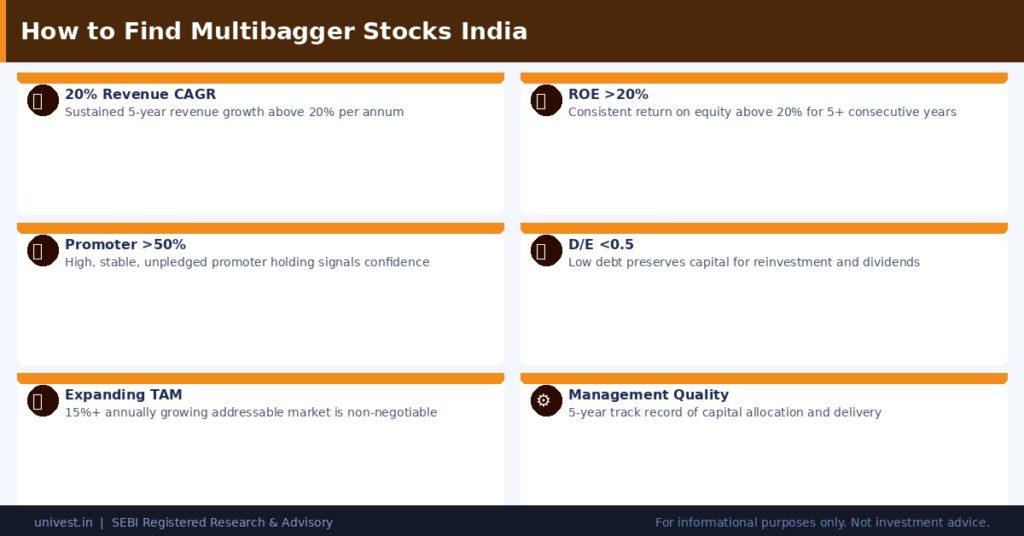
Criterion 1: Revenue CAGR of 20%+ Over 5 Years
A genuine multibagger almost always starts with a business that is growing its revenue at 20% or more CAGR over a 5-year period. This sustained growth is the fundamental engine of a compounding stock price. Use Screener.in's custom query: "Sales growth 5yr > 20%" to filter this universe. Verify that growth is consistent — not just a single quarter spike — by checking year-by-year revenue figures in the financial history.
Key caveat: revenue growth alone is meaningless if the company is growing unprofitably. Filter simultaneously for improving operating margins or at least stable margins alongside the revenue growth. A company growing revenue 20% while its margins erode from 15% to 5% is value-destructive, not a multibagger candidate.
Criterion 2: Return on Equity (ROE) Above 20% Consistently
ROE measures how efficiently a company uses shareholder capital to generate profits. A consistently high ROE — above 20% for at least 3–5 consecutive years — is one of the most reliable indicators of a business with a genuine competitive advantage (moat). Companies with high ROE can reinvest profits at attractive rates, compounding shareholder value without needing to dilute equity constantly.
India's best multibaggers have historically maintained ROE above 25%: Bajaj Finance (30%+), Titan (30%+), Asian Paints (25%+). Use the Screener.in query "Return on equity > 20%" combined with a 5-year filter to identify businesses with structural profitability rather than one-time windfalls.
Criterion 3: Strong Promoter Holding (Preferably 50%+)
Promoter holding is the percentage of a company's shares held by the founding family or group. A high and stable (or increasing) promoter holding indicates that the people who built the business believe in its future — the most powerful signal of insider confidence. Bajaj Auto's Bajaj family, Titan's TATA group, and Havells' Gupta family have maintained high promoter stakes while delivering exceptional shareholder returns.
Warning signs: promoter pledging (borrowing against shares) is a red flag indicating financial stress. Even if promoter holding is 70%, if 60% of those shares are pledged, the effective free float is much larger than it appears — and a margin call could trigger forced selling that collapses the stock price. Always check pledged percentage alongside holding percentage on Screener.in.
Criterion 4: Debt-Free or Low Debt (D/E < 0.5)
The best multibaggers in India are typically debt-free or carry minimal debt relative to equity. This matters for two reasons: first, low debt means more profits flow to shareholders rather than to lenders; second, debt-free companies have maximum flexibility to invest during downturns when competitors are constrained by debt covenants. Use the filter "Debt to equity < 0.5" on any screener to isolate this characteristic.
Financial companies (banks, NBFCs) are the exception — they inherently carry high debt (deposits, borrowings) as part of their business model. For non-financial companies, a debt/equity below 0.5 is the threshold. Completely debt-free companies — like many specialty chemical and pharma mid-caps — are particularly attractive as multibagger candidates because all FCF goes directly to reinvestment or shareholder returns.
Criterion 5: Expanding Total Addressable Market (TAM)
Even the best-managed business cannot be a multibagger if it operates in a shrinking or stagnant market. Before investing in any multibagger candidate, assess whether its TAM is expanding. India's most productive multibagger sectors have been: specialty chemicals (China+1), defence electronics, EV components, specialty pharma (biosimilars), and affordable housing finance — all sectors where the addressable market is growing 15%+ annually driven by structural policy or demand shifts.
The question is not just "how big is the market today?" but "how much larger could it realistically be in 5–10 years?" A company capturing an expanding market can grow 30% even with stable market share — and if it gains share on top of market growth, the compounding accelerates dramatically.
Criterion 6: Improving Margins or At Least Margin Stability
Multibagger companies typically show one of two margin profiles: either steadily expanding margins as operating leverage kicks in at scale (revenue grows faster than fixed costs), or highly stable margins that remain consistent across economic cycles — indicating durable pricing power. Margin compression, unless explained by specific investment cycles, is a warning sign.
Filter for "EBITDA margin > 15%" on Screener.in as a baseline. Then examine the 5-year margin trend manually. Companies where EBITDA margins have expanded from 10% to 18% over 5 years while revenue grew 25% annually are exhibiting the classic multibagger operating leverage pattern.
Criterion 7: Management Quality and Capital Allocation Track Record
This is the most important and least quantifiable criterion. Management quality — specifically the ability to allocate capital wisely between reinvestment, acquisitions, dividends, and buybacks — determines whether a company translates its business strength into shareholder returns. Study the last 5 years of annual reports: Did management deliver on the targets set in previous years? Did acquisitions create value or destroy it? Was shareholder money returned when no reinvestment opportunities existed?
India's best multibagger managements — the Bajaj family, the Tata Group's operating subsidiaries, the founders of Divi's Laboratories — have a consistent track record of disciplined capital allocation and honest, transparent communication with shareholders. Management commentary in annual reports and quarterly concall transcripts reveals character over time.
Screen for multibagger candidates using revenue growth, ROE, and debt filters — Check Univest Screener
| Criterion | Threshold to Filter | Screener Filter Command |
| Revenue CAGR (5yr) | > 20% | "Sales growth 5yr > 20" |
| Return on Equity | > 20% consistently | "Return on equity > 20" |
| Promoter Holding | > 50% (stable/rising) | "Promoter holding > 50" |
| Debt/Equity | < 0.5 | "Debt to equity < 0.5" |
| EBITDA Margin | > 15% | "Operating profit margin > 15" |
| Market Cap | Rs 500–5,000 Cr (early stage) | "Market cap > 500 and < 5000" |
| Pledging | < 10% of promoter holding | Check manually on NSE/Screener |
Download the Univest iOS App or Univest Android App for SEBI-registered research on multibagger candidate stocks across sectors.
5 Sectors with Highest Multibagger Probability in India 2026
- Specialty Chemicals (China+1): India's specialty chemical exports have grown 18% CAGR over 5 years. Global clients are diversifying away from China, with Indian producers gaining long-term supply contracts. TAM is expanding structurally.
- Defence Electronics: India's defence capex is growing 10% annually, with 68% domestic procurement target. Companies like Bharat Electronics, Data Patterns, and Paras Defence have demonstrated 40%+ revenue growth as indigenisation accelerates.
- Healthcare (Biosimilars + Specialty Pharma): Global biosimilar market growing 25% CAGR through 2030. Indian pharma companies (Biocon, Dr Reddy's, Cipla) with biosimilar pipelines have decades-long growth visibility.
- EV Components + Battery Technology: India's EV sales are expected to reach 10 million units annually by 2030. Component suppliers in wiring harnesses, EV motors, battery management systems, and charging infrastructure are at the early stage of a massive demand cycle.
- Affordable Financial Services (Small Finance Banks, Microfinance): India's financial inclusion agenda leaves 400+ million people underbanked. Small finance banks and microfinance institutions serving Tier 3/4 cities have 20%+ AUM growth potential as India's credit penetration deepens.
5 Common Mistakes When Hunting for Multibagger Stocks
- Confusing Price Fall with Value: A stock falling 40% from its high is not automatically cheap. It may be falling because business fundamentals are deteriorating. Always verify whether the earnings and revenue trend is intact before treating a price fall as a buying opportunity.
- Anchoring to a Previous High: "This stock was at Rs 500, now at Rs 200 — it has to go back." This anchoring bias ignores whether business fundamentals justify the previous price. A stock can go from Rs 500 to Rs 50 if earnings collapse.
- Ignoring Sector Cycle Timing: Buying a commodity stock at peak cycle pricing or an IT stock during peak US tech boom expectations can lock capital for years even in a quality business. Multibaggers from commodity sectors (steel, metals) are particularly cycle-dependent.
- Over-Concentrating on One Multibagger Bet: Even after rigorous research, any single stock carries idiosyncratic risk. Holding 10–15 multibagger candidates reduces the damage if one disappoints, while still providing concentrated enough exposure to benefit from the best performers.
- Selling Too Early on Valuation Concerns: Many investors sold Bajaj Finance at 20x P/E, only to watch it reach 60x. Exceptional businesses can sustain "expensive" valuations for years as earnings grow into the multiple. A "sell" on valuation alone is often premature for genuine compounders.
Subscribe to Univest Pro for SEBI-registered research on high-potential growth stocks — Start Free Trial
Conclusion
Finding multibagger stocks in India requires systematic application of seven criteria: 20%+ revenue CAGR, ROE above 20%, high-and-stable promoter holding, low debt, expanding TAM, stable or improving margins, and quality management with a disciplined capital allocation history. Apply these filters on the Univest Screener or Screener.in to build a watch list of 15–20 candidates. Then do qualitative research — read annual reports, listen to concall transcripts, understand the competitive positioning. Multibaggers are found through patient, methodical research — not hot tips or trending stocks.
Investments in securities are subject to market risk. Please read all related documents carefully before investing. This content is for educational purposes only and does not constitute investment advice. Past performance is not indicative of future results. Consult a SEBI-registered investment advisor before making any investment decision.
Frequently Asked Questions
Q1. How do I identify a multibagger stock in India before it runs?
Identify multibagger stocks early by screening for: revenue CAGR > 20%, ROE > 20%, D/E < 0.5, promoter holding > 50%, and market cap Rs 500–5,000 crore. Then verify: expanding TAM, consistent margin improvement, and management track record of delivering on stated targets. Early identification requires finding these characteristics before widespread institutional coverage — typically in mid-cap and small-cap companies under Rs 5,000 crore market cap.
Q2. What is the best screener to find multibagger stocks in India?
The Univest Screener and Screener.in are the best free tools for multibagger screening in India. Screener.in allows custom formula-based queries: "Sales growth 5yr > 20% AND Return on equity > 20% AND Debt to equity < 0.5 AND Promoter holding > 50%." The Univest Screener combines these fundamental filters with SEBI-registered analyst ratings, giving additional validation on whether research professionals have already identified the same candidates.
Q3. Which sectors produce the most multibagger stocks in India?
Historically, India's multibagger stocks have been concentrated in: specialty chemicals, consumer discretionary (particularly branded consumer goods), financial services (NBFCs like Bajaj Finance), IT services (mid-cap IT during growth phases), specialty pharma (complex generics and biosimilars), and infrastructure-adjacent companies (cables, pipes, transformers). For 2026 onwards, defence electronics, EV components, and specialty chemicals (China+1 theme) offer the most visible multibagger pipeline.
Q4. What is a good ROE for a multibagger stock?
A sustainable ROE of 20% or above is the minimum threshold for genuine multibagger candidates among non-financial companies. India's best compounders have maintained 25–35% ROE over extended periods: Bajaj Finance (30%+), Titan (30%+), Asian Paints (25%+), Page Industries (50%+). The key is consistency — one year of high ROE from a one-time gain does not qualify; look for 5+ consecutive years of 20%+ ROE.
Q5. How long does it take for a multibagger stock to deliver returns?
Genuine multibaggers typically deliver their maximum returns over 5–15 year holding periods, not months. Bajaj Finance took 10 years to deliver 100x. Titan took 15 years to deliver 100x. Investors who try to find "quick multibaggers" in 6–12 months are typically exposed to speculative small-cap pumps rather than genuine business compounders. Patience is the single most important trait for multibagger investing.
Q6. Is promoter pledging a disqualifier for a multibagger stock?
High promoter pledging (above 25–30% of their holding) is a significant red flag that often disqualifies a multibagger candidate. Pledged shares create forced-selling risk if the stock falls below margin call levels, can signal promoter financial stress, and reduce the effective promoter alignment with minority shareholders. Some companies with pledging have still delivered good returns, but the risk profile is materially higher — most multibagger frameworks recommend avoiding high-pledging companies.
Q7. What P/E ratio is acceptable for multibagger stocks in India?
There is no single "right" P/E for multibagger stocks — the appropriate P/E depends on growth rate and return metrics. A stock growing earnings 30% annually can justify 40–50x P/E if that growth is sustainable. The PEG ratio (P/E divided by earnings growth rate) is more useful: a PEG below 1.0 generally indicates undervaluation for a growth company. Avoid anchoring to absolute P/E thresholds like "anything above 30x is expensive" for high-growth businesses.
Q8. Should I use a SEBI-registered advisor to find multibagger stocks?
Yes — a SEBI-registered advisory service like Univest provides research-validated multibagger candidate ideas across mid-cap and small-cap segments that you can use as starting points for your own research. The advisory does not replace your due diligence but significantly reduces the screening burden. Reading the rationale behind each recommendation builds your own analytical capabilities over time.
Recent Article
Coal India Share Price Target 2026: Analyst Forecasts, Bull & Bear Case
Bharti Airtel Share Price Target 2026: Analyst Forecasts, Bull & Bear Case
State Bank of India Share Price Target 2026: Analyst Forecasts, Bull & Bear Case
Paytm Share Price Target 2026: Analyst Forecasts, Bull & Bear Case
Recent Articles

Is Pulz Electronics the Best Stock in Its Sector? A Look at the Numbers
22 October 2026

Is D-Link India the Best Stock in Its Sector? A Look at the Numbers
22 October 2026

Is Intec Capital the Best Stock in Its Sector? A Look at the Numbers
22 October 2026

Is Cella Space the Best Stock in Its Sector? A Look at the Numbers
22 October 2026
Note: This blog is for information purpose only. Investments and trading are subject to market risks, read all scheme related documents carefully.
Reviews






Recent Posts
Is Pulz Electronics the Best Stock in Its Sector? A Look at the Numbers
Is D-Link India the Best Stock in Its Sector? A Look at the Numbers
Is Intec Capital the Best Stock in Its Sector? A Look at the Numbers
Is Cella Space the Best Stock in Its Sector? A Look at the Numbers
Is Zeal Global Services the Best Stock in Its Sector? A Look at the Numbers

Uniresearch Global Pvt Ltd
Research Analyst
SEBI Registration Number — INH000013776
Uniresearch is a subsidiary of Univest Communication Technologies Private Limited
Company Address: Registered Address: Ground Floor, Unitech Commercial Tower 2, Block B, Greenwood City, Unit 1-3, Sector 45, Gurugram, Haryana 122003
Write to us : support@univest.in, compliance@univest.in
Verify on SEBI registry →RESEARCH ANALYST
Get SEBI Registered
advice on the stocks
trending today.
Get 3 FREE Trade Ideas

for Startups Accelerator 2024

Trusted by 1Cr Indians

Awarded No.1 by Economic Times