
How to Find Multibagger Stocks 2026 — Complete Step-by-Step Research Framework
Updated: 2 Apr 2026 • 4:01 pm
Posted by:

Learning how to find multibagger stocks is the highest-value skill an Indian equity investor can develop. Most investors either pick stocks based on tips, social media recommendations, or news — approaches that consistently underperform. The investors who have built genuine wealth from the Indian stock market — identifying Eicher Motors at Rs.500, HDFC Bank at Rs.100, or Relaxo Footwear at Rs.50 — used systematic, repeatable research frameworks, not luck.
This article covers the complete, step-by-step methodology for how to find multibagger stocks in India — using publicly available tools (Screener.in, Univest Screener, NSE filings) and a logical research process that any individual investor can apply consistently.
What Are Multibagger Stocks? — Definition
Click Here – Get Free Investment Predictions
A multibagger stock is a company whose share price multiplies by 2x, 5x, 10x, or more from the investor's purchase price over a 3–10 year period. Multibagger returns are achieved not through short-term trading or momentum, but through identifying companies with compounding competitive advantages while they are still small — and holding through the full growth cycle.
The term was coined by Peter Lynch who noted that the greatest stock market fortunes were built by investors who found 'ten-baggers' — stocks that went up 10x. In India, the Nifty Smallcap 250 has produced hundreds of 10–100x stocks in the last two decades.
Screen for multibagger candidates using SEBI-compliant tools — Univest Screener — filter by ROCE, revenue growth, promoter holding, and more.
How to Find Multibagger Stocks — 7-Step Screening Framework
Tap to Access Best Research Pieces on High-Growth Stocks
| Step | Filter / Action | Tool | Pass Criterion |
| Step 1 | ROCE Screen | Screener.in / Univest | ROCE > 20% for last 3 years |
| Step 2 | Revenue Growth | Screener.in | Revenue CAGR > 20% for last 3 years |
| Step 3 | Debt Check | Screener.in | Debt-to-Equity ratio < 0.5 |
| Step 4 | Promoter Holding | NSE Filing / Screener | Promoter holding > 45%, zero pledging |
| Step 5 | Market Cap Filter | NSE / Screener | Market cap Rs.200 Cr – Rs.5,000 Cr |
| Step 6 | Sector Analysis | Industry reports, Budget docs | Company in structural growth sector |
| Step 7 | Valuation Check | Screener.in / Annual Report | P/E below 5-year average or PEG < 1 |
Step-by-step multibagger stock screener framework. This is a research process, not an automated buy signal. Each stock passing this screen requires further qualitative analysis. Source: Univest Research.
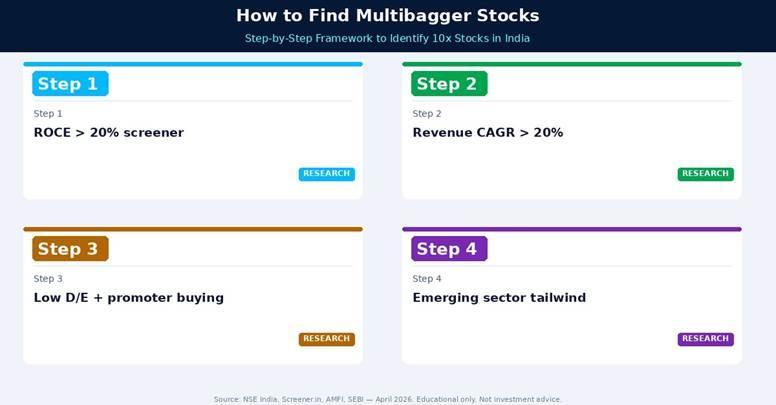
Step 1 & 2 — ROCE and Revenue Growth: The Foundation
Start with ROCE. Filter for companies with consistently above 20% ROCE over the last 3 consecutive years on Screener.in. This single filter alone eliminates approximately 80% of listed companies — leaving only capital-efficient businesses that are genuinely creating value with each rupee invested.
Add the revenue growth filter. Among the ROCE>20% universe, further screen for revenue CAGR>20% for the last 3 years. This intersection — high efficiency + high growth — is where multibagger stocks live. In a universe of 2,200+ NSE-listed companies, these two filters typically return 50–150 candidates for further research.
Steps 3 & 4 — Financial Health and Promoter Alignment
The debt-to-equity filter (D/E<0.5) is critical because highly leveraged companies can deliver great returns in bull markets but collapse in corrections. Multibagger investing requires 5–7 year holding periods — during which there will inevitably be market corrections, credit cycle tightening, and sector downturns. Low-debt companies survive and emerge stronger from these periods.
Promoter holding above 45% with zero pledging is one of the most reliable quality signals. When promoters hold large, unpledged stakes, they have the most to lose from poor governance and the most to gain from long-term value creation. Falling promoter holding or increasing pledging are red flags that should cause immediate re-evaluation.
Steps 5, 6 & 7 — Market Cap, Sector, and Valuation
The market cap filter (Rs.200–5,000 crore) ensures you are looking at companies in the right part of their growth curve. A Rs.300 crore market cap company that grows to Rs.3,000 crore delivers 10x. This is far more achievable than expecting a Rs.50,000 crore company to become Rs.5 lakh crore.
Sector analysis confirms the tailwind. A company with great financials in a structurally declining sector (e.g., print media) has a far lower probability of becoming a multibagger than an equally strong company in a structural growth sector (defence, EV, digital, renewable energy). The sector tailwind is like compound interest — it adds to the company's own growth rate.
Finally, valuation: use Price-to-Earnings-Growth (PEG ratio). A company growing at 25% that trades at a P/E of 25 has a PEG of 1.0 — fairly valued. A company growing at 25% at a P/E of 15 has a PEG of 0.6 — significantly undervalued for the growth rate. PEG below 1 is a classic multibagger entry signal.
Key Screening Criteria for Multibagger Stocks
- ROCE > 20% for 3 consecutive years — non-negotiable capital efficiency threshold
- Revenue CAGR > 20% for 3 years — confirmed growth trajectory, not a fluke
- D/E ratio < 0.5 — financial resilience through market cycles
- Promoter holding > 45% with zero pledging — alignment of promoter interest with minority shareholders
- Market cap Rs.200 Cr – Rs.5,000 Cr — still in early growth phase with room for market cap expansion
- Company operates in a sector with a visible 5-10 year structural growth driver
- PEG ratio below 1 — growth is underpriced relative to current valuation
Apply all these filters instantly — Check Univest Screener for research-backed multibagger picks.
Risks of Investing in Multibagger Stocks
- Screener output is a starting list, not a final buy recommendation — qualitative research is essential
- Revenue growth can slow suddenly if a key client is lost or product goes obsolete
- Promoter pledging can appear after a screen — monitor quarterly updates
- Even high-ROCE businesses can get disrupted by new technology or regulatory changes
- Entry at the right price matters — even the best multibagger bought at too high a P/E can deliver poor returns
Download the Univest iOS App or Univest Android App for SEBI-registered stock research, daily picks, and multibagger screeners.
FAQs
What is the best way to find multibagger stocks?
The best systematic approach is: (1) Screen for ROCE>20% + Revenue CAGR>20% + D/E<0.5 on Screener.in or Univest Screener, (2) Cross-filter for promoter holding>45% with zero pledging, (3) Filter for market cap Rs.200-5,000 crore, (4) Identify sector tailwinds, (5) Check valuation (PEG<1). This framework identifies 20-50 candidate stocks for deeper qualitative research.
Can I use technical analysis to find multibagger stocks?
Technical analysis helps with entry timing — buying after a period of consolidation rather than chasing a breakout reduces downside risk. However, multibagger identification is fundamentally a qualitative and quantitative exercise about business quality. Charts are useful for timing entry but should never replace fundamental research for multibagger stock selection.
How many multibagger stocks should I own?
A focused portfolio of 8–15 high-conviction multibagger candidates is optimal. Fewer than 5 creates dangerous concentration; more than 20 dilutes returns and makes it impossible to track all positions properly. Each position should represent 3–7% of your total equity portfolio to balance conviction with risk management.
Which screeners are best for finding multibagger stocks?
The best freely available screeners in India are Screener.in (for financial metrics — ROCE, revenue growth, D/E), the Univest Screener (for pre-built multibagger screens and technical + fundamental combination), Tickertape (for peer comparison and event tracking), and NSE India (for shareholding patterns and order book data from filings).
How long should I hold a multibagger stock?
The optimal holding period for a multibagger is until the core investment thesis is intact — typically 3–7 years. Exit when: (1) the stock has fully reflected all the expected growth and is now fairly or over-valued, (2) the business fundamentals deteriorate (ROCE drops, debt increases, management changes), or (3) a significantly better opportunity emerges to redeploy capital.
Is it possible to find multibaggers in 2026 given current valuations?
Yes — the Indian mid and small-cap universe still contains many undervalued compounders. The Nifty 50 at 20x P/E appears fair, but thousands of small-cap companies still trade at 10–15x earnings despite 20%+ growth. The 2025-26 correction in small and mid-cap stocks has created attractive entry points in high-quality businesses in defence, chemicals, and capital goods.
Disclaimer: Investments in securities are subject to market risks. This article is for educational purposes only and does not constitute investment advice or stock recommendations. The stocks mentioned are for illustrative/research purposes only. Past performance is not indicative of future returns. Please consult a SEBI-registered investment advisor before making any investment decisions.
Recent Articles:
Why is the Mega Corporation Share Price Falling?
Why is Adani Green Energy Share Price Falling?
Why is JP Power Share Price Falling?
Why is the MRF Share Price Falling?
Recent Articles

4 Smallcap Operating Margin Above 30 Per Cent Stocks to Watch for Future Multibagger Potential: Capri Global, Travel Food Services, Vijaya Diagnostic and Saregama
27 October 2026

4 Midcap Operating Margin Above 30 Per Cent Stocks to Watch for Future Multibagger Potential: MCX, Oberoi Realty, Premier Energies and Hindustan Copper
27 October 2026

4 Largecap Operating Margin Above 30 Per Cent Stocks to Watch for Future Multibagger Potential: Sun Pharma, HAL, Hindustan Zinc and Indian Hotels
27 October 2026

4 Smallcap Dividend Yield Above 2 Per Cent Stocks to Watch for Future Multibagger Potential: CESC, Shipping Corporation, RITES and Gujarat Pipavav
27 October 2026
Note: This blog is for information purpose only. Investments and trading are subject to market risks, read all scheme related documents carefully.
Reviews






Recent Posts
4 Smallcap Operating Margin Above 30 Per Cent Stocks to Watch for Future Multibagger Potential: Capri Global, Travel Food Services, Vijaya Diagnostic and Saregama
4 Midcap Operating Margin Above 30 Per Cent Stocks to Watch for Future Multibagger Potential: MCX, Oberoi Realty, Premier Energies and Hindustan Copper
4 Largecap Operating Margin Above 30 Per Cent Stocks to Watch for Future Multibagger Potential: Sun Pharma, HAL, Hindustan Zinc and Indian Hotels
4 Smallcap Dividend Yield Above 2 Per Cent Stocks to Watch for Future Multibagger Potential: CESC, Shipping Corporation, RITES and Gujarat Pipavav
4 Midcap Dividend Yield Above 2 Per Cent Stocks to Watch for Future Multibagger Potential: Godrej Consumer, Ashok Leyland, NMDC and NALCO
Popular this week
4 Largecap Dividend Yield Above 2 Per Cent Stocks to Watch for Future Multibagger Potential: HDFC Bank, UltraTech Cement, Tech Mahindra and Union Bank

Uniresearch Global Pvt Ltd
Research Analyst
SEBI Registration Number — INH000013776
Uniresearch is a subsidiary of Univest Communication Technologies Private Limited
Company Address: Registered Address: Ground Floor, Unitech Commercial Tower 2, Block B, Greenwood City, Unit 1-3, Sector 45, Gurugram, Haryana 122003
Write to us : support@univest.in, compliance@univest.in
Verify on SEBI registry →RESEARCH ANALYST
Get SEBI Registered
advice on the stocks
trending today.
Get 3 FREE Trade Ideas

for Startups Accelerator 2024

Trusted by 1Cr Indians

Awarded No.1 by Economic Times