
Intraday Stock Advisory in India 2026: How It Works, What to Expect & How to Choose
Wed Apr 01 2026

What Is Intraday Stock Advisory?
Get intraday stock recommendations from SEBI-registered analysts at Univest — from Rs.6/day.
Intraday stock advisory is a service where a SEBI-registered Research Analyst provides stock buy or sell recommendations that are meant to be executed and squared off within the same trading session — typically between 9:15 AM and 3:15 PM on NSE and BSE. Each intraday recommendation includes three critical parameters: the entry price (or range), the stop-loss (maximum acceptable loss), and the target price (expected profit exit). Trading without all three parameters is speculation, not disciplined intraday trading.
Intraday trading accounts for approximately 73% of NSE’s daily trading volume when F&O is included — reflecting the enormous appetite for short-term market participation among Indian retail investors. However, the vast majority of intraday traders are not profitable in the long run. SEBI’s own studies have shown that over 80% of intraday traders lose money. The primary reason is not bad market conditions — it is trading without a systematic, research-backed advisory framework with strict risk discipline.
This is the core value proposition of intraday stock advisory: not guaranteed profits, but a systematic, SEBI-backed research process that significantly improves a trader’s odds relative to trading on intuition, tips from friends, or unregistered Telegram channels.
How Intraday Stock Advisory Works — The Process
Pre-Market Analysis (7:00 AM — 9:15 AM)
Professional intraday advisory begins hours before the market opens. The research team analyses overnight developments — US market close, Asian market opening, global commodity prices (crude, gold), FII/DII preliminary flow estimates, key economic data releases scheduled for the day, and any company-specific news from earnings, regulatory filings, or management interviews published after the previous day’s market close.
This pre-market analysis feeds into the morning shortlisting — identifying which stocks have the best intraday setups based on technical configuration, volume profile, and news catalysts. Stocks in play (those with specific catalysts), stocks near key technical breakout levels, and sector-specific movers based on overnight global cues all factor into this process.
Call Generation and Review (9:00 AM — 9:20 AM)
By 9:00 AM, the analyst team has a shortlist of potential intraday setups. Each setup is evaluated for risk-reward ratio (typically minimum 1:2 — for every Rs.1 of risk at stop-loss, the target should offer Rs.2 of reward), liquidity (the stock should have sufficient daily volume to execute without significant slippage), and alignment with the day’s broader market direction.
Calls are then formatted with precise entry price (or entry range), stop-loss level, and target price, and reviewed by the Research Analyst before going live. This quality control step — where a SEBI-registered professional reviews and approves each call — is what separates legitimate advisory from unregistered tip channels that publish whatever their algorithm or operator decides without oversight.
Real-Time Delivery and Monitoring (9:15 AM — 3:30 PM)
Approved calls are delivered to subscribers instantly through app notifications, SMS, and/or email at or around market open. For time-sensitive intraday calls, speed of delivery is critical — a call sent 30 minutes after market open for a stock already at the target is useless. Quality advisory platforms deliver calls within minutes of the analyst’s approval.
Throughout the session, the advisory team monitors open positions and sends updates if market conditions change materially — such as an index reversal, unexpected news, or if the technical setup is no longer valid. Exit calls are given when either the stop-loss or target is hit, or when market conditions warrant early exit.
Understanding Entry, Stop-Loss, and Target
| Parameter | What It Means | How to Use It |
| Entry Price | Price at which to buy (or sell short) | Enter only if stock is at or near entry. If price has moved 2%+ past entry, skip the trade. |
| Stop-Loss (SL) | Maximum acceptable loss level — exit immediately if hit | Set a hard stop-loss order, not a mental one. Never hope a stock recovers past SL. |
| Target (T1/T2) | Expected profit exit price. T1 is conservative; T2 is optimistic. | Book partial profits at T1. Trail stop-loss if holding for T2. |
| Risk-Reward | Ratio of potential gain to potential loss | Minimum 1:2 ratio — for Rs.1 risk, expect Rs.2 reward. Reject trades with lower ratios. |
Basic trade parameter framework for intraday advisory. Apply consistently to every recommendation regardless of confidence level.
A critical discipline point: when the stop-loss is hit, exit immediately. The most common mistake intraday traders make — even those following quality advisory — is converting an intraday trade into an overnight hold when the stop-loss is breached. This converts a limited, defined risk into an unlimited, undefined risk.
Realistic Expectations — Win Rate, Capital, and Position Sizing
What Win Rate Should You Expect?
A SEBI-registered intraday advisory service with a strong track record typically delivers a win rate of 55-65% over a sustained period. This means that in any given batch of 100 recommendations, approximately 55-65 will be profitable and 35-45 will hit the stop-loss. The profit formula is not just win rate — it is win rate multiplied by average profit relative to average loss. A service with a 60% win rate and a 1:2 risk-reward ratio is significantly profitable over time even with 40% losing trades.
How Much Capital Do You Need?
Intraday trading with advisory can be started with as little as Rs.50,000 — but Rs.1-2 lakh provides more flexibility for position sizing across multiple recommendations on the same day. Risk no more than 1-2% of your total trading capital per trade. If your capital is Rs.1 lakh, your maximum risk per trade is Rs.1,000-2,000. This discipline ensures that a losing streak of 10 consecutive stop-losses — which will happen to every trader eventually — does not wipe out your account.
Position Sizing — The Most Underrated Skill
Position sizing means determining how many shares to buy based on the gap between your entry price and stop-loss. If the entry is Rs.1,000 and stop-loss is Rs.980 (Rs.20 risk per share), and your maximum risk per trade is Rs.2,000, you can buy 100 shares (Rs.2,000 / Rs.20). Never buy more shares than your position sizing formula allows, regardless of how confident you are in the advisory recommendation.
Univest’s intraday advisory includes not just entry/SL/target but contextual information about why the trade is being recommended — the technical pattern, catalyst, and sector context. This education helps you become a better trader over time, not just a passive follower of tips. Access it at Univest.
How to Choose the Right Intraday Advisory Service
- Verify SEBI registration — every legitimate intraday advisory service must be backed by a SEBI-registered Research Analyst. Verify on sebi.gov.in before subscribing.
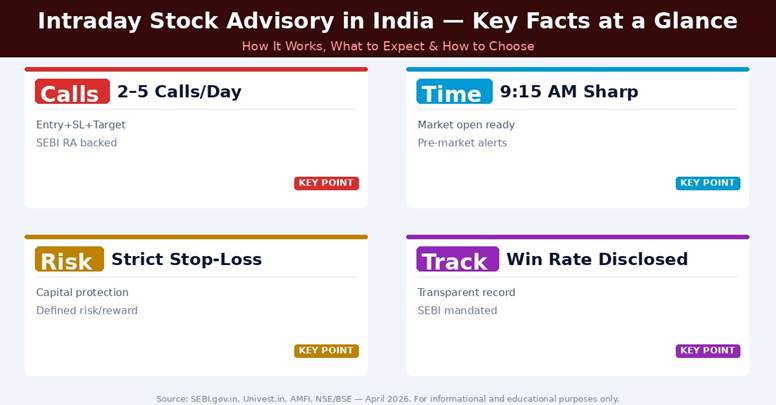
- Check disclosed win rate and profit factor over a minimum 12-month period. Demand the full track record — not cherry-picked trades.
- Ensure every recommendation comes with entry, stop-loss, and target. Any intraday advisory that gives only buy/sell signals without stop-loss is incomplete and dangerous.
- Evaluate call timing — intraday calls must be delivered before or at market open. A service that sends calls at 11 AM for 9:30 AM setups is providing no actionable value.
- Assess frequency — 2-5 quality intraday calls per day is optimal. Services that send 15-20 calls daily are prioritising volume over quality and make it impossible to manage all positions simultaneously.
- Check for real-time monitoring and update alerts during market hours. The best advisory services send updates when stop-losses or targets are hit.
Download the Univest iOS App or Univest Android App for SEBI-registered intraday advisory, real-time alerts, and integrated brokerage at Rs.5 per trade.
Conclusion
Intraday stock advisory in India, when delivered by a SEBI-registered Research Analyst with a proven track record and complete trade parameters, is a legitimate and valuable tool for traders who understand risk management. It is not a get-rich-quick mechanism — it is a systematic approach to improving trade quality. The Rs.6/day entry point on Univest makes it accessible to every intraday trader, and the integration of SEBI-registered advisory with low-cost brokerage eliminates the fragmented workflow of using separate advisory and execution platforms. Apply strict position sizing, never skip stop-losses, and evaluate your performance honestly against the advisory’s disclosed track record. That combination — quality advisory plus disciplined risk management — is the foundation of sustainable intraday trading.
Frequently Asked Questions
What is intraday stock advisory?
Intraday stock advisory is a service where a SEBI-registered Research Analyst provides stock buy or sell recommendations to be executed and closed within the same trading day. Each recommendation includes entry price, stop-loss, and target price. Quality intraday advisory is backed by pre-market analysis, technical setup identification, and real-time monitoring during market hours.
How many intraday calls per day is normal?
A quality SEBI-registered intraday advisory service typically provides 2-5 calls per day. This is optimal — enough to diversify across multiple setups without creating an unmanageable number of simultaneous positions. Services that send 10-20 calls per day are usually prioritising volume over quality and make it impractical for retail traders to execute all recommendations properly.
What is a good win rate for intraday advisory?
A win rate of 55-65% over a sustained 12-month period with a minimum 1:2 risk-reward ratio is considered good for SEBI-registered intraday advisory. This means 55-65% of trades hit their target while 35-45% hit the stop-loss. The overall profitability depends on the combination of win rate and risk-reward — a 60% win rate with 1:2 risk-reward generates positive returns even with 40% losing trades.
What happens if I miss the entry price for an intraday call?
If the stock has moved significantly past the recommended entry price — typically more than 1.5-2% — skip the trade. Entering at a price materially above the recommended entry changes the risk-reward calculation and makes the stop-loss percentage larger relative to your actual entry. Never chase a missed intraday entry. The next recommendation will come.
Is intraday trading profitable with advisory?
Intraday trading with quality SEBI-registered advisory is more profitable than trading without guidance — but it is still not guaranteed to be profitable for every trader. The two most common reasons traders fail even with good advisory are: (1) not following stop-losses and converting intraday trades to overnight holds, and (2) position sizing too large relative to their capital, which means losing streaks cause disproportionate damage. Advisory improves your trade quality; discipline and position sizing determine your long-term P&L.
Can I do intraday trading without advisory?
Yes — but SEBI’s data shows over 80% of intraday traders lose money. Trading without advisory requires you to independently develop technical analysis skills, pre-market research capabilities, position sizing discipline, and risk management framework — skills that take years to develop. A SEBI-registered advisory service provides professional research output at a cost (Rs.6/day on Univest) that is a fraction of what a single bad trade typically costs.
What is the difference between intraday advisory and F&O advisory?
Intraday equity advisory recommends buying or selling shares of individual companies for same-day closure. F&O (Futures and Options) advisory recommends positions in stock futures, index futures (Nifty, Bank Nifty), or options contracts. F&O advisory requires higher capital, carries leverage risk, and demands a deeper understanding of options Greeks (delta, theta, vega) and margin requirements. Univest provides both intraday equity and F&O advisory under its SEBI-registered research framework.
Disclaimer: Intraday trading involves significant market risk and is not suitable for all investors. SEBI data indicates that the majority of intraday traders incur losses. This article is for educational purposes only. Always trade with a defined stop-loss and never risk more than 1-2% of your capital per trade. Past advisory performance does not guarantee future results. Consult a SEBI-registered Research Analyst before making any trading decision.
Read Articles
Best Platforms Combining Stock Research and Trading in 2026
Univest—Best Stock Advisory Services in India
Best Mutual Funds To Invest in India For High Returns

Related Posts
Nifty 100 Stocks List 2026 — Complete Index, Top Companies & Sector Weightage
High Book Value Stocks in India 2026 — Meaning, Best Picks & How to Invest
Bajaj Auto Share Price Target 2026: Analyst Forecasts, Bull & Bear Case
ITC Share Price Target 2026: Analyst Forecasts, Bull & Bear Case
Adani Enterprises Share Price Target 2026: Analyst Forecasts, Bull & Bear Case
