
Why Is Tata Consumer Products Share Price Falling? Key Reasons & Share Price Target
Updated: 6 Apr 2026 • 1:55 pm
Posted by:

Tata Consumer Products share price has fallen approximately 12-15% from its January 2026 peak of Rs 1,220.90 to trade near Rs 1,078, with FMCG sector stocks hitting fresh 52-week lows in early April 2026. For a company that owns Tata Tea, Tata Salt, and Tata Starbucks — three of India's most recognised consumer brands — the decline has unsettled investors who expect the Tata brand premium to provide a floor.
The paradox is stark: Tata Consumer Products reported Q3 FY26 net profit up 38% to Rs 385 crore and revenue up 15% to Rs 5,112 crore. Yet the stock fell 5% on results day and has continued lower. Tata Consumer Products share price falling despite strong earnings is a signal that macro risks are being priced in ahead of their financial impact.
This article explains every key reason why the Tata Consumer Products share price is falling and provides share price targets for 2026.
About Tata Consumer Products
Click Here – Get Free Investment Predictions
Tata Consumer Products Limited (NSE: TATACONSUM) is a leading FMCG company within the Tata Group. Founded in 1962 and headquartered in Mumbai, the company owns some of India's most trusted consumer brands: Tata Tea, Tata Salt, Himalayan Water, Tata Sampann (pulses and spices), Eight O'Clock Coffee, Tetley (UK/international), Organic India, and the Ching's Secret range through Capital Foods.
It also operates Tata Starbucks — a 50:50 joint venture with Starbucks Corporation — with over 400 cafes across India. The company serves over 200 million households in India. Market cap is approximately Rs 1,03,000 crore. Promoter holding stands at 33.8%. The stock trades at approximately 68x trailing P/E, reflecting the premium investors assign to the Tata brand and FMCG growth story.
Why Is Tata Consumer Products Share Price Falling? Key Reasons
Tap to Access Best Research Pieces on Univest
1. West Asia Conflict Threatening Input Cost Recovery
The West Asia conflict that escalated in April 2026 has driven crude oil prices above $100 per barrel. For FMCG companies, this creates a multi-channel cost hit: palm oil prices rise (critical for food and household products), polymer costs for packaging increase, and LAB prices for detergent formulations surge. BNP Paribas analysts flagged that if crude remains elevated, even FY28 earnings estimates for FMCG stocks may need to be cut.
For Tata Consumer Products specifically, the timing is particularly unfavourable. The company's EBITDA margin was recovering through H2 FY26, after contracting 210 basis points YoY in one quarter due to tea price surges. A new input cost spike from crude threatens to set back this margin recovery, which was the key driver of analyst confidence.
2. FMCG Sector-Wide De-rating — HUL, Godrej, Tata All Hit Lows
Tata Consumer Products is not falling in isolation. Hindustan Unilever, Godrej Consumer Products, and Tata Consumer have all been hitting 52-week lows simultaneously in the first week of April 2026. The entire FMCG sector is under pressure from FII selling, crude oil risk, and concerns about rural demand.
Business Standard reported that FIIs have been trimming emerging market FMCG exposure as global uncertainty rises. Indian consumer staples, which had commanded premium valuations through 2024-25, are facing a multiple compression cycle. Tata Consumer's fall is amplified by its high valuation going into this correction.
3. High Valuation at 68x P/E Offers No Safety Margin
Tata Consumer Products was trading at 68-78x P/E at its January 2026 peak — pricing in several years of double-digit earnings growth. The company's return on equity is approximately 7.39% over the last three years — relatively modest for such a premium valuation.
In high-multiple FMCG stocks, any slowdown in earnings momentum or any macro headwind triggers disproportionate de-rating. The stock fell 5% even on the day Q3 results showed 38% profit growth, because the market expected even stronger performance. At 68x P/E, the market is factoring in perfection — and perfection is difficult to sustain when crude prices surge.
4. India Business Margin Hit by Tea Price Volatility
Tata Consumer's India-branded business accounts for approximately 56% of the total profit. In one recent quarter, the India segment posted a 43% fall in profit due to a surge in tea leaf prices caused by weather-related supply disruptions. While the company's India volume grew 15% YoY in Q3 FY26 — an impressive figure — the margin impact of tea price spikes is significant.
Tea leaf prices are structurally volatile. Climate events in key growing regions of Assam, Darjeeling, and Sri Lanka can spike spot prices rapidly. This inherent raw material risk creates earnings volatility that makes investors cautious about holding the stock at high multiples.
5. Tetley (International Business) Faces Consumer Downtrading
Tata Consumer's UK operations under the Tetley brand face headwinds from Western consumer downtrading. As cost-of-living pressures persist in the UK and Europe, consumers are shifting from branded premium teas to private label or value options. International revenue grew just 8% in Q3 FY26, with the segment contributing approximately 30% to consolidated revenue.
Currency headwinds — pound and euro weakness against the dollar — are compressing the rupee value of international earnings. While the international business showed 53% profit growth in Q3 FY26, this was partly aided by a low base and specific business mix.
6. Acquisitions Creating Integration Costs and Amortisation Drag
Tata Consumer's acquisitions — Capital Foods (Ching's Secret, Smith & Jones) and Organic India — have added revenue but also meaningful integration costs, goodwill amortisation, and working capital requirements. While these acquisitions position the company well for the premium and health food segments, their near-term profitability contribution is limited.
Analysts at ICICI Securities and Nomura remain broadly positive on the medium-term thesis but note that the pace of margin delivery from these acquisitions through FY27 will be the key execution watch point. Any integration delay or distribution disruption could further pressure earnings.
Tata Consumer Products Latest News That Impacted the Stock
- January 7, 2026: Stock touches 52-week high of Rs 1,220.90 on strong India business momentum and analyst upgrades.
- January 28, 2026: Q3 FY26 results declared — net profit up 38% YoY to Rs 385 crore, revenue up 15% to Rs 5,112 crore. Despite strong numbers, the stock falls 5% as the market expected higher margins.
- March 11, 2025: An earlier 52-week low of Rs 930.10 was recorded during the previous broader market selloff.
- March 2026: Broader FMCG selloff begins. HUL, Godrej Consumer, and Tata Consumer all fall as FII selling accelerates.
- Early April 2026: West Asia conflict escalates. Crude oil crosses $100. BNP Paribas flags FMCG margin risk. FMCG stocks, including Tata Consumer, hit fresh lows.
- Ongoing: Tata Starbucks JV continues expanding (400+ stores) but remains loss-making, adding complexity to consolidated P&L analysis.
Financial Performance Analysis
Q3 FY26 results showed strong growth metrics across all key segments, but the sequential trend and forward macro risks are the focus for investors:
| Key Metric | Q3 FY26 (Dec 2025) | Q3 FY25 (Dec 2024) | YoY Change |
| Revenue from Operations | Rs 5,112 Cr | Rs 4,445 Cr | +15% YoY |
| Net Profit (Consolidated) | Rs 385 Cr | Rs 279 Cr | +38% YoY |
| India Volume Growth | 15% YoY | ~8% | Strong |
| EBITDA Growth | 28% YoY | — | Beat estimates |
| Tata Sampann Growth | 45% YoY | — | Strong |
| Market Cap | ~Rs 1,03,000 Cr | — | At ~Rs 1,078/share |
The strong Q3 numbers confirm that the India business is executing well. The concern is forward-looking: West Asia conflict and crude prices were not yet reflected in the December quarter numbers. Q4 FY26 and Q1 FY27 will reveal the true margin impact. Track Tata Consumer Products' live financial data on [Univest Screener](https://univest.in/screeners).
Technical Signals: What the Charts Are Saying
Tata Consumer Products is trading below its 20-day and 50-day moving averages, with the stock making lower lows through March and early April 2026. The 52-week range is Rs 930.10 (low) to Rs 1,220.90 (high). Key support is at Rs 1,000-1,020 (psychological level and prior consolidation zone). Resistance is at Rs 1,100-1,120 — a zone the stock has struggled to reclaim after breaking below it.
The RSI has been trending below 50, suggesting continued selling pressure. A close above Rs 1,120 with volume would signal the beginning of technical recovery. Download the Univest iOS App or Univest Android App to track Tata Consumer live and get daily research insights.
Market Sentiment & Institutional Positioning
Tata Consumer Products has a promoter holding of 33.8% (Tata Sons group). Mutual fund shareholding stands at approximately 8.66%. FIIs have been reducing exposure to Indian FMCG stocks broadly — a trend accelerated by the West Asia conflict and crude oil spike.
Most major brokerages — Goldman Sachs, Nomura, CLSA, and ICICI Securities — maintain broadly positive long-term views. Nomura continues to guide double-digit sales growth. Goldman Sachs called Q3 results "firing on all cylinders." However, near-term price targets have been trimmed to reflect crude oil and margin risk. The market is anticipating earnings risk before it materialises in financial statements.
Future Outlook: Can Tata Consumer Products Recover?
Tata Consumer Products has genuine medium-term catalysts. India's business volume growth at 15% is best-in-class for Indian FMCG. Quick commerce constitutes 18% of India's business and grew over 100% in Q3 FY26 — a structural shift in distribution. Tata Sampann grew 45%. The GTM strategy revamp, with 80% distributor transitions completed, positions the company well for FY27 execution.
If crude oil prices stabilise as the West Asia conflict de-escalates, the margin risk being priced in may not fully materialise. The Tata brand's pricing power — particularly for Tata Salt, which is a market leader — provides some protection against raw material inflation. Long-term, the company's 10-15 year premiumisation journey from commodity staples to branded health and wellness is structurally compelling.
The contrarian case, however, is real: at 68x P/E with a 7.4% ROE, Tata Consumer is priced for perfection. If crude remains above $100 and FY27 earnings disappoint, multiple compression from 68x to 40-45x could still mean meaningful downside even if revenues grow. Tata Consumer is a quality business at a price that leaves limited near-term margin of safety.
Tata Consumer Products Share Price Target
Subscribe to Univest Pro for Premium Stock Research and F&O Setups
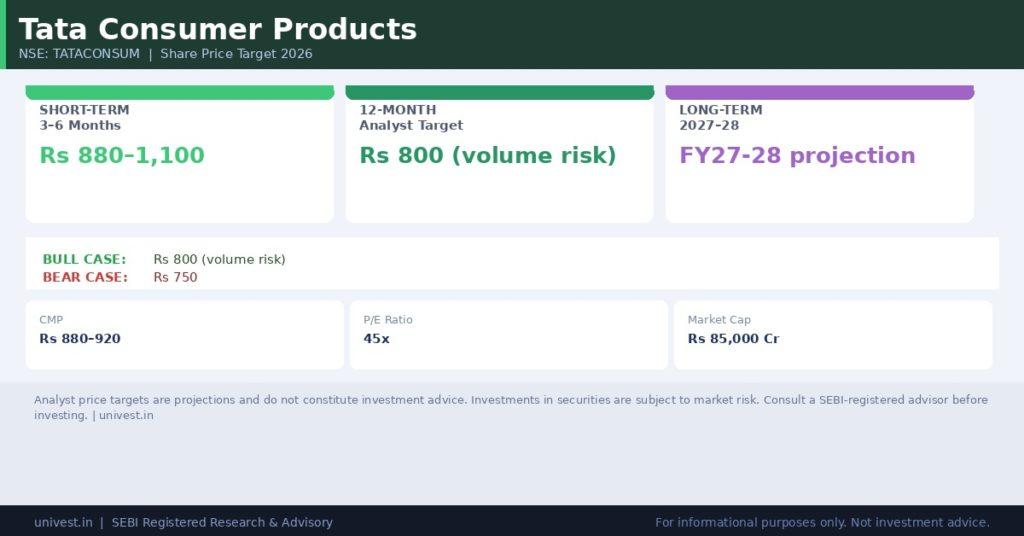
Short-Term Target (3-6 Months)
Support at Rs 1,000-1,020. If the macro environment stabilises and West Asia tensions ease, a recovery to Rs 1,100-1,150 is possible. Bear case (crude above $100 sustained): Rs 950-980.
12-Month Analyst Target
Analyst consensus targets Rs 1,250-1,350 for Tata Consumer Products on a 12-month basis, based on approximately 10% revenue CAGR and 19% PAT CAGR projected through FY28. At CMP of Rs 1,078, this implies 16-25% upside over 12 months.
Long-Term Target (2027-2028)
Analysts forecast PAT CAGR of approximately 19% through FY28 and EBITDA CAGR of 13%. Delivered consistently, the stock could re-rate toward Rs 1,500-1,700 by FY28. Key milestones: Starbucks JV break-even, Tata Sampann reaching Rs 2,000 crore revenue, Capital Foods integration completing. Track live analysis on the Explore Univest Screener.
Conclusion
Tata Consumer Products share price is falling because of a combination of FMCG sector-wide de-rating, West Asia conflict risks raising input costs, high valuation multiples offering no safety margin, and institutional selling. The fundamentals — 15% volume growth, 38% profit growth, strong quick commerce momentum — are intact. Short-term support is Rs 1,000-1,020; 12-month analyst target is Rs 1,250-1,350. Investors should accumulate in phases rather than in a single entry. *This article is for informational purposes only. Please conduct your own research and consult a SEBI-registered financial advisor before making any investment decisions.*
FAQs
Q1. Why is Tata Consumer Products share price falling in 2026?
Tata Consumer Products share price is falling due to FMCG sector-wide selling, the West Asia conflict driving crude oil above $100 and threatening input cost recovery, elevated valuation at 68x P/E with limited safety margin, FII outflows from FMCG stocks, and market concerns about forward margin pressure. Despite strong Q3 FY26 results — net profit up 38% to Rs 385 crore — the stock has fallen as the market prices in risks that have not yet appeared in quarterly numbers.
Q2. What is Tata Consumer Products share price target 2026?
Analyst consensus points to a 12-month target of Rs 1,250-1,350 for Tata Consumer Products, implying 16-25% upside from current levels near Rs 1,078. Short-term support is Rs 1,000-1,020. Bear case if crude stays elevated: Rs 950-980. Brokerages including Goldman Sachs, Nomura, CLSA, and ICICI Securities maintain broadly positive long-term outlooks with double-digit earnings growth projections through FY28.
Q3. What brands does Tata Consumer Products own?
Tata Consumer Products owns Tata Tea, Tata Salt, Himalayan Water, Tata Sampann (pulses, spices, and healthy foods), Eight O'Clock Coffee, Tetley (UK and international), Organic India, and the Ching's Secret and Smith & Jones ranges through Capital Foods. It also operates Tata Starbucks — a 50:50 JV with Starbucks Corporation with over 400 cafes across India.
Q4. Is Tata Consumer Products a good long-term buy?
Tata Consumer Products' long-term investment case is based on India's premiumisation of food and beverages, a dominant brand portfolio, and improving distribution execution. Brokerages project 10% revenue CAGR and 19% PAT CAGR through FY28. However, at 68x P/E with a 7.4% ROE, the stock is priced for perfection. Patient investors with 3-5 year horizons may find current levels attractive, but near-term volatility is real.
Q5. What is Tata Consumer Products' market cap?
Tata Consumer Products' market cap is approximately Rs 1,03,000 crore as of early 2026 at a share price of around Rs 1,078. The company has approximately 95.5 crore shares outstanding. It is one of the largest branded FMCG companies in India by market capitalisation, behind HUL but ahead of several other consumer staples companies in the listed space.
Q6. How did the West Asia conflict affect Tata Consumer?
The West Asia conflict has driven crude oil above $100 per barrel, increasing costs of palm oil, polymers, and packaging materials — all inputs relevant to Tata Consumer Products' manufacturing. BNP Paribas flagged that sustained crude above pre-conflict levels could put even FY28 FMCG earnings estimates at risk. This forward risk is being priced into Tata Consumer Products' share price before appearing in quarterly results.
Q7. What is Tata Consumer Products' P/E ratio?
Tata Consumer Products was trading at approximately 68x trailing P/E as of early 2026. This is a significant premium to the broader FMCG sector, reflecting the Tata brand equity, diversified portfolio, and expectations of sustained double-digit earnings growth. However, the high multiple leaves the stock vulnerable to de-rating if earnings growth moderates or macro headwinds intensify, as is currently being witnessed.
Q8. Does Tata Consumer Products pay dividends?
Yes, Tata Consumer Products paid a dividend of Rs 8.25 per share in April 2025 for FY25, translating to a dividend yield of approximately 0.71-0.77% at current prices. The company is a consistent dividend payer within the Tata Group. Dividend growth has been modest, as management prioritises reinvestment in brand building, distribution expansion, new product launches, and acquisitions for long-term growth.
Also Read
Why is KRBL Share Price Falling? Check Next Share Price Target
Why is Reliance Infrastructure's Share Price Falling? Check Next Share Price Target
Why is Mahanagar Gas Share Price Falling? Check Next Share Price Target
Why is Happiest Minds' Share Price Falling? Check Next Share Price Target
Recent Articles

Tata Consumer Products Shares Jump 7% After Q2 Results: Is This Tata Group Stock a Buy Now? Elara Target, Price Hikes, Valuation and Risks
27 October 2026

Acutaas Chemicals Shares Jump 13% to a Record High After Q2 Profit Rises 71%, Up About 580% in 5 Years: Guidance, Valuation and Risks
27 October 2026

Amazon Stock: Morgan Stanley and UBS Raise Price Targets Ahead of Q3 Results on 29 October, but What Do AWS Margins, Capex and Risks Say?
27 October 2026

Nifty FMCG Index Is Down 22% in 2026: Is Diwali a Buying Opportunity? Valuation, Margin Pressure, Technical Levels and Stocks to Watch
27 October 2026
Note: This blog is for information purpose only. Investments and trading are subject to market risks, read all scheme related documents carefully.
Reviews





Recent Posts
Tata Consumer Products Shares Jump 7% After Q2 Results: Is This Tata Group Stock a Buy Now? Elara Target, Price Hikes, Valuation and Risks
Acutaas Chemicals Shares Jump 13% to a Record High After Q2 Profit Rises 71%, Up About 580% in 5 Years: Guidance, Valuation and Risks
Amazon Stock: Morgan Stanley and UBS Raise Price Targets Ahead of Q3 Results on 29 October, but What Do AWS Margins, Capex and Risks Say?
Nifty FMCG Index Is Down 22% in 2026: Is Diwali a Buying Opportunity? Valuation, Margin Pressure, Technical Levels and Stocks to Watch
Fujiyama Power Systems Shares: Motilal Oswal Sees 36% More Upside With a Rs 500 Target, but Is This Rooftop Solar Stock Still a Buy? Q1 Numbers, Valuation and Risks
Popular this week
Jio Financial Services Share Price Decoded: Reliance Stock Performance Amid Jio Platforms Listing Buzz, Q2 Results, Outlook and Key Levels

Uniresearch Global Pvt Ltd
Research Analyst
SEBI Registration Number — INH000013776
Uniresearch is a subsidiary of Univest Communication Technologies Private Limited
Company Address: Registered Address: Ground Floor, Unitech Commercial Tower 2, Block B, Greenwood City, Unit 1-3, Sector 45, Gurugram, Haryana 122003
Write to us : support@univest.in, compliance@univest.in
Verify on SEBI registry →RESEARCH ANALYST
Get SEBI Registered
advice on the stocks
trending today.
Get 3 FREE Trade Ideas

for Startups Accelerator 2024

Trusted by 1Cr Indians

Awarded No.1 by Economic Times