
Why Is Persistent Systems Share Price Falling? Key Reasons & Share Price Target
Updated: 6 Apr 2026 • 3:30 pm
Posted by:

Persistent Systems' share price has fallen approximately 27-35% from its 52-week high of Rs 6,597-6,788, touching a low of Rs 4,529 on the NSE. Despite being one of India's fastest-growing mid-cap IT companies, the stock has corrected sharply in 2026 as the broader Nifty IT index contracted 20-25% amid AI disruption fears, US tech spending caution, and global trade uncertainty.
Persistent Systems share price falling is particularly notable because the company's fundamentals — revenue CAGR of 25-30%, ROE of 27.65%, and consistent margin performance — remain among the best in Indian IT. Yet the market is pricing in risks that the quarterly numbers haven't yet fully reflected: slower US deal closures, AI-related business model disruption, and a deceleration from 25%+ growth to potentially lower single-digit to low double-digit growth rates.
This article explains every key reason behind the Persistent Systems share price falling, analyses Q3 FY26 financial performance, and provides share price targets for 2026.
About Persistent Systems
Click Here – Get Free Investment Predictions
Persistent Systems Limited (NSE: PERSISTENT) was incorporated in May 1990 in Pune and is a global digital engineering and enterprise modernisation company. The company serves BFSI (Banking, Financial Services and Insurance), Healthcare & Life Sciences, and Technology sectors, with operations in over 20 countries.
At CMP of approximately Rs 4,529, the market cap stands at approximately Rs 70,000-75,000 crore. Persistent has approximately 24,590 employees as of early 2026. Revenue for the latest trailing twelve months is approximately Rs 4,032 crore (FY25-26). The company's 52-week high was Rs 6,597 (December 2025 to early January 2026), and the 52-week low is Rs 4,148.95. The company's all-time high was Rs 6,788.90 in December 2024.
Why Is Persistent Systems Share Price Falling? Key Reasons
Tap to Access Best Research Pieces on Univest
1. Nifty IT Sector Broad De-rating — All Mid-Cap IT Names Correcting
The entire Indian IT sector has corrected 20-25% from its January 2026 peaks. Nifty IT fell approximately 1.5% in a single session in April 2026 as fears of Iran's threats to subsea cables heightened risks to India's digital connectivity. Broader US tech spending uncertainty, AI disruption fears, and tariff-related demand concerns are weighing on every Indian IT stock — large-cap and mid-cap alike.
Persistent Systems, being among the higher-valuation mid-cap IT names, experiences a more pronounced correction than the sector average when de-rating occurs. A stock at 50x P/E corrects more violently than one at 20x P/E when sector sentiment turns.
2. Revenue Growth Deceleration Below Consensus Expectations
Persistent Systems' Q3 FY26 results showed constant currency revenue growth of approximately 8.2% year-on-year — below the 12-15% consensus forecast. Management cited delays in US deal closures and cautious enterprise spending as primary factors. Total Contract Value bookings remained flat quarter-on-quarter, with large deals pushed into future periods due to client budget reviews.
The stock fell 5-7% on this guidance disappointment. Investors in Persistent Systems were paying a premium precisely because the company had consistently delivered 25-30% growth. A deceleration to low double-digit growth fundamentally changes the valuation calculus.
3. Premium Valuation at 40-50x P/E Cannot Sustain Slowdown
At its peak, Persistent Systems traded at 50-55x forward P/E — a multiple that required sustained 25-30% revenue growth to justify. The Q3 FY26 constant currency growth of 8.2% represents a significant miss against these expectations. At the revised growth trajectory, the stock deserves a much lower multiple — perhaps 25-35x — which mathematically implies the current price levels or even lower.
As of March 2026, the P/E ratio stood at approximately 40.79x, already compressed from peak levels. Further compression is possible if growth continues to moderate in Q4 FY26 and Q1 FY27.
4. US Revenue Concentration Creates Spending Cycle Risk
Over 80% of Persistent Systems' revenue comes from the Americas — primarily the US. BFSI and Healthcare, its two largest vertical exposures, both saw enterprise IT spending caution in 2025-26 as US companies assessed the impact of AI tools on their technology budgets. When US IT spending slows, Persistent feels it disproportionately relative to more geographically diversified peers.
The US-India trade relationship and tariff uncertainty in early 2026 added another layer of concern. CLSA cut its target to Rs 8,058 from Rs 8,865, maintaining an Outperform call, noting "broad-based target price cuts and downside risk signal valuation pressure, though structural AI positioning remains intact."
5. AI Disruption Risk — Near-Term Uncertainty Despite Long-Term Positioning
Persistent Systems has been proactively positioning for the AI era — partnering with NVIDIA (BioNeMo platform for drug discovery, announced March 17, 2026), Microsoft Azure, and AWS. The company's NVIDIA AI collaboration is forward-looking and builds long-term revenue potential.
However, the market is simultaneously pricing in the risk that AI automation could reduce demand for certain software engineering and testing services that form a portion of Persistent's current revenues. The near-term disruption risk is being discounted even as the company builds AI capabilities for future growth. This creates a transition discount in the stock price.
6. Margin Trade-off From Investment in Capabilities
Persistent has been aggressively hiring senior talent and investing in AI engineering capabilities — the right long-term strategy, but one that compresses near-term margins. Q3 FY26 net profit of Rs 439.45 crore was up 17.82% YoY but fell 6.79% QoQ, reflecting this investment cycle. EBITDA margin at 16.23% is lower than the 18-20% range that the market expects for Persistent's growth profile, creating a further valuation headwind.
Persistent Systems Latest News That Impacted the Stock
- December 2024 – January 2026: Persistent Systems peaks at Rs 6,788, an all-time high. Strong revenue growth narrative drives the stock.
- Q3 FY26 results: Constant currency revenue growth at 8.2% YoY misses 12-15% consensus. Large deal signings flat QoQ. Stock falls 5-7% on results day.
- February 26, 2026: Stock slips 21% in a month; enters technically oversold territory. CLSA cuts target to Rs 8,058, maintains Outperform.
- March 17, 2026: Persistent Systems announces NVIDIA AI collaboration (BioNeMo for drug discovery). Stock still falls 2.60% on the day — market waiting for the commercial revenue impact.
- March 17, 2026: Persistent Systems France S.A.S. stake transferred to Aepona Group as part of entity rationalisation.
- March 23, 2026: Next Q4 FY26 earnings call set for April 23, 2026 — market awaiting deal pipeline update and growth guidance confirmation.
- April 2026: The IT sector faces broader pressure from Iran threats to subsea cables and US tariff concerns. Nifty IT falls; Persistent falls in sympathy.
Financial Performance Analysis
Persistent Systems remains fundamentally strong, but the growth deceleration from its 25-30% historical pace is the key concern:
| Key Metric | Q3 FY26 (Dec 2025) | Q3 FY25 (Dec 2024) | YoY Change |
| Revenue (Quarterly) | ~Rs 3,778 Cr | ~Rs 2,894 Cr | +30.5% (reported INR) |
| Net Profit (PAT) | Rs 439 Cr | Rs 373 Cr | +17.8% YoY |
| Net Profit (QoQ) | Rs 439 Cr | Rs 471 Cr | -6.8% QoQ |
| Constant Currency Growth | 8.2% YoY | ~25% YoY | Sharp deceleration |
| EBITDA Margin | 16.23% | ~17% | Compressed |
| Market Cap | ~Rs 70,000-75,000 Cr | — | At ~Rs 4,529/share |
The YoY INR revenue growth of 30%+ looks strong, but is partly influenced by currency. The constant currency growth of 8.2% — the metric the market focuses on — is the real concern. Analysts were expecting 12-15%. Track live data on Univest Screener to monitor Persistent Systems' quarterly evolution.
Technical Signals: What the Charts Are Saying
Persistent Systems is in a clear downtrend, making lower lows and lower highs since its December 2024 all-time high of Rs 6,788. The stock has broken below a rising trendline with significant volume — a bearish technical signal. The RSI is below its 14-period average, suggesting continued downside pressure.
Key technical support is near Rs 4,150 (per Bonanza Portfolio analyst). Resistance is at Rs 5,000-5,200. A decisive move above Rs 5,000 could trigger recovery toward Rs 5,200. The 52-week high/low range is Rs 6,597 / Rs 4,148.95. Download the Univest iOS App or Univest Android App to get live charts and daily IT sector insights.
Market Sentiment & Institutional Positioning
Analyst targets range from Rs 3,602 (bearish end) to Rs 8,500 (bull case) based on TradingView consensus. CLSA has a target of Rs 8,058 (Outperform). Anand Rathi supports levels near Rs 4,600. Market cap at Rs 70,000-75,000 crore. ROE of 27.65% remains high, reflecting the company's asset-light model and strong profitability.
Institutional investors — both FIIs and domestic mutual funds — hold meaningful positions in Persistent but have been trimming given sector headwinds. The company's earnings beat for the next quarter (April 23, 2026, results date) is the near-term catalyst that could reverse sentiment.
Future Outlook: Can Persistent Systems Recover?
Persistent Systems has strong structural tailwinds that remain intact. AI services demand from BFSI, Healthcare, and Technology clients will grow significantly through FY27-28. The company's NVIDIA partnership, Microsoft Azure and AWS collaborations, and Private Equity and Life Sciences practices are being built now and will convert to revenue over 12-24 months.
If Q4 FY26 results (April 23, 2026) show deal pipeline recovery and constant currency growth stabilisation above 10%, the stock could recover rapidly. At 40x P/E on ~Rs 150 EPS for FY27 (consensus estimate), the stock's fair value is approximately Rs 6,000 — implying meaningful upside from current levels.
The contrarian view: Persistent Systems' growth may structurally moderate to 15-20% from the 25-30% pace of 2023-24, as the company's scale makes the law of large numbers work against it. At 40x P/E on moderated growth, the stock may find it difficult to sustain even current levels without a sector re-rating.
Persistent Systems Share Price Target
Subscribe to Univest Pro for Premium Stock Research and F&O Setups
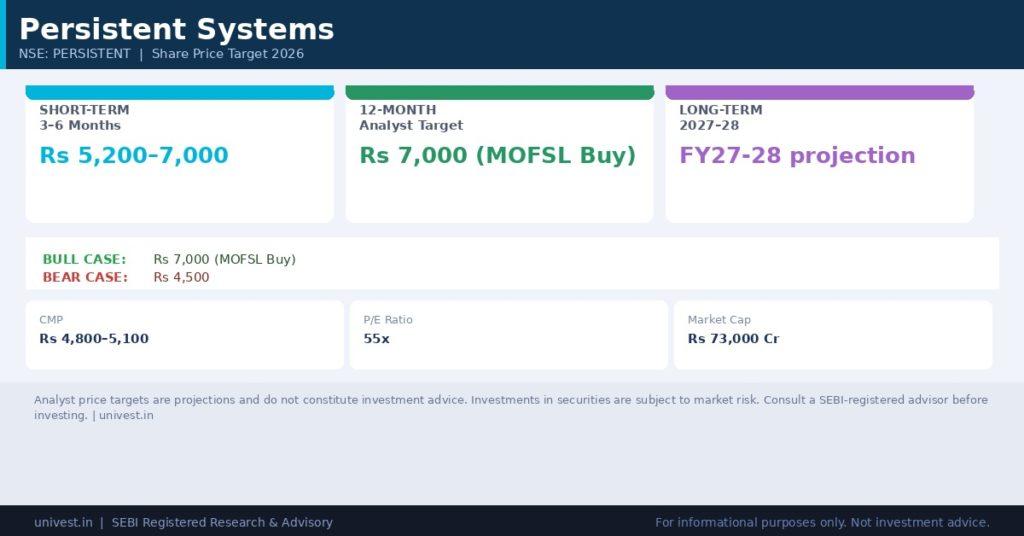
Short-Term Target (3-6 Months)
Support at Rs 4,150. If Q4 FY26 results beat estimates, recovery to Rs 5,000-5,200 is possible. Bear case (continued growth deceleration): Rs 3,600-4,000.
12-Month Analyst Target
CLSA maintains an Outperform with a target of Rs 8,058 — implying approximately 78% upside from Rs 4,529, based on AI positioning and deal pipeline recovery. Average analyst consensus from 35 analysts tracked is approximately Rs 6,612, implying approximately 46% upside. The estimated next quarter EPS is Rs 33.15.
Long-Term Target (2027-2028)
If Persistent Systems delivers 20%+ revenue CAGR through FY27-28 and AI engineering practices start contributing meaningfully, the stock could re-rate toward Rs 7,000-8,500 by FY28. TradingView's max analyst estimate is Rs 8,500. Track live targets on Explore Univest Screener.
Conclusion
Persistent Systems share price is falling because of a combination of IT sector-wide de-rating, revenue growth deceleration to 8.2% constant currency (vs. 12-15% expected), US spending caution, and premium valuation compression. Fundamentally, Persistent remains one of India's strongest IT companies — high ROE, strong deal pipeline, and AI positioning. Short-term support is Rs 4,150; 12-month analyst target is Rs 6,612 on average. Q4 FY26 results on April 23, 2026, are the near-term catalyst. *This article is for informational purposes only. Please conduct your own research and consult a SEBI-registered financial advisor before making any investment decisions.*
FAQs
Q1. Why is the Persistent Systems share price falling in 2026?
Persistent Systems share price is falling primarily due to IT sector-wide de-rating, Q3 FY26 constant currency growth of 8.2% missing the 12-15% consensus estimate, US enterprise spending caution causing deal closure delays, premium valuation compression (from 50x to 40x P/E), and broader AI disruption fears weighing on Indian IT stocks. The stock is down approximately 27-35% from its 52-week high of Rs 6,597.
Q2. What is Persistent Systems share price target 2026?
Analyst consensus from 35 analysts is approximately Rs 6,612 for Persistent Systems, implying around 46% upside from the current level of Rs 4,529. CLSA maintains an Outperform with a target of Rs 8,058. Bear-case estimate from some analysts is Rs 3,602. Near-term support is Rs 4,150; resistance is at Rs 5,000-5,200. Q4 FY26 results on April 23, 2026 are the key catalyst.
Q3. Is Persistent Systems a good investment at current levels?
Persistent Systems has strong fundamentals — ROE of 27.65%, positive free cash flow, and AI positioning through NVIDIA and Microsoft Azure partnerships. At the current level of Rs 4,529, the risk-reward appears favourable for investors with a 2-3 year horizon. However, near-term volatility is likely if US spending remains cautious. Accumulating in tranches rather than a single entry is a prudent approach given sector uncertainty.
Q4. What sectors does Persistent Systems serve?
Persistent Systems primarily serves BFSI (Banking, Financial Services and Insurance), Healthcare & Life Sciences, and Technology companies. BFSI and Healthcare constitute the majority of revenue. The company also serves the private equity sector through its newly launched PE and Professional Services practice headed by Hari Abhyankar (appointed March 2026), and Life Sciences through its AI-powered drug discovery collaboration with NVIDIA.
Q5. What was Persistent Systems' Q3 FY26 revenue?
Persistent Systems reported Q3 FY26 revenue of approximately Rs 3,778 crore (Rs 37.78 billion), representing approximately 30.5% YoY growth in INR terms. However, constant currency revenue growth was approximately 8.2% YoY — significantly below the 12-15% consensus estimate. Net profit was Rs 439.45 crore, up 17.82% YoY but down 6.79% sequentially. EPS for the quarter was Rs 28.55.
Q6. What is Persistent Systems' NVIDIA partnership about?
Persistent Systems announced on March 17, 2026, a collaboration with NVIDIA to deploy an AI-powered platform called GenMolVS for drug discovery in the Life Sciences sector. The platform uses NVIDIA's BioNeMo, NeMo Agent toolkit, and AI Enterprise infrastructure to simulate molecular behaviour and accelerate drug screening — potentially reducing research timelines significantly. This positions Persistent in the high-value AI-for-healthcare segment.
Q7. When are Persistent Systems' next earnings?
Persistent Systems is scheduled to release its Q4 FY26 earnings on April 23, 2026. The market will closely watch constant currency revenue growth (consensus expectation approximately 10-12%), deal TCV bookings (recovering or flat), EBITDA margin trends (recovering toward 17-18% or compressing further), and management commentary on US enterprise spending and AI practice ramp-up.
Q8. What is Persistent Systems' ROE?
Persistent Systems has a return on equity of 27.65% — one of the highest in Indian mid-cap IT. This reflects the company's asset-light business model and strong earnings generation relative to equity capital. High ROE is a key reason why institutional investors have historically paid premium valuations for Persistent Systems. The current correction represents a premium compression, not a fundamental deterioration of ROE.
Also Read
Why is KRBL Share Price Falling? Check Next Share Price Target
Why is Reliance Infrastructure's Share Price Falling? Check Next Share Price Target
Why is Mahanagar Gas Share Price Falling? Check Next Share Price Target
Why is Happiest Minds' Share Price Falling? Check Next Share Price Target
Recent Articles

Tata Consumer Products Shares Jump 7% After Q2 Results: Is This Tata Group Stock a Buy Now? Elara Target, Price Hikes, Valuation and Risks
27 October 2026

Acutaas Chemicals Shares Jump 13% to a Record High After Q2 Profit Rises 71%, Up About 580% in 5 Years: Guidance, Valuation and Risks
27 October 2026

Amazon Stock: Morgan Stanley and UBS Raise Price Targets Ahead of Q3 Results on 29 October, but What Do AWS Margins, Capex and Risks Say?
27 October 2026

Nifty FMCG Index Is Down 22% in 2026: Is Diwali a Buying Opportunity? Valuation, Margin Pressure, Technical Levels and Stocks to Watch
27 October 2026
Note: This blog is for information purpose only. Investments and trading are subject to market risks, read all scheme related documents carefully.
Reviews






Recent Posts
Tata Consumer Products Shares Jump 7% After Q2 Results: Is This Tata Group Stock a Buy Now? Elara Target, Price Hikes, Valuation and Risks
Acutaas Chemicals Shares Jump 13% to a Record High After Q2 Profit Rises 71%, Up About 580% in 5 Years: Guidance, Valuation and Risks
Amazon Stock: Morgan Stanley and UBS Raise Price Targets Ahead of Q3 Results on 29 October, but What Do AWS Margins, Capex and Risks Say?
Nifty FMCG Index Is Down 22% in 2026: Is Diwali a Buying Opportunity? Valuation, Margin Pressure, Technical Levels and Stocks to Watch
Fujiyama Power Systems Shares: Motilal Oswal Sees 36% More Upside With a Rs 500 Target, but Is This Rooftop Solar Stock Still a Buy? Q1 Numbers, Valuation and Risks
Popular this week
Jio Financial Services Share Price Decoded: Reliance Stock Performance Amid Jio Platforms Listing Buzz, Q2 Results, Outlook and Key Levels

Uniresearch Global Pvt Ltd
Research Analyst
SEBI Registration Number — INH000013776
Uniresearch is a subsidiary of Univest Communication Technologies Private Limited
Company Address: Registered Address: Ground Floor, Unitech Commercial Tower 2, Block B, Greenwood City, Unit 1-3, Sector 45, Gurugram, Haryana 122003
Write to us : support@univest.in, compliance@univest.in
Verify on SEBI registry →RESEARCH ANALYST
Get SEBI Registered
advice on the stocks
trending today.
Get 3 FREE Trade Ideas

for Startups Accelerator 2024

Trusted by 1Cr Indians

Awarded No.1 by Economic Times