
Why Is Jain Irrigation Share Price Falling? Key Reasons & Share Price Target
Updated: 6 Apr 2026 • 5:20 pm
Posted by:

Jain Irrigation Systems share price has fallen to approximately Rs 30 — a level that makes it technically a penny stock and represents one of the most dramatic destructions of shareholder wealth in Indian mid-cap history. The company's shares peaked above Rs 180-200 in the mid-2010s and have declined approximately 83-85% to current levels, reflecting a multi-year combination of debt accumulation, government subsidy payment delays, and corporate governance concerns.
Jain Irrigation's share price falling to Rs 30 is not a recent phenomenon — it represents years of structural challenges. The company is the world's second-largest drip irrigation manufacturer, a genuinely important business for Indian agriculture, yet it has been unable to translate its operational scale into shareholder returns due to structural financial distress.
This article explains every key reason behind the Jain Irrigation share price at Rs 30, the debt restructuring situation, and what a realistic share price target looks like for 2026.
About Jain Irrigation Systems
Click Here – Get Free Investment Predictions
Jain Irrigation Systems Limited (NSE: JISLJALEQS) was founded in 1963 by Bhavarlal Jain and is headquartered in Jalgaon, Maharashtra. The company is the world's second-largest manufacturer of drip and micro-irrigation systems, and also has significant operations in food processing, hi-tech agriculture, and PVC pipes.
Jain Irrigation's micro-irrigation systems serve farmers across India and globally, helping improve water efficiency and crop yields. Its food processing division processes fruits and vegetables (including mangoes, pomegranates, and vegetables) at its facilities in Maharashtra. The company is listed on NSE and BSE. At the current CMP near Rs 30, the market cap is approximately Rs 1,400-1,500 crore. The company carries significant debt on its books.
Why is Jain Irrigation's share price falling? Key Reasons
Tap to Access Best Research Pieces on Univest
1. Massive Accumulated Debt — Multiple Years of Financial Stress
Jain Irrigation's fundamental problem is a debt burden that has been on the company's balance sheet for years. The company aggressively expanded its irrigation business across multiple geographies and built out its food processing capacity — both requiring significant capital. When government subsidy payments slowed and international food processing margins compressed, the company could not service debt from operations alone.
The debt burden has forced the company into multiple rounds of bank negotiations, loan restructuring, and working capital constraints — creating a vicious cycle where reduced operational spending hurts revenues, which further limits debt repayment capacity.
2. Government Subsidy Payment Delays Causing Working Capital Crisis
Jain Irrigation's drip irrigation business in India depends heavily on government subsidy schemes. Under the Pradhan Mantri Krishi Sinchayee Yojana (PMKSY) and state-level schemes, farmers receive subsidies of 55-90% of the cost of drip irrigation systems — with the company supplying the systems and awaiting government reimbursement.
State governments have chronically delayed these subsidy payments, leaving Jain Irrigation with massive receivables outstanding for months or years. This working capital trap — supply now, receive payment much later — has been a persistent cause of cash flow stress that prevented the company from reducing debt.
3. Debt Restructuring Process — Multiple Rounds
Jain Irrigation has gone through multiple rounds of debt restructuring with its lenders. The company's lenders have been patient — partly because Jain's underlying business (drip irrigation) is critical for Indian food security and agriculture policy. However, the restructuring process creates uncertainty: investors cannot easily model future cash flows when restructuring terms, timelines, and haircut possibilities remain unclear.
The restructuring also means the company's management time and resources are directed toward lender management rather than business building — a drag on growth.
4. Promoter Share Pledging — High and Persistent
Jain Irrigation's promoter family has pledged a significant percentage of their shareholding as collateral for loans. High promoter pledging creates the risk of forced selling — if the pledged shares' value falls below the margin maintenance threshold (margin call), lenders can sell the shares in the market, creating further price pressure.
This risk is particularly acute at price levels near Rs 30, where the stock's absolute value is low and any pledge triggering creates disproportionate market impact. High promoter pledging is a major governance red flag that institutional investors use as a reason to avoid the stock.
5. International Business Underperformance
Jain Irrigation expanded internationally into food processing in the US, Europe, and the Middle East through its subsidiary operations. These international businesses added complexity and capital requirements without proportional earnings contribution. Performance has been mixed — creating doubts about the wisdom of international diversification when the domestic balance sheet was already stressed.
The food processing subsidiaries have faced margin pressure from competitive international markets and commodity price volatility.
6. Governance Concerns — Delayed Filings and Regulatory Queries
Jain Irrigation has faced concerns around delayed financial filings on certain occasions, and regulatory queries from stock exchanges have added to investor wariness. While the company has been regularising its compliance, the historical track record on governance makes it an avoid for ESG-conscious institutional investors and domestic fund managers with strict governance criteria.
Jain Irrigation's Latest News That Impacted the Stock
- Ongoing since 2019-20: Jain Irrigation's debt problems emerge publicly as government subsidy payments slow and working capital stress intensifies.
- 2021-2022: Multiple rounds of bank debt restructuring. Lenders agree to extended repayment schedules in exchange for operational oversight.
- FY23-25: Company works to stabilise operations. Drip irrigation business continues with government projects. The food processing segment faces margin pressure.
- FY26: Stock trades near the Rs 28-35 range as the company remains in restructuring limbo. No major positive catalysts emerge to re-rate the stock.
- April 2026: Trading near Rs 30. Q4 FY26 results awaited — market watches for any progress on debt reduction and government receivables collection.
Financial Performance Analysis
Detailed quarterly financials for Jain Irrigation are difficult to assess due to the complexity of restructuring and international subsidiary consolidation. Key macro metrics are:
| Key Metric | Status (FY26) | Historical Peak | Current Assessment |
| Share Price | ~Rs 30 | Rs 180+ (2015) | Down 83% |
| Market Cap | ~Rs 1,400-1,500 Cr | Much higher | Distressed valuation |
| Debt Status | Under restructuring | — | High risk |
| Business Operations | Continuing | — | Functional but constrained |
| Government Receivables | Large outstanding | — | Key cash flow risk |
| Promoter Pledging | Significant | — | Governance concern |
Investors considering Jain Irrigation should verify the latest financial data directly from NSE filings and Screener.in before making any decision. Track available data on Univest Screener.
Technical Signals: What the Charts Are Saying
Jain Irrigation at Rs 30 is in the penny stock range (technically below Rs 50). Trading volumes are thin relative to its outstanding share count. The stock shows no clear trend — it oscillates in a low-price range with occasional spikes on news, followed by a decline.
Technical analysis is of limited use for a stock in financial restructuring. Price targets from technical levels are unreliable because the stock's movement is driven by fundamental events (debt resolution, government payments) rather than normal market dynamics. Download the Univest iOS App or Univest Android App and check fundamental research before any decision on Jain Irrigation.
Market Sentiment & Institutional Positioning
Most institutional investors — mutual funds, FIIs, and quality-focused DIIs — have exited or have minimal positions in Jain Irrigation. The stock is primarily held by retail investors hoping for a turnaround, some deep-value and distressed asset specialists, and agricultural sector funds with mandated exposure.
The company's fundamental business — drip irrigation — is strategically important for Indian food security and water conservation. Government support for the sector (through PMKSY and state schemes) means the business will not be shut down. But the financial restructuring needed to return value to shareholders is complex and time-consuming.
Future Outlook: Can Jain Irrigation Recover?
A full Jain Irrigation recovery is possible but would require: (a) successful debt resolution with banks and lenders; (b) acceleration of government subsidy payments under PMKSY; (c) potential strategic investor entry for the food processing business; and (d) resolution of the international subsidiary complexities.
If all these factors align by FY27-28, Jain Irrigation could see a genuine turnaround. The underlying drip irrigation market in India is growing — water scarcity, government mandates for micro-irrigation, and increasing farmer awareness all support long-term demand. India's drip irrigation penetration remains low compared to countries like Israel and Spain, representing a multi-decade growth opportunity.
The honest contrarian view: debt restructuring stories in India frequently take longer than expected and often end with equity dilution, haircuts, or conversions that further reduce the share price before recovery. Retail investors in Jain Irrigation since 2019 have waited five-plus years for a turnaround that has not materialised. The probability of a meaningful recovery in the near term (12-24 months) is not high without a specific catalyst such as a strategic investor announcement or government receivable settlement.
Jain Irrigation Share Price Target
Subscribe to Univest Pro for Premium Stock Research and F&O Setups
Short-Term Target (3-6 Months)
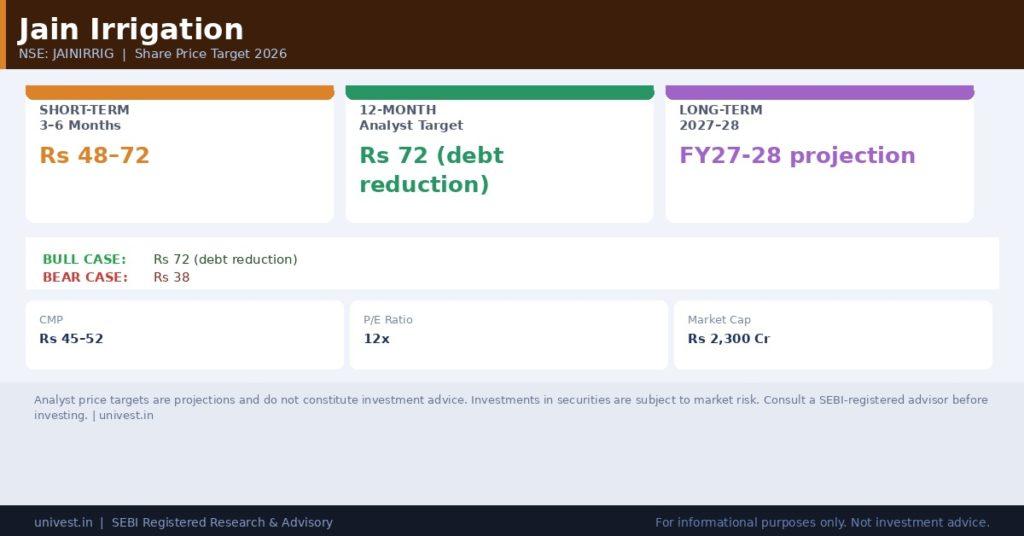
Range: Rs 25-40 based on current trading dynamics. Very high risk. Any negative debt news: Rs 18-22. Any positive catalyst (government payment, strategic investor): Rs 45-60.
12-Month Target
Turnaround scenario: Rs 45-65. Status quo (restructuring continues): Rs 25-35. The outcome is binary and event-driven. Not suitable for investors seeking predictable returns.
Long-Term Target (2027-2028)
Full resolution of debt and resumption of normal operations scenario: Rs 80-120 by FY28. This is speculative. Most conservative investors should not assign high probability to this scenario without confirmed debt resolution. Track the latest developments on the Explore Univest Screener
Conclusion
Jain Irrigation's share price at Rs 30 reflects years of structural financial challenges: debt accumulation, government subsidy payment delays, promoter pledging, and governance concerns. The underlying drip irrigation business is strategically important for India, but financial distress has prevented shareholders from benefiting. This is a very high-risk, speculative investment suitable only for experienced investors who fully understand distressed asset dynamics. The 12-month range is Rs 25-65, depending on debt resolution events. *This article is for informational purposes only. Please conduct your own research and consult a SEBI-registered financial advisor before making any investment decisions.*
FAQs
Q1. Why is Jain Irrigation's share price falling?
Jain Irrigation's share price is at Rs 30 due to years of accumulated debt from aggressive expansion, chronic delays in government subsidy payments under PMKSY (leaving large receivables outstanding), multiple rounds of bank debt restructuring creating investor uncertainty, high promoter share pledging creating forced-selling risk, and governance concerns, including delayed financial filings. The stock has fallen 83%+ from its 2015 peak of Rs 180+.
Q2. What is Jain Irrigation's share price target for 2026?
Jain Irrigation's 12-month price range is extremely wide, given the binary nature of the restructuring outcome. Status-quo scenario: Rs 25-35. Turnaround scenario (debt resolution, government payments): Rs 45-65. The company is in financial distress with no confirmed timeline for resolution. Most mainstream analysts do not actively cover Jain Irrigation. It is suitable only for high-risk investors comfortable with distressed asset situations.
Q3. Is Jain Irrigation a good investment?
Jain Irrigation is a high-risk investment suitable only for experienced investors who understand distressed debt situations. The company's fundamental business — drip irrigation — is important and structurally growing in India. However, the financial restructuring is complex, the timeline is uncertain, and further equity dilution cannot be ruled out. The five-plus-year restructuring saga has been discouraging for retail investors who expected a faster resolution.
Q4. What does Jain Irrigation do?
Jain Irrigation Systems is the world's second-largest manufacturer of drip and micro-irrigation systems, serving farmers in India and globally. It also has significant food processing operations — processing mangoes, pomegranates, tomatoes, and other agricultural products at its facilities in Maharashtra. Additionally, the company manufactures PVC pipes, PE pipes, and other agricultural infrastructure products. The drip irrigation business is its core and most strategic division.
Q5. Why does Jain Irrigation depend on government subsidies?
In India, drip and micro-irrigation systems are heavily subsidised for farmers under the Pradhan Mantri Krishi Sinchayee Yojana (PMKSY) and state-level schemes. Subsidies range from 55-90% of the system cost. Jain Irrigation supplies irrigation systems to farmers who pay only their share, with the government reimbursing the subsidised portion directly to Jain. Chronic delays in this government reimbursement have created massive working capital stress for the company.
Q6. What is the promoter pledging situation at Jain Irrigation?
Jain Irrigation's promoter family has pledged a significant proportion of their shareholding as collateral. High promoter pledging creates a specific risk: if the share price falls below margin maintenance levels, lenders can sell the pledged shares in the open market — creating further price pressure and a negative feedback loop. Verify the latest promoter pledge data from BSE/NSE filings before making any investment decision.
Q7. Has Jain Irrigation undergone debt restructuring?
Yes, Jain Irrigation has undergone multiple rounds of debt restructuring with its lenders over the past 5-6 years. Lenders have agreed to extended repayment schedules and restructured loan terms to keep the company as a going concern, given its strategic importance to Indian agriculture. The restructuring is ongoing, and the terms and timelines have not been fully resolved — this uncertainty is the primary reason institutional investors avoid the stock.
Q8. What would trigger a Jain Irrigation share price recovery?
Key triggers for Jain Irrigation share price recovery would include: (1) successful debt resolution with banks, with clear repayment schedule and no further haircut risk; (2) acceleration of government subsidy payments reducing the outstanding receivables; (3) a strategic investor entering the food processing business and providing fresh capital; and (4) promoter reducing pledge levels to below 30%. Any combination of these events could push the stock toward Rs 50-80. None is imminent as of April 2026.
Also Read
Why is KRBL Share Price Falling? Check Next Share Price Target
Why is Reliance Infrastructure's Share Price Falling? Check Next Share Price Target
Why is Mahanagar Gas Share Price Falling? Check Next Share Price Target
Why is Happiest Minds' Share Price Falling? Check Next Share Price Target
Recent Articles

Supreme Industries Dividend: Stock Down 4% Today as Rs 12 Per Share Payout Is Declared, Record Date Fixed; Check Yield and Stock Split History
26 October 2026

Up 174% in 1 Year! Can Monolithisch India Shares Rise Further? Experts Decode Valuation, Levels and Targets
26 October 2026

Mind-Boggling Monday at Indian Stock Markets: Sensex and Nifty Mirror Life's Ups and Downs, October 26 Trade Details
26 October 2026

Raymond Share Price Up Over 145% in 2026 So Far: Will the Rally in This Defence-Engineering Stock Sustain? Experts Views, Target
26 October 2026
Note: This blog is for information purpose only. Investments and trading are subject to market risks, read all scheme related documents carefully.
Reviews






Recent Posts
Supreme Industries Dividend: Stock Down 4% Today as Rs 12 Per Share Payout Is Declared, Record Date Fixed; Check Yield and Stock Split History
Up 174% in 1 Year! Can Monolithisch India Shares Rise Further? Experts Decode Valuation, Levels and Targets
Mind-Boggling Monday at Indian Stock Markets: Sensex and Nifty Mirror Life's Ups and Downs, October 26 Trade Details
Raymond Share Price Up Over 145% in 2026 So Far: Will the Rally in This Defence-Engineering Stock Sustain? Experts Views, Target
Baba Arts Ltd. Hits Lower Circuit on BSE, 26 October 2026
Popular this week
Top IT Stocks to Buy After Q2 Results: TCS vs Infosys vs Wipro vs HCL Tech vs Tech Mahindra, What Market Experts Recommend

Uniresearch Global Pvt Ltd
Research Analyst
SEBI Registration Number — INH000013776
Uniresearch is a subsidiary of Univest Communication Technologies Private Limited
Company Address: Registered Address: Ground Floor, Unitech Commercial Tower 2, Block B, Greenwood City, Unit 1-3, Sector 45, Gurugram, Haryana 122003
Write to us : support@univest.in, compliance@univest.in
Verify on SEBI registry →RESEARCH ANALYST
Get SEBI Registered
advice on the stocks
trending today.
Get 3 FREE Trade Ideas

for Startups Accelerator 2024

Trusted by 1Cr Indians

Awarded No.1 by Economic Times