
Why Is Indiamart Intermesh Share Price Falling? Key Reasons & Share Price Target
Updated: 6 Apr 2026 • 4:13 pm
Posted by:

Indiamart Intermesh share price has fallen approximately 27% from its 52-week high of Rs 2,799 to trade near Rs 2,046-2,066, with the stock touching a 52-week low of Rs 1,900.10. For India's dominant B2B marketplace — holding approximately 60% market share in the online B2B classifieds space — the fall puzzles investors who expect platform dominance to translate into sustained growth.
Indiamart Intermesh share price falling is driven by a stagnation in paying subscribers — the company's core monetisation metric — combined with revenue deceleration, analyst downgrades from Nomura and Nuvama, and a broader SaaS/tech sector de-rating. The stock's fundamental strength (cash-rich balance sheet, profitable business, no debt) makes the fall less about business failure and more about growth expectations reset.
This article explains every key reason behind the Indiamart Intermesh share price falling and provides share price targets for 2026.
About Indiamart Intermesh
Click Here – Get Free Investment Predictions
Indiamart InterMESH Limited (NSE: INDIAMART) was incorporated in 1999 and is India's largest online B2B marketplace, connecting buyers and suppliers. Founded by Dinesh Agarwal and headquartered in Noida, the platform serves SMEs, large enterprises, and individuals across industrial goods, machinery, electrical equipment, textiles, chemicals, and thousands of other categories.
As of Q3 FY26, the platform has approximately 8.7 million supplier storefronts (up 6% YoY), 221,000 paying subscription suppliers, and 28 million unique business enquiries. Revenue for Q3 FY26 was Rs 402 crore (consolidated, up 13% YoY). Market cap is approximately Rs 12,131 crore. Promoter holding stands at 49.1%. The company also owns Busy Infotech (accounting software). Deferred revenue as of December 31, 2025 stood at Rs 1,775 crore — a strong indicator of future contracted revenue.
Why Is Indiamart Intermesh Share Price Falling? Key Reasons
Tap to Access Best Research Pieces on Univest
1. Paying Subscriber Growth Stagnation — First Decline Since COVID
The most critical reason for Indiamart Intermesh share price falling is the stagnation in paying subscribers. During its Q3 FY25 results (January 2025), Indiamart reported the first decline in paying subscribers since the COVID period — a sharp warning sign for a business whose revenue is directly tied to subscription count.
Nuvama downgraded Indiamart and slashed its target from Rs 2,500 to Rs 1,970, citing this subscriber decline. Nomura downgraded to Reduce with a target of Rs 1,900, down from Rs 3,150. While Q3 FY26 showed 221,000 paying suppliers (stable from the prior quarter), the growth rate has slowed dramatically from the 15-20% annual pace of 2022-23.
2. Q2 FY26 Net Profit Falls 39% YoY — Revenue Declines
Indiamart's Q2 FY26 (September 2025) results showed revenue falling 2.9% YoY to Rs 401.20 crore and net profit falling 38.79% YoY to Rs 82.70 crore. Net profit margins fell 36.96% to 20.61%. This was the third consecutive quarter of profit decline, with net profit declining from Rs 180.6 crore in Q1 FY26 to Rs 82.7 crore in Q2 FY26 — a 46% sequential fall.
The Q3 FY26 recovery — revenue up 13% YoY to Rs 402 crore and net profit of Rs 188 crore at a 35% margin — was more encouraging. However, the market remains cautious given the inconsistency of quarterly results.
3. Standalone Collection Growth Guidance Below 10%
During earnings calls for Q3 FY25, Indiamart's management guided for less than 10% growth in standalone collections for upcoming quarters. Collections represent the cash received from subscribers, and management's own guidance of sub-10% growth is conservative relative to the 15-20% historic growth the market had priced in.
Standalone collection growth in Q3 FY26 was 14% YoY (Rs 390 crore), beating the cautious guidance. However, the market had already de-rated the stock significantly based on the earlier conservative stance, and the recovery has not fully restored confidence.
4. High Valuation De-rating as Growth Slows
Indiamart Intermesh peaked at Rs 9,000+ per share in 2021 when the B2B tech growth narrative was at its strongest. The stock has corrected dramatically from those levels. Even at Rs 2,066, the P/E ratio (based on quarterly run-rate earnings) is approximately 20-22x — which is low by historical standards but reflects growth uncertainty.
The broader Indian SaaS and tech sector has been de-rated globally as interest rates rose and growth investors shifted to value. Indiamart, while not a pure-play SaaS company, is classified with B2B tech peers and suffers when that sector de-rates.
5. ARPU (Average Revenue Per Subscriber) Stagnation
Indiamart's revenue per paying subscriber — while growing modestly — has not accelerated meaningfully. The company's ability to raise prices for existing subscribers is constrained by SME budget sensitivity and competition from vertical B2B platforms (industrial chemicals, textiles, etc.) that offer category-specific alternatives at lower prices.
If paying subscriber count is stagnant and ARPU growth is moderate, top-line revenue growth becomes mathematically constrained — which is exactly what the market is pricing in for FY27.
6. Exclusion from AI Search Platforms Creating New Competition Narrative
Indiamart filed a complaint in Kolkata alleging "selective discrimination" after its website was excluded from ChatGPT's listing results. While the legal merit of this claim is unclear, it highlights a new risk: if AI-powered search and procurement tools bypass traditional B2B directories, Indiamart's moat could be challenged. The market is beginning to factor in this disruptive risk, even if it is multi-year in materialisation.
Indiamart Intermesh Latest News That Impacted the Stock
- January 2025: Q3 FY25 results — first subscriber decline since COVID. Nomura downgrades to Reduce (target Rs 1,900). Nuvama cuts target to Rs 1,970. Stock falls 8.72% on the day.
- January 2026: Q2 FY26 results — revenue falls 2.9% YoY, PAT falls 39% YoY to Rs 82.7 crore. Significant negative sentiment.
- January 20, 2026: Q3 FY26 results — revenue up 13% to Rs 402 crore (consolidated), paying suppliers at 221,000. PAT margin recovers to 35%. Mixed but better-than-expected.
- March-April 2026: Nalanda India Equity Fund increases holding from 4.44% to 5.14% (acquiring 423,115 shares). Positive institutional buying signal.
- Ongoing: JM Financial had upgraded Indiamart to Buy in January 2026 citing positive medium-term outlook. Some analyst divergence on near-term versus medium-term outlook.
Financial Performance Analysis
Indiamart's quarterly results have been volatile, with Q3 FY26 showing recovery from Q2 FY26 weakness:
| Key Metric | Q3 FY26 (Dec 2025) | Q3 FY25 (Dec 2024) | YoY Change |
| Revenue (Consolidated) | Rs 402 Cr | Rs 354 Cr | +13% YoY |
| Net Profit Margin | 35% | ~28% | Recovered |
| Collections from Customers | Rs 426 Cr | Rs 365 Cr | +17% YoY |
| Paying Suppliers | 221,000 | ~215,000 | ~3% growth |
| Deferred Revenue | Rs 1,775 Cr | Rs 1,490 Cr | +19% YoY |
| Supplier Storefronts | 8.7 million | 8.2 million | +6% YoY |
The deferred revenue of Rs 1,775 crore (up 19% YoY) is a strong positive indicator — it represents subscription payments already received that will be recognised as revenue in future quarters, providing revenue visibility. Track Indiamart's live metrics on Univest Screener.
Technical Signals: What the Charts Are Saying
Indiamart Intermesh is trading below its 50-day and 200-day moving averages. The 52-week range is Rs 1,900.10 (low) to Rs 2,799 (high). The stock has been consolidating between Rs 1,900 and Rs 2,300 for several months. Key support is Rs 1,900 (52-week low). Resistance is at Rs 2,300-2,400.
Nalanda India Equity Fund's increasing stake (from 4.44% to 5.14%) in March 2026 provides some institutional support signal. Download the Univest iOS App or Univest Android App to track Indiamart live.
Market Sentiment & Institutional Positioning
Promoter Dinesh Agarwal holds 49.1% — a majority stake signalling alignment with shareholder value. Market cap is approximately Rs 12,131 crore. The company has no debt and generates strong free cash flow.
Analyst views are divided: Nomura and Nuvama are bearish (targets Rs 1,900-1,970). JM Financial upgraded to Buy. The divergence reflects uncertainty about whether Q3 FY26's recovery is sustainable or an outlier. Nalanda India Equity Fund's recent buying is an encouraging institutional signal.
Future Outlook: Can Indiamart Recover?
Indiamart Intermesh has genuine recovery catalysts. Collections growth of 17% YoY in Q3 FY26 and deferred revenue up 19% indicate the business is building revenue momentum. Management's investment in AI-enabled technologies and platform improvements for buyer-seller matching could improve subscriber conversion and retention.
If paying subscribers return to growth of 5-8% annually and ARPU rises through premium subscription tiers, Indiamart can deliver 12-15% revenue growth sustainably. The Busy Infotech accounting software acquisition adds a recurring SaaS revenue stream. The company's Rs 3,000+ crore in cash and investments (as of FY25 data) provides a massive buffer and potential for buybacks or acquisitions.
The contrarian view: AI-powered B2B tools (ChatGPT, Google AI, industry-specific AI platforms) could reduce the need for a centralised B2B directory. Indiamart's moat — its 8.7 million supplier storefronts — is valuable today but may become less defensible if AI enables direct supplier discovery without a marketplace intermediary. This is a 5-10 year threat but the market is beginning to price it in.
Indiamart Intermesh Share Price Target
Subscribe to Univest Pro for Premium Stock Research and F&O Setups
Short-Term Target (3-6 Months)
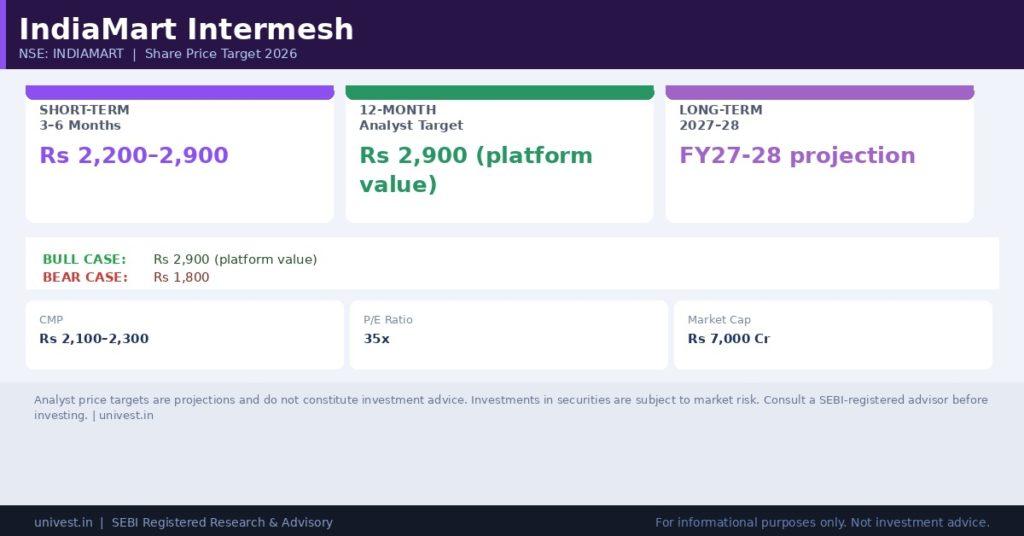
Support at Rs 1,900 (52-week low). If collections growth sustains above 15% YoY, recovery to Rs 2,300-2,500 is possible. Bear case: Rs 1,800-1,900 if subscribers stagnate again.
12-Month Analyst Target
Nomura target: Rs 1,900 (Reduce). Nuvama target: Rs 1,970 (Reduce). JM Financial: Buy (target above current levels). Average consensus: approximately Rs 2,000-2,200, implying near-flat to modest downside from current levels. Long-term bull case: Rs 2,800-3,000 on sustained collection growth.
Long-Term Target (2027-2028)
If Indiamart delivers 15%+ collection CAGR through FY27-28, and paying subscribers recover to 240,000-260,000, the stock could re-rate toward Rs 3,000-3,500. This requires sustained SME spending recovery and platform differentiation from AI competition. Track live on Explore Univest Screener.
Conclusion
Indiamart Intermesh share price is falling because of paying subscriber stagnation, a period of profit decline that raised questions about growth trajectory, analyst downgrades from Nomura and Nuvama, and sector-wide B2B tech de-rating. The Q3 FY26 recovery — 13% revenue growth, 35% margin, 17% collection growth — is encouraging. Short-term support Rs 1,900; 12-month consensus approximately Rs 2,000-2,200. Long-term bull case Rs 3,000+ on subscriber recovery. *This article is for informational purposes only. Please conduct your own research and consult a SEBI-registered financial advisor before making any investment decisions.*
FAQs
Q1. Why is Indiamart Intermesh share price falling?
Indiamart Intermesh share price is falling primarily due to the first-ever decline in paying subscribers since COVID (reported in Q3 FY25), consecutive quarters of profit decline (Q2 FY26 PAT fell 39% YoY to Rs 82.7 crore), management guidance of sub-10% collection growth, and downgrades from Nomura (target Rs 1,900) and Nuvama (target Rs 1,970). A broader B2B tech sector de-rating has compounded the stock-specific headwinds.
Q2. What is Indiamart share price target 2026?
Analyst targets are divided. Nomura has a Reduce rating with a target of Rs 1,900, implying modest further downside. Nuvama targets Rs 1,970. JM Financial upgraded to Buy citing medium-term positives. Average 12-month consensus is approximately Rs 2,000-2,200. If Q3 FY26's recovery sustains, recovery toward Rs 2,500 is possible. The 52-week low of Rs 1,900.10 is the key downside risk.
Q3. What is Indiamart's cash and investment position?
Indiamart Intermesh has a strong balance sheet with approximately Rs 3,000+ crore in cash, liquid investments, and deferred revenue (Rs 1,775 crore as of December 2025). The company is debt-free. This financial strength provides a buffer against business headwinds and potential for buybacks or acquisitions. The cash-rich status is a key fundamental differentiator that prevents the stock from falling as sharply as pure-play tech names.
Q4. How many paying subscribers does Indiamart have?
Indiamart had approximately 221,000 paying subscription suppliers as of Q3 FY26 (December 2025) — broadly stable from prior quarters. At its peak growth phase in 2022-23, the paying subscriber base was growing 15-20% annually. The deceleration to near-flat growth is the primary reason for analyst concern. Indiamart also has approximately 8.7 million non-paying supplier storefronts and 28 million unique business enquiries.
Q5. Who are Indiamart's main competitors?
Indiamart's primary competitors include JustDial (general listings), TradeIndia, Global Trade Plaza, and vertical B2B platforms in specific sectors (chemicals, textiles, agriculture). Internationally, Alibaba's B2B platforms compete for cross-border trade. The emerging threat is AI-powered procurement tools and vertical marketplaces that allow buyers to discover suppliers without a general-purpose directory.
Q6. What is Indiamart's deferred revenue?
Indiamart's deferred revenue was Rs 1,775 crore as of December 31, 2025 — up 19% YoY. Deferred revenue represents subscription fees already collected from suppliers but not yet recognised as revenue (because the subscription period extends beyond the quarter-end). This is a forward indicator of revenue — a high and growing deferred revenue balance signals future revenue visibility and subscriber retention.
Q7. Is Indiamart a profitable company?
Yes, Indiamart is profitable. Q3 FY26 showed a net profit margin of 35% — recovering from the weak Q2 FY26 margin of 20.6%. The company generates strong free cash flow, has no debt, and holds substantial cash and investments. The profitability concern is about growth rather than existence — the market worries that subscriber and revenue growth may not sustain at the 15-20% historical rates that justified premium valuations.
Q8. What is Indiamart's promoter holding?
Indiamart Intermesh's promoter (Dinesh Agarwal, founder and CEO, and family) holds approximately 49.1% of the company. Nalanda India Equity Fund recently increased its stake from 4.44% to 5.14% in March 2026 — a notable institutional buying signal. The promoter's majority stake and active management role provide stability. The company has maintained a consistent dividend of Rs 30 per share for FY25.
Also Read
Why is KRBL Share Price Falling? Check Next Share Price Target
Why is Reliance Infrastructures Share Price Falling? Check Next Share Price Target
Why is Mahanagar Gas Share Price Falling? Check Next Share Price Target
Why is Happiest Minds Share Price Falling? Check Next Share Price Target
Recent Articles

Supreme Industries Dividend: Stock Down 4% Today as Rs 12 Per Share Payout Is Declared, Record Date Fixed; Check Yield and Stock Split History
26 October 2026

Up 174% in 1 Year! Can Monolithisch India Shares Rise Further? Experts Decode Valuation, Levels and Targets
26 October 2026

Mind-Boggling Monday at Indian Stock Markets: Sensex and Nifty Mirror Life's Ups and Downs, October 26 Trade Details
26 October 2026

Raymond Share Price Up Over 145% in 2026 So Far: Will the Rally in This Defence-Engineering Stock Sustain? Experts Views, Target
26 October 2026
Note: This blog is for information purpose only. Investments and trading are subject to market risks, read all scheme related documents carefully.
Reviews






Recent Posts
Supreme Industries Dividend: Stock Down 4% Today as Rs 12 Per Share Payout Is Declared, Record Date Fixed; Check Yield and Stock Split History
Up 174% in 1 Year! Can Monolithisch India Shares Rise Further? Experts Decode Valuation, Levels and Targets
Mind-Boggling Monday at Indian Stock Markets: Sensex and Nifty Mirror Life's Ups and Downs, October 26 Trade Details
Raymond Share Price Up Over 145% in 2026 So Far: Will the Rally in This Defence-Engineering Stock Sustain? Experts Views, Target
Baba Arts Ltd. Hits Lower Circuit on BSE, 26 October 2026
Popular this week
Top IT Stocks to Buy After Q2 Results: TCS vs Infosys vs Wipro vs HCL Tech vs Tech Mahindra, What Market Experts Recommend

Uniresearch Global Pvt Ltd
Research Analyst
SEBI Registration Number — INH000013776
Uniresearch is a subsidiary of Univest Communication Technologies Private Limited
Company Address: Registered Address: Ground Floor, Unitech Commercial Tower 2, Block B, Greenwood City, Unit 1-3, Sector 45, Gurugram, Haryana 122003
Write to us : support@univest.in, compliance@univest.in
Verify on SEBI registry →RESEARCH ANALYST
Get SEBI Registered
advice on the stocks
trending today.
Get 3 FREE Trade Ideas

for Startups Accelerator 2024

Trusted by 1Cr Indians

Awarded No.1 by Economic Times