
Why Is IDBI Bank Share Price Falling? Key Reasons & Share Price Target
Updated: 6 Apr 2026 • 1:16 pm
Posted by:

IDBI Bank's share price has fallen nearly 45% from its 52-week high of Rs 118.38, crashing to a low of Rs 61.50 by late March 2026. In a single session on March 16, 2026, IDBI Bank shares plunged 16.5% after reports emerged that the government's privatisation attempt had collapsed — one of the sharpest single-day declines in Indian banking history.
For years, investors held IDBI Bank shares at a premium because of the privatisation story. The expectation that a private strategic buyer would take control, improve governance, and unlock shareholder value drove the stock up 116% from October 2022 to February 2026. That premium has now vanished. The stock has lost approximately 40% in March 2026 alone, making it one of the worst-performing banking stocks of the year.
This article explains every key reason behind the IDBI Bank share price falling, analyses the bank's financial performance, and provides a realistic share price target for 2026 based on verified analyst data.
About IDBI Bank
Get Free Investment Predictions
IDBI Bank Limited was established in 1964 as a development finance institution and later converted into a full-service commercial bank. Headquartered in Mumbai, the bank offers retail banking, corporate banking, NRI services, and treasury operations. As of Q3 FY26, the Government of India holds 45.48% and the Life Insurance Corporation of India holds 49.24% of the bank — a combined 94.72% — leaving only 5.28% in public float.
Despite this unusual ownership structure, IDBI Bank has made genuine operational progress. Its Gross NPA ratio declined to 2.57% in Q3 FY26 from 3.57% a year earlier. Net NPA held at 0.18%. Capital Adequacy Ratio improved to 24.63%, and Q3 FY26 net profit came in at Rs 1,935 crore. Yet the stock has been destroyed by one single factor: the failure of the privatisation process that the entire investment thesis was built around.
Why is IDBI Bank's share price falling? Key Reasons
Tap to Access Best Research Pieces on Univest
1. Privatisation Bid Collapsed — Bids Fell Below Reserve Price
The most decisive reason for IDBI Bank's share price falling is the collapse of its privatisation bid. The government and LIC were seeking to sell a combined 60.72% stake — the government 30.48% and LIC 30.24%. Financial bids were submitted in early February 2026 by Fairfax Financial Holdings (Canada) and Emirates NBD (UAE). Both bids reportedly fell short of the government's undisclosed reserve price, which was set approximately 41% above book value.
On March 16, 2026, news of the likely scrapping broke. IDBI Bank shares crashed 16.5% that session, hitting Rs 76.25 intraday. Over the following two weeks, the stock fell further to Rs 61.50 — its lowest since 2025. The privatisation premium that had accumulated over four years was erased in a fortnight.
2. Privatisation Premium Vanishes — Stock Re-rated as a Pure PSU
Before the bid failure, markets priced IDBI Bank as a "privatisation candidate" deserving a forward P/E of 10-12x — above the typical PSU bank multiple. After the collapse, nine analysts polled showed an average target price of approximately Rs 42-43, signalling the stock should trade purely on PSU fundamentals.
As of March 2026, the P/E ratio sat at 7-9x, compared to private sector peers like HDFC Bank at 16x and SBI at 12x. The gap is justified from the market's perspective: IDBI Bank has a 5% float, no private sector governance premium, and uncertain future ownership. The re-rating from privatisation candidate to standard PSU has been severe.
3. Thin Public Float Creates Illiquidity and Volatility
With only 5.28% of IDBI Bank shares in public hands, the stock is exceptionally illiquid. Institutional investors who accumulated shares anticipating the privatisation event are now trying to exit through a very narrow door. This amplifies every sell order into an outsized price decline.
The government is reportedly considering an OFS route to increase public shareholding as an interim measure. An OFS would improve liquidity long term, but creates near-term supply pressure — more shares entering the market from the government or LIC would further weigh on the price before stabilising.
4. Emirates NBD Exits — Fewer Credible Bidders Remain
Emirates NBD, one of the Middle East's largest banks and a credible strategic fit for IDBI, reportedly redirected its focus toward acquiring a stake in RBL Bank with a $3 billion investment. This significantly weakened the competitive dynamics of the IDBI bidding process. With fewer credible international buyers willing to pay the government's reserve price, the process was always fragile.
The exit of a marquee buyer signals to investors that IDBI Bank's valuation expectations — as set by the government — may be structurally misaligned with what strategic buyers are willing to pay for a majority PSU bank stake in India's regulatory environment.
5. Net Interest Margin Declining Amid Broader Pressure
Beyond the privatisation drama, IDBI Bank's core profitability metric is under pressure. Net Interest Margin declined to 3.52% in Q3 FY26, below peer benchmarks. Interest income fell to Rs 7,074 crore from Rs 7,816 crore a year earlier — a 9.5% YoY decline. As the loan mix evolves and competition for deposits remains intense, NIM compression will continue to cap earnings growth.
Without the privatisation catalyst to drive a re-rating, the market will increasingly focus on NIM trends, credit growth, and CASA ratio evolution to assess IDBI Bank's standalone value. None of these metrics currently justify a premium to PSU peers.
6. Broader PSU Banking Sector Weakness and FII Selling
Public sector banks broadly have been de-rated by foreign institutional investors in 2025-26 as India's credit cost cycle normalises and regulatory scrutiny increases. IDBI Bank, with its unique hybrid ownership and thin float, underperforms even within this weak PSU bank cohort. FII participation in IDBI is minimal, which means any systematic selling by domestic institutions creates outsized price pressure.
IDBI Bank Latest News That Impacted the Stock
- October 2022: Government formally invites Expressions of Interest for 60.72% stake sale. Stock rallies strongly on privatisation hope.
- Early February 2026: Financial bids submitted by Fairfax Financial Holdings and Emirates NBD. Both reportedly below the reserve price.
- March 16, 2026: Reports emerge that bids fell short. IDBI Bank shares crash 16.5% intraday to Rs 76.25 on NSE. Heavy trading volume.
- March 23, 2026: Shares fall further 7% to a fresh 52-week low of Rs 67.38. Reports suggest the government is considering the OFS route instead of a strategic sale.
- March 30, 2026: Stock slides to Rs 61.50. Government confirms plans to restart privatisation process from scratch. No buyer finalised.
- April 2026: Government signals it will relaunch process. Ministers expected to reassess reserve price mechanism. Stock stabilises near Rs 74 in oversold territory.
Financial Performance Analysis
IDBI Bank's operating fundamentals, viewed in isolation, show genuine improvement. The paradox is that the stock fell despite a clean balance sheet, precisely because the privatisation premium that had propped up valuations evaporated.
| Key Metric | Q3 FY26 (Dec 2025) | Q3 FY25 (Dec 2024) | YoY Change |
| Net Profit | Rs 1,935 Cr | Rs 1,908 Cr | +1.4% (flat) |
| Interest Income | Rs 7,074 Cr | Rs 7,816 Cr | -9.5% YoY |
| Gross NPA Ratio | 2.57% | 3.57% | Improved -100 bps |
| Net NPA Ratio | 0.18% | 0.18% | Stable |
| Capital Adequacy Ratio | 24.63% | 21.98% | Improved |
| Net Interest Margin | 3.52% | ~3.8% | Compressed |
The operational clean-up is real. Provision coverage at 99.33% means virtually all bad loans are fully provided for. But the market is not rewarding these improvements without the privatisation catalyst. If you want to monitor IDBI Bank's live financial metrics, check Univest Screener for real-time fundamental data.
Technical Signals: What the Charts Are Saying
IDBI Bank is trading below all key moving averages — 5-day, 20-day, 50-day, 100-day, and 200-day. The 14-day RSI stood at approximately 35 in late March 2026, in technically oversold territory. The 52-week range is Rs 61.50 (low) to Rs 118.38 (high), set just ahead of the failed bidding process.
Key technical support is at Rs 65, which corresponds to the swing low from January 2025. A recovery toward Rs 75-80 is technically possible from the oversold zone, but a sustained uptrend requires fresh privatisation news. Resistance is at Rs 80-85. Download the Univest iOS App or Univest Android App to track IDBI Bank's live price and get daily research insights.
Market Sentiment & Institutional Positioning
With 94.72% held by government entities, the effective public float is just 5.28%. FII participation is minimal. Retail investors who accumulated shares on privatisation hopes are the primary sellers. Mutual fund participation is limited due to the thin float and governance concerns.
Nine analysts tracked show a consensus Sell rating with an average target of approximately Rs 42-43. This bearish consensus reflects not a view on the bank's operations — which are improving — but a view that without privatisation, the stock cannot sustain a premium to PSU peers. Positive Q4 FY26 results would not materially change this sentiment unless accompanied by credible privatisation news.
Future Outlook: Can IDBI Bank Recover?
The government has confirmed it will restart the IDBI Bank privatisation from scratch. A ministerial panel will review the reserve price mechanism. Early signals suggest consensus is forming to relaunch. If a credible buyer — potentially a domestic financial institution or a reconsidered international player — comes forward and submits a qualifying bid, the stock could re-rate rapidly.
The bank's fundamentals provide a strong base. Gross NPA at 2.57%, Capital Adequacy at 24.63%, and consistent profitability at Rs 1,900+ crore quarterly make IDBI Bank fundamentally sound. An OFS to improve float would also attract new institutional investors.
The contrarian view: the government's reserve price was set 41% above book value. If that expectation does not change, a second attempt could fail too. Fairfax and Emirates NBD may not return. Without any buyer, IDBI Bank is a PSU bank trading at 7-9x P/E with a 5% float, and further downside toward analyst targets of Rs 42-43 remains the bear case.
IDBI Bank Share Price Target
Subscribe to Univest Pro for Premium Stock Research and F&O Setups
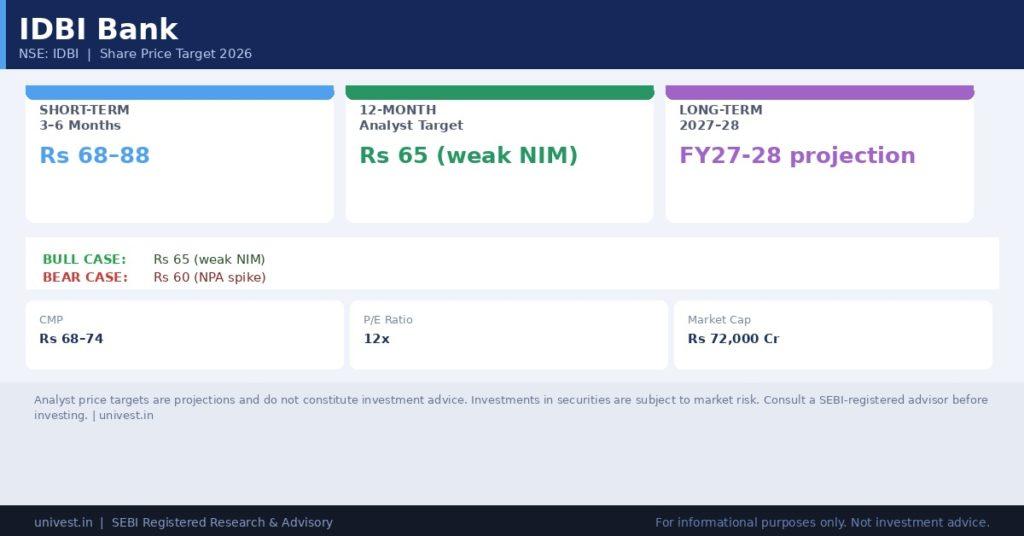
Short-Term Target (3-6 Months)
Technical support at Rs 65. Oversold bounce potential to Rs 75-85 in the near term. Bear case if privatisation news disappoints further: Rs 42-50, as per analyst consensus.
12-Month Analyst Target
Consensus of nine analysts pegs the 12-month target at approximately Rs 42-43 in the status quo (no privatisation) scenario. If the government restarts and progresses the process with a credible buyer, select analysts project recovery toward Rs 90-100. The outcome is binary and news-driven.
Long-Term Target (2027-2028)
Successful privatisation with a strategic buyer completing by FY27 could push the stock toward Rs 120-150, reflecting operational improvement and governance premium. Continued delay keeps the stock in the Rs 55-80 range. Track live analysis on the Explore Univest Screener.
Conclusion
IDBI Bank's share price is falling because the privatisation premium — accumulated over four years and representing 40-50% of the stock price — has been erased by the collapse of the first bid attempt. Fundamentals are improving, but that is insufficient without the privatisation catalyst. Short-term target is Rs 65-85; 12-month target is Rs 42-43 in the no-privatisation scenario or Rs 90-100 if the process advances. Long-term investors must watch government announcements closely. *This article is for informational purposes only. Please conduct your own research and consult a SEBI-registered financial advisor before making any investment decisions.*
FAQs
Q1. Why is the IDBI Bank share price falling in 2026?
IDBI Bank's share price is falling primarily because its privatisation bid collapsed in March 2026. Financial bids from Fairfax Financial and Emirates NBD fell below the government's reserve price, erasing the privatisation premium investors had priced in over four years. The stock crashed 16.5% on March 16, 2026, alone. Additional headwinds include a 5.28% public float, declining net interest margin to 3.52%, and a negative analyst consensus.
Q2. What is IDBI Bank's share price target for 2026?
Analyst consensus on IDBI Bank's 12-month target is approximately Rs 42-43, reflecting the full removal of privatisation premium and re-rating as a standard PSU bank. If the government restarts and progresses the stake sale, some analysts project a recovery toward Rs 90-100. Short-term technical support is at Rs 65. The outcome is binary and depends entirely on privatisation progress.
Q3. Is IDBI Bank safe to invest in now?
IDBI Bank has strong fundamentals — Gross NPA at 2.57%, Capital Adequacy at 24.63%, and quarterly profits around Rs 1,935 crore. However, the investment case now depends entirely on privatisation progress, which is uncertain. With a 5.28% free float and a negative analyst consensus with a target of Rs 42-43, the stock carries high event-driven risk. It is suitable only for investors with a 2-3 year horizon and high risk tolerance.
Q4. Who owns IDBI Bank?
The Government of India holds 45.48%, and LIC holds 49.24% of IDBI Bank, for a combined 94.72%. The remaining approximately 5.28% is publicly held. The government and LIC were seeking to sell a combined 60.72% to a private strategic buyer, but the first attempt failed in March 2026 after bids reportedly fell below the reserve price.
Q5. Why did the IDBI Bank privatisation fail?
The IDBI Bank privatisation failed because financial bids submitted by Fairfax Financial Holdings and Emirates NBD reportedly did not meet the government's confidential reserve price, which was reportedly set approximately 41% above book value. The mismatch between government valuation expectations and market-based bids caused the entire process to be scrapped, triggering a 16-45% collapse in the share price.
Q6. What is IDBI Bank's Gross NPA ratio?
IDBI Bank's Gross NPA ratio improved to 2.57% in Q3 FY26 (December 2025), down from 3.57% in Q3 FY25. Net NPA remained stable at 0.18%, one of the lowest in the Indian banking sector. Provision coverage stands at 99.33%, reflecting comprehensive provisioning for bad loans. These metrics confirm strong improvement in asset quality over the past three years.
Q7. What will happen next for IDBI Bank privatisation?
The government has confirmed it will restart the IDBI Bank privatisation process from scratch. A ministerial panel will reassess the reserve price mechanism and launch a fresh Expression of Interest. The government may also pursue an OFS route to improve public shareholding as an interim step. No specific timeline has been confirmed for the next attempt, creating ongoing uncertainty for the stock.
Q8. What is the 52-week range for IDBI Bank shares?
IDBI Bank's 52-week high was Rs 118.38, recorded in early January 2026 as privatisation seemed imminent. The 52-week low is approximately Rs 61.50, hit in late March 2026 after the privatisation bid collapsed. The stock has lost nearly 48% from its peak in under three months — one of the sharpest single-event-driven corrections in Indian banking stocks in recent history.
Also Read
Why is KRBL Share Price Falling? Check Next Share Price Target
Why is Reliance Infrastructure's Share Price Falling? Check Next Share Price Target
Why is Mahanagar Gas Share Price Falling? Check Next Share Price Target
Why is Happiest Minds Share Price Falling? Check Next Share Price Target
Recent Articles

Signet Industries Ltd. Hits Upper Circuit on NSE, 9 October 2026
9 October 2026

Precision Electronics Ltd. Hits Lower Circuit for the 2nd Straight Session on BSE, 9 October 2026
9 October 2026

Globe International Carriers Ltd. Hits Upper Circuit on NSE, 9 October 2026
9 October 2026

Gillette India (GILLETTE) Share Price Falls 2.11% as FMCG Valuation Stands Out
9 October 2026
Note: This blog is for information purpose only. Investments and trading are subject to market risks, read all scheme related documents carefully.
Reviews





Recent Posts
Signet Industries Ltd. Hits Upper Circuit on NSE, 9 October 2026
Precision Electronics Ltd. Hits Lower Circuit for the 2nd Straight Session on BSE, 9 October 2026
Globe International Carriers Ltd. Hits Upper Circuit on NSE, 9 October 2026
Gillette India (GILLETTE) Share Price Falls 2.11% as FMCG Valuation Stands Out
JK Cement (JKCEMENT) Share Price Falls for Second Straight Session

Uniresearch Global Pvt Ltd
Research Analyst
SEBI Registration Number — INH000013776
Uniresearch is a subsidiary of Univest Communication Technologies Private Limited
Company Address: Registered Address: Ground Floor, Unitech Commercial Tower 2, Block B, Greenwood City, Unit 1-3, Sector 45, Gurugram, Haryana 122003
Write to us : support@univest.in, compliance@univest.in
Verify on SEBI registry →RESEARCH ANALYST
Get SEBI Registered
advice on the stocks
trending today.
Get 3 FREE Trade Ideas

for Startups Accelerator 2024

Trusted by 1Cr Indians

Awarded No.1 by Economic Times