
Why Is Bandhan Bank Share Price Falling? Key Reasons & Share Price Target
Updated: 6 Apr 2026 • 3:16 pm
Posted by:

Bandhan Bank's share price has been under sustained pressure in 2026, falling to near its 52-week low range of Rs 134-159. The stock hit its lower circuit limit on March 16, 2026, shedding more than 10% in three days — a sharp decline even by microfinance bank standards. At current levels near Rs 159, the stock is down approximately 17% from its 52-week high of Rs 192.48.
Bandhan Bank's share price has two distinct drivers: microfinance sector stress that has plagued the bank for multiple quarters, and a more recent shock from reports that the promoter group — Bandhan Financial Services — is exploring options to sell its stake or list its holding company. Both factors create genuine uncertainty about ownership, profitability, and the bank's strategic direction.
This article explains every key reason behind the Bandhan Bank share price falling, examines the Q3 FY26 financials, and provides realistic share price targets for 2026.
About Bandhan Bank
Click Here – Get Free Investment Predictions
Bandhan Bank Limited was established in 2015 when Bandhan Financial Services — formerly India's largest NBFC-MFI — received a banking licence from the Reserve Bank of India. Headquartered in Kolkata, the bank serves the unbanked and underbanked population of India, with a particular focus on Eastern India, especially West Bengal and Assam.
The bank operates over 6,350 outlets across India, offering microfinance (its Emerging Entrepreneurs Business or EEB segment), retail banking, MSME loans, and affordable housing finance. Market cap stands at approximately Rs 23,575 crore. Promoter holding (Bandhan Financial Services) is 39.74%, which exceeds the RBI's regulatory limit of 26% for private bank promoters, and this regulatory pressure to reduce stake is at the heart of the current price volatility.
Why is Bandhan Bank's share price falling? Key Reasons
Tap to Access Best Research Pieces on Univest
1. Promoter Stake Sale Rumours Create Supply Overhang
The most immediate trigger for the March 2026 fall is reports that Bandhan Financial Services (the promoter, 39.74% stake) is hiring an investment bank to explore selling control to strategic buyers or private equity, or alternatively listing the holding company via an IPO by June 2026.
On March 16, 2026, the stock hit the lower circuit limit after these reports emerged. Investors fear that a large block of promoter shares entering the market — whether via direct sale to PE, listing, or secondary placement — will create significant supply pressure. The timing coincides with broader market weakness, amplifying the sell-off.
2. RBI Regulation Requires Promoter Stake Reduction to 26%
Bandhan Bank's promoter — Bandhan Financial Services — currently holds 39.74%, which is 13.74 percentage points above the RBI's 26% cap for private bank promoters. This is not optional: the RBI requires the stake to be reduced, and this regulatory overhang has been a persistent drag on investor sentiment.
Any mechanism to reduce the promoter stake — direct sale, OFS, IPO of the holding company — means equity supply entering the market. This structural reality makes institutional investors cautious about building large positions in Bandhan Bank until the dilution path becomes clear.
3. Q3 FY26 Net Profit Fell 52% Year-on-Year
Bandhan Bank's Q3 FY26 results, declared on January 22, 2026, showed net profit falling 51.79% YoY to Rs 205.59 crore from Rs 426.48 crore in Q3 FY25. Total income fell 7.11% YoY to Rs 6,122 crore. This sharp decline reflects the ongoing stress in the microfinance segment, elevated provisioning requirements, and NIM compression.
On a sequential basis, there was improvement — PAT rose 84% QoQ and net revenue grew 7.8% QoQ — suggesting the worst may be behind in terms of the earnings trough. However, the YoY numbers confirm that the bank's profitability is significantly impaired compared to its pre-microfinance-stress levels.
4. Microfinance Sector Remains Under Stress
Bandhan Bank has historically derived a large portion of its loan book from its Emerging Entrepreneurs Business (EEB) — the microfinance segment targeting rural and semi-urban female borrowers. The broader microfinance industry is facing a severe credit stress cycle in 2025-26. Portfolio at Risk (PAR) 180+ days for the sector rose from 12.6% in March 2025 to 14.9% in June 2025.
State elections in Assam and West Bengal — Bandhan's core microfinance markets — have historically correlated with deteriorating repayment discipline as political discourse about loan waivers and debt forgiveness increases. This election-cycle risk is being priced into the stock.
5. CASA Ratio Declining, Funding Costs Rising
Bandhan Bank's CASA (Current Account and Savings Account) ratio declined to 27.26% in December 2025, from 31.73% a year earlier. A falling CASA ratio means the bank is increasingly relying on costlier term deposits to fund its loan book, compressing the Net Interest Margin. This is a structural challenge for a bank that built its competitive advantage on low-cost funding.
The low interest coverage ratio flagged by Screener. in reinforces concerns about the bank's ability to service its obligations comfortably under ongoing stress conditions.
6. Leadership Transition and Governance Uncertainty
Bandhan Bank's founder, MD & CEO, Chandra Shekhar Ghosh, departed in April 2024. Leadership transitions at founder-led organisations — particularly in financial services — create uncertainty about strategy, risk appetite, and execution. The new management under Partha Pratim Sengupta is executing a diversification strategy, reducing microfinance concentration and growing secured retail loans, but the transition takes time to deliver results.
Bandhan Bank Latest News That Impacted the Stock
- January 22, 2026: Q3 FY26 results — net profit falls 52% YoY to Rs 206 crore. Revenue falls 7.11% YoY to Rs 6,122 crore. GNPA improves to 3.3% from 5% in Q2 FY26. Stock drops on results day.
- January 23, 2026: Post-results, Motilal Oswal upgrades to Buy (PT: Rs 175), Emkay upgrades to Buy (PT: Rs 180). Stock recovers briefly on positive analyst calls.
- November 2025: Bandhan Bank announces sell-off of bad and written-off loans worth over Rs 6,900 crore to asset reconstruction companies — balance sheet cleanup step.
- March 16, 2026: Stock hits lower circuit limit — drops more than 10% over three days. Reports emerge that the promoter group is exploring stake sale options.
- March 17, 2026: Stock exchanges query Bandhan Bank on ownership reports. Bank clarifies it has not received any formal communication.
- March 2026: RBI approves SBI Mutual Fund acquiring up to 9.99% stake in Bandhan Bank — positive signal for institutional participation.
- April 2026: Trading window closed as the bank prepares the Q4 FY26 results announcement. New Independent Director Debashish Mukherjee was appointed on March 25, 2026.
Financial Performance Analysis
Bandhan Bank's financials show a bank going through a difficult transition — profitability under pressure while asset quality slowly improves:
| Key Metric | Q3 FY26 (Dec 2025) | Q3 FY25 (Dec 2024) | YoY Change |
| Net Profit | Rs 206 Cr | Rs 426 Cr | -51.8% YoY |
| Total Income | Rs 6,122 Cr | Rs 6,591 Cr | -7.1% YoY |
| Gross NPA | 3.33% | ~4.7% | Improved |
| Net NPA | 1.0% | ~1.4% (Q2) | Improving |
| CASA Ratio | 27.26% | 31.73% | Declined |
| Market Cap | ~Rs 23,575 Cr | — | At ~Rs 159/share |
The sequential improvement (PAT up 84% QoQ) is encouraging and suggests the bank may be past the earnings trough. The YoY decline, however, highlights the severity of the microfinance stress cycle. Track live financial metrics for Bandhan Bank on Univest Screener
Technical Signals: What the Charts Are Saying
Bandhan Bank is trading below all key moving averages — 5-day, 20-day, 50-day, 100-day, and 200-day. The 52-week range is Rs 134.25 (low) to Rs 192.48 (high). Key support is near Rs 134-140 (52-week low zone). Resistance is at Rs 165-175. A recovery above Rs 175 with sustained volume would signal a trend reversal.
The stock's beta is elevated, meaning it moves significantly more than the broader market in both directions. Near-term catalysts for a bounce: Q4 FY26 results showing continued QoQ improvement in PAT and further NPA reduction. Download the Univest iOS App or Univest Android App to track Bandhan Bank live and receive daily research insights.
Market Sentiment & Institutional Positioning
Promoter (Bandhan Financial Services) holds 39.74% — above the RBI's 26% cap. This regulatory compulsion to reduce stake is the dominant institutional concern. Retail holding has risen as institutional investors have exited. Low ROE of 11.5% over three years is below the industry average for private sector banks, which typically command ROE of 15-20%.
Motilal Oswal and Emkay have upgraded to Buy, citing improving fundamentals and attractive valuations. CLSA has an Outperform rating with a target of Rs 143. MarketsMOJO had a Sell rating revised to Hold as technicals improved. The RBI's approval for SBI Mutual Fund to acquire up to 9.99% is a positive signal for institutional interest at lower levels.
Future Outlook: Can Bandhan Bank Recover?
Bandhan Bank is executing a credible turnaround strategy. Bad loan sell-off of Rs 6,900 crore to ARCs signals aggressive balance sheet cleanup. Secured loan portfolio growth — home loans, MSME, personal loans — is reducing the microfinance concentration risk. New MD Partha Pratim Sengupta has committed to digital initiatives and operational efficiency for Q4 FY26 and beyond.
If microfinance NPAs continue to improve through Q4 FY26, and if the promoter stake sale is executed at a reasonable price without excessive supply overhang, Bandhan Bank can recover meaningfully. SBI Mutual Fund's regulatory approval to hold up to 9.99% provides a potential institutional anchor buyer.
The contrarian perspective: Bandhan Bank's core microfinance exposure remains structurally risky in a sector with over-indebtedness, political interference risk, and regulatory uncertainty. Even if NPAs recover, the CASA ratio decline and NIM compression represent structural challenges for profitability recovery. A return to the Rs 400+ levels of 2023 may take several years, if achievable at all in the current interest rate environment.
Bandhan Bank Share Price Target
Subscribe to Univest Pro for Premium Stock Research and F&O Setups
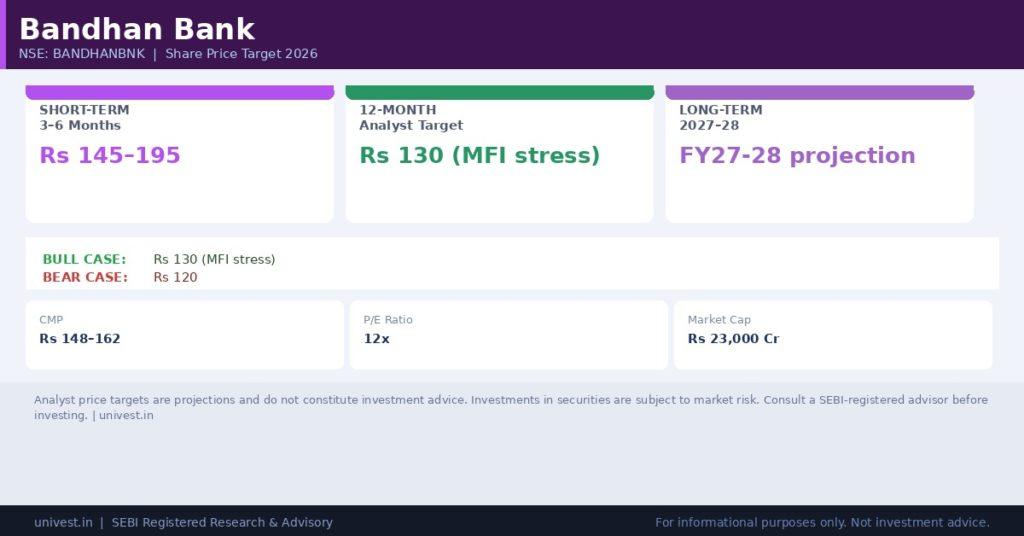
Short-Term Target (3-6 Months)
Support at Rs 134-140 (52-week low zone). A bounce toward Rs 165-180 is possible if Q4 FY26 results show NPA improvement and promoter stake clarity emerges. Bear case: Rs 120-130 if stress worsens.
12-Month Analyst Target
Motilal Oswal target: Rs 175. Emkay target: Rs 180. CLSA target: Rs 143. Average analyst consensus is approximately Rs 160-180 for 12 months, implying near-term sideways to modest upside from current levels near Rs 159.
Long-Term Target (2027-2028)
If microfinance stress peaks in FY26 and the bank successfully diversifies its loan book to 50%+ secured by FY27, ROE recovery toward 15% could support a stock price of Rs 250-300 by FY28. This scenario requires both asset quality improvement and successful promoter stakeholder resolution. Track the live target on the Explore Univest Screener
Conclusion
Bandhan Bank share price is falling because of three converging pressures: promoter stake overhang from mandatory regulatory dilution, a Q3 FY26 profit decline of 52% YoY from microfinance stress, and election-cycle risk in Eastern India's microfinance markets. Sequential improvement in Q3 FY26 (PAT up 84% QoQ) suggests the worst may be past earnings-wise. Short-term target is Rs 134-180; 12-month analyst targets range Rs 143-180. Long-term recovery to Rs 250-300 depends on successful loan book diversification and promoter resolution. *This article is for informational purposes only. Please conduct your own research and consult a SEBI-registered financial advisor before making any investment decisions.*
FAQs
Q1. Why is Bandhan Bank share price falling in 2026?
Bandhan Bank's share price is falling due to three primary factors: reports that the promoter group is exploring a stake sale or holding company IPO (creating supply overhang fears), Q3 FY26 net profit falling 52% YoY to Rs 206 crore from ongoing microfinance sector stress, and election-cycle risk in Assam and West Bengal that historically weakens microfinance repayment rates. The stock hit its lower circuit limit on March 16, 2026, following the promoter stake sale news.
Q2. What is Bandhan Bank's share price target for 2026?
Analyst targets for Bandhan Bank include Motilal Oswal at Rs 175, Emkay at Rs 180, and CLSA at Rs 143. The 12-month consensus is approximately Rs 160-180, representing near-flat to modest upside from current levels near Rs 159. Short-term support is at Rs 134-140 (52-week low zone). Recovery toward Rs 250-300 is a longer-term scenario dependent on microfinance normalisation and loan book diversification.
Q3. Why must the Bandhan Bank promoter reduce its stake?
The Reserve Bank of India requires promoters of private sector banks to progressively reduce their stake to 26%. Bandhan Financial Services currently holds 39.74% — exceeding the RBI cap by 13.74 percentage points. This is a regulatory requirement, not a choice. The bank has been exploring OFS, strategic sale, or listing the holding company as mechanisms to comply. Any of these mechanisms creates equity supply, which weighs on the stock price.
Q4. What is Bandhan Bank's microfinance exposure?
Bandhan Bank's Emerging Entrepreneurs Business (EEB) — its microfinance segment — was historically over 50% of its loan book. The bank has been actively diversifying into secured loans (home loans, MSME) to reduce this concentration. The broader microfinance sector is under significant stress in FY26, with Portfolio at Risk (PAR) 180+ days rising from 12.6% to 14.9% for the industry, directly impacting Bandhan's NPAs.
Q5. What were Bandhan Bank's Q3 FY26 results?
Bandhan Bank reported Q3 FY26 net profit of Rs 205.59 crore — down 51.79% YoY from Rs 426.48 crore in Q3 FY25. Total income fell 7.11% YoY to Rs 6,122 crore. However, on a sequential (QoQ) basis, PAT rose 84% and net revenue grew 7.8%, suggesting the earnings trough may be behind. Gross NPA improved to 3.33% in Q3 FY26 from 5.02% in Q2 FY26.
Q6. Is Bandhan Bank a good investment now?
Bandhan Bank is attractively valued at its current levels, with improving fundamentals and multiple analyst upgrades. However, it is a high-risk investment. The promoter stake resolution creates near-term uncertainty, microfinance stress is not fully behind, and the CASA ratio is declining. It is suitable for investors willing to absorb near-term volatility in exchange for potential 2-3 year recovery upside.
Q7. What is Bandhan Bank's Gross NPA ratio?
Bandhan Bank's Gross NPA ratio improved significantly to 3.33% in Q3 FY26 (December 2025), down from 5.02% in Q2 FY26 (September 2025). Net NPA improved to 1.0% from 1.4% QoQ. This represents meaningful asset quality improvement, driven by the bank's aggressive write-off and bad loan sell-off strategy — including the disposal of Rs 6,900 crore of written-off loans to asset reconstruction companies.
Q8. What is Bandhan Bank's promoter holding?
Bandhan Financial Services holds 39.74% of Bandhan Bank — significantly above the RBI's 26% regulatory cap for private bank promoters. The promoter group is reportedly exploring a strategic sale to PE investors, a direct sale of shares, or an IPO of the holding company by June 2026 as mechanisms to reduce its stake. This regulatory compulsion and the uncertainty around execution are among the primary overhangs weighing on the stock.
Also Read
Why is KRBL Share Price Falling? Check Next Share Price Target
Why is Reliance Infrastructures Share Price Falling? Check Next Share Price Target
Why is Mahanagar Gas Share Price Falling? Check Next Share Price Target
Why is Happiest Minds' Share Price Falling? Check Next Share Price Target
Recent Articles

Defence Stocks Today Soar Up to 9% as DAC Clears Rs 2.12 Lakh Crore Proposals: Apollo Micro, Paras Defence, BEL, HAL and Data Patterns in Focus
27 October 2026

Defence Stocks Today Soar Up to 9% as DAC Clears Rs 2.12 Lakh Crore Proposals: Apollo Micro, Paras Defence, BEL, HAL and Data Patterns in Focus
27 October 2026

Indo Rama Synthetics (India) Ltd. Hits Upper Circuit on BSE, 27 October 2026
27 October 2026

RAVITA ENGINEERING SER L Hits Lower Circuit for the 2nd Straight Session on NSE, 27 October 2026
27 October 2026
Note: This blog is for information purpose only. Investments and trading are subject to market risks, read all scheme related documents carefully.
Reviews






Recent Posts
Defence Stocks Today Soar Up to 9% as DAC Clears Rs 2.12 Lakh Crore Proposals: Apollo Micro, Paras Defence, BEL, HAL and Data Patterns in Focus
Defence Stocks Today Soar Up to 9% as DAC Clears Rs 2.12 Lakh Crore Proposals: Apollo Micro, Paras Defence, BEL, HAL and Data Patterns in Focus
Indo Rama Synthetics (India) Ltd. Hits Upper Circuit on BSE, 27 October 2026
RAVITA ENGINEERING SER L Hits Lower Circuit for the 2nd Straight Session on NSE, 27 October 2026
Dalmia Bharat Shares Hit 52-Week Low After Q2 Results: Should Investors Buy, Sell or Hold? Cost Pressure, Exceptional Charge and Key Levels
Popular this week
Aequs Shares Crash 19% After Q2 Losses Widen: Buy, Sell or Hold? Aerospace Order Book, Consumer Electronics Drag and Key Levels

Uniresearch Global Pvt Ltd
Research Analyst
SEBI Registration Number — INH000013776
Uniresearch is a subsidiary of Univest Communication Technologies Private Limited
Company Address: Registered Address: Ground Floor, Unitech Commercial Tower 2, Block B, Greenwood City, Unit 1-3, Sector 45, Gurugram, Haryana 122003
Write to us : support@univest.in, compliance@univest.in
Verify on SEBI registry →RESEARCH ANALYST
Get SEBI Registered
advice on the stocks
trending today.
Get 3 FREE Trade Ideas

for Startups Accelerator 2024

Trusted by 1Cr Indians

Awarded No.1 by Economic Times