
Why Is Bajaj Electricals Share Price Falling? Key Reasons & Share Price Target
Updated: 6 Apr 2026 • 3:41 pm
Posted by:

Bajaj Electricals share price has fallen approximately 50% from its 52-week high of Rs 711 to trade near Rs 342-354, making it one of the steepest mid-cap consumer brand corrections of 2025-26. The stock has declined 39-42% over the past year and 40% over the last six months, underperforming the broader consumer sector significantly.
The reason behind Bajaj Electricals share price falling is not one event but a combination of severely weak quarterly results, channel stock normalisation, margin compression to an 18-quarter low, and a CFO resignation that shook investor confidence. Q3 FY26 revealed a net loss of Rs 34.10 crore — a sharp reversal from the net profit of Rs 33.36 crore in Q3 FY25.
This article explains every key reason why Bajaj Electricals share price is falling and provides share price targets for 2026.
About Bajaj Electricals
Click Here – Get Free Investment Predictions
Bajaj Electricals Limited was incorporated in 1938 and is part of the Bajaj Group. The company operates in two segments: Consumer Products (fans, kitchen appliances, lighting, water heaters) and Lighting Solutions (LED lamps, professional lighting). It holds popular brands including Bajaj, Morphy Richards, Nirlep, and Nex. Headquartered in Mumbai, Bajaj Electricals operates through 20 branch offices and has a pan-India distribution network.
At CMP near Rs 342-354, the market cap is approximately Rs 4,038-4,080 crore. The 52-week high is Rs 711, and the 52-week low is Rs 335.05. Promoter holding is 62.7%. Operating revenue for the trailing twelve months is approximately Rs 4,488 crore. The company has a low ROE of 8.93% over the last three years and delivered poor sales growth of -0.65% over the past five years — fundamental weaknesses that the stock price is now reflecting.
Why Is Bajaj Electricals Share Price Falling? Key Reasons
Tap to Access Best Research Pieces on Univest
1. Q3 FY26 Net Loss of Rs 34 Crore — Revenue Falls 18.5%
The most direct cause of the Bajaj Electricals share price falling is its Q3 FY26 results, declared on February 10, 2026. The company reported a net loss of Rs 34.10 crore, compared to a net profit of Rs 33.36 crore in Q3 FY25 — a swing of Rs 67 crore. Revenue from operations fell 18.5% to Rs 1,048-1,051 crore from Rs 1,287-1,290 crore in Q3 FY25.
The Consumer Products segment — fans, appliances, and lighting — saw revenue fall 25.2% to Rs 776.81 crore. An exceptional item of Rs 28.89 crore related to the implementation of new Labour Codes compounded the loss. HDFC Securities described Q3 FY26 as posting "18-quarter-low margins" — the worst margin performance in four and a half years.
2. Channel Stock Normalisation Crushing Revenue
Bajaj Electricals has explicitly cited "channel stock normalisation" across all categories as a primary reason for the revenue degrowth. During 2023-24, distributors and dealers stocked up, heavily anticipating strong demand. Now, the channel is working down that excess inventory before placing fresh orders.
This inventory destocking cycle is not specific to Bajaj Electricals — it affects the broader consumer electricals sector — but Bajaj's exposure to fans and appliances (cyclical categories) makes it more vulnerable to channel correction than peers with greater services or professional lighting mix.
3. Gross Margin Contraction Due to Lower Volume in High-Margin Categories
The company's gross margin contracted due to lower volume across high-margin categories, as stated in its Q3 FY26 post-earnings presentation. Fans and premium appliances typically carry higher margins than lighting. When these categories de-grow 25%, the mix shifts toward lower-margin products, compressing overall gross margins. This margin compression, combined with a fixed cost base, turned the P&L negative.
Bajaj Electricals also faces rising competition from Havells, Orient Electric, Crompton, and Polycab in fans and appliances — all of which have invested more aggressively in premiumisation and marketing, putting pressure on Bajaj's market share.
4. CFO Resignation Adds Governance Uncertainty
On October 31, 2025, the board of Bajaj Electricals accepted the resignation of EC Prasad as Chief Financial Officer, effective January 26, 2026. A CFO departure during a period of weak financial performance raises governance concerns among institutional investors. The market interprets CFO exits as a potential signal of deeper financial management challenges or strategic disagreements.
The absence of a permanent CFO during Q3 FY26 — when the company posted its worst results in 18 quarters — added to investor anxiety. The company had also faced GST demands (Rs 67-80 lakh) in March 2026, though these are manageable in quantum.
5. Structural Weakness: -0.65% Revenue CAGR Over 5 Years
Screener.in data shows Bajaj Electricals delivered -0.65% revenue CAGR over the past five years — effectively no growth. In a period when Indian consumer spending expanded significantly, and peers like Havells and Crompton grew revenues at a 10-15% CAGR, Bajaj Electricals stagnated. This structural underperformance reflects deeper issues: slower innovation, weaker brand positioning in premium segments, and distribution gaps.
A low ROE of 8.93% over three years confirms the capital allocation challenge. The company generates thin returns on equity despite operating in a consumer category with inherently good pricing dynamics.
6. New Wires Business Entry — Diversification or Distraction?
Bajaj Electricals announced in its regulatory filing that it plans to introduce wires as a new business line to tap the rising demand from housing and infrastructure electrification. While this is a growth initiative, investors are cautious. The wires segment is highly competitive (dominated by Polycab, Finolex, and KEI Industries) and entering a new category during a period of core business weakness raises execution risk questions.
Bajaj Electricals Latest News That Impacted the Stock
- October 31, 2025: Board accepts CFO EC Prasad's resignation, effective January 26, 2026. Investor sentiment weakens.
- February 10, 2026: Q3 FY26 results declared — net loss of Rs 34.10 crore, revenue down 18.5% to Rs 1,051 crore. HDFC Securities downgrades with a lower target. Shares fall.
- February 2026: Company announces entry into the wires segment as a new business line. Execution risks flagged by analysts.
- March 24, 2026: GST assessment order dated March 30, 2026 demanding Rs 67.31 lakh. The company plans to appeal. Not material in quantum.
- March 26, 2026: Bajaj Electricals granted 18,894 stock options under its Performance Stock Option Plan 2023.
- March 2026: Stock consolidates near the 52-week low range of Rs 335-360. The trading window closed on April 1, 2026, ahead of Q4 FY26 audited results.
Financial Performance Analysis
The Q3 FY26 numbers confirm a significant cyclical and potentially structural deterioration:
| Key Metric | Q3 FY26 (Dec 2025) | Q3 FY25 (Dec 2024) | YoY Change |
| Revenue from Operations | Rs 1,048-1,051 Cr | Rs 1,287-1,290 Cr | -18.5% YoY |
| Net Profit / (Loss) | Rs -34.10 Cr | Rs +33.36 Cr | Turned Loss |
| Consumer Products Revenue | Rs 776.81 Cr | Rs 1,038.45 Cr | -25.2% YoY |
| Lighting Solutions Revenue | Rs 274.10 Cr | Rs 251.27 Cr | +9% YoY |
| Total Expenses | Rs 1,085.78 Cr | Rs 1,257.89 Cr | -13.6% |
| Market Cap | ~Rs 4,038-4,080 Cr | — | At ~Rs 350/share |
Lighting Solutions grew by 9%, but it is too small to offset the collapse in Consumer Products. The company is debt-free, which is a positive — it means the losses are operational, not financial. Track Bajaj Electricals' live metrics on Univest Screener.
Technical Signals: What the Charts Are Saying
Bajaj Electricals is in a sustained downtrend, trading below all key moving averages — 5-day, 20-day, 50-day, 100-day, and 200-day. The EPS Rank from O'Neil Methodology is 16 — poor, indicating inconsistent earnings. The RS Rating is 10 — signalling significant underperformance versus the broader market.
The 52-week range is Rs 335.05 (low) to Rs 711 (high). The current price near Rs 342-354 is near its 52-week low. Key support is at Rs 335. Resistance is at Rs 400-420, where prior bounces have failed. A close above Rs 420 with strong volume would signal a trend change. Download the Univest iOS App or Univest Android App to track Bajaj Electricals live.
Market Sentiment & Institutional Positioning
Promoter holding is 62.7% — stable. However, overall institutional interest is low. The EPS Rank of 16 and RS Rating of 10 indicate the stock is in the bottom 10-20% of all stocks tracked on momentum and earnings quality. This makes it structurally unattractive for institutional momentum buyers.
ICICI Direct holds a Buy rating for the long term. Most brokerages, including HDFC Securities, revised targets lower after Q3 FY26. The company's debt-free status and Bajaj Group brand equity provide a floor, but the lack of near-term earnings visibility limits institutional interest.
Future Outlook: Can Bajaj Electricals Recover?
Bajaj Electricals' recovery depends on two things: channel destocking completion and margins returning to normalcy. If Q4 FY26 and Q1 FY27 show channel inventory normalising and volume recovering in fans and appliances, earnings could recover sharply given the operating leverage in the business.
The company is also investing in product innovation — new premium fan ranges, energy-efficient appliances, and smart home products — and the wires segment could be a long-term growth driver if executed well. The Bajaj brand's 85-year heritage provides pricing credibility in the mass and mid-premium segments.
The contrarian argument: Bajaj Electricals has not grown revenues in five years. It has lost market share to Havells, Crompton, and Polycab in key categories. The consumer electronics space is intensely competitive, and Bajaj lacks the R&D investment and marketing spend of its peers. Channel destocking completion will provide a base effect boost in quarterly results, but sustained double-digit growth may remain elusive without a strategic reset.
Bajaj Electricals Share Price Target
Subscribe to Univest Pro for Premium Stock Research and F&O Setups
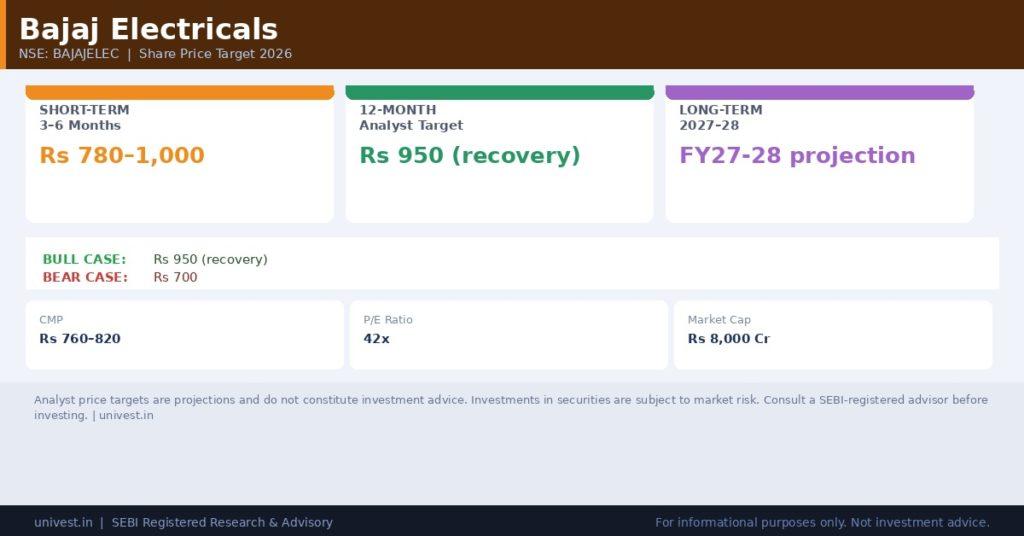
Short-Term Target (3-6 Months)
Support at Rs 335 (52-week low). If channel destocking completes and Q4 FY26 shows recovery, the stock could rebound to Rs 400-450. Bear case: Rs 300-320 if consumer demand remains weak.
12-Month Analyst Target
ICICI Direct has a Buy rating. Most analyst targets post Q3 FY26 downgrade are in the Rs 420-480 range. At CMP of Rs 342, this implies 23-40% upside over 12 months — but delivery requires concrete evidence of channel recovery and margin normalisation.
Long-Term Target (2027-2028)
If Bajaj Electricals returns to revenue growth of 8-10% CAGR and margins recover to 5-6% PAT margin, the stock could re-rate toward Rs 550-650 by FY28. This is the bull case. Track live targets on Explore Univest Screener.
Conclusion
Bajaj Electricals share price is falling because Q3 FY26 delivered India's iconic electricals brand's worst quarterly performance in 18 quarters — a net loss of Rs 34 crore, revenue down 18.5%, and margins at multi-year lows. Channel destocking is cyclical, but structural issues around revenue growth and market share loss create longer-term questions. Short-term support at Rs 335; 12-month analyst targets are Rs 420-480. *This article is for informational purposes only. Please conduct your own research and consult a SEBI-registered financial advisor before making any investment decisions.*
FAQs
Q1. Why is Bajaj Electricals' share price falling in 2026?
Bajaj Electricals' share price is falling because Q3 FY26 results posted a net loss of Rs 34.10 crore — a swing from Rs 33.36 crore profit in Q3 FY25. Revenue fell 18.5% to Rs 1,051 crore, with the Consumer Products segment down 25.2%. Reasons include channel stock normalisation (dealer destocking), new Labour Code implementation costs of Rs 28.89 crore, gross margin compression due to degrowth in high-margin categories, and a CFO resignation.
Q2. What is Bajaj Electricals share price target 2026?
Analyst targets for Bajaj Electricals post the Q3 FY26 correction are approximately Rs 420-480 for 12 months, implying 23-40% upside from current levels near Rs 342-354. ICICI Direct maintains a long-term Buy. Short-term support is Rs 335 (52-week low). A recovery above Rs 400-420 would signal channel destocking is completing. Long-term target by FY28 is Rs 550-650 in the recovery scenario.
Q3. What products does Bajaj Electricals make?
Bajaj Electricals operates in two segments. Consumer Products includes fans (ceiling, pedestal, wall), kitchen appliances (mixers, pressure cookers), water heaters, and other home appliances under the Bajaj, Morphy Richards, and Nirlep brands. Lighting Solutions includes LED lamps, fixtures, panels, battens, and professional lighting for industrial, street, and infrastructure applications. The company recently announced its entry into the wires segment.
Q4. Is Bajaj Electricals a debt-free company?
Yes, Bajaj Electricals is a debt-free company, which is a significant positive. The net losses in Q3 FY26 are entirely operational — driven by revenue decline and margin compression — not financial leveraging. The debt-free balance sheet means the company can absorb the current cyclical downturn without the added pressure of interest payments, providing a more resilient foundation for recovery when channel destocking completes.
Q5. What is Bajaj Electricals' market cap?
Bajaj Electricals' market cap is approximately Rs 4,038-4,080 crore at current levels near Rs 342-354. This represents a significant compression from the Rs 8,000+ crore market cap at its 52-week high of Rs 711. The promoter holds 62.7% of the company. Operating revenue for the trailing twelve months is approximately Rs 4,488 crore, making the stock trade at approximately 0.9x revenue — near historically low valuations.
Q6. Who are Bajaj Electricals' main competitors?
Bajaj Electricals' primary competitors in fans are Havells, Crompton Greaves Consumer Electricals, Orient Electric, and Usha International. In appliances, it competes with Havells, Philips India, Butterfly Gandhimathi, and various MNC brands. In professional lighting, it competes with Signify (Philips), Wipro Lighting, and Syska. Havells and Crompton have been the most aggressive in premiumisation and distribution expansion, taking share from Bajaj.
Q7. What is the impact of channel destocking on Bajaj Electricals?
Channel destocking means dealers and distributors who over-stocked during 2023-24 are now selling from existing inventory rather than placing new orders with Bajaj Electricals. This directly reduces the company's revenue (fewer fresh orders) and impacts margins (lower fixed cost absorption). The management has cited this as the primary driver of the 25.2% Consumer Products revenue decline in Q3 FY26. Destocking cycles typically last 2-4 quarters.
Q8. What is Bajaj Electricals' five-year revenue CAGR?
According to Screener data, Bajaj Electricals has delivered a revenue CAGR of approximately -0.65% over the past five years — effectively zero revenue growth. This is significantly below peers like Havells (12-15% CAGR) and Crompton (10-12% CAGR). The structural stagnation in top-line growth, combined with a weak ROE of 8.93% over three years, reflects the challenges the company faces in a competitive consumer electricals market.
Also Read
Why is KRBL Share Price Falling? Check Next Share Price Target
Why is Reliance Infrastructure's Share Price Falling? Check Next Share Price Target
Why is Mahanagar Gas Share Price Falling? Check Next Share Price Target
Why is Happiest Minds' Share Price Falling? Check Next Share Price Target
Recent Articles

Tata Consumer Products Shares Jump 7% After Q2 Results: Is This Tata Group Stock a Buy Now? Elara Target, Price Hikes, Valuation and Risks
27 October 2026

Acutaas Chemicals Shares Jump 13% to a Record High After Q2 Profit Rises 71%, Up About 580% in 5 Years: Guidance, Valuation and Risks
27 October 2026

Amazon Stock: Morgan Stanley and UBS Raise Price Targets Ahead of Q3 Results on 29 October, but What Do AWS Margins, Capex and Risks Say?
27 October 2026

Nifty FMCG Index Is Down 22% in 2026: Is Diwali a Buying Opportunity? Valuation, Margin Pressure, Technical Levels and Stocks to Watch
27 October 2026
Note: This blog is for information purpose only. Investments and trading are subject to market risks, read all scheme related documents carefully.
Reviews






Recent Posts
Tata Consumer Products Shares Jump 7% After Q2 Results: Is This Tata Group Stock a Buy Now? Elara Target, Price Hikes, Valuation and Risks
Acutaas Chemicals Shares Jump 13% to a Record High After Q2 Profit Rises 71%, Up About 580% in 5 Years: Guidance, Valuation and Risks
Amazon Stock: Morgan Stanley and UBS Raise Price Targets Ahead of Q3 Results on 29 October, but What Do AWS Margins, Capex and Risks Say?
Nifty FMCG Index Is Down 22% in 2026: Is Diwali a Buying Opportunity? Valuation, Margin Pressure, Technical Levels and Stocks to Watch
Fujiyama Power Systems Shares: Motilal Oswal Sees 36% More Upside With a Rs 500 Target, but Is This Rooftop Solar Stock Still a Buy? Q1 Numbers, Valuation and Risks
Popular this week
Jio Financial Services Share Price Decoded: Reliance Stock Performance Amid Jio Platforms Listing Buzz, Q2 Results, Outlook and Key Levels

Uniresearch Global Pvt Ltd
Research Analyst
SEBI Registration Number — INH000013776
Uniresearch is a subsidiary of Univest Communication Technologies Private Limited
Company Address: Registered Address: Ground Floor, Unitech Commercial Tower 2, Block B, Greenwood City, Unit 1-3, Sector 45, Gurugram, Haryana 122003
Write to us : support@univest.in, compliance@univest.in
Verify on SEBI registry →RESEARCH ANALYST
Get SEBI Registered
advice on the stocks
trending today.
Get 3 FREE Trade Ideas

for Startups Accelerator 2024

Trusted by 1Cr Indians

Awarded No.1 by Economic Times