
Textile Penny Stocks India 2026: PLI Scheme + China+1 = 10-Year Multibagger Opportunity
Updated: 2 Apr 2026 • 2:10 pm
Posted by:

What Are Textile Penny Stocks?
Click Here — Get Free Investment Predictions from SEBI-Registered Analysts
Textile penny stocks are low-price shares of small and mid-size companies in India's textile and apparel sector — typically trading below Rs.50 or Rs.100. India's textile industry is the second-largest employer in the country after agriculture, contributing approximately 13% of total industrial production and 12% of export earnings. The government has set a Rs.10,683 crore Production Linked Incentive (PLI) scheme specifically for the textile sector, targeting $100 billion in exports by 2030.
This combination — government PLI incentives, China+1 global sourcing realignment, and a massive domestic consumption base — creates a structural backdrop that historically produces multibagger returns in quality small-cap textile companies over 5-10 years. The challenge is identifying the genuine quality operators among the hundreds of listed small textile companies, many of which have poor fundamentals.
Why Textile Penny Stocks Have Multibagger Potential in 2026
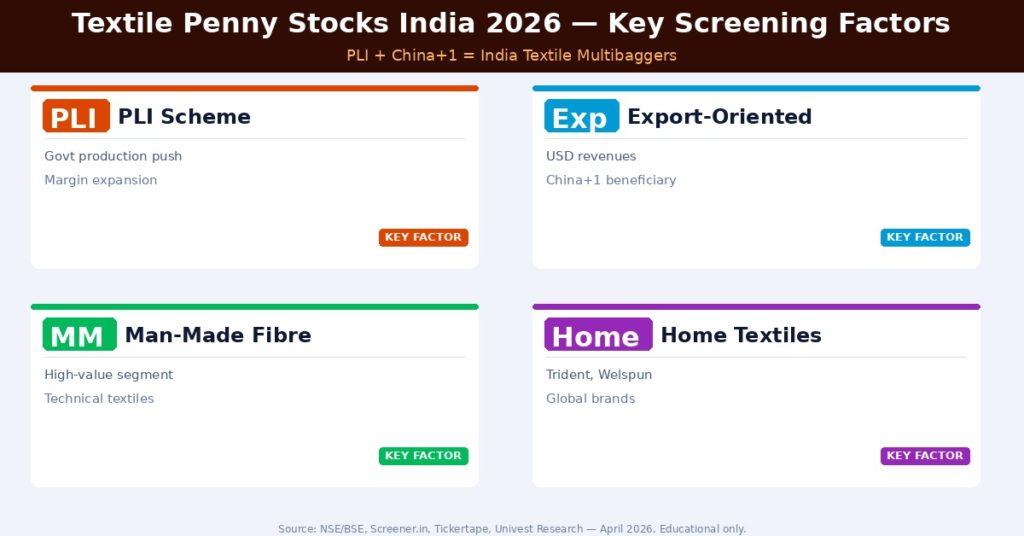
Textile penny stocks — PLI scheme tailwind, China+1 exports, man-made fibre demand, home textile global brands
PLI Scheme — Direct Revenue Uplift for Eligible Companies
India's Rs.10,683 crore Production Linked Incentive scheme for textiles specifically targets man-made fibre (MMF) segment and technical textiles — two sub-sectors where India was significantly underrepresented globally. PLI-eligible companies receive a production incentive of 15% in Year 1, declining to 11% by Year 6. For a small textile company with Rs.100 crore annual revenue, a 15% PLI-linked incentive translates to Rs.15 crore in additional income — potentially more than the company's entire pre-PLI operating profit.
China+1 Strategy — The Once-in-a-Generation Export Opportunity
The global apparel, home textiles, and technical textile supply chain spent three decades concentrated in China. The pandemic exposed the fragility of this single-source dependency, and geopolitical tensions have accelerated the diversification. India, Bangladesh, Vietnam, and Cambodia are the primary beneficiaries — but India has unique advantages in cotton-based products, home textiles, and increasingly man-made fibre fabrics, where it has been investing in capacity.
Technical Textiles — The High-Growth Niche Within Textiles
Technical textiles — including nonwoven fabrics, geotextiles for infrastructure projects, medical textiles, agro-textiles, and protective clothing — are growing at a 12-14% CAGR globally. India's technical textile market is still nascent, creating early-mover advantages for small companies that establish niche positions in specific technical textile categories. The government's Rs.4,445 crore National Technical Textiles Mission specifically supports R&D and capacity creation in this segment.
| Textile Sub-Sector | PLI Eligible? | Export Potential | Representative Companies |
| Man-Made Fibre Fabrics | Yes — core target | High — replacing China exports | Welspun India, Century Enka, others |
| Home Textiles (Towels, Bedsheets) | Partial | Very high — US/EU demand | Trident, Welspun (graduated), Himatsingka |
| Denim Textiles | No — cotton-based | Moderate — India strong in denim | Nandan Denim, Aravali Industries |
| Technical Textiles | Yes — under NTTM | Growing rapidly | Garware Technical Fibres (larger), small cos |
| Garment/Apparel | Partial (MSME focus) | High — China+1 beneficiary | SK International, smaller exporters |
Sub-sector overview for textile penny stock screening. Not a buy recommendation.
Top Textile Penny Stocks to Watch in 2026
Trident Limited — Home Textiles Giant in Penny Zone
Trident Limited is the largest manufacturer of terry towels in India and among the top 5 globally. It also manufactures paper and chemicals. Trading in the Rs.25-40 range, Trident qualifies as a penny stock and has delivered a 23% CAGR over 10 years. The company is debt-light, has consistent ROCE above 15%, and has built significant global brand relationships, including with IKEA, Walmart, and major US retailers. Trident's home textile division directly benefits from the China+1 sourcing strategy of global retail chains.
Nandan Denim — Denim Fabric Export Play
Nandan Denim is India's largest denim fabric manufacturer by capacity. Trading below Rs.30-50 in the penny zone, it has been a beneficiary of improving denim demand from garment exporters who supply global fast-fashion brands. The company has been working on its balance sheet — reducing D/E from above 2 toward 1 — and improving EBITDA margins through product mix upgrades toward premium stretch denim.
Morarjee Textiles — Premium Fabric Niche
Morarjee Textiles, part of the Ashok Piramal Group, manufactures premium cotton shirting fabrics and high-fashion printed fabrics for global brands. Trading below Rs.50, it is a niche textile penny stock that serves quality-conscious export markets in Europe and North America. The premium product positioning provides some insulation from commodity price cycles affecting bulk fabric manufacturers.
| Company | Sub-Sector | Price Range | Key Metric | Why Watch |
| Trident Ltd | Home Textiles | Rs.25-40 | ROCE>15%, 10Y CAGR 23% | Global home textile leader, China+1 |
| Nandan Denim | Denim Fabric | Rs.25-45 | Improving D/E | India's largest denim exporter, growth |
| Morarjee Textiles | Premium Fabric | Rs.30-50 | Piramal Group backing | Niche premium exports, global clients |
| Padam Cotton Yarns | Cotton Yarn | Rs.5-20 | High 5Y CAGR | Very small, high risk, pure speculation |
| SBC Exports | Garment Export | Rs.20-50 | Revenue CAGR improving | China+1 garment beneficiary |
Indicative list only. Not a buy recommendation. Verify current fundamentals on NSE/BSE before investing.
Risks in Textile Penny Stocks
- Cotton and polyester price volatility — raw material costs can swing 20-30% annually, directly impacting margins for weaving, spinning, and fabric companies that cannot pass costs on immediately.
- Currency risk for exporters — a strengthening rupee against the dollar directly reduces realisations for textile exporters. Most export revenues are in USD or EUR.
- Competition from Bangladesh and Vietnam — both countries offer lower labour costs for apparel manufacturing. India has advantages in fabric and yarn, but faces strong competition in made-up garments.
- Power cost sensitivity — textile manufacturing is power-intensive. States like Gujarat and Rajasthan offer power subsidies, but changes in energy policy can significantly impact margins.
- Working capital intensity — textile businesses typically have 90-120 day receivable cycles, requiring significant working capital that strains free cash flow generation.
Get SEBI-registered analyst guidance on textile sector stocks at Univest.
Conclusion
Textile penny stocks in India in 2026 sit at the intersection of government policy support (PLI scheme), global supply chain realignment (China+1), and domestic consumption growth — a rare triple-tailwind that creates genuine structural upside potential for quality operators over a 5-10 year horizon. The key is separating the genuine quality players from the commodity fabric manufacturers with poor fundamentals. Focus on companies with export orientation, debt reduction, improving ROCE, and exposure to technical textiles or home textile categories where India has established global brand relationships.
Frequently Asked Questions
What are the best textile penny stocks in India in 2026?
The most frequently cited textile penny stocks in India in 2026 include Trident Limited (home textiles, Rs.25-40), Nandan Denim (denim fabric, Rs.25-45), Morarjee Textiles (premium fabrics, Rs.30-50), and SBC Exports (garment exports). Trident is the highest quality name with a 10-year 23% CAGR track record. Always verify current fundamentals before investing.
How does the PLI scheme benefit textile penny stocks?
India's Rs.10,683 crore PLI scheme for textiles provides production-linked incentives of 11-15% to eligible companies for 5-7 years. For small textile penny stocks, this can represent a significant additional revenue stream — potentially doubling operating profits in early years. PLI-eligible companies are focused on man-made fibre fabrics and technical textiles. Not all penny stocks qualify — companies must meet minimum investment and production thresholds.
Which textile segment has the best penny stock opportunity?
Technical textiles and home textiles offer the best risk-reward within India's textile penny stock universe. Technical textiles (nonwovens, geotextiles, medical textiles) have a 12-14% global CAGR, government NTTM scheme support, and an early-mover advantage for small companies. Home textiles (towels, bedsheets) have established global brand relationships and direct China+1 sourcing benefit from US and European retailers.
Is Trident Limited a penny stock?
Yes, Trident Limited trades in the Rs.25-40 range (as of April 2026), placing it in penny stock territory by the common Indian definition of below Rs.50. Trident is, however, a significantly different quality proposition from most penny stocks — it is India's largest terry towel manufacturer, has a 23% 10-year CAGR, and serves major global retailers. It is a quality large company whose stock has retreated to penny price levels due to the broader market correction.
What are the risks of investing in textile penny stocks?
Key risks include raw material (cotton, polyester) price volatility that directly compresses margins, currency risk from USD revenue for exporters, competition from Bangladesh and Vietnam in garment manufacturing, power cost sensitivity, high working capital requirements, and governance risk common to all small-cap companies. Always limit textile penny stock exposure to a small portion of your overall portfolio.
Disclaimer: This article is for informational and educational purposes only and does not constitute investment advice or stock recommendations. Penny stocks carry very high risk, including potential total loss of capital. All data sourced from NSE/BSE, Screener.in, Tickertape, and company filings as of April 2026. Past performance does not guarantee future results. Consult a SEBI-registered financial advisor before making any investment decisions.
Recent Articles

3 Gas Terminal and Logistics Stocks With a Strong Future Roadmap: Petronet LNG, Delhivery and Gateway Distriparks
9 October 2026

3 Engineering Services and Telecom Technology Stocks With a Strong Future Roadmap: Cyient, Cyient DLM and HFCL
9 October 2026

3 Wellness Brand and Medical Device Stocks With a Strong Future Roadmap: Emami, Zydus Wellness and Poly Medicure
9 October 2026

3 Textile and Apparel Manufacturing Stocks With a Strong Future Roadmap: KPR Mill, Gokaldas Exports and Vardhman Textiles
9 October 2026
Note: This blog is for information purpose only. Investments and trading are subject to market risks, read all scheme related documents carefully.
Reviews






Recent Posts
3 Gas Terminal and Logistics Stocks With a Strong Future Roadmap: Petronet LNG, Delhivery and Gateway Distriparks
3 Engineering Services and Telecom Technology Stocks With a Strong Future Roadmap: Cyient, Cyient DLM and HFCL
3 Wellness Brand and Medical Device Stocks With a Strong Future Roadmap: Emami, Zydus Wellness and Poly Medicure
3 Textile and Apparel Manufacturing Stocks With a Strong Future Roadmap: KPR Mill, Gokaldas Exports and Vardhman Textiles
3 Premium Drinks Brand Stocks With a Strong Future Roadmap: United Breweries, Tilaknagar Industries and Sula Vineyards

Uniresearch Global Pvt Ltd
Research Analyst
SEBI Registration Number — INH000013776
Uniresearch is a subsidiary of Univest Communication Technologies Private Limited
Company Address: Registered Address: Ground Floor, Unitech Commercial Tower 2, Block B, Greenwood City, Unit 1-3, Sector 45, Gurugram, Haryana 122003
Write to us : support@univest.in, compliance@univest.in
Verify on SEBI registry →RESEARCH ANALYST
Get SEBI Registered
advice on the stocks
trending today.
Get 3 FREE Trade Ideas

for Startups Accelerator 2024

Trusted by 1Cr Indians

Awarded No.1 by Economic Times