
Tata Steel Share Price Target 2026: Analyst Forecast, Bull & Bear Case
Updated: 8 Apr 2026 • 6:38 pm
Posted by:

Tata Steel (NSE: TATASTEEL) is trading at Rs 148 as of early April 2026, against a 52-week high of Rs 185 and a 52-week low of Rs 120. The stock has delivered a 1-year return of -12%, placing it firmly in investor focus ahead of Q4 FY26 results and the annual FY27 guidance season. The analyst consensus 12-month Tata Steel share price target stands at Rs Rs 165–185 — implying meaningful potential movement from current levels.
Whether you are a long-term holder reassessing your position or a new investor evaluating entry levels, understanding where analysts see Tata Steel heading over the next 12–24 months requires looking beyond the CMP. This article covers the current share price, key catalysts and risks, technical support and resistance, institutional positioning, and a structured breakdown of the short-term, 12-month, and long-term Tata Steel share price targets.
About Tata Steel
[Click Here – Get Free Investment Predictions on Univest]
Tata Steel is a leading Indian publicly listed company in the Steel / Metals sector, with a market capitalisation of Rs 1,86,000 Cr. It trades at a price-to-earnings ratio of approximately 22x and price-to-book of 1.4x. In Q3 FY26, the company reported revenue of Rs 55,693 Cr and PAT of Rs 327 Cr. The current dividend expectation is Rs Rs 0.6–0.8 per share for FY26.
At its 52-week high of Rs 185, Tata Steel commanded a premium that partially reflected sector-wide enthusiasm and strong earnings delivery. The correction to Rs 148 has reset expectations — creating a debate between investors who see value at current levels and those who believe further pressure is possible in a high-macro-uncertainty environment. The share price target discussion below is structured to help you navigate both scenarios.
Tata Steel Share Price Snapshot — April 2026
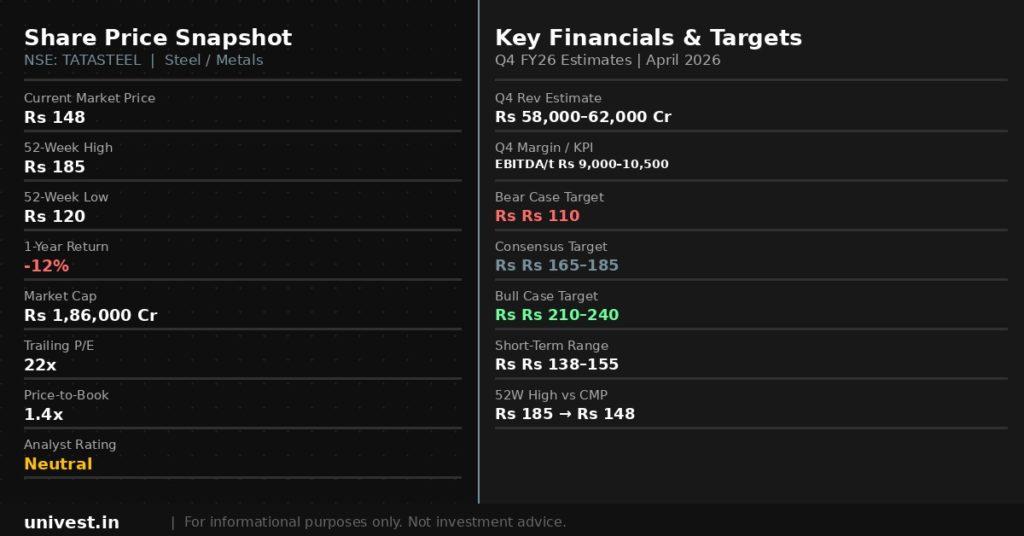
| Parameter | Value | Context |
| Current Market Price (CMP) | Rs 148 | NSE, early April 2026 |
| 52-Week High | Rs 185 | Peak valuation benchmark |
| 52-Week Low | Rs 120 | Support floor reference |
| 1-Year Return | -12% | Relative to Nifty -5% |
| Market Cap | Rs 1,86,000 Cr | Full market capitalisation |
| Trailing P/E | 22x | Valuation vs sector |
| P/B Ratio | 1.4x | Asset value premium |
| Expected Dividend | Rs Rs 0.6–0.8 | FY26 final dividend |
| Analyst Rating | Neutral | Consensus direction |
Track live price, fundamentals, and analyst upgrades on Univest Screener.
5 Key Catalysts for Tata Steel Share Price in 2026
[Tap to Access Best Research on Univest]
1. UK Steelworks Restructuring Outcome
UK Steelworks Restructuring Outcome is one of the primary variables that analysts are tracking ahead of Tata Steel's Q4 FY26 results and FY27 guidance. The market's reaction to management commentary on this factor will likely determine whether the stock can sustain a recovery toward the Rs Rs 165–185 consensus target or faces renewed pressure. Investors should monitor quarterly earnings calls and any exchange filings that address this issue directly.
2. India Volumes and EBITDA Per Tonne
India Volumes and EBITDA per tonne are one of the primary variables that analysts are tracking ahead of Tata Steel's Q4 FY26 results and FY27 guidance. The market's reaction to management commentary on this factor will likely determine whether the stock can sustain a recovery toward the Rs Rs 165–185 consensus target or faces renewed pressure. Investors should monitor quarterly earnings calls and any exchange filings that address this issue directly.
3. Chinese Steel Export Impact on Prices
Chinese Steel Export Impact on Prices is one of the primary variables that analysts are tracking ahead of Tata Steel's Q4 FY26 results and FY27 guidance. The market's reaction to management commentary on this factor will likely determine whether the stock can sustain a recovery toward the Rs Rs 165–185 consensus target or faces renewed pressure. Investors should monitor quarterly earnings calls and any exchange filings that address this issue directly.
4. Carbon Border Adjustment Europe
Carbon Border Adjustment Europe is one of the primary variables that analysts are tracking ahead of Tata Steel's Q4 FY26 results and FY27 guidance. The market's reaction to management commentary on this factor will likely determine whether the stock can sustain a recovery toward the Rs Rs 165–185 consensus target or faces renewed pressure. Investors should monitor quarterly earnings calls and any exchange filings that address this issue directly.
5. Debt Reduction from India Free Cash Flow
Debt Reduction from India Free Cash Flow is one of the primary variables that analysts are tracking ahead of Tata Steel's Q4 FY26 results and FY27 guidance. The market's reaction to management commentary on this factor will likely determine whether the stock can sustain a recovery toward the Rs Rs 165–185 consensus target or faces renewed pressure. Investors should monitor quarterly earnings calls and any exchange filings that address this issue directly.
Key Risks to the Tata Steel Share Price Target
US Tariff and Global Macro Headwinds
The 26% US reciprocal tariff on Indian goods — announced April 2, 2026 — has created a macro overhang that affects all Indian equities. For Tata Steel specifically, the indirect impact comes from FII outflows, earnings estimate cuts if global demand slows, and currency volatility. A tariff resolution in India-US negotiations would be a meaningful positive catalyst for re-rating.
Earnings Miss Risk in Q4 FY26 or FY27 Guidance
If Tata Steel's Q4 FY26 results come in below analyst estimates, or if FY27 guidance is below consensus, the share price could fall sharply from current levels — regardless of the longer-term fundamental story. Investors should be prepared for short-term volatility around results announcements.
FII Outflow Continuation
Foreign institutional investors have sold Rs 22,000 crore in Indian equities in a single week following the tariff announcement. Tata Steel's FII holding stands at a level where continued selling would create meaningful price pressure, particularly in the absence of strong domestic institutional support.
Sector-Specific Regulatory Risk
The Steel / Metals sector operates within a framework of evolving regulations. Any policy changes that increase compliance costs, restrict business practices, or alter competitive dynamics could affect Tata Steel's profitability beyond what current consensus models.
Valuation Multiple Compression
At 22x trailing P/E and 1.4x P/B, Tata Steel is not cheaply valued. In a risk-off environment, high-multiple stocks face disproportionate selling as investors rotate to defensives and fixed income. Any sustained period of elevated interest rates would put downward pressure on the multiple even if earnings hold up.
Technical Analysis: Support and Resistance Levels
Tata Steel is currently trading at Rs 148, below its 200-day moving average (DMA) — a broadly bearish technical configuration. The 52-week low of Rs 120 represents the most critical downside support. Below that level, the next support zones would be at prior consolidation areas identifiable from the 2-year price chart.
Key resistance on the upside sits at the 200-DMA, followed by the 52-week high of Rs 185. The stock needs to reclaim its 200-DMA on a closing basis before the broader trend can be considered to have reversed. For swing traders, the Rs Rs 138–155 range represents the near-term trading band.
Download the Univest iOS App or Univest Android App to set live price alerts and track Tata Steel movements in real time.
Institutional Positioning and Shareholding
Institutional holding trends for Tata Steel are a critical leading indicator for price direction. When FII holding falls for 2+ consecutive quarters, it often signals sustained price weakness; when it reverses, it frequently precedes a recovery rally. For Tata Steel specifically, the current FII holding trend and any changes in DII (domestic mutual fund) accumulation should be tracked closely.
Retail investor participation in Tata Steel has increased over the past year as the price corrected — a common pattern where retail investors perceive value while institutions are selling. This divergence typically resolves when institutional confidence returns, often triggered by a strong earnings print or macro improvement.
Tata Steel Share Price Target 2026: Short, Medium and Long Term
[Subscribe to Univest Pro for Premium Research and F&O Setups]
Short-Term Price Target (3–6 Months)
In the near term, Tata Steel's share price is likely to remain rangebound between Rs 138 and Rs 155, pending clarity on Q4 FY26 results, FY27 guidance, and macro developments, including the India-US tariff negotiation outcome. The bull case for the 3–6 month window would require a strong Q4 results beat combined with positive FY27 guidance, which could push the stock toward the upper end of the Rs Rs 138–155 range or beyond.
12-Month Analyst Consensus Target
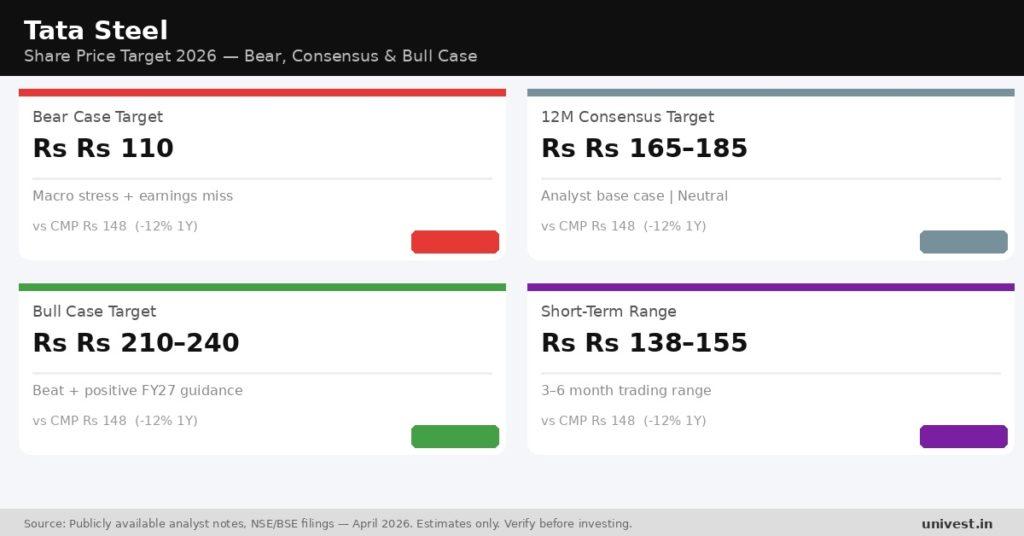
| Scenario | Price Target | Assumption |
| Bear Case | Rs Rs 110 | Earnings miss + macro deterioration |
| Base Case (Consensus) | Rs Rs 165–185 | In-line earnings + normal macro |
| Bull Case | Rs Rs 210–240 | Earnings beat + positive FY27 guidance |
| Short-Term Range | Rs Rs 138–155 | 3–6 month trading range |
| Long-Term Outlook (2027–28) | Rs Rs 220–280 | Full earnings cycle recovery |
The analyst consensus 12-month target for Tata Steel is Rs 165–185, representing a Neutral recommendation. This target assumes normalisation of the current macro headwinds, delivery on Q4 FY26 estimates, and positive FY27 guidance. In the bear case, a sustained risk-off environment combined with an earnings miss could push the stock toward Rs 110.
Long-Term Target (2027–28)
For investors with a 2–3 year horizon, analysts project Tata Steel toward Rs Rs 220–280. This long-term target is predicated on: full cycle earnings recovery, sector-level demand normalisation, institutional re-entry into the stock, and the company executing on its stated growth strategy for FY27–28.
Compare Tata Steel analyst targets against sector peers on Univest Screener.
Conclusion
Tata Steel (NSE: TATASTEEL) is trading at Rs 148, with a 12-month analyst consensus target of Rs 165–185 and a long-term outlook of Rs 220–280. The stock is currently below its 200-day moving average, reflecting macro uncertainty and near-term earnings caution. Key catalysts for re-rating include UK Steelworks Restructuring Outcome and India Volumes and EBITDA Per Tonne. Key risks include global macro headwinds, FII selling, and the potential for an earnings miss in Q4 FY26 or FY27.
Whether Tata Steel is a good buy at current levels depends on your investment horizon, risk appetite, and portfolio context. The bear case is well-defined at Rs 110; the 12-month upside potential at consensus is clear. For long-term investors who can hold through near-term volatility, the current correction may represent an entry opportunity — but position sizing and monitoring are essential.
For more share price target analysis across sectors, visit Univest Blogs.
Frequently Asked Questions
What is the Tata Steel share price target for 2026?
The Tata Steel share price target for 2026 is Rs 165–185 based on analyst consensus. The bear case is Rs 110, and the bull case is Rs 210–240. These are analyst estimates based on publicly available data as of April 2026 — actual price performance may differ materially.
Is Tata Steel a good buy at Rs 148?
At Rs 148, Tata Steel trades at 22x trailing P/E. The analyst consensus is Neutral with a 12-month target of Rs 165–185. Whether it is a good buy depends on your risk tolerance, investment horizon, and portfolio context. The short-term range is Rs 138–155. Consult a SEBI-registered financial advisor before investing.
What is the Tata Steel share price target for 2027?
For 2027, analysts project Tata Steel toward the Rs 220–280 range — assuming full cycle earnings recovery, FY27 guidance delivery, and normalisation of macro headwinds. This long-term target assumes no material deterioration in fundamentals and a stable macro environment through FY27–28.
Why is Tata Steel falling?
Tata Steel has declined -12% over the past year, reflecting a combination of macro headwinds (US tariff uncertainty, FII outflows), sector-specific challenges, and valuation compression. The stock has moved from Rs 185 to Rs 148 — a decline of 20%. Recovery requires a catalyst such as strong Q4 FY26 results and positive FY27 guidance.
What is Tata Steel's current dividend yield?
Tata Steel is expected to pay a dividend of Rs 0.6–0.8 per share for FY26, translating to a yield of approximately 0.0% at the current price of Rs 148. This provides some income floor while investors wait for price recovery.
What are the key risks for Tata Steel in 2026?
The key risks for Tata Steel in 2026 include: US tariff impact on macro sentiment, FII outflows from Indian equities, Q4 FY26 earnings miss risk, FY27 guidance below consensus, and valuation multiple compression in a risk-off environment. Investors should monitor quarterly results and analyst revision trends closely.
What are Tata Steel's 52-week high and low?
Tata Steel's 52-week high is Rs 185, and the 52-week low is Rs 120. The current price of Rs 148 is closer to the 52-week low, reflecting the broader market correction. The 52-week low is the critical downside support level to watch.
How can I track Tata Steel share price target updates?
You can track live price alerts, analyst upgrades and downgrades, and fundamental changes for Tata Steel on the Univest Screener and Univest App. Download the Univest iOS App or Univest Android App to receive real-time research from SEBI-registered analysts and set custom price alerts for Tata Steel.
Disclaimer: Investment in the share market is subject to risk. This article is for informational and educational purposes only and does not constitute investment advice. All analyst targets and financial data are sourced from publicly available information, including NSE/BSE filings, Screener. in, and company investor relations pages. Analyst targets are estimates and may change. Verify all numbers before investing. Consult a SEBI-registered financial advisor before making any investment decisions.
Recent Articles
Infosys Q4 Results 2026: Date, Revenue, PAT & Analyst Outlook
Best Agrolife Q4 FY26 Results Preview & Earnings Expectations
Bhansali Engineering Polymers Q4 FY26 Results Preview & Earnings Outlook
Recent Articles

Power Stocks: Anand Rathi Sees Demand Cycle Shifting to Value, Flags Clean Max and ACME Solar
8 October 2026

AMFI Reclassification From February 2027: Six Stocks Including Bosch, Lenskart and LG Electronics Could Enter the Large-Cap Club, Says Nuvama
8 October 2026

Hotel Stocks to Buy Before Diwali 2026? JM Financial Sees 12-13% RevPAR Growth and Backs Leela, Lemon Tree and ITC Hotels
8 October 2026

Paytm Share Price Drops 5% to Rs 1,641.50 as UPI MDR Rollout May Slip to January 2027: What Brokerages Say
8 October 2026
Note: This blog is for information purpose only. Investments and trading are subject to market risks, read all scheme related documents carefully.
Reviews






Recent Posts
Power Stocks: Anand Rathi Sees Demand Cycle Shifting to Value, Flags Clean Max and ACME Solar
AMFI Reclassification From February 2027: Six Stocks Including Bosch, Lenskart and LG Electronics Could Enter the Large-Cap Club, Says Nuvama
Hotel Stocks to Buy Before Diwali 2026? JM Financial Sees 12-13% RevPAR Growth and Backs Leela, Lemon Tree and ITC Hotels
Paytm Share Price Drops 5% to Rs 1,641.50 as UPI MDR Rollout May Slip to January 2027: What Brokerages Say
Physicswallah Share Price Jumps 41% in 2026 While Sensex Falls 8%: Is Motilal Oswal's Rs 200 Target Within Reach?
Popular this week
Sapphire Foods India (SAPPHIRE) Share Price Falls 5.09% as Mid Cap FMCG Stock Trades Lower

Uniresearch Global Pvt Ltd
Research Analyst
SEBI Registration Number — INH000013776
Uniresearch is a subsidiary of Univest Communication Technologies Private Limited
Company Address: Registered Address: Ground Floor, Unitech Commercial Tower 2, Block B, Greenwood City, Unit 1-3, Sector 45, Gurugram, Haryana 122003
Write to us : support@univest.in, compliance@univest.in
Verify on SEBI registry →RESEARCH ANALYST
Get SEBI Registered
advice on the stocks
trending today.
Get 3 FREE Trade Ideas

for Startups Accelerator 2024

Trusted by 1Cr Indians

Awarded No.1 by Economic Times