
Tata Mutual Fund: Best Schemes, SIP Plans, Returns & Complete Guide 2026
Updated: 1 Apr 2026 • 10:22 pm
Posted by:

Tata Mutual Fund, managed by Tata Asset Management Private Limited — a subsidiary of Tata Sons — is one of India's most trusted AMC brands, backed by the Tata Group's 150-year legacy of institutional integrity. With Rs.2.25 lakh crore in AUM across 452 schemes as of December 2025, Tata Mutual Fund may not be the largest AMC in India, but its fund management quality and brand trust make it a preferred choice for millions of long-term investors.
The Tata Small Cap Fund has been one of the standout performers in its category — delivering a 5-year CAGR of 21.30%, well above the small-cap category average. The Tata Mid Cap Fund has consistently delivered 19.57% over 3 years, and the India Pharma and Healthcare Fund has rewarded investors with sector-specific returns. These are not passive or index-tracking products — they are actively managed funds where sector expertise and stock selection drive alpha.
This article covers Tata Mutual Fund's best schemes, historical returns with live April 2026 data, who should invest in each fund, SIP starting guide, and tax implications. For personalised mutual fund recommendations, visit Univest.
About Tata Asset Management (Tata Mutual Fund)
Click Here — Get Free Investment Predictions
Tata Asset Management Private Limited was incorporated on March 15, 1994, as a subsidiary of Tata Sons — the holding company of the Tata Group. Over 30 years, it has built a reputation for ethical fund management, transparent communication with investors, and consistent performance across market cycles. Tata Mutual Fund serves 50+ lakh investors across India through 452 schemes spanning equity, debt, hybrid, ETFs, and solution-oriented categories.
The fund management team follows a research-driven, bottom-up stock selection approach. Key equity fund managers include Chandraprakash Padiyar (Small Cap), Anand V Sharma and Aditya Bagul (Flexi Cap), and specialised managers for sector and thematic funds. The AMC's research process emphasises fundamental quality, scalability of business models, and management track record — making its equity funds particularly suited for patient long-term investors.
Tata Mutual Fund has been an early mover in thematic and sector funds — India's Digital, Pharma Healthcare, and Banking and Financial Services funds are among the category leaders. The minimum SIP across most Tata equity schemes is Rs.100, and the lump sum minimum is Rs.5,000 for most schemes.
Top Tata Mutual Fund Schemes in 2026
Tap to Access Best Research Pieces on Univest
| Fund Name | Category | AUM (Cr) | 5Y CAGR | Min SIP | Risk |
| Tata Small Cap Fund | Small Cap | Rs.10,715 | 21.30% | Rs.100 | Very High |
| Tata Mid Cap Fund | Mid Cap | Rs.4,000+ | 13.54% | Rs.100 | Very High |
| Tata Flexi Cap Fund | Flexi Cap | Rs.3,699 | 11.99% | Rs.100 | Very High |
| Tata India Pharma & Healthcare | Sectoral | Rs.3,500+ | 16.56% | Rs.100 | Very High |
| Tata Banking & Fin Services | Sectoral | Rs.2,000+ | 14.4% | Rs.100 | Very High |
| Tata Large Cap Fund | Large Cap | Rs.2,500+ | 11.65% | Rs.100 | Very High |
Source: Tata AMC, Groww, Tickertape, INDmoney — April 2026. 5Y CAGR based on Direct Growth plan. Past returns do not guarantee future performance.
Detailed Fund Analysis — Tata Mutual Fund
Tata Small Cap Fund — The Jewel of the Tata MF Stable
The Tata Small Cap Fund is the standout performer in the Tata Mutual Fund range — delivering a 5-year CAGR of 21.30% (Regular Plan, as of February 2026) and consistently outperforming its benchmark, the Nifty Smallcap 250 TRI, over the long term. Managed by Chandraprakash Padiyar, the fund invests in a diversified portfolio of small-cap companies with strong fundamentals, low debt, and scalable business models.
The AUM stands at Rs.10,715 crore as of March 2026 — a size that still allows meaningful positions in smaller companies without the liquidity constraints that plague larger small-cap funds. The fund's alpha ratio of 10.25 is among the highest in the small-cap category, indicating consistent stock-selection skill above the benchmark. Exit load of 0.50% applies if redeemed within 30 days — lower than most equity funds.
Monitor the Tata Small Cap Fund's top holdings and sector allocation in real time on the Univest iOS App or Univest Android App.
Tata India Pharma and Healthcare Fund — Structural Sector Bet
The Tata India Pharma and Healthcare Fund is a sector fund investing in pharmaceutical companies, hospitals, diagnostics, and medical devices. With a 5-year CAGR of 16.56% and a 3-year CAGR of 19.57%, it has been one of the better-performing pharma sector funds in India. The fund benefits from structural tailwinds — India's growing health insurance coverage, rising healthcare spending as a percentage of GDP, and India's position as the pharmacy of the world through generic drug exports.
This fund is suitable only for investors who have a specific view on the healthcare sector and can tolerate sector-specific volatility. Unlike diversified equity funds, thematic and sector funds can underperform by 20-30% relative to the broader market if the sector undergoes a correction, which has happened in pharma in FY24 before the recovery. A minimum 5-7 year horizon is essential.
Tata Flexi Cap Fund — Quality Across Market Caps
The Tata Flexi Cap Fund is managed by Anand Sharma and Aditya Bagul with a philosophy of investing in companies with 'potential' rather than market cap or size — what Tata AMC calls its 'go anywhere' strategy. The fund delivered a 5-year CAGR of 11.99% (Direct Plan) and a 1-year return of 7.76% — both slightly below category leaders but with lower volatility as indicated by a standard deviation of 12.53. AUM stands at Rs.3,699 crore as of March 2026.
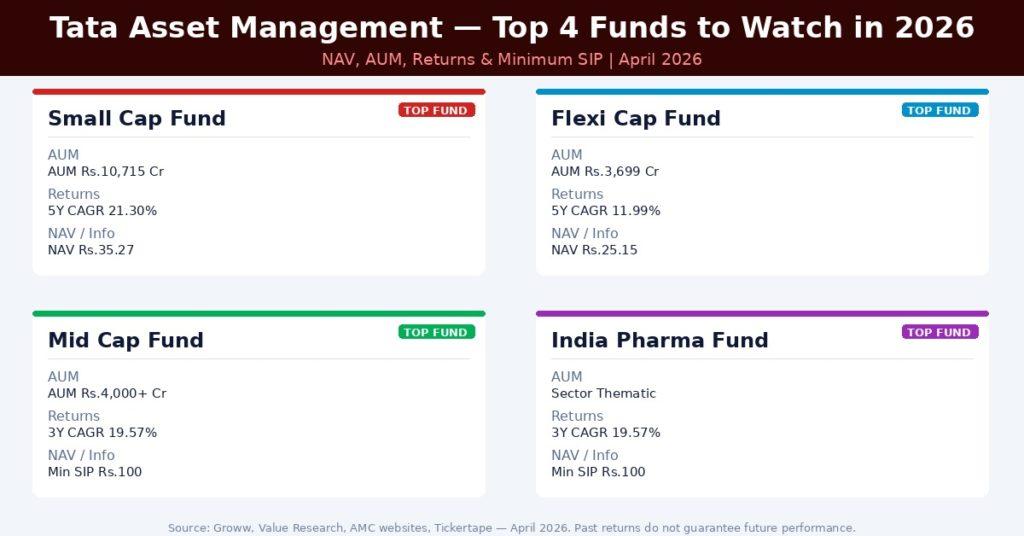
Tata Mutual Fund — top 4 schemes with AUM, returns, NAV and risk rating
How to Start SIP in Tata Mutual Fund
Starting a SIP in Tata Mutual Fund is straightforward, with a minimum SIP starting at Rs. 100 for most equity schemes. Here is the step-by-step process:
- Visit www.tatamutualfund.com or use any SEBI-registered mutual fund platform. Complete your one-time KYC using Aadhaar OTP and PAN.
- Choose between the Direct Plan (lower expense ratio) and the Regular Plan. The Direct Plan of the Tata Flexi Cap Fund has an expense ratio of 0.61% vs the Regular Plan's higher cost — Direct is recommended for self-directed investors.
- Select your SIP amount (minimum Rs.100 for equity funds), SIP date, and link your bank account for automated monthly deductions.
- Start with the Flexi Cap or Mid Cap Fund for diversified exposure. Add the Small Cap Fund only when you understand small-cap volatility and have a 7-year-plus horizon.
Who Should Invest in Tata Mutual Fund?
Tata Mutual Fund schemes are particularly well-suited for investors who value brand trust and long-term institutional integrity alongside fund performance. The Small Cap Fund is appropriate for aggressive investors with a minimum 7-year horizon who want exposure to India's emerging businesses. The Mid Cap and Flexi Cap Funds suit moderate-to-aggressive investors building a 5-year SIP portfolio. The Pharma and Healthcare Fund is for sector-specific investors with conviction in India's healthcare growth story. Conservative investors should look at Tata Mutual Fund's debt and hybrid offerings rather than pure equity schemes.
For personalised mutual fund scheme recommendations based on your risk profile, financial goals, and investment horizon, visit Univest Mutual Fund Advisory—India's SEBI-registered mutual fund and stock research platform.
Tax Implications — Tata Mutual Fund Equity Schemes
Mutual fund taxation in India is scheme-category specific. For all equity funds (large cap, midcap, small cap, flexi cap, ELSS, thematic) managed by this AMC:
- Short-Term Capital Gains (STCG) — if you redeem within 12 months of investment, gains are taxed at 20% regardless of your income tax slab.
- Long-Term Capital Gains (LTCG) — if you redeem after 12 months, gains above Rs.1.25 lakh per financial year are taxed at 12.5% without indexation benefit. Gains up to Rs.1.25 lakh annually are tax-free.
- ELSS (Tax Saver) Schemes — investments up to Rs.1.5 lakh per year qualify for deduction under Section 80C. The 3-year lock-in ensures all gains are automatically long-term.
- Dividend income — any dividends declared by equity mutual fund schemes are added to your taxable income and taxed at your applicable income tax slab rate.
Use the Univest Screener to compare post-tax returns across mutual fund categories and plan your portfolio tax-efficiently.
Key Risks Before Investing in Tata Mutual Fund
- Small-cap liquidity risk — the Tata Small Cap Fund, while outperforming over 5 years, has periods of severe underperformance, such as the -4.44% 1-year return (Regular Plan, as of February 2026). Small-cap funds require the ability to stay invested through 2-3 year drawdown periods without redemption.
- Smaller AUM disadvantage — with Rs.2.25 lakh crore total AUM, Tata Mutual Fund is significantly smaller than ICICI Prudential (Rs.11.30 lakh crore) and HDFC AMC (Rs.8+ lakh crore), which may translate to fewer research resources across sectors.
- Thematic fund concentration risk — the Pharma and Banking sector funds are undiversified and can significantly underperform the broader market during sector-specific corrections.
- Flexi Cap performance below category leaders — the Tata Flexi Cap Fund's 5-year CAGR of 11.99% is below the category's top performers like HDFC Flexi Cap (15%+) and Motilal Oswal Flexi Cap (20.5%). Investors who chose Tata Flexi Cap over peers have underperformed on a risk-adjusted basis.
- Exit load structure — the 0.50% exit load for redemption within 30 days for equity schemes is shorter than most peers, which is a positive. However, investors must still be aware that short-term trading in mutual funds generates unnecessary costs and tax friction.
Conclusion
Tata Mutual Fund — backed by 30 years of Tata Group institutional integrity — offers a compelling combination of consistent performance, brand trust, and accessible SIP options. The Small Cap Fund's 21.30% 5-year CAGR stands out in its category, the Mid Cap and Flexi Cap Funds provide diversified equity building blocks, and the Pharma Healthcare Fund rewards sector-conviction investors. For investors who value the Tata brand's promise of ethical, transparent operations alongside strong fund management, Tata Mutual Fund deserves a meaningful allocation in any long-term mutual fund portfolio.
Frequently Asked Questions
Is Tata Mutual Fund good for long-term investment?
Yes, Tata Mutual Fund has a 30-year track record and is backed by the Tata Group — one of India's most trusted corporate conglomerates. The Tata Small Cap Fund's 21.30% 5-year CAGR and the Mid Cap Fund's consistent performance make them solid long-term investment vehicles. For investors who prioritise institutional trust, ethical governance, and consistent performance over chasing the highest short-term returns, Tata Mutual Fund is a reliable choice.
What is the Tata Small Cap Fund's 5-year return?
The Tata Small Cap Fund has delivered a 5-year CAGR of 21.30% (Regular Plan) as of February 2026, well above the small-cap category average. The Direct Plan return is marginally higher due to the lower expense ratio of 0.41% vs the Regular Plan's 1.68%. The alpha ratio of 10.25 indicates consistent outperformance relative to the Nifty Smallcap 250 TRI benchmark over this period.
What is the Tata Mutual Fund's total AUM?
Tata Mutual Fund manages approximately Rs.2.25 lakh crore (Rs.2,25,719 crore) in AUM as of December 2025, spread across 452 schemes. This includes equity, debt, hybrid, ETF, and solution-oriented funds. While smaller than AMCs like ICICI Prudential (Rs.11.30 lakh crore) or HDFC (Rs.8+ lakh crore), Tata AMC's manageable AUM size actually helps in agility, especially in mid and small-cap stock selection.
What is the NAV of Tata Small Cap Fund?
The NAV of the Tata Small Cap Fund Direct Growth option was Rs.35.27 as of March 27, 2026. The Regular Plan NAV was approximately Rs.36.11 as of February 9, 2026. NAV is updated daily after market close and is available on the Tata AMC website, AMFI portal, and the Univest app for live tracking.
Can I start SIP in Tata Mutual Fund with Rs.100?
Yes, you can start a SIP in most Tata Mutual Fund equity schemes with a minimum of Rs.100 per month. This includes the Tata Small Cap Fund, Tata Flexi Cap Fund, Tata Mid Cap Fund, and sector funds like Pharma Healthcare and Banking. The minimum lump sum investment is typically Rs.5,000 for equity schemes and Rs.100 for SIP. This accessibility makes Tata Mutual Fund suitable for investors starting with small monthly savings.
Is Tata Mutual Fund better than Nippon India Mutual Fund?
Both Tata and Nippon India Mutual Fund have strong offerings in different categories. Tata excels in small-cap (21.30% 5Y CAGR vs Nippon's 23%+) and sector funds. Nippon India has historically been stronger in small-cap and mid-cap categories on absolute returns. For index funds, both offer competitive low-cost options. The right choice depends on the specific scheme and category you are comparing, not the AMC brand alone.
How to check Tata Mutual Fund NAV?
You can check Tata Mutual Fund's daily NAV through: (1) the Tata AMC website (tatamutualfund.com), (2) the AMFI website (amfiindia.com), which lists all scheme NAVs daily, (3) CAMS or KFintech portals, or (4) the Univest app, which provides real-time NAV and portfolio tracking for all Tata Mutual Fund schemes.
What are the best Tata Mutual Fund schemes for SIP in 2026?
For 2026, the Tata Small Cap Fund is the standout pick for aggressive investors — 21.30% 5Y CAGR, manageable AUM, and strong alpha generation. The Tata Mid Cap Fund suits moderate investors wanting mid-cap exposure. For diversified equity, the Tata Flexi Cap Fund is a low-volatility option. For sector conviction investors, the Tata India Pharma and Healthcare Fund (16.56% 5Y CAGR) is worth considering with a 7-year horizon.
Disclaimer: Mutual fund investments are subject to market risks. Please read all scheme-related documents carefully before investing. All NAV, AUM, and return data in this article are sourced from AMFI, AMC websites, Groww, Value Research, and Tickertape as of April 2026. Past returns do not guarantee future performance. This article is for informational and educational purposes only and does not constitute investment advice. Consult a SEBI-registered financial advisor before making any investment decision.
Recent Articles

Best SIP to Invest in 2026: How to Pick Funds by Goal, Horizon and Cost, With the SIP Maths
8 October 2026

Best Mutual Fund Advisor in India: How to Choose One You Can Trust, From SEBI Checks to Fee Traps
8 October 2026

Tata Resources & Energy Fund Direct Growth Review 2026: NAV, Returns, Portfolio & Should You Invest?
21 September 2026

Kotak Multi Asset Allocation Fund Direct Growth Review 2026: NAV, Returns, Portfolio & Should You Invest?
21 September 2026
Note: This blog is for information purpose only. Investments and trading are subject to market risks, read all scheme related documents carefully.
Reviews






Recent Posts
Best SIP to Invest in 2026: How to Pick Funds by Goal, Horizon and Cost, With the SIP Maths
Best Mutual Fund Advisor in India: How to Choose One You Can Trust, From SEBI Checks to Fee Traps
Tata Resources & Energy Fund Direct Growth Review 2026: NAV, Returns, Portfolio & Should You Invest?
Kotak Multi Asset Allocation Fund Direct Growth Review 2026: NAV, Returns, Portfolio & Should You Invest?
Baroda BNP Paribas Large & Mid Cap Fund Direct Growth Review 2026: NAV, Returns, Portfolio & Should You Invest?

Uniresearch Global Pvt Ltd
Research Analyst
SEBI Registration Number — INH000013776
Uniresearch is a subsidiary of Univest Communication Technologies Private Limited
Company Address: Registered Address: Ground Floor, Unitech Commercial Tower 2, Block B, Greenwood City, Unit 1-3, Sector 45, Gurugram, Haryana 122003
Write to us : support@univest.in, compliance@univest.in
Verify on SEBI registry →RESEARCH ANALYST
Get SEBI Registered
advice on the stocks
trending today.
Get 3 FREE Trade Ideas

for Startups Accelerator 2024

Trusted by 1Cr Indians

Awarded No.1 by Economic Times