
Stock Market for Beginners in India 2026: The Complete Step-by-Step Guide
Updated: 6 Apr 2026 • 6:36 pm
Posted by:

India's stock market for beginners has never been more accessible — with over 16 crore demat accounts opened as of March 2026 and the NSE now the world's largest derivatives exchange by volume. Yet most first-time investors lose money in their first year, not because markets are rigged, but because they start trading before they understand the basics.
India's BSE (Bombay Stock Exchange) and NSE (National Stock Exchange) list over 5,000 companies. The Sensex — India's benchmark index tracking 30 of BSE's largest stocks — has historically delivered approximately 12% CAGR returns over 20-year periods. The Nifty 50 tracks 50 large-cap stocks on NSE and is the more widely followed index for institutional investors.
This guide covers everything a beginner needs to know about the Indian stock market in 2026: how it works, how to open a demat account, how to pick your first stock, what mistakes to avoid, and how to use a SEBI-registered advisory service to learn alongside real investments.
What is the Stock Market? — Basics for Beginners
[Click Here – Get Free Investment Predictions on Univest]
The stock market is a regulated marketplace where investors buy and sell shares (ownership stakes) in publicly listed companies. When you buy one share of Tata Consultancy Services (TCS) on NSE, you own a tiny fraction of TCS — and you benefit when TCS's profits grow and its share price rises. India has two primary stock exchanges: BSE (Bombay Stock Exchange, est. 1875) and NSE (National Stock Exchange, est. 1992). Almost all stocks are listed on both.
The stock market for beginners in India operates Monday to Friday, 9:15 AM to 3:30 PM IST (pre-market session: 9:00–9:15 AM). You cannot buy or sell shares outside these hours in the equity segment, though derivative contracts on F&O have different hours. All transactions are cleared by the National Securities Clearing Corporation of India (NSCCL) and shares are held in dematerialised (digital) form in your demat account.
Key Dates and Budget Highlights Relevant to Beginners in 2026
[Tap to Access Best Research Pieces on Univest]
- Budget 2026-27 STT Revision: The Securities Transaction Tax (STT) on F&O trades was revised in Budget 2025 and applies from FY26. Beginners in equity delivery trading are not affected — STT on delivery trades remains 0.1% of transaction value.
- RBI Rate Cuts FY26: The RBI cut repo rates by 50 bps in FY26 to 5.75%, making fixed deposits less attractive and pushing more savers toward equity markets — a structural tailwind for new investors.
- SEBI F&O Regulations 2025: SEBI tightened F&O eligibility criteria in 2025 — beginners are advised to trade only in equity delivery (not derivatives) for the first 12 months until fundamentals are mastered.
- Demat Account Growth: 16 crore+ demat accounts by March 2026, with 40% first-time investors. This growth is driven by simpler KYC, lower brokerage, and mobile-first trading apps.
- West Asia Conflict (April 2026): Crude oil above $100 has increased market volatility in April 2026. Beginners should start with SIP-like equity investments rather than lump-sum entries during high-volatility periods.
Step-by-Step: How to Start Investing in the Stock Market as a Beginner
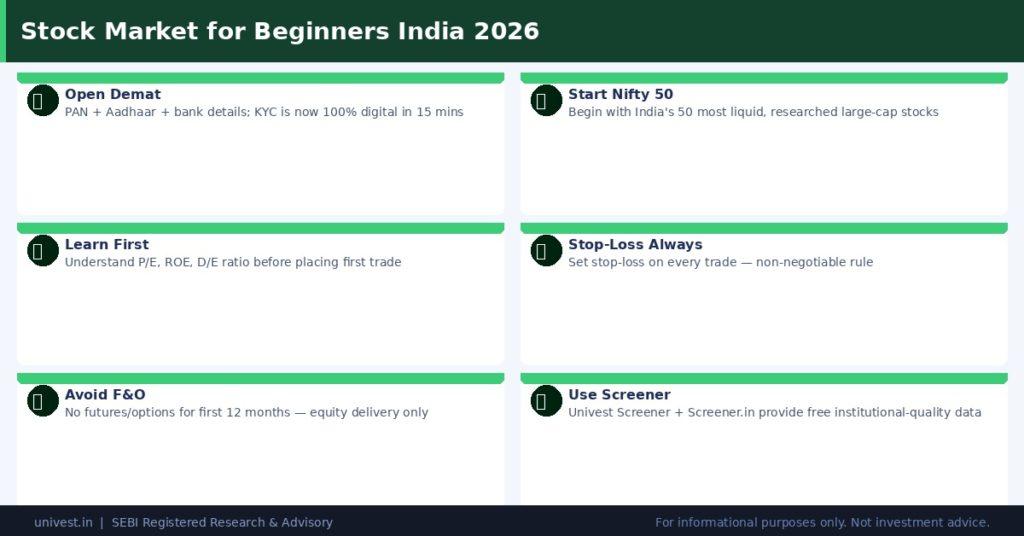
Step 1: Learn the Basics Before You Invest
The biggest mistake beginners make is opening a demat account and immediately buying stocks based on tips. Before you invest even Rs 1, spend two to four weeks understanding: what is a P/E ratio, what does revenue growth mean, what is a stop-loss, and what is the difference between an equity delivery trade and an intraday trade. Use free resources on Univest Blogs and Screener.in to build your knowledge base.
Step 2: Open a Demat Account
A demat account holds your shares in electronic form. You need two linked accounts to trade: a demat account (holds shares) and a trading account (executes buy/sell orders). Most platforms open both simultaneously. Documents required: PAN card, Aadhaar card, bank passbook copy, and a cancelled cheque. The KYC process is now fully digital and takes 15–30 minutes on mobile.
Choose a broker with low brokerage: full-service brokers charge 0.3–0.5% per trade, while discount brokers charge flat Rs 5–20 per trade regardless of trade size. For beginners with smaller trade sizes, discount brokers significantly reduce costs.
Step 3: Start with Nifty 50 or Large-Cap Stocks
As a beginner, your first stock purchases should be from the Nifty 50 — India's 50 largest, most liquid, and most institutionally tracked companies. These include TCS, HDFC Bank, Reliance Industries, Infosys, ICICI Bank, and others. Large-cap stocks are less likely to be manipulated, have transparent financial disclosures, and are easier to research. Avoid penny stocks and small-cap stocks until you have 12+ months of experience.
Step 4: Understand Before Buying — Research Every Stock
For every stock you consider buying, answer five questions: What does the company do? Is revenue growing? Is the company profitable? What is its debt level? Is the promoter holding stable? Use Screener.in for financial data and the Univest Screener for combined fundamental + technical signals. Never buy a stock because a friend recommended it or because it appeared on a viral social media post.
Screen stocks by revenue growth, ROE, and momentum — Check Univest Screener
Step 5: Use a Stop-Loss on Every Trade
A stop-loss is an automatic sell order that triggers when a stock falls below a pre-defined price, limiting your loss. For example, if you buy a stock at Rs 100, setting a stop-loss at Rs 90 means your maximum loss is 10% per trade. Never enter a trade without a stop-loss. This single discipline separates investors who survive the learning curve from those who wipe out their capital in the first year.
Common Stock Market Mistakes Beginners Make in India
- Trading on Tips Without Research: Acting on Telegram tips, WhatsApp forwards, or YouTube "analysts" without doing your own research is the most common way beginners lose money. SEBI has repeatedly warned about unregistered advisors operating on these platforms.
- Starting with F&O Before Equity: Futures and options are leveraged instruments where you can lose more than your invested capital. Most beginners who start with F&O trading lose their initial capital within six months. Start with equity delivery for at least 12 months.
- Over-Concentrating in One Stock: Never put more than 10–15% of your equity portfolio in a single stock. Even the best-researched companies can decline 30–50% on unexpected news — sector funds or index funds provide better starting diversification.
- Ignoring Taxes: Short-term capital gains (holding < 1 year) on equity are taxed at 20%, while long-term gains above Rs 1.25 lakh are taxed at 12.5% (post-Budget 2024 changes). Factor taxes into your return expectations from day one.
- Selling Good Stocks Too Early, Holding Bad Stocks Too Long: Behavioral finance research shows investors tend to sell winning stocks prematurely (to "lock in profit") while holding losing stocks indefinitely (hoping for recovery). The opposite is correct: cut losses short, let winners run.
Download the Univest iOS App or Univest Android App for SEBI-registered advisory, daily market insights, and a beginner-friendly stock screener.
Best Stocks for Beginners to Research in India 2026
| Company | NSE Symbol | Sector | Why for Beginners |
| HDFC Bank | HDFCBANK | Banking | India's largest private bank; transparent disclosures; liquid |
| TCS | TCS | IT Services | India's largest IT company; consistent dividend payer; low debt |
| Reliance Industries | RELIANCE | Conglomerate | Diversified; Jio + Retail + O2C; promoter-led with Ambani family |
| Infosys | INFY | IT Services | Strong corporate governance; quarterly guidance discipline |
| ITC | ITC | FMCG/Conglomerate | High dividend yield; FMCG + agri + hotels — diversified cashflows |
| SBI | SBIN | PSU Banking | Government backing; 500 Mn customer base; improving RoE |
| NTPC | NTPC | Power | Regulated earnings; 5%+ dividend yield; renewable expansion |
Data for educational reference. Verify current financials on Screener.in and NSE before investing. Not a stock recommendation.
How to Use a SEBI-Registered Advisory to Learn Faster
One of the fastest ways to learn stock market investing as a beginner is to follow a SEBI-registered advisory service — not to blindly act on its recommendations, but to understand why a stock was recommended. Read the research rationale, check the entry and stop-loss levels, and then decide whether you agree with the analyst's view based on your own basic research.
Univest Pro, starting at Rs 6/day, provides exactly this learning environment: SEBI-registered analyst calls with full rationale, entry, stop-loss, and target — creating a classroom where your capital is simultaneously at work and your knowledge base is growing.
Conclusion
The stock market for beginners in India in 2026 is more accessible than ever — mobile KYC, flat-fee brokerage, and SEBI-registered advisory apps have democratised institutional-quality research. Start with the Nifty 50, use Screener.in or the Univest Screener for research, set stop-losses on every trade, and never act on unregistered tips. Beginners who respect these four rules have a genuinely strong chance of building wealth through equity over a 5–10 year horizon. Those who do not respect them lose capital in the first 12 months.
Investments in securities are subject to market risk. Please read all related documents carefully before investing. This content is for educational purposes only and does not constitute investment advice. Past performance is not indicative of future results. Consult a SEBI-registered investment advisor before making any investment decision.
Frequently Asked Questions
Q1. How do beginners start investing in the stock market in India?
Beginners should: (1) open a demat + trading account with a SEBI-registered broker, (2) learn basic financial metrics like P/E, revenue growth, and debt/equity ratio, (3) start with Nifty 50 large-cap stocks with transparent financials, (4) set a stop-loss on every trade, and (5) use a SEBI-registered advisory service like Univest to learn alongside real investments. Avoid F&O and penny stocks for at least the first 12 months.
Q2. How much money do I need to start investing in the Indian stock market?
You can start with as little as Rs 500–1,000 to buy one share of some stocks, or Rs 100 to invest in an index fund via SIP (Systematic Investment Plan). There is no statutory minimum. However, to effectively practice trading and cover brokerage costs meaningfully, most beginners find Rs 10,000–25,000 as a starting amount allows enough diversification across 3–5 stocks.
Q3. What is a demat account and why do beginners need it?
A demat account (dematerialised account) holds your shares in electronic form instead of physical certificates. It is mandatory to have a demat account to buy or sell shares on NSE or BSE. It is linked to a trading account (for executing orders) and a bank account (for fund transfers). Documents needed: PAN, Aadhaar, and bank details. KYC is now 100% digital and takes 15–30 minutes.
Q4. What are the basic risks of investing in the stock market for beginners?
Key risks for beginners include: (1) market risk — stock prices can fall significantly even for quality companies during broader market corrections, (2) liquidity risk — some small-cap stocks may be difficult to sell quickly, (3) fraud risk — unregistered advisors can cause capital loss, (4) behavioral risk — emotional buying at highs and panic selling at lows. Using SEBI-registered advisory, setting stop-losses, and diversifying across sectors reduce these risks.
Q5. Is the Indian stock market safe for beginners?
The Indian stock market is regulated by SEBI (Securities and Exchange Board of India), making it one of Asia's most tightly regulated equity markets. Investor protection mechanisms include mandatory disclosures by listed companies, SEBI SCORES complaint portal, and T+1 settlement (shares credited within one trading day). Safety for beginners comes from sticking to SEBI-regulated brokers, avoiding unregistered "advisors," and starting with large-cap stocks.
Q6. What is the Nifty 50 and why should beginners start with it?
The Nifty 50 is the benchmark index of the National Stock Exchange, tracking India's 50 largest companies by market capitalisation across sectors. For beginners, it is ideal because these companies have transparent financial disclosures, strong institutional research coverage, high liquidity, and decades of financial history. Index funds tracking the Nifty 50 are also the simplest starting investment for complete beginners — buying one unit gives diversified exposure to 50 companies.
Q7. How do beginners avoid stock market scams in India?
Three rules prevent most scams: (1) never act on tips from unregistered Telegram, WhatsApp, or Instagram accounts — SEBI has flagged thousands of such fraudulent operators, (2) verify the SEBI registration number of any advisory service on sebi.gov.in before paying, (3) never pay large upfront fees (Rs 20,000+) for guaranteed profit advisory — no SEBI-registered entity can guarantee profits.
Q8. What is the best way for beginners to learn stock market investing in India?
The most effective learning method combines: (1) reading free educational content on platforms like Univest Blogs, Screener.in, and Groww, (2) using paper trading or small-capital trades to apply concepts in real markets, (3) subscribing to a SEBI-registered advisory service and reading the research rationale behind every recommendation — this is equivalent to paid mentoring at Rs 6–30 per day. Avoid courses charging Rs 10,000–50,000 that promise to make you an expert in a weekend.
Recent Article
Mphasis Q4 Results 2026: Date, Revenue Estimates, Key Catalysts & Share Price Target
Mastek Q4 Results 2026: Date, Revenue Estimates, Key Catalysts & Share Price Target
Cyient Q4 Results 2026: Date, Revenue Estimates, Key Catalysts & Share Price Target
KPIT Technologies Q4 Results 2026: Date, Revenue Estimates, Key Catalysts & Share Price Target
Zensar Technologies Q4 Results 2026: Date, Revenue Estimates, Key Catalysts & Share Price Target
Recent Articles

Is Gujarat Ambuja Exports the Best Stock in Its Sector? A Look at the Numbers
16 October 2026

Is Samvardhana Motherson International the Best Stock in Its Sector? A Look at the Numbers
16 October 2026

Is Nitta Gelatin India the Best Stock in Its Sector? A Look at the Numbers
16 October 2026

Is Fermenta Biotech the Best Stock in Its Sector? A Look at the Numbers
16 October 2026
Note: This blog is for information purpose only. Investments and trading are subject to market risks, read all scheme related documents carefully.
Reviews






Recent Posts
Is Gujarat Ambuja Exports the Best Stock in Its Sector? A Look at the Numbers
Is Samvardhana Motherson International the Best Stock in Its Sector? A Look at the Numbers
Is Nitta Gelatin India the Best Stock in Its Sector? A Look at the Numbers
Is Fermenta Biotech the Best Stock in Its Sector? A Look at the Numbers
Is Kansai Nerolac Paints the Best Stock in Its Sector? A Look at the Numbers
Popular this week
Is WPIL the Best Stock in Its Sector? A Look at the Numbers

Uniresearch Global Pvt Ltd
Research Analyst
SEBI Registration Number — INH000013776
Uniresearch is a subsidiary of Univest Communication Technologies Private Limited
Company Address: Registered Address: Ground Floor, Unitech Commercial Tower 2, Block B, Greenwood City, Unit 1-3, Sector 45, Gurugram, Haryana 122003
Write to us : support@univest.in, compliance@univest.in
Verify on SEBI registry →RESEARCH ANALYST
Get SEBI Registered
advice on the stocks
trending today.
Get 3 FREE Trade Ideas

for Startups Accelerator 2024

Trusted by 1Cr Indians

Awarded No.1 by Economic Times