
Sensex Drops 554 Points on Expiry Day — What Wrecked the 4% Rally in 24 Hours?
Updated: 9 Apr 2026 • 1:33 pm
Posted by:

If you watched Dalal Street yesterday — Wednesday, April 8 — and cheered a 4% single-day rally, Thursday was a rude reminder that markets don't hand out wins that easily. Sensex closed down 554 points at around 77,009. Nifty 50 slipped to roughly 23,863. And the five-day winning streak that had everyone quietly optimistic? Gone, just like that.
This wasn't a random selloff. There were four very specific reasons this happened. Let's go through each one, because understanding Thursday's fall matters more than just knowing the number.
First, the Obvious: Profit-Booking Was Coming
When any index rises nearly 4% in a single session, traders who bought early start cashing out the next morning. That's not pessimism — that's basic market behavior. Wednesday's rally was triggered by the Iran-US ceasefire announcement, which caused oil prices to fall sharply and gave markets a shot of optimism.
But by Thursday morning, US President Donald Trump made it clear that tensions were far from over. His social media post signalled the situation with Iran remained unstable until a 'real pact' was reached. Oil prices reversed course almost immediately, climbing back toward $92 a barrel. The ceasefire euphoria, as beautiful as it was for 24 hours, had a very short shelf life.
Track live Nifty and Sensex levels on Univest Screener.
The Expiry Day Effect — Not Just a Coincidence
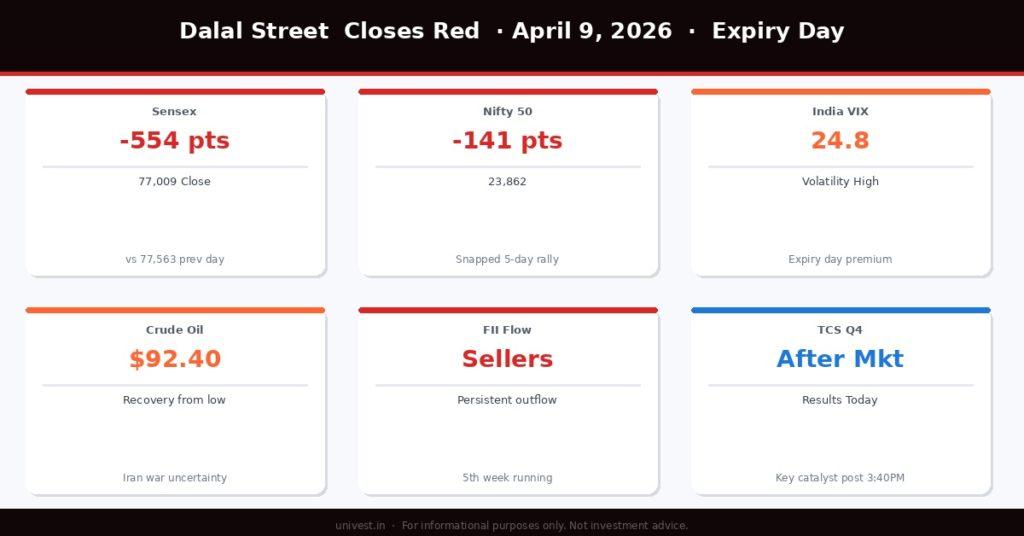
Thursday was also Sensex weekly expiry day. That matters more than most retail investors realise. On expiry days, institutional desks are unwinding positions, options sellers are covering risk, and traders who held long positions from Wednesday's surge are rolling over or squaring off.
India VIX — the market's fear gauge — was elevated around 24.8 through much of the session. That's not extreme panic territory, but it reflects real uncertainty. When VIX is high on expiry day, the swings get amplified. Stocks that should have moved half a percent ended up moving two percent in either direction. That kind of volatility is why a lot of retail traders got stopped out of positions they thought were safe.
Adani Ports fell more than two percent. Infosys was among the laggards. Banking names, which led Wednesday's charge, gave back a chunk of their gains. It wasn't a collapse — it was a controlled retreat. But the timing of expiry made it messier than it needed to be.
TCS Q4 Results Kept Everyone on Their Toes
Tata Consultancy Services was due to report Q4 FY26 results after market hours on April 9. India's largest IT company releasing its earnings was always going to make the market cautious during the trading session. Analysts expected net profit to rise roughly 12–14% year-on-year to around Rs 13,750 crore, with revenue growing nearly 8% to approximately Rs 69,500 crore.
But expectations and results are different animals. Nobody wanted to hold large long positions in IT stocks while waiting for numbers after the bell. So TCS, Infosys, and HCL Tech saw nervous trading, despite the fact that TCS had already rallied sharply across the previous five sessions. The wait-and-watch approach drained buying energy from a sector that had been the market's backbone in recent weeks.
Get free investment predictions on Univest ahead of Q4 results.
Crude Oil — The Wild Card That Just Won't Go Away
The West Asia conflict between the US and Iran has been driving crude oil's mood swings for weeks now. Brent crude fell sharply on Wednesday when the ceasefire was announced — some brokers reported it briefly dipping toward $88 a barrel. By Thursday morning, with Trump's remarks throwing doubt on the peace deal, Brent recovered to around $92.40.
For India, which imports roughly 85% of its crude requirements, every dollar increase in oil price has a direct impact on the current account deficit, retail fuel costs, and corporate margins across aviation, paints, chemicals, and logistics. When oil goes up, FII funds that model India's macro story get nervous, and selling pressure picks up almost automatically.
FIIs Remain Persistent Sellers — But DIIs Are Buying
Foreign institutional investors continued their selling streak on Thursday. FII outflows have been running for weeks — with reports of over Rs 1.14 lakh crore in FII selling through March 2026. The pattern hasn't fully reversed yet, even as the broader market has bounced from its April 2 low.
The silver lining is domestic institutional investors — mutual funds, insurance companies, and pension funds — who have been buying into this weakness. DII inflows of around Rs 7,979 crore on a recent trading day show that domestic money is absorbing the FII selling. This is the difference between a correction that bottoms out versus one that turns into a genuine bear market.
Market Snapshot — April 9, 2026
| Index / Metric | Closing Level | Change | Key Note |
| Sensex | ~77,009 | -554 pts (-0.71%) | 5-session rally snapped |
| Nifty 50 | ~23,863 | -141 pts (-0.59%) | Below 24,000 again |
| India VIX | ~24.8 | Elevated | Expiry day volatility |
| Brent Crude | ~$92.40 | Recovered | Iran deal uncertainty |
| Bank Nifty | Weak | Gave back gains | Post-ceasefire unwind |
| Nifty IT | Cautious | Wait-and-watch | TCS Q4 post market |
What Should You Actually Do Right Now?
Thursday's close in the red doesn't erase what happened this week. The market is up significantly from its April 2 low. The key question for the coming sessions is whether TCS's Q4 results — and the broader IT earnings season — give the market a reason to sustain or whether the earnings season disappoints.
If TCS prints strong numbers with confident FY27 guidance, expect IT to rally sharply on Friday. That could lift the Nifty back above 24,100. If numbers disappoint or guidance is cautious, IT stocks could see another leg down, which would drag the index further.
The RBI's rate decisions, crude oil's direction, and FII buying-selling data in the next 10 days are the three gauges worth watching. For investors with longer horizons, the structural story of India's economy hasn't changed — this volatility is a feature of the current market cycle, not a sign that something fundamental has broken.
Download the Univest iOS App or Univest Android App for daily market alerts and SEBI-registered research.
FAQs
Why did Sensex fall today on April 9, 2026?
Sensex fell 554 points on April 9 due to four reasons: profit-booking after Wednesday's 4% surge, Sensex weekly expiry day volatility, Trump's unclear remarks on the Iran-US situation reversing crude oil's fall, and pre-TCS Q4 results caution keeping IT stocks in a wait-and-watch mode. FII selling also continued, capping any recovery attempt.
What happened to Nifty on April 9, 2026?
Nifty 50 slipped around 141 points to close near 23,863, falling below the 24,000 mark after five consecutive sessions of gains. The index had surged 3.78% on Wednesday following the Iran-US ceasefire announcement, and Thursday's dip was largely a consolidation of those outsized gains against the backdrop of renewed geopolitical uncertainty.
Why did the market fall on Sensex expiry day?
Expiry days amplify market moves because institutional desks unwind futures and options positions simultaneously. With India VIX at 24.8 and geopolitical uncertainty from the Iran situation, traders who were long from Wednesday's rally chose to square off positions rather than risk holding through a potentially volatile outcome. This position unwinding, combined with FII selling, pushed markets lower.
Will the market recover tomorrow — April 10, 2026?
Market direction on April 10 will depend primarily on TCS Q4 FY26 results announced after close on April 9. If TCS reports strong revenue growth (above 7–8% YoY) and gives confident FY27 guidance, IT stocks are likely to rally, lifting the Nifty back toward 24,100–24,200. Gift Nifty and global market cues will also set the morning tone.
What is India VIX and why does it matter?
India VIX is the NSE's volatility index — often called the 'fear gauge.' It reflects the market's expectation of volatility over the next 30 days. A VIX around 25 indicates high uncertainty. When VIX is elevated, options premiums are expensive and intraday swings are wider than normal. Traders use VIX as a risk management signal.
Disclaimer: Investments are subject to market risk. This article is for educational and informational purposes only and does not constitute investment advice. Consult a SEBI-registered financial advisor before making investment decisions.
For more market analysis, visit Univest Blogs.
Recent Article
Mphasis Q4 Results 2026: Date, Revenue Estimates, Key Catalysts & Share Price Target
Mastek Q4 Results 2026: Date, Revenue Estimates, Key Catalysts & Share Price Target
Cyient Q4 Results 2026: Date, Revenue Estimates, Key Catalysts & Share Price Target
KPIT Technologies Q4 Results 2026: Date, Revenue Estimates, Key Catalysts & Share Price Target
Zensar Technologies Q4 Results 2026: Date, Revenue Estimates, Key Catalysts & Share Price Target
Recent Articles

Indian Railway Finance Corporation (IRFC): IRFC Share Price Falls 2.03% as Finance Valuation Stays in Focus
19 October 2026

Modulex Construction Technologies Ltd. (MODULEX) Construction Technologies 52 Week Low Streak: Why the Stock Has Stayed Near Its One-Year Low
19 October 2026

Veeram Securities (VSL) Share Price Rises 8.14% as VSL Trades at Rs 9.83
19 October 2026

Fiem Industries (FIEMIND) Share Price Falls 5.38% as Mid Cap Auto Ancillary Slides
19 October 2026
Note: This blog is for information purpose only. Investments and trading are subject to market risks, read all scheme related documents carefully.
Reviews






Recent Posts
Indian Railway Finance Corporation (IRFC): IRFC Share Price Falls 2.03% as Finance Valuation Stays in Focus
Modulex Construction Technologies Ltd. (MODULEX) Construction Technologies 52 Week Low Streak: Why the Stock Has Stayed Near Its One-Year Low
Veeram Securities (VSL) Share Price Rises 8.14% as VSL Trades at Rs 9.83
Fiem Industries (FIEMIND) Share Price Falls 5.38% as Mid Cap Auto Ancillary Slides
SAI URJA INDO VENTURES (SAIURJA) Share Price Rises 9.34% Today

Uniresearch Global Pvt Ltd
Research Analyst
SEBI Registration Number — INH000013776
Uniresearch is a subsidiary of Univest Communication Technologies Private Limited
Company Address: Registered Address: Ground Floor, Unitech Commercial Tower 2, Block B, Greenwood City, Unit 1-3, Sector 45, Gurugram, Haryana 122003
Write to us : support@univest.in, compliance@univest.in
Verify on SEBI registry →RESEARCH ANALYST
Get SEBI Registered
advice on the stocks
trending today.
Get 3 FREE Trade Ideas

for Startups Accelerator 2024

Trusted by 1Cr Indians

Awarded No.1 by Economic Times