
Penny Multibagger Stocks for the Next 10 Years in India (2026–2036)
Updated: 2 Apr 2026 • 1:02 pm
Posted by:

What Are Penny Multibagger Stocks for the Next 10 Years?
Click Here — Get Free Investment Predictions from SEBI-Registered Analysts
Penny multibagger stocks for the next 10 years are low-priced shares — typically trading below Rs.50 — that have the fundamental business quality to multiply investor capital 5x, 10x, or more over a decade-long horizon. The keyword here is "decade." A 10-year view completely changes the investment calculus: short-term volatility becomes irrelevant, and long-term business compounding becomes everything. A penny stock trading at Rs.10 today that grows earnings at 20% CAGR for 10 years will see its fair value rise to Rs.62 — a 6-bagger — even if the P/E multiple stays flat.
The difference between a penny multibagger for the next 10 years and a random cheap stock is screener discipline. India's stock exchanges list thousands of sub-Rs.50 stocks. The vast majority are value traps — cheap for a reason, with deteriorating fundamentals, high debt, promoter pledging, and no path to profitability. The genuine 10-year multibaggers are a small subset that pass all five of the following filters simultaneously.
This article covers the exact screener criteria, sector themes, and key stocks to watch. Use the Univest Screener to apply these filters live.
The 5-Filter Screener for Penny Multibagger Stocks (Next 10 Years)
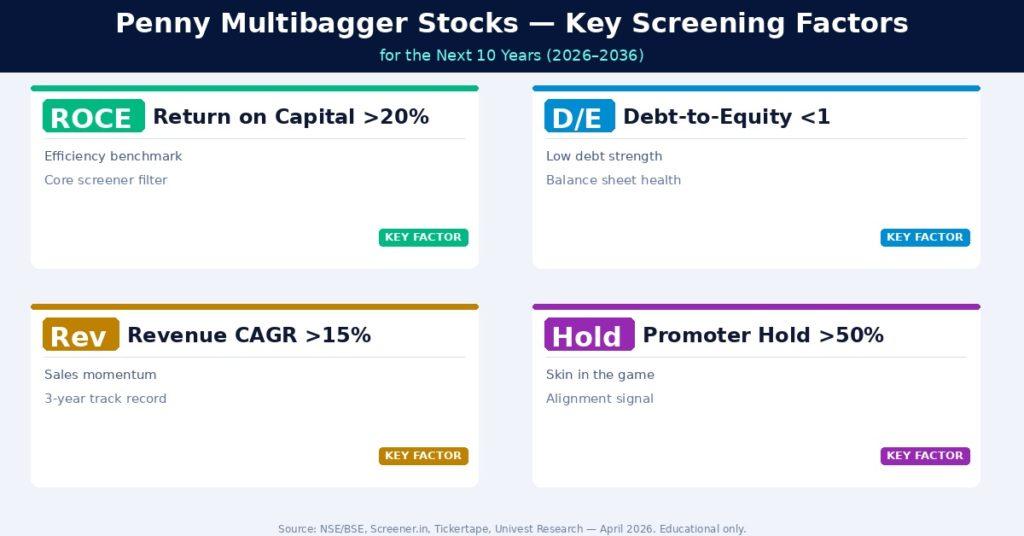
Penny multibagger screener — ROCE>20%, D/E<1, revenue CAGR>15%, promoter hold>50%, P/E<30
| Filter | Threshold | Why It Matters |
| Return on Capital Employed (ROCE) | Above 20% | Proves capital is deployed efficiently — the single best predictor of long-term compounding |
| Debt-to-Equity Ratio | Below 1.0 | Low debt means the interest burden doesn't erode profits; the company survives downturns |
| Revenue CAGR (3 Years) | Above 15% | Confirms business growth momentum, not a one-time spike |
| Promoter Holding | Above 50% | High promoter stake = alignment of interest with minority shareholders |
| P/E Ratio | Below 30 | Entry at reasonable valuation — overpaying even for a good business destroys returns |
Screener criteria for identifying penny multibagger stocks for the next 10 years. Apply on Screener.in or Univest Screener.
Why a 10-Year Horizon Changes Everything
The Power of Compounding at 20% CAGR
At a 20% compound annual growth rate — achievable by quality small companies in growth industries — Rs.1 lakh invested today becomes Rs.6.19 lakh in 10 years. At 25% CAGR, it becomes Rs.9.31 lakh. At 30% CAGR — possible in the early years of a high-quality penny stock — Rs.1 lakh becomes Rs.13.79 lakh. This is the mathematical case for patience with fundamentally sound penny stocks.
The critical insight is that most retail investors abandon penny stocks during the first 2-3 years when prices often remain flat or fall. The compounding happens in years 5-10 as the business scales, earnings become more predictable, institutional investors begin covering the stock, and the P/E multiple re-rates upward. Entry + patience + stop-loss discipline is the formula.
India's 10-Year Structural Tailwinds Favour Small Companies
India is expected to become the world's third-largest economy by 2030-2031. This macro backdrop creates multiple structural tailwinds specifically for small companies in the following sectors where penny multibaggers are most likely to emerge:
- Specialty Chemicals — China+1 strategy driving global sourcing shifts to India. India's speciality chemical market is expected to grow at a 12-13% CAGR through 2030. Small chemical companies with export orientation and debt-free balance sheets are prime 10-year candidates.
- Defence & Aerospace Manufacturing — DRDO indigenisation, PLI schemes for defence, and Rs.6 lakh crore defence budget over 5 years. Small component manufacturers supplying HAL, BEL, and DRDO are structural multibagger candidates.
- Textiles & Technical Textiles — Rs.10,683 crore PLI scheme, export target of $100 billion by 2030, and China+1 sourcing by global brands. Technical textile companies making nonwovens, geotextiles, and medical textiles are undercovered penny stocks with a 10-year runway.
- Digital Infrastructure & IT Services — India's Rs.10 lakh crore digital economy target by 2026, UPI transaction growth, and AI adoption are creating demand for small niche IT companies providing specific SaaS, fintech middleware, and enterprise software solutions.
- Renewable Energy Components — A 500 GW renewable capacity target by 2030 requires massive supply chains. Small manufacturers of solar components, wind turbine parts, EV charging infrastructure, and grid storage are early-stage but structural opportunities.
Screen all these sector penny stocks with fundamental filters on the Univest Screener — free, updated daily with live NSE/BSE data.
Key Penny Stocks to Watch for the Next 10 Years (Indicative List)
The following stocks frequently appear in screener results matching the 5-filter criteria above. This is an illustrative watchlist — not a buy recommendation. Always conduct your own due diligence and verify current fundamentals before investing.
| Company | Sector | Why on Watchlist | Key Risk |
| Trident Ltd | Textiles & Paper | Home textiles global exporter, consistent ROCE>20%, zero pledging | Commodity price exposure |
| Nandan Denim | Denim Textiles | Capacity expansion, improving margins, China+1 beneficiary | High working capital cycle |
| Mangalam Industrial Finance | NBFC | Zero debt, consistent profitability, rural lending focus | Small scale, low liquidity |
| Rama Steel Tubes | Steel/Infra | Infrastructure capex beneficiary, improving D/E ratio | Cyclical sector risk |
| Urja Global | Clean Energy | Solar energy play, early-stage growth, improving revenues | Execution risk, competition |
| SBC Exports | Textile Exports | Garment exporter, revenue CAGR improving, low valuation | Customer concentration |
| Mishtann Foods | Food Processing | Revenue growth 40%+ CAGR, expanding distribution | Promoter holding changes |
Indicative watchlist only. Verify all fundamentals on NSE/BSE filings and Screener.in before any investment decision. Not a buy recommendation.
Red Flags to Avoid in Penny Multibagger Selection
High Promoter Pledging — The Silent Killer
A company where the promoter has pledged more than 30% of their holding is a serious red flag, regardless of how attractive the other metrics look. Pledged shares mean lenders can force-sell them in a margin call during a market downturn — creating sudden selling pressure and price crashes that can erode 50-80% of your investment in weeks. Always check pledging on the BSE shareholding pattern disclosures.
Earnings Without Cash Flow — The Accounting Illusion
Many penny stocks show impressive net profit growth while simultaneously burning cash. A company can book revenue before collecting it and defer expenses to future quarters — making profits look strong while cash flow stays negative. Always check the "Cash Flow from Operations" in the annual report. Genuine compounders have operating cash flow that matches or exceeds reported profits over multi-year periods.
Auditor Qualifications and Related Party Transactions
Read the auditor's report in the annual report. "Qualified" audit opinions, emphasis of matter notes, or large related party transactions — where the company is doing significant business with promoter-owned entities — are serious governance red flags in penny stocks. Avoid any company where the auditor has flagged concerns in multiple consecutive years.
Get SEBI-registered analyst guidance on penny stock selection at Univest. Download the Univest iOS App or Univest Android App.
How to Invest in Penny Multibagger Stocks for 10 Years
- Define your allocation — limit penny stocks to 5-10% of your total equity portfolio. Never allocate capital you cannot afford to lose entirely to this category.
- Screen rigorously using the 5-filter criteria — ROCE>20%, D/E<1, Revenue CAGR>15%, Promoter holding>50%, P/E<30. This filters out 95% of penny stocks.
- Build a diversified basket of 8-12 stocks across sectors — do not concentrate in one sector or one stock. Diversification across chemicals, textiles, NBFC, defence, and digital themes reduces single-stock risk.
- Set a staggered entry — do not invest the entire planned allocation at once. Use SIP-style entries over 6-12 months to average your cost.
- Review annually, not daily — check fundamentals every quarter, but do not track daily price movements. Penny stocks are illiquid and volatile; daily monitoring leads to panic selling.
- Set a hard exit rule for fundamental deterioration — if ROCE drops below 15% for two consecutive quarters, D/E crosses 2, or the auditor qualifies the report, exit regardless of price movement.
Conclusion
Penny multibagger stocks for the next 10 years exist in India — but they are rare, require disciplined screening, and demand patient conviction. The combination of India's structural economic growth story, government capex across infrastructure and manufacturing, PLI schemes driving domestic production, and the China+1 trade shift creates genuine multi-decade opportunities in speciality chemicals, textiles, defence components, and clean energy. Apply the 5-filter screener, diversify across 8-12 stocks, stay invested for the full 10 years, and review fundamentals quarterly — that is the evidence-based framework for finding tomorrow's multibaggers among today's penny stocks.
Frequently Asked Questions
Which penny stocks will become multibaggers in 10 years?
No one can predict with certainty which specific penny stocks will become multibaggers. The best approach is screening for companies with ROCE above 20%, debt-to-equity below 1, revenue CAGR above 15%, promoter holding above 50%, and P/E below 30. Stocks passing all five criteria in high-growth sectors — speciality chemicals, textiles, defence manufacturing, and digital infrastructure — have the strongest historical odds of delivering 5-10x returns over a decade.
How much should I invest in penny multibagger stocks?
Never invest more than 5-10% of your total equity portfolio in penny stocks, even if you are confident in the selection. The illiquidity, governance risk, and manipulation risk in penny stocks make them unsuitable for large allocations. Build a basket of 8-12 stocks to diversify within the category, and use SIP-style entry over 6-12 months to reduce timing risk.
What is the best screener to find penny multibagger stocks?
Screener.in and the Univest Screener are the two best free tools for filtering penny multibagger candidates. Key filters: Price below Rs.50, Market Cap above Rs.100 crore (for liquidity), ROCE above 20%, Debt-to-Equity below 1, Revenue CAGR (3Y) above 15%, Promoter holding above 50%.
What is the 10-year CAGR target for penny stocks?
A penny stock delivering 20% CAGR for 10 years turns Rs.1 lakh into Rs.6.19 lakh. At 25% CAGR, Rs.1 lakh becomes Rs.9.31 lakh. These are achievable for genuinely quality small companies but require staying invested through 2-3 year periods of price stagnation or decline. The 10-year horizon specifically is important because most penny stock value creation happens in years 5-10 as earnings scale and institutional coverage begin.
Are penny stocks safe for long-term investment?
Penny stocks are the highest-risk category of equity investment. Even well-screened penny stocks can fail due to management fraud, regulatory changes, technology disruption, or business model failures. The appropriate risk management approach is: limit allocation to 5-10% of portfolio, diversify across 8-12 stocks, insist on quality fundamentals over low price alone, and review financials quarterly. Never invest money you cannot afford to lose entirely in this category.
Can penny stocks give 100x returns in India?
Yes — India has documented examples of penny stocks delivering 100x returns over 10-15 years. Titan Company traded below Rs.10 in the early 2000s. Eicher Motors was a sub-Rs. 100 stocks in 2009. However, for every 100x return story, there are hundreds of penny stocks that went to zero. The selection process — screening for ROCE, low debt, revenue growth, and promoter alignment — is what separates the 100x outcomes from the 0x outcomes.
How to research penny stocks for long-term investment?
Read the annual report — specifically the MD&A section, auditor's report, and cash flow statement. Check shareholding patterns on NSE/BSE for promoter pledging. Screen on Screener.in for ROCE, D/E, and revenue CAGR trends. Read exchange filings (NSE/BSE announcements) for any regulatory issues, auditor changes, or unexplained management changes. Follow the Univest research team for SEBI-backed analysis on penny stock candidates.
What sectors have the best penny multibagger stocks for the next 10 years?
Based on India's structural growth themes for 2026-2036, the sectors with the highest concentration of genuine penny multibagger candidates are: specialty chemicals (China+1 exports), technical textiles (PLI scheme + export growth), defence manufacturing (DRDO indigenisation + Rs.6 lakh crore budget), renewable energy components (500 GW target), and digital infrastructure/niche IT services (Rs.10 lakh crore digital economy). Penny stocks in these sectors with strong fundamentals offer the best 10-year risk-reward.
Disclaimer: This article is for informational and educational purposes only and does not constitute investment advice or stock recommendations. Penny stocks carry very high risk, including potential total loss of capital. All data sourced from NSE/BSE, Screener.in, Tickertape, and company filings as of April 2026. Past performance does not guarantee future results. Consult a SEBI-registered financial advisor before making any investment decisions.
Recent Articles

3 Gas Terminal and Logistics Stocks With a Strong Future Roadmap: Petronet LNG, Delhivery and Gateway Distriparks
9 October 2026

3 Engineering Services and Telecom Technology Stocks With a Strong Future Roadmap: Cyient, Cyient DLM and HFCL
9 October 2026

3 Wellness Brand and Medical Device Stocks With a Strong Future Roadmap: Emami, Zydus Wellness and Poly Medicure
9 October 2026

3 Textile and Apparel Manufacturing Stocks With a Strong Future Roadmap: KPR Mill, Gokaldas Exports and Vardhman Textiles
9 October 2026
Note: This blog is for information purpose only. Investments and trading are subject to market risks, read all scheme related documents carefully.
Reviews






Recent Posts
3 Gas Terminal and Logistics Stocks With a Strong Future Roadmap: Petronet LNG, Delhivery and Gateway Distriparks
3 Engineering Services and Telecom Technology Stocks With a Strong Future Roadmap: Cyient, Cyient DLM and HFCL
3 Wellness Brand and Medical Device Stocks With a Strong Future Roadmap: Emami, Zydus Wellness and Poly Medicure
3 Textile and Apparel Manufacturing Stocks With a Strong Future Roadmap: KPR Mill, Gokaldas Exports and Vardhman Textiles
3 Premium Drinks Brand Stocks With a Strong Future Roadmap: United Breweries, Tilaknagar Industries and Sula Vineyards

Uniresearch Global Pvt Ltd
Research Analyst
SEBI Registration Number — INH000013776
Uniresearch is a subsidiary of Univest Communication Technologies Private Limited
Company Address: Registered Address: Ground Floor, Unitech Commercial Tower 2, Block B, Greenwood City, Unit 1-3, Sector 45, Gurugram, Haryana 122003
Write to us : support@univest.in, compliance@univest.in
Verify on SEBI registry →RESEARCH ANALYST
Get SEBI Registered
advice on the stocks
trending today.
Get 3 FREE Trade Ideas

for Startups Accelerator 2024

Trusted by 1Cr Indians

Awarded No.1 by Economic Times