
Ola Electric Cut Prices by Rs 60,000 and the Stock Jumped 33% Is This the Comeback — or a Trap?
Updated: 9 Apr 2026 • 1:16 pm
Posted by:

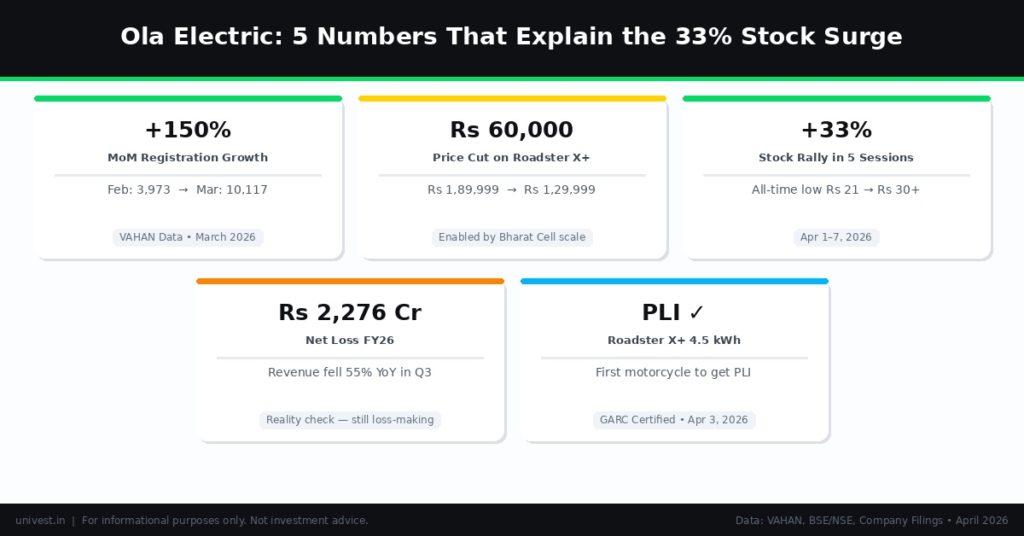
Ola Electric's stock hit an all-time low of Rs 21.21 on March 2, 2026. Seven weeks later, it has surged more than 33% to cross Rs 30 again. Three things happened simultaneously — a Rs 60,000 price slash on the Roadster X+, a PLI certification, and March registrations exploding 150% month-on-month to 10,117 units. The market celebrated. But before you chase this rally, there is a calculation every investor needs to run first.
Click Here – Get Free Stock Insights on Univest
What Actually Happened in 5 Days
Most coverage of the Ola Electric share price surge focuses on the headline — "33% jump." Here is what drove it, broken down event by event:
April 1, 2026: Bhavish Aggarwal announces daily orders crossed 1,000 units in the last week of March. Stock jumps 12.68% in a single session — its best single-day performance in months.
April 2, 2026: Ola Electric officially slashes the price of the Roadster X+ 9.1 kWh by Rs 60,000 — from Rs 1,89,999 to Rs 1,29,999. The reason given: 4680 Bharat Cell production at the Gigafactory has ramped up to the point where cost savings can be passed to customers. A second cut of Rs 20,000 was also announced on the 4.5 kWh variant, now at Rs 1,09,999. Stock gains another 9%.
April 3, 2026: Ola Electric receives PLI (Production Linked Incentive) certification for the Roadster X+ 4.5 kWh from the Global Automotive Research Centre (GARC) under the PLI-Auto Scheme. This is the first motorcycle in the Roadster portfolio to receive PLI certification — unlocking government incentives that directly improve unit economics.
April 6, 2026: The stock hits Rs 30.40 — a seven-week high — on combined volumes of 125.79 million shares across NSE and BSE. The five-session rally crosses 33%.
Three catalysts. One week. The market is telling you something changed. The real question is whether it changed enough.
The Rs 60,000 Cut — Innovation or Desperation?
This is the question nobody in the mainstream coverage answered properly.
When a company cuts its flagship product's price by 32% overnight, there are exactly two possible readings:
Reading 1 (Bull case): Ola Electric's 4680 Bharat Cell production has scaled enough that the actual manufacturing cost fell dramatically. Tesla followed this exact playbook — as Gigafactory output scaled, Model 3 prices dropped from $49,000 to $39,000. If Ola Electric is genuinely passing on cost savings rather than sacrificing margin, this price cut is a signal of industrial maturity. The Gigafactory is now on a trajectory toward 6 GWh capacity. At that scale, the 4680 Bharat Cell — entirely designed and manufactured in India — makes Ola one of the very few companies in the world with true vertical integration in EV battery production.
Reading 2 (Bear case): Inventory was building, demand had collapsed (registrations were a dismal 3,973 in February versus 10,117 in March), and the price cut was an emergency measure to clear stock and revive sales numbers ahead of Q4 FY26 results. If this is the case, the margin hit is severe. At Rs 1,29,999 for the 9.1 kWh variant, Ola needs to sell significantly more units just to generate the same revenue it earned at Rs 1,89,999.
Here is the math that matters: If Ola's revenue per Roadster X+ 9.1 kWh fell from Rs 1,89,999 to Rs 1,29,999, the company needs to sell 46% more units at the new price just to break even on top-line revenue. At current margins — Ola reported a net loss of Rs 487 crore in Q3 FY26 on revenue that fell 55% year-on-year — even maintaining flat revenue requires a massive volume acceleration.
March's 10,117 registrations are promising. But context matters: Ola's own peak was well above 30,000 units per month in mid-2024. 10,117 is a recovery from a rock-bottom February, not a return to dominance.
Tap to Access Best EV Research Pieces on Univest
What the 1 Million Milestone Really Means
Ola Electric crossed 1 million cumulative VAHAN registrations in early April 2026 — a genuine milestone and the first EV brand in India to do so. The number has symbolic importance for the EV adoption story in India.
But strip the emotion away and look at where Ola stands in the competitive landscape right now:
| Brand | March 2026 Registrations | Market Position |
| TVS Motor (iQube) | ~40,000+ units | Market leader |
| Ola Electric | 10,117 units | ~5–6% market share |
| Bajaj Auto (Chetak) | ~28,000+ units | #2 |
| Ather Energy | ~15,000+ units | Gaining fast post-IPO |
| Hero MotoCorp (Vida) | Scaling | Aggressive expansion |
Ola Electric, which once commanded 30–35% of India's electric two-wheeler market, is now at approximately 5–6% market share in March 2026. The V-shaped recovery management talks about is real — but it is a V from February's 3,973 units, not from the heights of 2024.
The March improvement is encouraging. It is not yet vindication.
The PLI Certification — Why This Matters More Than the Price Cut
The PLI certification on the Roadster X+ 4.5 kWh is arguably the most structurally significant development of the week, yet it received the least coverage.
Under the PLI-Auto Scheme, eligible EV manufacturers receive financial incentives linked to production volumes. These incentives — effectively a government subsidy on manufacturing — improve the economics per unit and reduce the net cost of production. Crucially, PLI certification also signals that Ola Electric's manufacturing processes meet the quality and localisation standards required by the government.
For a company that has been battling perceptions around quality (there were sustained consumer complaints about service, software bugs, and breakdown rates through 2024–25), PLI certification from GARC is a government-endorsed quality stamp. It matters for both the stock's credibility and the unit economics.
The Roadster X+ 9.1 kWh is next in line for PLI certification — and that, combined with the price cut to Rs 1,29,999, could make the Roadster one of the most competitively priced performance electric motorcycles in India.
Track Ola Electric's live fundamentals and peer comparison on Univest Screener
What the Financials Actually Say
Before the 33% rally rewrites the narrative, here is the scorecard:
| Metric | Q3 FY26 | Q3 FY25 | Change |
| Revenue | Rs 828 Cr (est.) | Rs 1,900 Cr | -55% YoY |
| Net Loss | Rs 487 Cr | Rs 267 Cr | Worsened |
| Gross Margin | Negative (est.) | Negative | Still burning |
| Operating Cash Flow | Negative | Negative | Persistently negative |
Net loss of Rs 2,276 crore for the full year FY26. Revenue that more than halved year-on-year. A stock that fell from its IPO price of Rs 76 to an all-time low of Rs 21.21 — a 72% destruction of value from listing.
Against this backdrop, trading at Rs 30 — still 60% below the IPO price and 80% below the all-time high of Rs 157 — the stock is pricing in some recovery, but not a full turnaround. There is a difference between oversold-bounce and fundamental-recovery, and the market has not yet got clear evidence of the latter.
The contrarian view worth considering: Ola Electric at Rs 30 may be the best risk-reward it has offered since listing. The downside from Rs 21 to zero is real but finite. The upside — if March's 10,117 units scales to 20,000+ in Q1 FY27, if the Gigafactory hits 6 GWh, if PLI incentives flow through — is a stock that re-rates toward Rs 55–65. That is a genuine asymmetric bet. But it is a speculative bet on execution, not a bet on current fundamentals.
The Three Questions That Will Decide Ola Electric's Stock in FY27Question 1: Can April and May sustain the March momentum?
March's 10,117 registrations followed a price cut and a new model launch. April needs to show that the demand is structural, not promotional. If April registrations come in above 12,000–14,000 without another price cut, the V-shaped recovery narrative holds. Below 8,000 and the bear case reasserts itself.
Question 2: What do Q4 FY26 results show about the Gigafactory margin improvement?
Ola Electric's management says the Rs 60,000 price cut was enabled by production cost savings — not a margin sacrifice. Q4 FY26 gross margin numbers will either confirm or deny this claim. If gross margin improves meaningfully (from deeply negative toward -5% or better), the cost story is real. If margins worsen despite higher volume, the price cut was defensive.
Question 3: Can the Roadster compete with Bajaj Pulsar EV and TVS Apache electric?
Both Bajaj and TVS are accelerating their electric motorcycle programmes. At Rs 1,29,999, the Roadster X+ 9.1 kWh is aggressive — but established-brand loyalty and service network quality are real factors in the Indian motorcycle market. Service was Ola's biggest weakness through FY25. The Q1 FY27 Net Promoter Score and service turnaround time data will matter as much as the sales numbers.
For Investors: What This Rally Tells You
The 33% surge in five sessions is a short-covering and sentiment-driven rally, not a fundamental re-rating. That is not a criticism — it is a fact about how markets work. After a 72% fall from IPO price, any credible positive news creates disproportionate short-term upside because the shorts squeeze.
The smart money question is: does this bounce have legs, or is Rs 30 the new ceiling?
Technical analysts have identified strong resistance at Rs 33–34. A sustained daily close above Rs 35 with volume would be a meaningful signal of trend reversal. Below Rs 24–22 is the critical support — a breach there would suggest the rally was a relief bounce only.
For long-term investors, the story is not about the 33% pop. It is about whether Ola Electric can demonstrate:
- Sustained monthly registrations above 15,000 units through Q1 FY27
- Gross margin improvement in Q4 FY26 results
- EBITDA breakeven visibility by FY28 (currently not expected even by bearish analysts before then)
None of these are guaranteed. All of them are possible. That is what makes Ola Electric — at Rs 30 — one of India's most debated stocks heading into FY27.
Download the Univest iOS App or Univest Android App to track Ola Electric live and get SEBI-registered research alerts.
The Bottom Line
Ola Electric's 33% surge is backed by three real catalysts — not hype. The Rs 60,000 price cut on the Roadster X+, the PLI certification for the Roadster motorcycle range, and a genuine 150% month-on-month registration recovery in March 2026 are all verifiable positive developments. They change the near-term narrative.
What they do not change yet: the net loss of Rs 2,276 crore for FY26, the revenue decline of more than 50% year-on-year, and a competitive landscape where TVS, Bajaj, and Ather are scaling hard.
The Ola Electric share price story in FY27 will be written by April, May, and June registration numbers — and by what Q4 FY26 results reveal about whether the price cut was powered by genuine manufacturing cost improvement or by balance sheet pressure.
Both interpretations are rational. Neither is certain. Watch the data, not the narrative.
Investments in securities are subject to market risk. Please read all related documents before investing. This content is for educational purposes only and does not constitute investment advice. Please consult a SEBI-registered financial advisor before making investment decisions.
Frequently Asked Questions
Why did Ola Electric share price surge 33% in five sessions?
Ola Electric's share price surged 33% across five sessions in early April 2026 driven by three catalysts: March 2026 registrations jumping 150% month-on-month to 10,117 units with daily orders exceeding 1,000 units in the final week; a Rs 60,000 price cut on the Roadster X+ 9.1 kWh (from Rs 1,89,999 to Rs 1,29,999) enabled by Bharat Cell production scaling at the Gigafactory; and PLI certification for the Roadster X+ 4.5 kWh from GARC under the PLI-Auto Scheme.
Is the Ola Electric rally sustainable?
The rally's sustainability depends on three data points not yet available: April and May registration numbers staying above 12,000 units without another price stimulus; Q4 FY26 gross margin data confirming the price cut was funded by manufacturing cost savings rather than balance sheet burn; and competitive positioning versus TVS and Bajaj in the electric motorcycle segment. Technical analysts identify Rs 33–35 as strong resistance, with Rs 24–22 as critical support.
What is the Ola Electric Roadster X+ price after the cut?
After the April 2026 price reduction, the Ola Electric Roadster X+ 9.1 kWh is priced at Rs 1,29,999 — a Rs 60,000 reduction from the previous price of Rs 1,89,999. The 4.5 kWh variant received a Rs 20,000 cut and is now priced at Rs 1,09,999. Both variants are currently sold through limited-time purchase windows rather than continuous open sales due to production constraints.
What is PLI certification and why does it matter for Ola Electric?
PLI certification under the PLI-Auto Scheme from the Government of India means Ola Electric's Roadster X+ 4.5 kWh has been verified by the Global Automotive Research Centre (GARC) as meeting the quality and localisation standards required to receive Production Linked Incentives. These government incentives improve the per-unit economics of EV manufacturing, effectively reducing the net cost of production. For Ola Electric, PLI certification is also a quality credibility signal after sustained consumer complaints about service quality through FY24–25.
What is Ola Electric's financial position in FY26?
Ola Electric reported a net loss of Rs 2,276 crore for the full year FY26. In Q3 FY26, the company posted a net loss of Rs 487 crore on revenues that declined approximately 55% year-on-year. Operating cash flow remains negative, and the company's stock is still down more than 60% from its IPO price of Rs 76. EBITDA breakeven is not expected by analyst consensus before FY28 at the earliest.
Who are Ola Electric's main competitors in March 2026?
In March 2026, Ola Electric's main competitors in the electric two-wheeler segment include TVS Motor (iQube — the market leader with 40,000+ monthly registrations), Bajaj Auto (Chetak — second place with approximately 28,000 units), Ather Energy (approximately 15,000 units and rapidly gaining post-IPO), and Hero MotoCorp (Vida — scaling aggressively). Ola Electric's March 2026 registrations of 10,117 units give it approximately 5–6% market share, down significantly from its peak of 30–35% market share in mid-2024.
What is the Ola Electric share price target for 2026?
Most analyst targets for Ola Electric have not been formally updated since the April 2026 rally. At current levels near Rs 30, the stock is 60% below its IPO price of Rs 76. The bull case — contingent on registration recovery to 20,000+ monthly units, gross margin improvement, and PLI incentive realisation — suggests potential re-rating toward Rs 55–65. The bear case, if Q4 FY26 results show further margin deterioration, points to renewed pressure toward the Rs 21–22 all-time low. Consult a SEBI-registered financial advisor before making investment decisions.
For live Ola Electric share price, peer comparison, and stock fundamentals, visit Univest Screener. For more market analysis and stock insights, visit Univest Blogs.
Recent Article
Mphasis Q4 Results 2026: Date, Revenue Estimates, Key Catalysts & Share Price Target
Mastek Q4 Results 2026: Date, Revenue Estimates, Key Catalysts & Share Price Target
Cyient Q4 Results 2026: Date, Revenue Estimates, Key Catalysts & Share Price Target
KPIT Technologies Q4 Results 2026: Date, Revenue Estimates, Key Catalysts & Share Price Target
Zensar Technologies Q4 Results 2026: Date, Revenue Estimates, Key Catalysts & Share Price Target
Recent Articles

Supreme Industries Dividend: Stock Down 4% Today as Rs 12 Per Share Payout Is Declared, Record Date Fixed; Check Yield and Stock Split History
26 October 2026

Up 174% in 1 Year! Can Monolithisch India Shares Rise Further? Experts Decode Valuation, Levels and Targets
26 October 2026

Mind-Boggling Monday at Indian Stock Markets: Sensex and Nifty Mirror Life's Ups and Downs, October 26 Trade Details
26 October 2026

Raymond Share Price Up Over 145% in 2026 So Far: Will the Rally in This Defence-Engineering Stock Sustain? Experts Views, Target
26 October 2026
Note: This blog is for information purpose only. Investments and trading are subject to market risks, read all scheme related documents carefully.
Reviews






Recent Posts
Supreme Industries Dividend: Stock Down 4% Today as Rs 12 Per Share Payout Is Declared, Record Date Fixed; Check Yield and Stock Split History
Up 174% in 1 Year! Can Monolithisch India Shares Rise Further? Experts Decode Valuation, Levels and Targets
Mind-Boggling Monday at Indian Stock Markets: Sensex and Nifty Mirror Life's Ups and Downs, October 26 Trade Details
Raymond Share Price Up Over 145% in 2026 So Far: Will the Rally in This Defence-Engineering Stock Sustain? Experts Views, Target
Baba Arts Ltd. Hits Lower Circuit on BSE, 26 October 2026
Popular this week
Top IT Stocks to Buy After Q2 Results: TCS vs Infosys vs Wipro vs HCL Tech vs Tech Mahindra, What Market Experts Recommend

Uniresearch Global Pvt Ltd
Research Analyst
SEBI Registration Number — INH000013776
Uniresearch is a subsidiary of Univest Communication Technologies Private Limited
Company Address: Registered Address: Ground Floor, Unitech Commercial Tower 2, Block B, Greenwood City, Unit 1-3, Sector 45, Gurugram, Haryana 122003
Write to us : support@univest.in, compliance@univest.in
Verify on SEBI registry →RESEARCH ANALYST
Get SEBI Registered
advice on the stocks
trending today.
Get 3 FREE Trade Ideas

for Startups Accelerator 2024

Trusted by 1Cr Indians

Awarded No.1 by Economic Times