
Kotak Mutual Fund: Best Schemes, SIP Plans, Returns & Complete Guide 2026
Updated: 1 Apr 2026 • 10:09 pm
Posted by:

Kotak Mutual Fund, managed by Kotak Mahindra Asset Management Company Limited (KMAMC) — a wholly owned subsidiary of Kotak Mahindra Bank — has grown steadily to manage approximately Rs.5.95 lakh crore in AUM across 261 schemes as of early 2026. With 25.9 lakh unique investors and 86 branches spread across 82 cities, Kotak Mutual Fund has established itself as one of India's reliable, research-driven AMCs backed by one of the country's strongest private sector banking franchises.
The flagship Kotak Flexicap Fund, managed by veteran fund manager Harsha Upadhyaya, has built an AUM of Rs.56,853 crore — one of the largest flexi cap funds in India. The Kotak Midcap Fund has accumulated Rs.61,694 crore in AUM, while the Kotak Small Cap Fund managed by Harish Bihani offers access to India's emerging businesses with a 'spot them young and watch them grow' philosophy.
This article covers Kotak Mutual Fund's best schemes, fund manager profiles, NAV data, SIP plans, who should invest, and tax implications for 2026. For personalised fund selection based on your risk profile, visit Univest.
About Kotak Mahindra Mutual Fund
Click Here — Get Free Investment Predictions
Kotak Mahindra Asset Management Company Limited was incorporated in 1998 as a wholly owned subsidiary of Kotak Mahindra Bank Limited. The AMC has built a strong investment framework centred on disciplined research, risk-awareness, and bottom-up stock selection. Unlike some peers known for concentrated or high-conviction approaches, Kotak AMC balances diversification with stock-specific conviction — resulting in lower volatility relative to the Nifty benchmarks across most equity categories.
The fund management team is led by Chief Investment Officer Harsha Upadhyaya for equities — one of India's most respected large and flexi cap fund managers with a track record spanning multiple market cycles. Arjun Khanna and Harish Bihani manage the mid and small-cap portfolios, respectively, bringing deep sector-specific research to their concentrated but fundamentally sound stock picks.
Kotak Mutual Fund also provides pension fund management services through its subsidiary, Kotak Mahindra Pension Fund Limited. The AMC offers income tax benefits under Section 80C through its ELSS scheme, making it a one-stop shop for both wealth creation and tax-efficient investing.
Top Kotak Mutual Fund Schemes in 2026
Tap to Access Best Research Pieces on Univest
| Fund Name | Category | AUM (Cr) | 5Y CAGR | Min SIP | Risk |
| Kotak Flexicap Fund | Flexi Cap | Rs.56,853 | 12.09% | Rs.100 | Very High |
| Kotak Midcap Fund | Mid Cap | Rs.61,694 | 17%+ | Rs.100 | Very High |
| Kotak Small Cap Fund | Small Cap | Rs.16,870 | 20%+ | Rs.100 | Very High |
| Kotak Emerging Equities | Large+Mid | Rs.45,000+ | 18%+ | Rs.100 | Very High |
| Kotak Equity Hybrid | Hybrid | Rs.7,000+ | 13.5% | Rs.100 | Moderate |
| Kotak ELSS Tax Saver | ELSS | Rs.5,000+ | 14%+ | Rs.500 | Very High |
Source: Kotak AMC, Groww, Value Research, Tickertape — April 2026. 5Y CAGR based on Direct Growth plan. Past returns do not guarantee future performance.
Detailed Fund Analysis — Kotak Mutual Fund
Kotak Flexicap Fund — The Steady Large and Midcap Compounder
The Kotak Flexicap Fund has built one of the largest AUMs in the flexi cap category at Rs.56,853 crore, managed since inception by Harsha Upadhyaya. The fund's strategy focuses on a few selected sectors across market capitalisation — rather than being broadly diversified, it takes sector-level conviction bets while maintaining stock-level diversification within each sector. The 5-year CAGR of 12.09% (Regular Plan) reflects a steady, low-volatility approach rather than a high-risk momentum strategy.
The latest NAV stands at Rs.86.84 (Direct Plan) as of March 31, 2026. The fund's expense ratio of 0.59% (Direct) is among the lowest in the flexi cap category for its AUM size. Minimum SIP starts at Rs.100. The 1-year return of -0.12% reflects the broader market consolidation in FY26. Over 3 years, the fund has delivered 48.31% cumulative returns.
Track the Kotak Flexicap Fund's live sector allocation, top 10 holdings, and peer comparison on Univest Screener.
Kotak Midcap Fund — Large AUM, Quality Midcap Selection
The Kotak Midcap Fund at Rs.61,694 crore in AUM is one of India's largest midcap funds. Despite its large size — which typically limits agility in smaller companies — the fund has maintained a 5-year CAGR above 17% through disciplined bottom-up stock selection. The fund invests predominantly in companies ranked 101-250 by full market capitalisation, with a minimum 65% allocation to midcap stocks as mandated by SEBI.
The fund is managed with a research-driven, bottom-up stock selection approach. It aims to identify companies that are in the early stages of scaling their business models — before they become widely tracked large-cap stocks. Exit load of 1% applies for redemptions within 1 year from the date of allotment (above 10% of the initial investment).
Kotak Small Cap Fund — Spot Them Young
The Kotak Small Cap Fund — managed by Harish Bihani — follows the philosophy of identifying fundamentally strong small-cap companies early, before they scale into midcaps. With an AUM of Rs.16,870 crore and a 20%+ 5-year CAGR, it has been a consistent outperformer in the small-cap category. The fund's disciplined approach to risk management — including a minimum 65% small-cap allocation but retaining up to 35% flexibility in other equity classes — helps navigate small-cap volatility better than many peers.
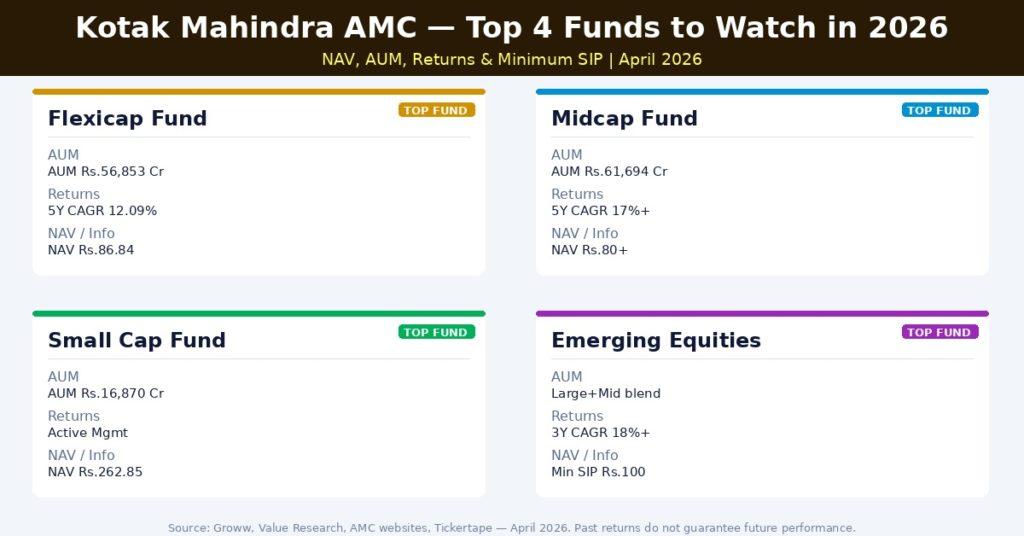
Kotak Mutual Fund — top 4 schemes with AUM, returns, NAV and risk rating
How to Start SIP in Kotak Mutual Fund
Kotak Mutual Fund offers one of the most flexible SIP structures in the industry — minimum SIP of Rs.100 for most equity schemes, multiple SIP dates, and fully paperless KYC. Here is how to start:
- Visit the Kotak AMC website (www.kotakmf.com) or use SEBI-registered platforms. Complete your KYC online using Aadhaar OTP and PAN — required once for all mutual fund investments.
- Choose the Direct Plan to avoid distributor commission. The Direct Plan expense ratio for the Flexicap Fund is 0.59% vs 1.43% for the Regular Plan — a significant difference compounded over the years.
- Select your scheme and SIP amount (minimum Rs.100 for most equity schemes). Common SIP dates are 1st, 5th, 10th, 15th, or 25th of the month.
- Set up a bank mandate through NACH for automated monthly deduction aligned with your salary credit date.
Who Should Invest in Kotak Mutual Fund?
Kotak Mutual Fund schemes are suitable for moderate-to-aggressive investors who prefer a research-driven, lower-volatility approach to equity investing. The Flexicap Fund is ideal for investors who want broad equity market exposure without the volatility of a concentrated portfolio. The Midcap and Small Cap Funds suit aggressive investors with a 7-year-plus horizon who can tolerate significant short-term NAV fluctuations. Conservative investors wanting equity exposure with downside protection should consider the Kotak Equity Hybrid Fund. First-time mutual fund investors with no specific conviction should start with the Flexicap Fund at Rs.100 SIP before exploring higher-risk categories.
For personalised mutual fund scheme recommendations based on your risk profile, financial goals, and investment horizon, visit Univest Mutual Fund Advisory—India's SEBI-registered mutual fund and stock research platform.
Tax Implications — Kotak Mutual Fund Equity Schemes
Mutual fund taxation in India is scheme-category specific. For all equity funds (large cap, midcap, small cap, flexi cap, ELSS, thematic) managed by this AMC:
- Short-Term Capital Gains (STCG) — if you redeem within 12 months of investment, gains are taxed at 20% regardless of your income tax slab.
- Long-Term Capital Gains (LTCG) — if you redeem after 12 months, gains above Rs.1.25 lakh per financial year are taxed at 12.5% without indexation benefit. Gains up to Rs.1.25 lakh annually are tax-free.
- ELSS (Tax Saver) Schemes — investments up to Rs.1.5 lakh per year qualify for deduction under Section 80C. The 3-year lock-in ensures all gains are automatically long-term.
- Dividend income — any dividends declared by equity mutual fund schemes are added to your taxable income and taxed at your applicable income tax slab rate.
Use the Univest Screener to compare post-tax returns across mutual fund categories and plan your portfolio tax-efficiently.
Key Risks Before Investing in Kotak Mutual Fund
- Large AUM performance drag — the Kotak Flexicap Fund at Rs.56,853 crore and Midcap Fund at Rs.61,694 crore face increasing difficulty generating alpha above benchmarks as portfolio size limits flexibility in smaller company positions.
- Sector concentration risk — the Flexicap Fund uses a 'focused on a few selected sectors' approach, which creates sector-level concentration risk when favourite sectors underperform for extended periods.
- Small-cap liquidity risk — small-cap funds face redemption pressure in sharp market corrections as the underlying stocks are less liquid, potentially forcing fund managers to sell quality holdings at unfavourable prices.
- Passive vs active debate — at an expense ratio of 1.43% for the Regular Plan, investors need to honestly evaluate whether active management consistently adds enough alpha over low-cost index funds in the long run.
- Fund manager transition risk — Kotak AMC's reputation in the flexi cap category is closely associated with Harsha Upadhyaya. Any transition in fund management would create temporary uncertainty about the fund's investment philosophy.
Conclusion
Kotak Mutual Fund offers a well-rounded product suite for investors seeking a research-driven, institutionally robust AMC backed by Kotak Mahindra Bank's formidable financial services franchise. The Flexicap Fund's steady compounding, the Midcap Fund's solid long-term returns, and the Small Cap Fund's emerging company focus together provide building blocks for a diversified equity portfolio. Start with the Flexicap Fund for core equity exposure, add the Midcap Fund when you are comfortable with midcap volatility, and use the ELSS scheme for annual tax-saving SIP investments.
Frequently Asked Questions
Which is the best Kotak mutual fund for SIP in 2026?
The best Kotak mutual fund for SIP in 2026 depends on your profile. For stable equity returns, the Kotak Flexicap Fund is a solid choice — Rs.100 minimum SIP, 12.09% 5-year CAGR, and low expense ratio. For higher growth potential with higher risk, the Kotak Midcap and Small Cap Funds are worth considering with a 7-year horizon. For tax savings, the Kotak ELSS Tax Saver Fund provides Section 80C benefits.
What is the Kotak Flexicap Fund NAV today?
The Kotak Flexicap Fund Direct Growth NAV was Rs.86.84 as of March 31, 2026. The Regular Plan NAV was Rs.78.31 as of March 28, 2026. NAV is declared daily by the AMC after market close and updated on AMFI's website. For the live NAV, check the Kotak AMC website, AMFI portal, or the Univest app.
Is Kotak Mutual Fund safe to invest in?
Kotak Mutual Fund is regulated by SEBI and backed by Kotak Mahindra Bank — one of India's most regulated financial institutions. The AMC follows SEBI-mandated risk controls, including daily NAV disclosure, monthly portfolio disclosure, and independent custodian arrangements. However, equity mutual funds carry market risk — NAVs can and do fall during bear markets. Kotak Mutual Fund is safe in the regulatory and institutional sense, but not capital-guaranteed.
What is the Kotak Midcap Fund's 5-year return?
The Kotak Midcap Fund has delivered a 5-year CAGR above 17% as of March 2026 (Direct Plan), with an AUM of Rs.61,694 crore. This return places it among the mid-tier performers in the midcap fund category — consistent but not exceptional relative to peers like Motilal Oswal Midcap Fund (22.89% CAGR) or HDFC Mid Cap Opportunities Fund. However, Kotak's lower volatility profile may suit investors who prefer smoother returns over maximum alpha.
How to redeem a Kotak mutual fund?
You can redeem your Kotak Mutual Fund units through the Kotak AMC website, CAMS online portal, or any platform where you originally invested. Redemption proceeds for equity funds are typically credited to your bank account within 2-3 business days (T+3 for equity). Note that a 1% exit load applies for redemptions within 12 months (above 10% of the original investment amount). ELSS funds have a mandatory 3-year lock-in.
Does Kotak offer index funds?
Yes, Kotak Mutual Fund offers a range of index funds, including the Kotak Nifty 50 Index Fund, Kotak Nifty Next 50 Index Fund, Kotak Nifty Midcap 150 Index Fund, and others. Index funds from Kotak are available at very low expense ratios — typically 0.10-0.20% for Direct Plans — making them a cost-efficient option for investors who prefer passive investing.
What is the minimum investment in Kotak Mutual Fund?
The minimum SIP for most Kotak Mutual Fund equity schemes is Rs.100 per month (Direct Plan). Minimum lump sum investment for equity schemes like the Flexicap and Midcap Funds is Rs.100. Some older schemes or specific plan options may have higher minimums. For the ELSS Tax Saver Fund, the minimum SIP is Rs.500.
How is Kotak Mutual Fund taxed?
Kotak Mutual Fund equity scheme gains are taxed as follows: Short-term capital gains (held less than 1 year) are taxed at 20%. Long-term capital gains (held over 1 year) above Rs.1.25 lakh in a financial year are taxed at 12.5% without indexation benefit. For ELSS schemes with a 3-year lock-in, all gains are automatically long-term. Dividends declared by any Kotak scheme are added to your taxable income and taxed at your applicable slab rate.
Disclaimer: Mutual fund investments are subject to market risks. Please read all scheme-related documents carefully before investing. All NAV, AUM, and return data in this article are sourced from AMFI, AMC websites, Groww, Value Research, and Tickertape as of April 2026. Past returns do not guarantee future performance. This article is for informational and educational purposes only and does not constitute investment advice. Consult a SEBI-registered financial advisor before making any investment decision.
Recent Articles

Best SIP to Invest in 2026: How to Pick Funds by Goal, Horizon and Cost, With the SIP Maths
8 October 2026

Best Mutual Fund Advisor in India: How to Choose One You Can Trust, From SEBI Checks to Fee Traps
8 October 2026

Tata Resources & Energy Fund Direct Growth Review 2026: NAV, Returns, Portfolio & Should You Invest?
21 September 2026

Kotak Multi Asset Allocation Fund Direct Growth Review 2026: NAV, Returns, Portfolio & Should You Invest?
21 September 2026
Note: This blog is for information purpose only. Investments and trading are subject to market risks, read all scheme related documents carefully.
Reviews






Recent Posts
Best SIP to Invest in 2026: How to Pick Funds by Goal, Horizon and Cost, With the SIP Maths
Best Mutual Fund Advisor in India: How to Choose One You Can Trust, From SEBI Checks to Fee Traps
Tata Resources & Energy Fund Direct Growth Review 2026: NAV, Returns, Portfolio & Should You Invest?
Kotak Multi Asset Allocation Fund Direct Growth Review 2026: NAV, Returns, Portfolio & Should You Invest?
Baroda BNP Paribas Large & Mid Cap Fund Direct Growth Review 2026: NAV, Returns, Portfolio & Should You Invest?

Uniresearch Global Pvt Ltd
Research Analyst
SEBI Registration Number — INH000013776
Uniresearch is a subsidiary of Univest Communication Technologies Private Limited
Company Address: Registered Address: Ground Floor, Unitech Commercial Tower 2, Block B, Greenwood City, Unit 1-3, Sector 45, Gurugram, Haryana 122003
Write to us : support@univest.in, compliance@univest.in
Verify on SEBI registry →RESEARCH ANALYST
Get SEBI Registered
advice on the stocks
trending today.
Get 3 FREE Trade Ideas

for Startups Accelerator 2024

Trusted by 1Cr Indians

Awarded No.1 by Economic Times