
ICICI Mutual Fund: Best Schemes, SIP Plans, Returns & Complete Guide 2026
Updated: 1 Apr 2026 • 9:50 pm
Posted by:

ICICI Mutual Fund — formally known as ICICI Prudential Mutual Fund — is not just the country's largest AMC, it is one of India's most searched investment brands. When investors search for ICICI mutual funds online, they are typically looking for three things: the best-performing ICICI schemes, the current NAV, or how to start a SIP. This article addresses all three in detail, with live April 2026 data.
As of December 2025, ICICI Mutual Fund manages Rs.11.30 lakh crore across 1,295 schemes. Beyond the well-known Bluechip and Balanced Advantage funds, ICICI Prudential runs some of India's best-performing thematic funds — the Infrastructure Fund has delivered over 28% in 5 years, the Value Discovery Fund has crossed 22% CAGR, and the Pharma Healthcare and Diagnostics Fund has returned 18%+ over 3 years.
This complete guide covers ICICI Mutual Fund's best schemes by category, detailed performance analysis, SIP starting guide, tax implications, and who should invest in each scheme. Get personalised fund recommendations at Univest.
About ICICI Prudential (ICICI Mutual Fund)
Click Here — Get Free Investment Predictions
ICICI Prudential Asset Management is the fund management arm of the ICICI Group — a combination of ICICI Bank's distribution muscle and Prudential Plc's global investment management expertise. Since 1993, the AMC has been at the forefront of India's mutual fund industry — it launched India's first infrastructure fund, one of the early balanced advantage funds, and has consistently been ranked among the top 3 AMCs by AUM across the past decade.
The AMC's fund management philosophy blends macroeconomic top-down analysis with micro-level bottom-up stock research. Sankaran Naren — Chief Investment Officer of ICICI Prudential AMC — is widely regarded as one of India's best equity fund managers, known for his contrarian approach of buying sectors when they are out of favour and reducing exposure when valuations become excessive.
ICICI Prudential reaches 97 lakh investors through 350+ locations, with the minimum SIP across most equity schemes at just Rs.100 — the most accessible large AMC for first-time investors in India.
Best ICICI Mutual Fund Schemes by Category 2026
Tap to Access Best Research Pieces on Univest
| Fund Name | Category | 3Y CAGR | 5Y CAGR | Min SIP | Risk |
| ICICI Pru Infrastructure Fund | Sectoral | 28%+ | 28%+ | Rs.100 | Very High |
| ICICI Pru Value Discovery Fund | Value | 22%+ | 22%+ | Rs.100 | Very High |
| ICICI Pru Pharma Healthcare Fund | Sectoral | 18%+ | 16%+ | Rs.100 | Very High |
| ICICI Pru Technology Fund | Sectoral | 16%+ | 18%+ | Rs.100 | Very High |
| ICICI Pru Bluechip (Large Cap) | Large Cap | 16.85% | 14.58% | Rs.100 | Very High |
| ICICI Pru Balanced Advantage Fund | Hybrid | 13%+ | 13%+ | Rs.100 | Moderate |
Source: ICICI Prudential AMC, Value Research, Groww — April 2026. CAGR based on the Direct Growth plan. Past returns do not guarantee future performance.
Detailed Fund Analysis — ICICI Mutual Fund
ICICI Prudential Infrastructure Fund — India's Capex Story in a Fund
The ICICI Prudential Infrastructure Fund is one of the most powerful thematic funds in India, delivering over 28% annualised returns over 5 years on the back of India's Rs.11.1 lakh crore government capex programme. The fund invests across power, roads, railways, defence, cement, metals, and engineering sectors that are the primary beneficiaries of public infrastructure spending. As a thematic fund, it has high concentration risk but equally high return potential for investors who believe in India's infrastructure decade.
This fund is not suitable for conservative investors or those with less than a 5-7 year investment horizon. Thematic funds go through prolonged periods of underperformance when the theme falls out of favour — which can last 2-3 years at a stretch. However, for investors who understand the capex cycle and are willing to stay patient, the 28%+ 5-year CAGR reflects the potential of this approach.
Analyse the Infrastructure Fund's current sector allocation and top holdings on the Univest Screener.
ICICI Prudential Value Discovery Fund — Contrarian Compounding
Managed by Sankaran Naren, the Value Discovery Fund embodies the contrarian philosophy — buy businesses that the market has temporarily mispriced, wait for the re-rating, and compound your returns. The fund's 22%+ 5-year CAGR is a testament to this approach working over long periods. AUM has grown to approximately Rs.43,000 crore as patient long-term investors have backed Naren's thesis through market cycles.
The fund's portfolio typically holds 60-80 stocks across sectors that are currently out of favour, which means it will underperform in momentum-driven bull markets but significantly outperform in recovery phases. For investors with a 7-10 year horizon who can stomach 2-3 years of underperformance, this fund has historically been one of the most rewarding large-AUM equity funds in India.
ICICI Prudential Pharma, Healthcare & Diagnostics Fund — Structural Long-Term Play
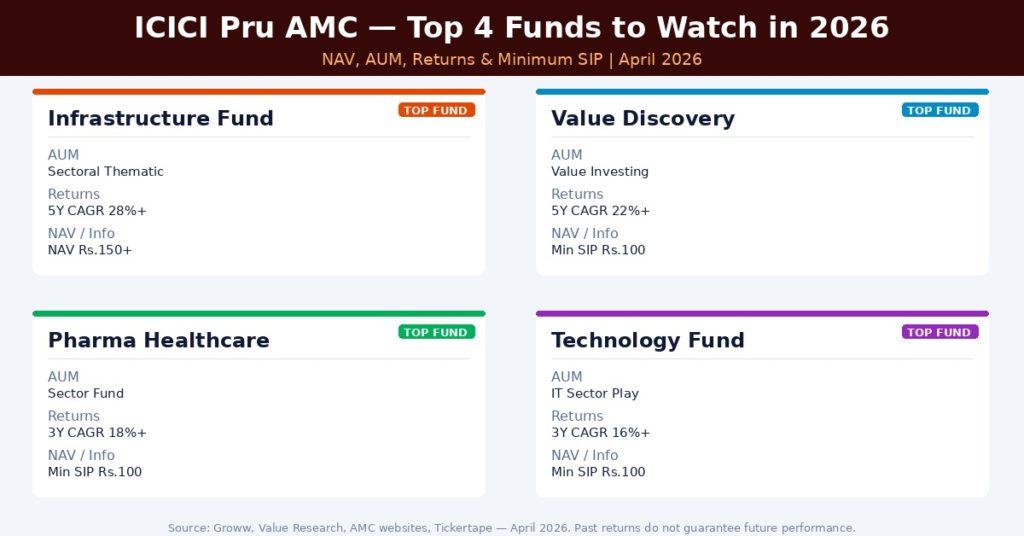
The pharma and healthcare sector is a structural growth story for India — rising income levels, growing health insurance penetration, generic drug exports, and healthcare infrastructure expansion. The ICICI Pru Pharma Healthcare Fund captures this theme through a diversified basket of pharmaceutical companies, hospitals, diagnostic chains, and medical devices. The 3-year CAGR above 18% reflects the sector's resilience through broader market volatility.
ICICI Mutual Fund — top 4 schemes with AUM, returns, NAV and risk rating
How to Start SIP in ICICI Mutual Fund
Starting a SIP in ICICI Prudential (ICICI Mutual Fund) is one of the simplest processes in Indian financial services. The minimum SIP is Rs.100, and the entire process is digital. Here are the steps:
- Visit the ICICI Prudential AMC website or use a SEBI-registered platform. Complete your one-time KYC using Aadhaar OTP and PAN.
- Select your scheme — start with the Bluechip Fund for core large-cap exposure or the Balanced Advantage Fund if you are a first-time equity investor.
- Choose the Direct Plan over the Regular Plan to avoid distributor commission and benefit from a lower expense ratio of 0.85% vs 1.40%.
- Set up a monthly SIP mandate with your bank using NACH (National Automated Clearing House) — this automates monthly deductions without manual effort.
Who Should Invest in ICICI Mutual Fund?
ICICI Mutual Fund (ICICI Prudential) schemes suit the widest range of investor profiles in India, given the AMC's breadth of offerings. First-time equity investors should start with the Balanced Advantage Fund (Rs.100 SIP, conservative hybrid exposure). Investors building a core long-term portfolio should use the Bluechip and Value Discovery Funds. Aggressive investors with a 7-year-plus horizon and sector conviction can allocate to the Infrastructure, Pharma, or Technology funds. Tax-saving investors should use the ELSS Tax Saver Fund for Section 80C benefits. The low minimum SIP of Rs.100 makes ICICI Prudential the most accessible AMC for any income level.
For personalised mutual fund scheme recommendations based on your risk profile, financial goals, and investment horizon, visit Univest Mutual Fund Advisory—India's SEBI-registered mutual fund and stock research platform.
Tax Implications — ICICI Mutual Fund Equity Schemes
Mutual fund taxation in India is scheme-category specific. For all equity funds (large cap, midcap, small cap, flexi cap, ELSS, thematic) managed by this AMC:
- Short-Term Capital Gains (STCG) — if you redeem within 12 months of investment, gains are taxed at 20% regardless of your income tax slab.
- Long-Term Capital Gains (LTCG) — if you redeem after 12 months, gains above Rs. 1.25 lakh per financial year are taxed at 12.5% without indexation benefit. Gains up to Rs.1.25 lakh annually are tax-free.
- ELSS (Tax Saver) Schemes — investments up to Rs.1.5 lakh per year qualify for deduction under Section 80C. The 3-year lock-in ensures all gains are automatically long-term.
- Dividend income — any dividends declared by equity mutual fund schemes are added to your taxable income and taxed at your applicable income tax slab rate.
Use the Univest Screener to compare post-tax returns across mutual fund categories and plan your portfolio tax-efficiently.
Key Risks Before Investing in ICICI Mutual Fund
- Thematic and sector fund concentration risk — Infrastructure, Pharma, and Technology funds are undiversified and can drop 30-40% if the sector undergoes a prolonged downturn.
- Large AUM performance drag — the Bluechip Fund at Rs.77,000+ crore struggles to generate meaningful alpha over the Nifty 50 index due to its size-driven large-cap constraint.
- Fund manager concentration risk — several ICICI Prudential flagship funds are managed by Sankaran Naren. Any transition in fund management responsibilities could alter the fund's investment style and short-term performance.
- Market timing risk for lump-sum investors — investing a lump sum at market peaks (Nifty 50 at 25,000+) and then seeing a correction creates psychological pressure that may lead to premature redemption.
- Expense ratio gap between Direct and Regular plans — the 55 basis point difference between Direct (0.85%) and Regular (1.40%) plans for the Bluechip Fund compounds to a significant return differential over 20 years.
Conclusion
ICICI Mutual Fund — through ICICI Prudential AMC — offers one of the most comprehensive scheme ranges in India's mutual fund industry. From the conservative Balanced Advantage Fund to the aggressive Infrastructure and Value Discovery Funds, there is an ICICI Prudential scheme for every investor profile. With India's long-term growth story intact, a disciplined SIP across one or two ICICI Prudential equity schemes remains one of the most reliable paths to long-term wealth creation for Indian retail investors.
Frequently Asked Questions
Which ICICI mutual fund is best for 2026?
For most investors in 2026, the best ICICI Mutual Fund scheme depends on your goal. For wealth creation over 7+ years, the Value Discovery Fund and Infrastructure Fund offer strong potential. For stable large-cap exposure, the Bluechip Fund is the benchmark. For tax savings, the ELSS Tax Saver Fund is optimal. For conservative equity entry, the Balanced Advantage Fund provides downside protection. There is no single 'best' scheme — match the fund to your specific goal, horizon, and risk tolerance.
What is the NAV of ICICI Prudential Bluechip Fund?
The NAV of the ICICI Prudential Bluechip Fund Direct Growth option was Rs.112.42 as of March 30, 2026. The Regular Growth NAV was approximately Rs.101.98 on the same date. NAV is declared daily after market close and reflects the market value of the fund's portfolio divided by the number of units outstanding.
How to check the ICICI mutual fund account statement?
You can check your ICICI Prudential Mutual Fund account statement through: (1) the ICICI Prudential AMC website using your PAN and registered mobile number, (2) CAMS online portal at camsonline.com, (3) AMFI's Consolidated Account Statement (CAS) at www.nsdl.co.in/fpi/nsdlcas.aspx, or (4) the Univest app if you invested through Univest.
Is ICICI Prudential better than the SBI mutual fund?
Both are strong AMCs with long track records and different strengths. ICICI Prudential excels in equity investing with a value-contrarian approach — its Value Discovery and Infrastructure funds have outstanding long-term returns. SBI Mutual Fund is stronger in index funds, debt funds, and government securities. For equity investing, ICICI Prudential's consistent delivery over 3 and 5-year periods gives it an edge in most equity categories.
What is the ICICI Prudential Infrastructure Fund's 5-year return?
The ICICI Prudential Infrastructure Fund has delivered a 5-year CAGR of over 28% (Direct Plan) as of March 2026, making it one of the best-performing sectoral funds in India over this period. This extraordinary return reflects India's government capex boom in roads, railways, power, and defence. However, past returns do not guarantee future performance, and thematic funds carry high concentration risk.
What is the ICICI Prudential ELSS fund?
The ICICI Prudential ELSS Tax Saver Fund is an equity-linked savings scheme that qualifies for tax deduction under Section 80C of the Income Tax Act — up to Rs.1.5 lakh per year. It has a mandatory 3-year lock-in period (the shortest lock-in among all 80C investment options). The fund invests across large, mid, and small-cap companies with a diversified portfolio. The 5-year CAGR is approximately 15.8% (Direct Plan).
Can I withdraw from the ICICI Prudential mutual fund anytime?
Yes, most ICICI Prudential mutual fund schemes are open-ended — meaning you can redeem your units on any business day at the prevailing NAV. The only exception is ELSS funds, which have a mandatory 3-year lock-in period. Exit load of 1% applies if you redeem equity fund units within 12 months of investment. Redemption proceeds are typically credited to your bank account within 2-3 business days.
How many returns does the ICICI Prudential mutual fund give?
Returns vary significantly by fund category. Equity funds have delivered 12-28% CAGR over 5 years, depending on the scheme. The Bluechip Fund has given 14.58% CAGR (Direct), Value Discovery 22%+ CAGR, and Infrastructure Fund 28%+ CAGR over 5 years. Hybrid funds like Balanced Advantage have given 13%+ CAGR. Debt and liquid funds return 6-8% annualised. Past returns are not indicative of future performance.
Disclaimer: Mutual fund investments are subject to market risks. Please read all scheme-related documents carefully before investing. All NAV, AUM, and return data in this article are sourced from AMFI, AMC websites, Groww, Value Research, and Tickertape as of April 2026. Past returns do not guarantee future performance. This article is for informational and educational purposes only and does not constitute investment advice. Consult a SEBI-registered financial advisor before making any investment decision.
Recent Articles

Best SIP to Invest in 2026: How to Pick Funds by Goal, Horizon and Cost, With the SIP Maths
8 October 2026

Best Mutual Fund Advisor in India: How to Choose One You Can Trust, From SEBI Checks to Fee Traps
8 October 2026

Tata Resources & Energy Fund Direct Growth Review 2026: NAV, Returns, Portfolio & Should You Invest?
21 September 2026

Kotak Multi Asset Allocation Fund Direct Growth Review 2026: NAV, Returns, Portfolio & Should You Invest?
21 September 2026
Note: This blog is for information purpose only. Investments and trading are subject to market risks, read all scheme related documents carefully.
Reviews






Recent Posts
Best SIP to Invest in 2026: How to Pick Funds by Goal, Horizon and Cost, With the SIP Maths
Best Mutual Fund Advisor in India: How to Choose One You Can Trust, From SEBI Checks to Fee Traps
Tata Resources & Energy Fund Direct Growth Review 2026: NAV, Returns, Portfolio & Should You Invest?
Kotak Multi Asset Allocation Fund Direct Growth Review 2026: NAV, Returns, Portfolio & Should You Invest?
Baroda BNP Paribas Large & Mid Cap Fund Direct Growth Review 2026: NAV, Returns, Portfolio & Should You Invest?

Uniresearch Global Pvt Ltd
Research Analyst
SEBI Registration Number — INH000013776
Uniresearch is a subsidiary of Univest Communication Technologies Private Limited
Company Address: Registered Address: Ground Floor, Unitech Commercial Tower 2, Block B, Greenwood City, Unit 1-3, Sector 45, Gurugram, Haryana 122003
Write to us : support@univest.in, compliance@univest.in
Verify on SEBI registry →RESEARCH ANALYST
Get SEBI Registered
advice on the stocks
trending today.
Get 3 FREE Trade Ideas

for Startups Accelerator 2024

Trusted by 1Cr Indians

Awarded No.1 by Economic Times