How to Choose a Stock Advisor in India 2026: 8-Step Checklist
Updated: 6 Apr 2026 • 6:48 pm
Posted by:

Choosing the wrong stock advisor in India can cost you more than the advisory fee — it can cost you significant capital. With thousands of advisory services operating in India, ranging from SEBI-registered research platforms to outright fraudulent Telegram channels, the ability to identify and verify a legitimate stock advisor has never been more critical for Indian retail investors.
In 2026, India has approximately 988 SEBI-registered Investment Advisers and several thousand registered Research Analysts — a small fraction of the tens of thousands of "advisors" and "analysts" active on social media. Knowing how to choose a stock advisor in India is not just a financial skill — it is a consumer protection skill that protects your capital from the epidemic of investment fraud.
This 8-step guide provides a systematic framework for choosing a stock advisor in India — covering SEBI verification, track record evaluation, pricing assessment, service scope analysis, and the specific red flags that identify fraudulent operators.
Why Choosing the Right Stock Advisor Matters More Than Ever
[Click Here – Get Free Investment Predictions on Univest]
The Indian investment advisory landscape has undergone massive change in 2025-26. On the positive side, quality SEBI-registered platforms like Univest, Smallcase, and MarketSmith India have made institutional-quality research available to retail investors at reasonable prices. On the negative side, the same technology that democratised good advisory also enabled an explosion of fraudulent operators reaching millions of investors simultaneously through social media.
SEBI's 2024 enforcement report shows that retail investors lost an estimated Rs 1,800 crore to fraudulent investment advisors in FY24 — with most losses in the F&O options segment where leverage amplifies both gains and losses. The solution is not to avoid advisory services — quality research genuinely improves investment outcomes — but to choose advisors systematically and rigorously, using the steps below.
The 8-Step Checklist: How to Choose a Stock Advisor in India
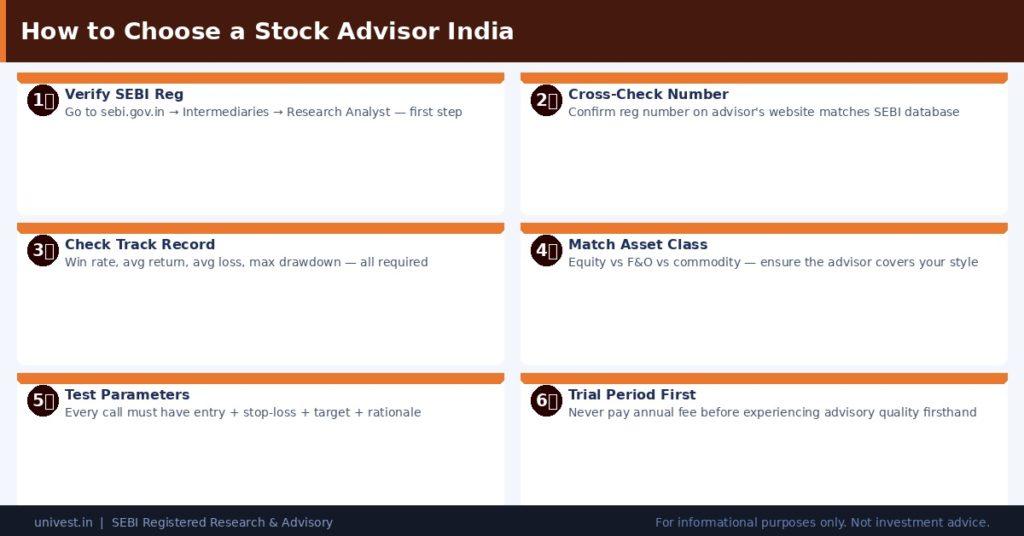
Step 1: Verify SEBI Registration — Non-Negotiable First Step
Before evaluating any stock advisor in India on any other dimension, verify their SEBI registration. Go to sebi.gov.in → Intermediaries / Market Infrastructure Institutions → Registered Entities → Research Analyst (or Investment Adviser). Search by the firm name or individual's name. A valid registration entry shows: registration number, date of registration, category (RA or RIA), and current status.
If the advisor does not appear in SEBI's registered entities database, they are operating illegally under Indian law — regardless of how compelling their track record screenshots look, how many followers they have on social media, or what testimonials they show. No registration = automatic disqualification. Period.
Step 2: Verify the Registration Number Against What They Display
A common fraud technique is displaying a fake or someone else's SEBI registration number. After finding the registration in SEBI's database, cross-verify: (1) the registration number shown on the advisor's website/app matches the SEBI record exactly, (2) the registered firm name matches what they market themselves as, and (3) there are no active disciplinary proceedings or cancellation notices on SEBI SCORES.
Real-world check: search the advisor's SEBI registration number on Google to see whether any investor complaints or SEBI actions appear alongside. Legitimate advisors have clean regulatory histories; fraudulent ones often have multiple SEBI enforcement news articles even if they have restarted under a different name.
Step 3: Evaluate the Track Record — Ask for Specific Metrics
A legitimate stock advisor in India will provide their track record in specific, quantifiable metrics — not just a list of profitable calls. The metrics that matter: (1) total number of calls generated in the last 12 months, (2) win rate (percentage of calls that hit target before stop-loss), (3) average return per winning call, (4) average loss per losing call, (5) maximum drawdown (largest peak-to-trough loss in a 12-month period).
Be very skeptical of advisors who show only profit screenshots or percentage returns without context. The most misleading advisory marketing shows 10 winning calls at 30–50% return each without disclosing that 30 other calls hit stop-loss at 10–15% loss. Demand the complete call history, or at minimum ask for the above 5 metrics as a minimum transparency test.
Step 4: Assess Asset Class Coverage Against Your Needs
Different investors need different advisory coverage. Clarify your needs before evaluating an advisor: Do you primarily trade equity delivery? Intraday equity? Index options (Nifty, Bank Nifty)? Stock F&O? Commodities (gold, crude, agri)? Mutual funds? An advisor who excels at equity delivery may be weak at F&O options, and vice versa. Match the advisor's declared primary expertise against your actual trading and investment patterns.
The best advisors — like Univest Pro — cover multiple asset classes (equity, F&O, commodity, mutual funds) under one platform, reducing the need for multiple subscriptions. But if your focus is purely, say, commodity trading, a commodity-specific SEBI-registered advisory may serve you better than a generalised equity-first platform.
Step 5: Evaluate Pricing Relative to Your Capital and Trade Frequency
A rule of thumb: advisory subscription costs should not exceed 1–2% of your annual trading capital. If you have Rs 5 lakh in trading capital, annual advisory spending of Rs 5,000–10,000 (Rs 14–27/day) is proportionate. For Rs 50 lakh capital, Rs 50,000–1,00,000 per year is reasonable for comprehensive advisory.
Warning: if an advisor's pricing is dramatically higher than this range without a compelling documented track record that justifies the premium, treat it as a red flag. The most credible advisory services — including Univest Pro at Rs 6/day — are deliberately priced to be accessible to the broad retail market rather than creating a high-margin luxury product for a small audience.
Step 6: Verify Trade Parameter Completeness
Every recommendation from a legitimate stock advisor in India should include: entry price or range, stop-loss level, target price, and the research rationale. For options advisory, additionally: specific strike price, recommended entry premium, stop-loss in premium terms, and expiry. For mutual fund advisory: specific scheme, NAV range for entry, and investment horizon.
Test any advisory service with a free trial period specifically to evaluate parameter completeness. If the advisor gives you "buy HDFC Bank" without an entry range, stop-loss, and target — that is not a legitimate advisory recommendation. It is a directional opinion with no action framework.
Step 7: Test Customer Support and SCORES Accessibility
Before subscribing to a paid plan, test the advisor's customer support: email a question and evaluate the response quality and speed. Ask specifically whether they are registered on SEBI's SCORES portal and whether you can file a complaint through SCORES if needed. A SEBI-registered advisor must be accessible through SCORES — this is a regulatory requirement, not optional.
Fraudulent advisors cannot be reached through SEBI SCORES because they are not registered. This single test — "Are you on SEBI SCORES?" — filters out 99% of fraudulent operators immediately, because they will either not know what SCORES is or will give a vague, evasive answer.
Step 8: Start With a Free Trial or Minimum Commitment Period
Even after clearing all 7 previous steps, do not commit to a long-term annual plan for an advisory service you have not experienced firsthand. Most legitimate advisors — including Univest — offer a trial period or month-to-month plans that allow you to evaluate the actual quality of recommendations before making an annual commitment. Use this period specifically to test: timeliness of calls, quality of rationale, accuracy of stop-loss calibration, and how the advisor communicates on losing calls (the real test of integrity).
Advisors who refuse any trial period and demand full annual payment upfront before you have seen a single call should be treated with maximum skepticism. This pricing structure is far more consistent with a scam than with a legitimate business.
Start a free trial of Univest Pro — SEBI-registered research advisory from Rs 6/day — Click here
Quick Reference: Legitimate vs Fraudulent Stock Advisor — Comparison Table
| Characteristic | Legitimate SEBI-Registered Advisor | Fraudulent/Unregistered Operator |
| SEBI Registration | Verifiable on sebi.gov.in | Cannot be verified; fake number or none |
| Track Record | Full call history; win rate + loss rate | Only cherry-picked winners shown |
| Trade Parameters | Entry + stop-loss + target + rationale | Vague direction only; no stop-loss |
| Returns Claim | "Historically," "potential" — no guarantees | "30% monthly guaranteed" — illegal |
| Pricing | Proportional; Rs 6–50/day for retail | Rs 10,000–2,00,000+ upfront demands |
| Communication | App, website, email with audit trail | WhatsApp only; messages deleted |
| Complaint Redressal | SEBI SCORES accessible | Not accessible on SCORES |
| Trial Period | Available for evaluation | Full payment demanded upfront |
Download the Univest iOS App or Univest Android App to access SEBI-registered stock advisory with complete trade parameters starting from Rs 6/day.
Conclusion
Choosing a stock advisor in India in 2026 requires systematic verification rather than emotional trust. The 8-step framework — SEBI registration verification, registration cross-check, track record evaluation, asset class assessment, pricing proportionality, trade parameter completeness, SCORES accessibility, and trial-first commitment — filters out virtually all fraudulent operators while identifying legitimate advisors who can genuinely improve your investment outcomes. Univest meets all 8 criteria with SEBI-registered research, transparent pricing from Rs 6/day, complete trade parameters, and SCORES accessibility. Start with the free screener at univest.in/screeners to experience the research quality before committing to a paid plan.
Investments in securities are subject to market risk. Please read all related documents carefully before investing. This content is for educational purposes only and does not constitute investment advice. Past performance is not indicative of future results. Consult a SEBI-registered investment advisor before making any investment decision.
Frequently Asked Questions
Q1. How do I check if a stock advisor is SEBI-registered in India?
Go to sebi.gov.in, navigate to "Intermediaries / Market Infrastructure Institutions," click "Registered Entities," and select either "Research Analyst" or "Investment Adviser." Search by firm name or individual name. A valid registration shows: registration number, date, category, and current status. Cross-verify this number with what the advisor displays on their marketing materials.
Q2. What is the difference between a SEBI Research Analyst and Investment Adviser?
A SEBI Research Analyst (RA) provides impersonal research reports and recommendations to all subscribers — they cannot provide personalised financial planning advice. An RIA (Registered Investment Adviser) provides personalised financial advice based on your specific financial profile, goals, and risk tolerance. For most retail stock market investors, an RA-backed platform like Univest is more practical. RIAs are better for comprehensive wealth management.
Q3. How much should I pay for a stock advisor in India?
Advisory cost should be proportional to your trading capital: approximately 1–2% annually is reasonable. For Rs 5 lakh capital, Rs 5,000–10,000/year (Univest Pro: from Rs 6/day = Rs 2,160/year) is proportionate. Paying Rs 50,000+ annually requires a very strong, verifiable track record from the advisor. Never pay large upfront amounts before experiencing the advisory firsthand.
Q4. Can a stock advisor guarantee returns in India?
No. SEBI regulations explicitly prohibit any registered Investment Adviser or Research Analyst from guaranteeing returns. Any advisor claiming "guaranteed profits," "30% monthly return," or similar is violating SEBI rules and is likely fraudulent. Always check for this red flag — if it appears, do not engage, and consider reporting to SEBI SCORES.
Q5. What should a stock advisory recommendation include?
A complete, legitimate stock advisory recommendation must include: entry price or price range, stop-loss level, target price, and research rationale (technical setup, fundamental context, or event catalyst). For options: additionally the specific strike, entry premium, and expiry. Any recommendation missing the stop-loss is incomplete and should not be acted on without adding your own stop-loss discipline.
Q6 How to Choose a Stock Advisor in India
Ask for: (1) total calls generated in last 12 months, (2) win rate as a percentage, (3) average return per winning call, (4) average loss per losing call, (5) maximum drawdown in the period. A win rate of 55–65% with an average win of 8–12% and average loss of 4–6% is realistic for a quality advisory. Win rates above 80% with average gains of 50%+ should be treated with extreme skepticism.
Q7. What is SEBI SCORES and why does it matter when choosing an advisor?
SEBI SCORES (Securities and Exchange Board of India Complaint Redress System) is SEBI's online platform for investor complaints against regulated entities. SEBI-registered advisors must be accessible through SCORES, meaning investors can file formal complaints against them for regulatory violations. Unregistered advisors cannot be reached through SCORES because they are outside SEBI's jurisdiction — making recovery of funds from fraudulent unregistered operators extremely difficult.
Q8. Is Univest a good choice as a stock advisor in India?
Univest is a SEBI-registered platform that meets all 8 criteria for a legitimate stock advisor: verifiable SEBI registration, disclosed research process, complete trade parameters (entry, stop-loss, target), proportional pricing (from Rs 6/day), multi-asset coverage (equity, F&O, commodity, MF), SCORES accessibility, and trial period availability. With 5 million+ investors and 75+ years of combined analyst experience, it is one of India's most established retail advisory platforms.
Read Articles
Best Platforms Combining Stock Research and Trading in 2026
Univest—Best Stock Advisory Services in India
Best Mutual Funds To Invest in India For High Returns
Recent Articles

Investment Advisory Services in India: Types, Fees, SEBI Rules and How to Pick the Right One
8 October 2026

Portfolio Advisory Services in India: What They Cover, What They Cost and How They Differ From PMS
8 October 2026

How to Choose a SEBI-Registered Stock Tips Provider in India for Intraday and Swing Trades in 2026
7 October 2026

Univest Stock Market Advisory in India: How a Research Call Is Built, What It Costs and Who It Suits
6 October 2026
Note: This blog is for information purpose only. Investments and trading are subject to market risks, read all scheme related documents carefully.
Reviews
Recent Posts
Investment Advisory Services in India: Types, Fees, SEBI Rules and How to Pick the Right One
Portfolio Advisory Services in India: What They Cover, What They Cost and How They Differ From PMS
How to Choose a SEBI-Registered Stock Tips Provider in India for Intraday and Swing Trades in 2026
Univest Stock Market Advisory in India: How a Research Call Is Built, What It Costs and Who It Suits
Best Stock Recommendation App in India for 2026: 7 Tests Univest Passes, and the One Limit You Should Know

Uniresearch Global Pvt Ltd
Research Analyst
SEBI Registration Number — INH000013776
Uniresearch is a subsidiary of Univest Communication Technologies Private Limited
Company Address: Registered Address: Ground Floor, Unitech Commercial Tower 2, Block B, Greenwood City, Unit 1-3, Sector 45, Gurugram, Haryana 122003
Write to us : support@univest.in, compliance@univest.in
Verify on SEBI registry →RESEARCH ANALYST
Get SEBI Registered
advice on the stocks
trending today.
Get 3 FREE Trade Ideas

for Startups Accelerator 2024

Trusted by 1Cr Indians

Awarded No.1 by Economic Times