
Debt-Free Penny Chemical Stocks in India 2026: Zero Debt, Multibagger Potential
Updated: 2 Apr 2026 • 1:21 pm
Posted by:

What Are Debt-Free Penny Chemical Stocks?
Click Here — Get Free Investment Predictions from SEBI-Registered Analysts
Debt-free penny chemical stocks are shares of small chemical companies that trade at low prices — typically below Rs.50 or Rs.100 — and carry zero or negligible long-term debt on their balance sheet. The combination of "debt-free" and "chemical sector" is particularly powerful because it means these companies can self-fund their expansion using internal cash flows rather than borrowing at high interest rates, giving them a significant competitive advantage over debt-laden peers during interest rate cycles.
India's chemical industry is one of the most exciting structural growth stories for the next decade. The industry is projected to grow at 9% CAGR through 2030, driven by domestic demand across pharmaceuticals, agriculture, paints, FMCG, and textiles, and by export opportunities from the global China+1 sourcing strategy. Smaller speciality chemical companies — many of which are penny stocks today — are positioned to disproportionately benefit from this shift.
Screen debt-free chemical penny stocks with zero-debt filters on the Univest Screener — live NSE/BSE data, updated daily.
Why Zero Debt Is Critical in Penny Chemical Stocks
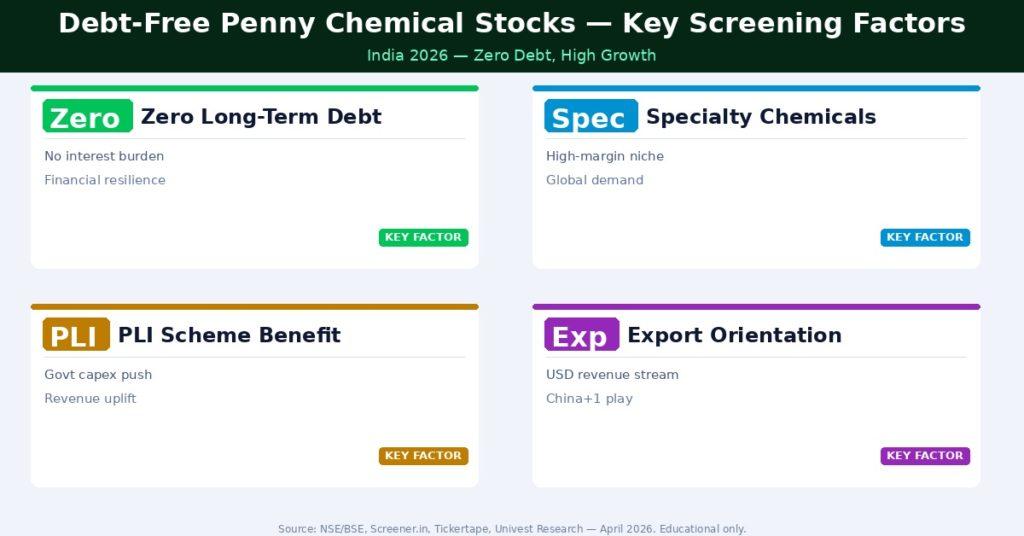
Debt-free chemical penny stocks — why zero debt matters, speciality chemicals advantage, PLI benefits, export upside
Financial Resilience Through Economic Cycles
Chemical companies are cyclically sensitive — raw material prices fluctuate, export demand varies with global economic conditions, and regulatory changes can suddenly increase compliance costs. A chemical company with zero debt has no interest burden to service during downturns. This means it can sustain operations, pay salaries, and continue R&D investment even when revenue temporarily contracts — something high-debt chemical peers simply cannot do.
Self-Funded Expansion Without Equity Dilution
Debt-free chemical companies can reinvest free cash flow into capacity expansion without diluting existing shareholders. A Rs.30 penny stock of a debt-free speciality chemical company that is expanding its reactor capacity using internal cash is a fundamentally different investment from a similar-priced company that must issue equity at low valuations or borrow at 12%+ to fund the same expansion.
Higher Valuation Re-Rating Potential
As institutional investors increasingly apply ESG and balance sheet quality filters, debt-free small companies attract premium P/E multiples relative to peers. A speciality chemical penny stock trading at Rs.25 with zero debt and 20% ROCE might trade at 15x earnings today — but as revenues scale and institutional coverage begins, re-rating to 25-30x earnings is common. This multiple expansion, compounding on top of earnings growth, is what creates 10x returns.
India's Chemical Sector — 10-Year Growth Drivers
China+1 Strategy — India's Biggest Chemical Opportunity
Global pharmaceutical, agrochemical, and speciality chemical companies are actively diversifying away from single-source dependency on China. India — with its established chemical manufacturing infrastructure, NISM-certified workforce, and competitive cost base — is the primary beneficiary of this reallocation. The Dahej, Ankleshwar, and Vapi chemical clusters in Gujarat alone are witnessing Rs.50,000+ crore in new investment announcements from multinational companies.
Speciality Chemicals — High Margin, Low Competition
Speciality chemicals — dye intermediates, agro-intermediates, performance chemicals, and fine chemicals — command significantly higher margins than commodity chemicals. The reason is product complexity: these chemicals require specialised synthesis routes, quality consistency, and regulatory approvals that create natural barriers to entry. Small Indian companies that have developed expertise in 2-5 specialty chemicals often become irreplaceable suppliers to large global companies.
PLI and Production Incentives
The Indian government's Production Linked Incentive schemes, combined with the PM MITRA textile park scheme (which drives demand for chemical dyes and intermediates), are creating additional tailwinds for chemical penny stocks. Companies that qualify for PLI benefits see a direct 10-15% uplift to their margins during the incentive period.
| Chemical Sub-Sector | Key Driver | Export Potential | Representative Penny Stocks |
| Dye Intermediates | Textile/pharma demand | H-acid, Vinyl Sulfone exports | Bodal Chemicals, Bhageria Industries |
| Agro-chemicals | Food security spending | Herbicide, insecticide APIs | Shivalik Rasayan, Insecticides India |
| Pharma Intermediates | API manufacturing growth | US FDA-compliant manufacturers | Vinati Organics (graduated), small API cos |
| Specialty Gases | Semiconductor demand | Neon, Krypton export potential | INOX Air Products, Chemplast (larger) |
| Flavours & Fragrances | FMCG market growth | Personal care export | SH Kelkar (larger), niche smaller cos |
Indicative sub-sectors and companies. Not a buy recommendation. Verify fundamentals on NSE/BSE and Screener.in before investing.
How to Screen Debt-Free Penny, Chemical Stocks
Step-by-Step Screener Approach on Screener.in
- Set Price filter: Less than Rs.100 (or Rs.50 for stricter penny definition)
- Set Sector: Chemicals
- Set Debt-to-Equity: Equal to 0 (strict zero debt) OR Less than 0.25 (near-zero debt)
- Set ROCE: Greater than 15% (preferred above 20%)
- Set Revenue Growth (3Y CAGR): Greater than 10%
- Set Promoter Holding: Greater than 40% (preferred above 50%)
- Sort by Market Cap descending — prioritise stocks above Rs.100 crore for basic liquidity
Apply these exact filters on the Univest Screener for a real-time list of debt-free chemical penny stocks passing all criteria.
Key Debt-Free Penny Chemical Stocks to Watch in 2026
| Company | Sub-Sector | Price Range | D/E | ROCE | Why Watchlist |
| Bodal Chemicals | Dye intermediates | Sub-Rs.100 | ~0 | 15-18% | H-acid dominant player, export expansion |
| Bhageria Industries | Dye intermediates | Sub-Rs.400 | ~0 | 20%+ | Consistent ROCE, no pledging, solar forward integration |
| Shivalik Rasayan | Agro-chemicals | Sub-Rs.500 | ~0 | 22%+ | Custom synthesis, pharma intermediate expansion |
| Nihal Trading | Specialty chemicals | Sub-Rs.50 | 0 | Positive | Very small, high risk, low liquidity — watchlist only |
| Mangalam Industrial | Diversified chemicals | Sub-Rs.50 | 0 | 8-12% | Zero debt, needs ROCE improvement to qualify fully |
Prices approximate as of April 2026. Not a buy recommendation. Verify current fundamentals before any investment decision.
Risks in Debt-Free Penny Chemical Stocks
- Environmental and regulatory compliance risk — chemical companies face CPCB and state pollution control board scrutiny. A compliance failure can result in a plant shutdown, creating sudden revenue loss regardless of balance sheet quality.
- Raw material price volatility — even debt-free chemical companies are exposed to raw material cost swings (benzene, toluene, methanol). Margin compression during high input cost periods can persist for 4-6 quarters.
- Customer concentration — many small speciality chemical companies derive 50-70% of revenue from 3-5 customers. Loss of a key customer, or a customer's decision to backwards-integrate, can permanently impair the revenue base.
- Technology obsolescence — speciality chemical processes can be disrupted by more efficient synthesis routes. Companies that do not invest in R&D can find their product advantages eroded over a 5-10 year period.
- Liquidity risk — penny stocks have low trading volumes. If you need to exit a position quickly, you may not find buyers at fair value, especially in bear markets.
Get SEBI-registered analyst guidance on chemical sector penny stocks at Univest.
Conclusion
Debt-free penny chemical stocks in India represent one of the most compelling categories for the long-term investor in 2026. The combination of zero-debt financial resilience, speciality chemical pricing power, and the China+1 structural tailwind creates a rare alignment of quality + growth + macro support. Apply the 5-step screener discipline, limit your allocation to a diversified basket, and maintain a 7-10 year investment horizon to allow the compounding to work. The best debt-free chemical penny stocks today are building the supply chains that global companies will depend on tomorrow.
Frequently Asked Questions
What are debt-free penny chemical stocks in India?
Debt-free penny chemical stocks are shares of small chemical manufacturing companies that trade at low prices (typically below Rs.50-100) and carry zero or negligible long-term debt. The absence of debt means these companies do not pay interest, retain more cash for growth, and are more resilient during economic downturns. Combined with India's speciality chemical growth story, they represent compelling long-term investment candidates.
Which chemical sector is best for penny stocks in India?
Speciality chemicals — specifically dye intermediates, agro-chemical intermediates, pharma intermediates, and performance chemicals — offer the best risk-reward for penny stock investors. These sub-sectors have high margins, natural barriers to entry from product complexity, strong export demand, and direct benefit from the China+1 sourcing shift by global companies.
How do I find zero-debt chemical penny stocks?
Use the Univest Screener or Screener.in with filters: Sector = Chemicals, Debt-to-Equity = 0, Price < Rs.100, ROCE > 15%, Promoter Holding > 40%, Revenue Growth > 10%. This combination filters out most low-quality penny stocks and highlights companies with genuine financial strength.
Why is zero debt important in chemical penny stocks?
Zero debt means the company pays no interest, retaining more of its operating profit as free cash flow. During raw material price spikes or demand downturns — both common in the chemical cycle — debt-free companies can sustain operations and invest in expansion while debt-heavy peers face financial distress. Over a 10-year horizon, this resilience compounds dramatically in favour of debt-free companies.
Are chemical penny stocks good for long-term investment?
Speciality chemical penny stocks with zero debt, consistent ROCE above 15%, and export orientation are among the better-quality choices within the high-risk penny stock universe for long-term investors. However, all penny stocks carry high risk — including potential total loss of capital. Limit allocation to 5-10% of portfolio and diversify across 8-12 stocks.
Disclaimer: This article is for informational and educational purposes only and does not constitute investment advice or stock recommendations. Penny stocks carry very high risk, including potential total loss of capital. All data sourced from NSE/BSE, Screener.in, Tickertape, and company filings as of April 2026. Past performance does not guarantee future results. Consult a SEBI-registered financial advisor before making any investment decisions.
Recent Articles

3 Gas Terminal and Logistics Stocks With a Strong Future Roadmap: Petronet LNG, Delhivery and Gateway Distriparks
9 October 2026

3 Engineering Services and Telecom Technology Stocks With a Strong Future Roadmap: Cyient, Cyient DLM and HFCL
9 October 2026

3 Wellness Brand and Medical Device Stocks With a Strong Future Roadmap: Emami, Zydus Wellness and Poly Medicure
9 October 2026

3 Textile and Apparel Manufacturing Stocks With a Strong Future Roadmap: KPR Mill, Gokaldas Exports and Vardhman Textiles
9 October 2026
Note: This blog is for information purpose only. Investments and trading are subject to market risks, read all scheme related documents carefully.
Reviews






Recent Posts
3 Gas Terminal and Logistics Stocks With a Strong Future Roadmap: Petronet LNG, Delhivery and Gateway Distriparks
3 Engineering Services and Telecom Technology Stocks With a Strong Future Roadmap: Cyient, Cyient DLM and HFCL
3 Wellness Brand and Medical Device Stocks With a Strong Future Roadmap: Emami, Zydus Wellness and Poly Medicure
3 Textile and Apparel Manufacturing Stocks With a Strong Future Roadmap: KPR Mill, Gokaldas Exports and Vardhman Textiles
3 Premium Drinks Brand Stocks With a Strong Future Roadmap: United Breweries, Tilaknagar Industries and Sula Vineyards

Uniresearch Global Pvt Ltd
Research Analyst
SEBI Registration Number — INH000013776
Uniresearch is a subsidiary of Univest Communication Technologies Private Limited
Company Address: Registered Address: Ground Floor, Unitech Commercial Tower 2, Block B, Greenwood City, Unit 1-3, Sector 45, Gurugram, Haryana 122003
Write to us : support@univest.in, compliance@univest.in
Verify on SEBI registry →RESEARCH ANALYST
Get SEBI Registered
advice on the stocks
trending today.
Get 3 FREE Trade Ideas

for Startups Accelerator 2024

Trusted by 1Cr Indians

Awarded No.1 by Economic Times