
Why Is Vodafone Idea Share Price Falling? Key Reasons & Share Price Target
Updated: 10 Apr 2026 • 1:59 pm
Posted by:

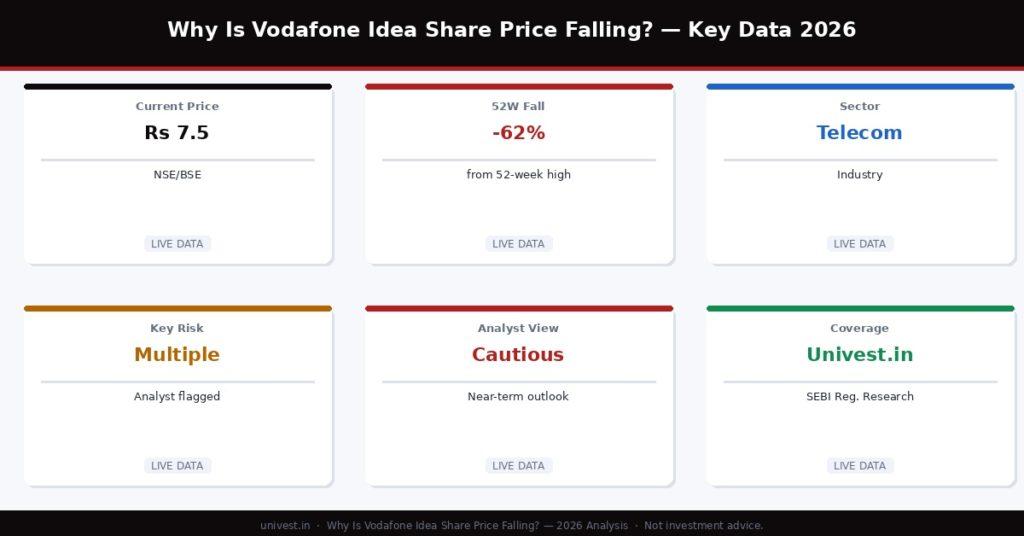
Vodafone Idea is trading at Rs 7.5, down 62% from its 52-week high of Rs 19.2. The sustained fall in the Vodafone Idea share price has unsettled investors who built positions during the stock's rally phase. At its current price, the stock is approaching its 52-week low of Rs 6.2, and the market is asking one question loudly: is this a buying opportunity, or is the decline a warning sign of deeper problems?
The Vodafone Idea share price falling is not random. There are specific, identifiable factors driving institutional selling, retail panic, and analyst downgrades — and this article examines each of them with real data from the latest quarterly results and exchange filings.
[Click Here – Get Free Investment Predictions](https://univest.in/user/log-in)
This article covers every key reason behind the Vodafone Idea share price fall, the latest financial performance data, technical levels to watch, institutional positioning, and what analysts think the Vodafone Idea share price target is for 2026.
About Vodafone Idea
[Click Here – Get Free Investment Predictions on Univest.
Vodafone Idea is a listed company in the Telecom sector with a market capitalisation of Rs 32,900 Cr. The stock trades at approximately -ve (losses) trailing P/E and N/A (negative book) price-to-book. Its 52-week range spans from Rs 6.2 to Rs 19.2, and the current price of Rs 7.5 puts the stock in the lower quarter of that range, reflecting the sustained selling pressure of recent months.
Why Is Vodafone Idea Share Price Falling? Key Reasons
[Tap to Access Best Research Pieces on Univest.
Existential Debt Crisis — Rs 2.1 Lakh Crore in Dues
Vodafone Idea faces aggregate dues of approximately Rs 2.1 lakh crore, including spectrum payments, AGR (Adjusted Gross Revenue) dues to the Department of Telecommunications, and bank debt. The government's moratorium on AGR payments provided temporary relief, but the company's ability to service this debt from operating cash flows remains deeply uncertain. Even with the government converting AGR dues to equity, the residual debt burden far exceeds what the current business can service.
Every quarter in which Vodafone Idea continues to operate is essentially a quarter in which its capital structure becomes more distressed. Net loss of Rs 6,609 crore in Q3 FY26, while improved YoY, signals that the path to profitability is extremely long even in the best case scenario.
Subscriber Loss to Jio and Airtel — Structural Erosion
Vodafone Idea lost approximately 2.2 million subscribers in Q3 FY26, primarily to Reliance Jio and Bharti Airtel. The churn is disproportionately weighted toward 4G and premium subscribers — the most valuable segment. With ARPU at Rs 166 vs. Jio's Rs 203 and Airtel's Rs 233, Vodafone Idea's pricing power is limited. Without a 5G rollout at scale and without a differentiated product offering, subscriber recovery is extremely difficult.
The company has 213 million subscribers as of Q3 FY26, down from over 300 million at its peak. Each subscriber lost represents approximately Rs 1,900 in annual ARPU, meaning subscriber erosion directly compresses the revenue base needed to service the debt.
5G Rollout Constraints — Capital Starvation
Jio and Airtel are aggressively rolling out 5G, with Jio already covering 99% of its 4G population with 5G by mid-FY26. Vodafone Idea has been unable to roll out 5G meaningfully due to capital constraints. Without 5G, the company cannot retain enterprise and premium consumer subscribers who will increasingly demand 5G speeds. This creates a vicious cycle: no capital for 5G, so subscriber losses continue; subscriber losses reduce cash flow, so there is less capital available.
Vodafone Idea Latest News That Impacted the Stock
September 2025: Government converts Rs 36,950 Cr AGR dues to equity; now holds 48.9% stake.
October 2025: Rs 18,000 Cr rights issue completed; fundraising less than target.
February 2026: Q3 FY26: Net loss Rs 6,609 Cr; ARPU improves marginally to Rs 166.
March 2026: Credit rating agencies maintain junk ratings; bank loan renewal uncertain.
April 2026: Stock hits 52-week low Rs 6.2 on broader market selloff.
Vodafone Idea Financial Performance Analysis
The quarterly financial data for Vodafone Idea provides important context for understanding why the share price is falling. The numbers below highlight the key metrics that institutional analysts track closely.
| Key Metric | Latest Quarter | Year-Ago Quarter | YoY Change |
| Revenue | Rs 11,117 Cr | Rs 10,672 Cr | +4.2% YoY |
| Net Profit (PAT) | Rs -6,609 Cr | Rs -7,176 Cr | Still loss-making |
| Market Cap | Rs 32,900 Cr | — | Current |
| P/E Ratio | -ve (losses) | — | Trailing |
| P/B Ratio | N/A (negative book) | — | Current |
If you want to track Vodafone Idea's financial metrics in real time, check the Univest Screener for live data, peer comparisons, and financial history.
Technical Signals: What the Charts Are Saying
Vodafone Idea is trading at Rs 7.5, below all key moving averages including the 50-day, 100-day, and 200-day MAs. The stock has formed a clear pattern of lower highs and lower lows since its 52-week high of Rs 19.2. Key support is at the 52-week low of Rs 6.2. Resistance is at Rs 6.5 in the near term.
Download the Univest iOS App or Univest Android App to track Vodafone Idea's live price and get daily research insights.
Market Sentiment and Institutional Positioning
Promoter holding stands at 35.9%, which is relatively modest and suggests limited promoter confidence buffer in volatile markets. FII holding at 5.8% is moderate, and DII holding at 18.4% indicates domestic institutions have modest exposure.
High FII ownership in any stock creates downside amplification when global risk appetite contracts. The Vodafone Idea share price falling has been exacerbated by FII selling that is driven by macro factors — crude oil, dollar strength, US rate expectations — rather than company-specific concerns alone.
Future Outlook: Can Vodafone Idea Recover?
Vodafone Idea is a high-risk, speculative holding with binary outcomes. The bull case requires: a strategic investor coming in at a significant valuation (unlikely at current debt levels), a dramatic improvement in ARPU to Rs 200+ through tariff hikes, and the government providing additional support beyond the existing equity conversion. The bear case is that the company is unable to refinance its debt, triggers a default, and either enters a resolution process or shuts down. This is not a stock for risk-averse investors.
Vodafone Idea Share Price Target 2026
Subscribe to Univest Pro for Premium Stock Research and F&O Setups.
Short-Term Target (3-6 Months)
In the short term, Vodafone Idea share price target is Rs 6.5-8.5 based on current technical positioning and near-term fundamental catalysts. The downside risk if the 52-week low of Rs 6.2 breaks is approximately 5-10% further.
12-Month Analyst Target
Analyst consensus 12-month Vodafone Idea share price target is Rs 8-12 (speculative), implying significant upside from the current price of Rs 7.5. This target assumes a partial recovery of the factors driving the current decline.
Long-Term Target (FY27-FY28)
In a recovery scenario where the key headwinds resolve, the Vodafone Idea share price target for FY28 is Rs 12-18 (bull case). This long-term bull case requires the fundamental concerns addressed in this article to show measurable improvement over the next 6-12 quarters.
For live Vodafone Idea tracking and peer comparison, explore the Univest Screener.
Conclusion
Vodafone Idea share price is falling due to a combination of company-specific headwinds and broader market pressures. The 52-week decline of 62% from the high of Rs 19.2 to the current Rs 7.5 has created both a risk and an opportunity. The risk is that the concerns identified in this article deepen; the opportunity is that the stock is now meaningfully cheaper than it was at the peak. Analyst consensus targets of Rs 8-12 (speculative) for 12 months and Rs 12-18 (bull case) for the longer term suggest significant potential upside for patient investors.
This article is for informational purposes only. Please conduct your own research and consult a SEBI-registered financial advisor before making any investment decisions.
Frequently Asked Questions
Q1. Why is Vodafone Idea share price falling in 2026?
Vodafone Idea share price is falling due to the reasons detailed in this article, including sector-specific headwinds, recent financial performance concerns, and broader market pressures. The stock has fallen 62% from its 52-week high of Rs 19.2 to its current price of Rs 7.5. Investors should review all factors and consult a SEBI-registered financial advisor before making investment decisions.
Q2. What is Vodafone Idea share price target?
The 12-month analyst consensus Vodafone Idea share price target is Rs 8-12 (speculative). The short-term target for 3-6 months is Rs 6.5-8.5, while the long-term target for FY27-FY28 is Rs 12-18 (bull case) in a recovery scenario. These are analyst projections and not guaranteed returns.
Q3. Should I buy Vodafone Idea shares now?
This article cannot provide personalised investment advice. Vodafone Idea is trading at Rs 7.5 with a 52-week range of Rs 6.2 to Rs 19.2. Analyst consensus targets suggest potential upside. However, all the risks outlined in this article remain live. Consult a SEBI-registered financial advisor for personalised advice.
Q4. What is Vodafone Idea's market cap and PE ratio?
Vodafone Idea's current market capitalisation is Rs 32,900 Cr with a trailing P/E of -ve (losses) and price-to-book ratio of N/A (negative book). The stock is trading at Rs 7.5 as of April 2026.
Q5. What are Vodafone Idea's latest quarterly results?
In the most recent quarter, Vodafone Idea reported revenue of Rs 11,117 Cr (+4.2% YoY) and net profit (PAT) of Rs -6,609 Cr (Still loss-making). Full quarterly financial data is available on the NSE/BSE filing portals and on the Univest Screener.
Q6. Who holds Vodafone Idea shares institutionally?
Vodafone Idea's shareholding: Promoters 35.9%, FIIs 5.8%, DIIs 18.4%. Check the latest quarter's shareholding pattern on NSE/BSE for the most current data.
Q7. What can trigger a recovery in Vodafone Idea share price?
Key recovery triggers for Vodafone Idea include: improvement in the fundamental factors causing the current decline, positive quarterly results showing reversal of the stressed metrics, broad market recovery, and any sector-specific positive news. Monitor developments closely.
Q8. What is the 52-week low of Vodafone Idea share price?
Vodafone Idea's 52-week low is Rs 6.2, reached during the recent market correction. The 52-week high was Rs 19.2. The current price of Rs 7.5 represents a fall of 62% from the 52-week high. Technical analysts identify Rs 6.2 as a key support level.
For more analysis on falling stocks, visit Univest Blogs.
Recent Articles


Note: This blog is for information purpose only. Investments and trading are subject to market risks, read all scheme related documents carefully.
Reviews






Recent Posts
Weekly Update- 24th October 2026
Reliance Industries Share Price Prediction for Monday, 26 October 2026
Infosys Share Price Prediction for Monday, 26 October 2026
TCS Share Price Prediction for Monday, 26 October 2026
ICICI Bank Share Price Prediction for Monday, 26 October 2026

Uniresearch Global Pvt Ltd
Research Analyst
SEBI Registration Number — INH000013776
Uniresearch is a subsidiary of Univest Communication Technologies Private Limited
Company Address: Registered Address: Ground Floor, Unitech Commercial Tower 2, Block B, Greenwood City, Unit 1-3, Sector 45, Gurugram, Haryana 122003
Write to us : support@univest.in, compliance@univest.in
Verify on SEBI registry →RESEARCH ANALYST
Get SEBI Registered
advice on the stocks
trending today.
Get 3 FREE Trade Ideas

for Startups Accelerator 2024

Trusted by 1Cr Indians

Awarded No.1 by Economic Times