
Why Is SBI Cards and Payment Services Share Price Falling? Key Reasons & Share Price Target
Updated: 10 Apr 2026 • 1:44 pm
Posted by:

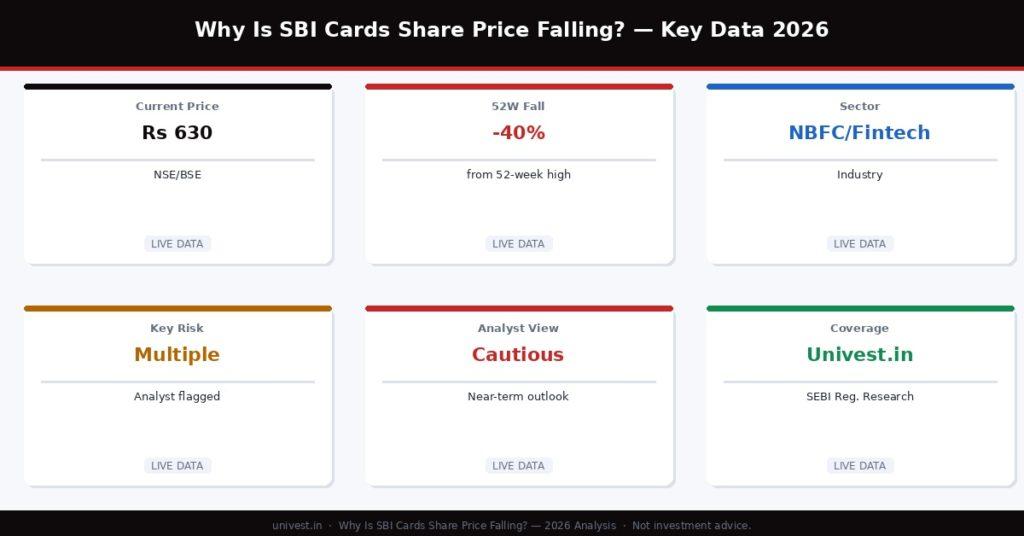
SBI Cards and Payment Services is trading at Rs 630, down 40% from its 52-week high of Rs 1,000. The sustained fall in the SBI Cards and Payment Services share price has unsettled investors who built positions during the stock's rally phase. At its current price, the stock is approaching its 52-week low of Rs 575, and the market is asking one question loudly: is this a buying opportunity, or is the decline a warning sign of deeper problems?
The SBI Cards and Payment Services share price falling is not random. There are specific, identifiable factors driving institutional selling, retail panic, and analyst downgrades — and this article examines each of them with real data from the latest quarterly results and exchange filings.
[Click Here – Get Free Investment Predictions](https://univest.in/user/log-in)
This article covers every key reason behind the SBI Cards and Payment Services share price fall, the latest financial performance data, technical levels to watch, institutional positioning, and what analysts think the SBI Cards and Payment Services share price target is for 2026.
About SBI Cards and Payment Services
[Click Here – Get Free Investment Predictions on Univest.
SBI Cards and Payment Services is a listed company in the Credit Cards / NBFC sector with a market capitalisation of Rs 59,500 Cr. The stock trades at approximately 20x trailing P/E and 3.8x price-to-book. Its 52-week range spans from Rs 575 to Rs 1,000, and the current price of Rs 630 puts the stock in the lower quarter of that range, reflecting the sustained selling pressure of recent months.
Why Is SBI Cards and Payment Services Share Price Falling? Key Reasons
[Tap to Access Best Research Pieces on Univest.
Credit Cost Surge — Unsecured Lending Stress
SBI Cards is India's second-largest credit card company and an almost pure-play unsecured lender. The unsecured credit cycle has turned sharply negative in FY26, with credit card delinquencies rising across all issuers as over-leveraged consumers struggle with EMI obligations across multiple products simultaneously.
SBI Cards' net credit costs increased to 9.1% in Q3 FY26 from 7.8% a year ago. This single metric explains the 27% PAT decline despite 9% revenue growth. Until credit costs normalise to 6-7%, earnings will remain under pressure.
RBI Regulatory Tightening on Unsecured Credit
The RBI increased risk weights on unsecured consumer credit from 100% to 125% in November 2023, and has maintained a cautious stance on credit card growth through subsequent circulars. This has constrained SBI Cards' ability to grow its outstanding book aggressively and has increased the capital cost of its existing portfolio. New account acquisition costs have also risen as consumers become more selective in credit applications.
Competitive Intensity — Premium Card Space Under Threat
HDFC Bank, Axis Bank, and ICICI Bank have launched aggressive premium credit card products with superior rewards programmes. SBI Cards, which historically dominated in the mass market segment through the SBI customer base, is seeing its high-spending premium card customers migrate to competitors with better rewards ecosystems.
SBI Cards and Payment Services Latest News That Impacted the Stock
September 2025: RBI circular on credit card settlement practices increases compliance costs.
October 2025: Q2 FY26: Net credit cost 8.8% annualised; PAT -24% YoY.
January 2026: Q3 FY26: Net credit cost 9.1%; new card issuance slowdown.
February 2026: Management guidance: credit costs expected to normalise in 4-6 quarters.
April 2026: At Rs 630 — 40% below 52-week high; approaching multi-year support levels.
SBI Cards and Payment Services Financial Performance Analysis
The quarterly financial data for SBI Cards and Payment Services provides important context for understanding why the share price is falling. The numbers below highlight the key metrics that institutional analysts track closely.
| Key Metric | Latest Quarter | Year-Ago Quarter | YoY Change |
| Revenue | Rs 4,750 Cr | Rs 4,360 Cr | +8.9% YoY |
| Net Profit (PAT) | Rs 383 Cr | Rs 526 Cr | -27.2% YoY |
| Market Cap | Rs 59,500 Cr | — | Current |
| P/E Ratio | 20x | — | Trailing |
| P/B Ratio | 3.8x | — | Current |
If you want to track SBI Cards and Payment Services's financial metrics in real time, check the Univest Screener for live data, peer comparisons, and financial history.
Technical Signals: What the Charts Are Saying
SBI Cards and Payment Services is trading at Rs 630, below all key moving averages including the 50-day, 100-day, and 200-day MAs. The stock has formed a clear pattern of lower highs and lower lows since its 52-week high of Rs 1,000. Key support is at the 52-week low of Rs 575. Resistance is at Rs 640 in the near term.
Download the Univest iOS App or Univest Android App to track SBI Cards and Payment Services's live price and get daily research insights.
Market Sentiment and Institutional Positioning
Promoter holding stands at 68.7%, which provides some confidence in management commitment to the business. FII holding at 10.4% is moderate, and DII holding at 12.8% indicates domestic institutions have modest exposure.
High FII ownership in any stock creates downside amplification when global risk appetite contracts. The SBI Cards and Payment Services share price falling has been exacerbated by FII selling that is driven by macro factors — crude oil, dollar strength, US rate expectations — rather than company-specific concerns alone.
Future Outlook: Can SBI Cards and Payment Services Recover?
SBI Cards' fundamental position as the second-largest credit card company in India, backed by the SBI customer base of 500 million, is genuinely strong. The credit cost cycle will normalise. At 20x P/E on suppressed earnings, the stock looks expensive near-term but cheap on a 2-year view when earnings normalise. Recovery to Rs 760-900 requires net credit costs declining to 7-7.5%. The 12-month target implies 20-45% upside. FII ownership is low at 10%, meaning any positive sentiment shift could drive sharp outperformance.
SBI Cards and Payment Services Share Price Target 2026
Subscribe to Univest Pro for Premium Stock Research and F&O Setups.
Short-Term Target (3-6 Months)
In the short term, SBI Cards and Payment Services share price target is Rs 640-710 based on current technical positioning and near-term fundamental catalysts. The downside risk if the 52-week low of Rs 575 breaks is approximately 5-10% further.
12-Month Analyst Target
Analyst consensus 12-month SBI Cards and Payment Services share price target is Rs 760-900, implying significant upside from the current price of Rs 630. This target assumes a partial recovery of the factors driving the current decline.
Long-Term Target (FY27-FY28)
In a recovery scenario where the key headwinds resolve, the SBI Cards and Payment Services share price target for FY28 is Rs 1,000-1,200. This long-term bull case requires the fundamental concerns addressed in this article to show measurable improvement over the next 6-12 quarters.
For live SBI Cards and Payment Services tracking and peer comparison, explore the Univest Screener.
Conclusion
SBI Cards and Payment Services share price is falling due to a combination of company-specific headwinds and broader market pressures. The 52-week decline of 40% from the high of Rs 1,000 to the current Rs 630 has created both a risk and an opportunity. The risk is that the concerns identified in this article deepen; the opportunity is that the stock is now meaningfully cheaper than it was at the peak. Analyst consensus targets of Rs 760-900 for 12 months and Rs 1,000-1,200 for the longer term suggest significant potential upside for patient investors.
This article is for informational purposes only. Please conduct your own research and consult a SEBI-registered financial advisor before making any investment decisions.
Frequently Asked Questions
Q1. Why is SBI Cards and Payment Services share price falling in 2026?
SBI Cards and Payment Services share price is falling due to the reasons detailed in this article, including sector-specific headwinds, recent financial performance concerns, and broader market pressures. The stock has fallen 40% from its 52-week high of Rs 1,000 to its current price of Rs 630. Investors should review all factors and consult a SEBI-registered financial advisor before making investment decisions.
Q2. What is SBI Cards and Payment Services share price target?
The 12-month analyst consensus SBI Cards and Payment Services share price target is Rs 760-900. The short-term target for 3-6 months is Rs 640-710, while the long-term target for FY27-FY28 is Rs 1,000-1,200 in a recovery scenario. These are analyst projections and not guaranteed returns.
Q3. Should I buy SBI Cards and Payment Services shares now?
This article cannot provide personalised investment advice. SBI Cards and Payment Services is trading at Rs 630 with a 52-week range of Rs 575 to Rs 1,000. Analyst consensus targets suggest potential upside. However, all the risks outlined in this article remain live. Consult a SEBI-registered financial advisor for personalised advice.
Q4. What is SBI Cards and Payment Services's market cap and PE ratio?
SBI Cards and Payment Services's current market capitalisation is Rs 59,500 Cr with a trailing P/E of 20x and price-to-book ratio of 3.8x. The stock is trading at Rs 630 as of April 2026.
Q5. What are SBI Cards and Payment Services's latest quarterly results?
In the most recent quarter, SBI Cards and Payment Services reported revenue of Rs 4,750 Cr (+8.9% YoY) and net profit (PAT) of Rs 383 Cr (-27.2% YoY). Full quarterly financial data is available on the NSE/BSE filing portals and on the Univest Screener.
Q6. Who holds SBI Cards and Payment Services shares institutionally?
SBI Cards and Payment Services's shareholding: Promoters 68.7%, FIIs 10.4%, DIIs 12.8%. Check the latest quarter's shareholding pattern on NSE/BSE for the most current data.
Q7. What can trigger a recovery in SBI Cards and Payment Services share price?
Key recovery triggers for SBI Cards and Payment Services include: improvement in the fundamental factors causing the current decline, positive quarterly results showing reversal of the stressed metrics, broad market recovery, and any sector-specific positive news. Monitor developments closely.
Q8. What is the 52-week low of SBI Cards and Payment Services share price?
SBI Cards and Payment Services's 52-week low is Rs 575, reached during the recent market correction. The 52-week high was Rs 1,000. The current price of Rs 630 represents a fall of 40% from the 52-week high. Technical analysts identify Rs 575 as a key support level.
For more analysis on falling stocks, visit Univest Blogs.
Recent Articles
Why is KRBL Share Price Falling? Check Next Share Price Target
Why is Reliance Infrastructures Share Price Falling? Check Next Share Price Target
Why is Mahanagar Gas Share Price Falling? Check Next Share Price Target
Why is Happiest Minds Share Price Falling? Check Next Share Price Target
Recent Articles

Infosys Dividend 2026: Rs 26 Per Share Interim Payout, Record Date, Q2 Profit Up 6.23% and What Shareholders Should Know
23 October 2026

Ambit Capital Telecom Picks: Why the Brokerage Backs Airtel, Vodafone Idea and Indus Towers With Buy Ratings and Higher Targets
23 October 2026

Delhi Pollution Curbs: Can They Be a Game-Changer for Auto and EV Stocks From Ather Energy to TMPV?
23 October 2026

Swiggy vs Eternal Shares Compared: Which Is the Better Stock After Q2 FY27 Results as Blinkit Profit Meets Instamart Loss?
23 October 2026
Note: This blog is for information purpose only. Investments and trading are subject to market risks, read all scheme related documents carefully.
Reviews






Recent Posts
Infosys Dividend 2026: Rs 26 Per Share Interim Payout, Record Date, Q2 Profit Up 6.23% and What Shareholders Should Know
Ambit Capital Telecom Picks: Why the Brokerage Backs Airtel, Vodafone Idea and Indus Towers With Buy Ratings and Higher Targets
Delhi Pollution Curbs: Can They Be a Game-Changer for Auto and EV Stocks From Ather Energy to TMPV?
Swiggy vs Eternal Shares Compared: Which Is the Better Stock After Q2 FY27 Results as Blinkit Profit Meets Instamart Loss?
Himadri Speciality Share Price Posts Its Biggest Weekly Fall Since 2008: What Q2 FY27 Margins, Valuation and Guidance Say

Uniresearch Global Pvt Ltd
Research Analyst
SEBI Registration Number — INH000013776
Uniresearch is a subsidiary of Univest Communication Technologies Private Limited
Company Address: Registered Address: Ground Floor, Unitech Commercial Tower 2, Block B, Greenwood City, Unit 1-3, Sector 45, Gurugram, Haryana 122003
Write to us : support@univest.in, compliance@univest.in
Verify on SEBI registry →RESEARCH ANALYST
Get SEBI Registered
advice on the stocks
trending today.
Get 3 FREE Trade Ideas

for Startups Accelerator 2024

Trusted by 1Cr Indians

Awarded No.1 by Economic Times