
Why Is IndusInd Bank Share Price Falling? Key Reasons & Share Price Target
Updated: 10 Apr 2026 • 12:13 pm
Posted by:

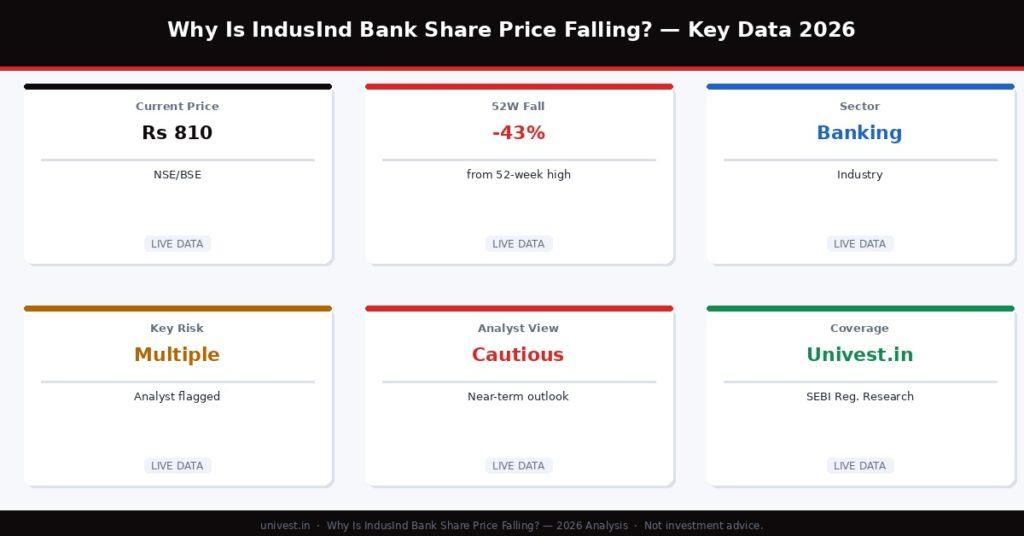
IndusInd Bank is trading at Rs 810, down 43% from its 52-week high of Rs 1,575. The sustained fall in the IndusInd Bank share price has unsettled investors who built positions during the stock's rally phase. At its current price, the stock is approaching its 52-week low of Rs 745, and the market is asking one question loudly: is this a buying opportunity, or is the decline a warning sign of deeper problems?
The IndusInd Bank share price falling is not random. There are specific, identifiable factors driving institutional selling, retail panic, and analyst downgrades — and this article examines each of them with real data from the latest quarterly results and exchange filings.
[Click Here – Get Free Investment Predictions](https://univest.in/user/log-in)
This article covers every key reason behind the IndusInd Bank share price fall, the latest financial performance data, technical levels to watch, institutional positioning, and what analysts think the IndusInd Bank share price target is for 2026.
About IndusInd Bank
[Click Here – Get Free Investment Predictions on Univest.
IndusInd Bank is a listed company in the Banking / NBFC sector with a market capitalisation of Rs 63,000 Cr. The stock trades at approximately 8x trailing P/E and 0.95x price-to-book. Its 52-week range spans from Rs 745 to Rs 1,575, and the current price of Rs 810 puts the stock in the lower quarter of that range, reflecting the sustained selling pressure of recent months.
Why Is IndusInd Bank Share Price Falling? Key Reasons
[Tap to Access Best Research Pieces on Univest.
Microfinance Portfolio Stress — The Core Problem
IndusInd Bank's microfinance loan book, which accounts for approximately 12% of total advances, has been the single largest factor behind the share price collapse. Non-performing assets in the microfinance segment surged sharply in Q3 FY26 as rural borrowers struggled with multiple lender exposure, over-indebtedness, and delayed government transfer payments. The bank's gross NPA ratio climbed to 2.25%, with microfinance NPAs alone contributing 150 basis points of incremental stress.
The MFI crisis is not isolated to IndusInd Bank — the entire sector has seen delinquency rates rise to 5-7% in stressed geographies including Rajasthan, Odisha, and parts of Tamil Nadu. But IndusInd Bank's above-average MFI exposure compared to HDFC Bank and Kotak Bank has made it the preferred short in the banking space for institutional investors.
Accounting Discrepancy — The Governance Shock
In March 2026, IndusInd Bank disclosed a material internal accounting discrepancy in its derivatives portfolio, estimated at approximately Rs 1,500-1,700 crore. The bank's management acknowledged that internal hedging transactions were not correctly recorded over multiple quarters. This revelation triggered an immediate 25% single-session fall in the stock and wiped approximately Rs 20,000 crore in market capitalisation.
The disclosure was particularly damaging because it followed a period of investor confidence in the bank's growth trajectory. The RBI has since sought clarification from the bank's board, and independent auditors have been appointed. Any material restatement of financials would be a further negative catalyst.
CEO Transition Risk — Leadership Vacuum
Managing Director and CEO Sumant Kathpalia's term was set to end in March 2026, and the RBI approved only a one-year extension rather than the customary three-year renewal. This decision signalled regulatory discomfort and created significant market uncertainty about leadership continuity. A sudden CEO transition at a bank facing asset quality stress and accounting issues simultaneously is precisely the scenario that triggers institutional de-risking.
The bank's board has begun a succession search, but the timeline and identity of the new CEO remain uncertain. Until a credible successor is announced and approved by the RBI, this leadership overhang will keep institutional investors cautious.
High FII Ownership Creating Downside Amplification
IndusInd Bank has one of the highest FII ownership ratios among Indian private sector banks at approximately 38%. When global risk appetite contracts, as it did sharply in Q1 2026 amid the US-Iran conflict and crude oil spike, FII selling in high-foreign-ownership Indian financials is disproportionate. IndusInd Bank has been caught in multiple rounds of FII selling that has little to do with the bank's specific fundamentals.
The combination of high FII ownership, a stock that has already fallen 43%, and an uncertain recovery timeline creates a classic 'falling knife' dynamic. Professional investors require a clear positive catalyst, such as a clean Q4 audit, new CEO announcement, or RBI comfort signal, before rebuilding positions.
IndusInd Bank Latest News That Impacted the Stock
January 2026: Q3 FY26 results: PAT fell 38.5% YoY to Rs 1,401 crore; MFI NPAs rise sharply.
February 2026: Management guidance on MFI recovery deferred to H1 FY27.
March 2026: Accounting discrepancy in derivatives portfolio disclosed; stock falls 25% in one session.
March 2026: RBI approves MD & CEO term extension of only 1 year instead of the standard 3 years.
April 2026: Rating agencies place IndusInd Bank on watchlist for potential downgrade.
April 2026: FII holding falls from 42% to 38% over 3 months of sustained selling.
IndusInd Bank Financial Performance Analysis
The quarterly financial data for IndusInd Bank provides important context for understanding why the share price is falling. The numbers below highlight the key metrics that institutional analysts track closely.
| Key Metric | Latest Quarter | Year-Ago Quarter | YoY Change |
| Revenue | Rs 14,100 Cr | Rs 13,850 Cr | +1.8% YoY |
| Net Profit (PAT) | Rs 1,401 Cr | Rs 2,278 Cr | -38.5% YoY |
| Market Cap | Rs 63,000 Cr | — | Current |
| P/E Ratio | 8x | — | Trailing |
| P/B Ratio | 0.95x | — | Current |
If you want to track IndusInd Bank's financial metrics in real time, check the Univest Screener for live data, peer comparisons, and financial history.
Technical Signals: What the Charts Are Saying
IndusInd Bank is trading at Rs 810, below all key moving averages including the 50-day, 100-day, and 200-day MAs. The stock has formed a clear pattern of lower highs and lower lows since its 52-week high of Rs 1,575. Key support is at the 52-week low of Rs 745. Resistance is at Rs 820 in the near term.
Download the Univest iOS App or Univest Android App to track IndusInd Bank's live price and get daily research insights.
Market Sentiment and Institutional Positioning
Promoter holding stands at 16.4%, which is relatively modest and suggests limited promoter confidence buffer in volatile markets. FII holding at 38.2% is significant, meaning global risk-off sentiment disproportionately impacts the stock, and DII holding at 28.6% indicates domestic institutions have meaningful exposure.
High FII ownership in any stock creates downside amplification when global risk appetite contracts. The IndusInd Bank share price falling has been exacerbated by FII selling that is driven by macro factors — crude oil, dollar strength, US rate expectations — rather than company-specific concerns alone.
Future Outlook: Can IndusInd Bank Recover?
IndusInd Bank's recovery depends on three conditions: a clean Q4 FY26 audit that resolves the derivatives discrepancy, MFI NPA formation peaking in Q1 FY27 with visible recovery by Q2 FY27, and a new CEO appointment that signals a fresh start with the board and regulators. At Rs 810 and 0.95x book value, the stock is trading at distressed-bank valuations for an institution that is not distressed in its core book. The contrarian case is compelling for investors with a 12-18 month horizon. The near-term risk is a material earnings restatement.
IndusInd Bank Share Price Target 2026
Subscribe to Univest Pro for Premium Stock Research and F&O Setups.
Short-Term Target (3-6 Months)
In the short term, IndusInd Bank share price target is Rs 820-880 based on current technical positioning and near-term fundamental catalysts. The downside risk if the 52-week low of Rs 745 breaks is approximately 5-10% further.
12-Month Analyst Target
Analyst consensus 12-month IndusInd Bank share price target is Rs 1,000-1,200, implying significant upside from the current price of Rs 810. This target assumes a partial recovery of the factors driving the current decline.
Long-Term Target (FY27-FY28)
In a recovery scenario where the key headwinds resolve, the IndusInd Bank share price target for FY28 is Rs 1,400-1,800. This long-term bull case requires the fundamental concerns addressed in this article to show measurable improvement over the next 6-12 quarters.
For live IndusInd Bank tracking and peer comparison, explore the Univest Screener.
Conclusion
IndusInd Bank share price is falling due to a combination of company-specific headwinds and broader market pressures. The 52-week decline of 43% from the high of Rs 1,575 to the current Rs 810 has created both a risk and an opportunity. The risk is that the concerns identified in this article deepen; the opportunity is that the stock is now meaningfully cheaper than it was at the peak. Analyst consensus targets of Rs 1,000-1,200 for 12 months and Rs 1,400-1,800 for the longer term suggest significant potential upside for patient investors.
This article is for informational purposes only. Please conduct your own research and consult a SEBI-registered financial advisor before making any investment decisions.
Frequently Asked Questions
Q1. Why is IndusInd Bank share price falling in 2026?
IndusInd Bank share price is falling due to the reasons detailed in this article, including sector-specific headwinds, recent financial performance concerns, and broader market pressures. The stock has fallen 43% from its 52-week high of Rs 1,575 to its current price of Rs 810. Investors should review all factors and consult a SEBI-registered financial advisor before making investment decisions.
Q2. What is IndusInd Bank share price target?
The 12-month analyst consensus IndusInd Bank share price target is Rs 1,000-1,200. The short-term target for 3-6 months is Rs 820-880, while the long-term target for FY27-FY28 is Rs 1,400-1,800 in a recovery scenario. These are analyst projections and not guaranteed returns.
Q3. Should I buy IndusInd Bank shares now?
This article cannot provide personalised investment advice. IndusInd Bank is trading at Rs 810 with a 52-week range of Rs 745 to Rs 1,575. Analyst consensus targets suggest potential upside. However, all the risks outlined in this article remain live. Consult a SEBI-registered financial advisor for personalised advice.
Q4. What is IndusInd Bank's market cap and PE ratio?
IndusInd Bank's current market capitalisation is Rs 63,000 Cr with a trailing P/E of 8x and price-to-book ratio of 0.95x. The stock is trading at Rs 810 as of April 2026.
Q5. What are IndusInd Bank's latest quarterly results?
In the most recent quarter, IndusInd Bank reported revenue of Rs 14,100 Cr (+1.8% YoY) and net profit (PAT) of Rs 1,401 Cr (-38.5% YoY). Full quarterly financial data is available on the NSE/BSE filing portals and on the Univest Screener.
Q6. Who holds IndusInd Bank shares institutionally?
IndusInd Bank's shareholding: Promoters 16.4%, FIIs 38.2%, DIIs 28.6%. High FII ownership creates sensitivity to global risk-off sentiment. Check the latest quarter's shareholding pattern on NSE/BSE for the most current data.
Q7. What can trigger a recovery in IndusInd Bank share price?
Key recovery triggers for IndusInd Bank include: improvement in the fundamental factors causing the current decline, positive quarterly results showing reversal of the stressed metrics, broad market recovery, and any sector-specific positive news. Monitor developments closely.
Q8. What is the 52-week low of IndusInd Bank share price?
IndusInd Bank's 52-week low is Rs 745, reached during the recent market correction. The 52-week high was Rs 1,575. The current price of Rs 810 represents a fall of 43% from the 52-week high. Technical analysts identify Rs 745 as a key support level.
For more analysis on falling stocks, visit Univest Blogs.
Recent Articles
Why is KRBL Share Price Falling? Check Next Share Price Target
Why is Reliance Infrastructures Share Price Falling? Check Next Share Price Target
Why is Mahanagar Gas Share Price Falling? Check Next Share Price Target
Why is Happiest Minds Share Price Falling? Check Next Share Price Target
Recent Articles

Infosys Dividend 2026: Rs 26 Per Share Interim Payout, Record Date, Q2 Profit Up 6.23% and What Shareholders Should Know
23 October 2026

Ambit Capital Telecom Picks: Why the Brokerage Backs Airtel, Vodafone Idea and Indus Towers With Buy Ratings and Higher Targets
23 October 2026

Delhi Pollution Curbs: Can They Be a Game-Changer for Auto and EV Stocks From Ather Energy to TMPV?
23 October 2026

Swiggy vs Eternal Shares Compared: Which Is the Better Stock After Q2 FY27 Results as Blinkit Profit Meets Instamart Loss?
23 October 2026
Note: This blog is for information purpose only. Investments and trading are subject to market risks, read all scheme related documents carefully.
Reviews






Recent Posts
Infosys Dividend 2026: Rs 26 Per Share Interim Payout, Record Date, Q2 Profit Up 6.23% and What Shareholders Should Know
Ambit Capital Telecom Picks: Why the Brokerage Backs Airtel, Vodafone Idea and Indus Towers With Buy Ratings and Higher Targets
Delhi Pollution Curbs: Can They Be a Game-Changer for Auto and EV Stocks From Ather Energy to TMPV?
Swiggy vs Eternal Shares Compared: Which Is the Better Stock After Q2 FY27 Results as Blinkit Profit Meets Instamart Loss?
Himadri Speciality Share Price Posts Its Biggest Weekly Fall Since 2008: What Q2 FY27 Margins, Valuation and Guidance Say

Uniresearch Global Pvt Ltd
Research Analyst
SEBI Registration Number — INH000013776
Uniresearch is a subsidiary of Univest Communication Technologies Private Limited
Company Address: Registered Address: Ground Floor, Unitech Commercial Tower 2, Block B, Greenwood City, Unit 1-3, Sector 45, Gurugram, Haryana 122003
Write to us : support@univest.in, compliance@univest.in
Verify on SEBI registry →RESEARCH ANALYST
Get SEBI Registered
advice on the stocks
trending today.
Get 3 FREE Trade Ideas

for Startups Accelerator 2024

Trusted by 1Cr Indians

Awarded No.1 by Economic Times