
Micro Cap Stocks in India 2026 — Definition, Screener Criteria & Risks Explained
Thu Apr 02 2026

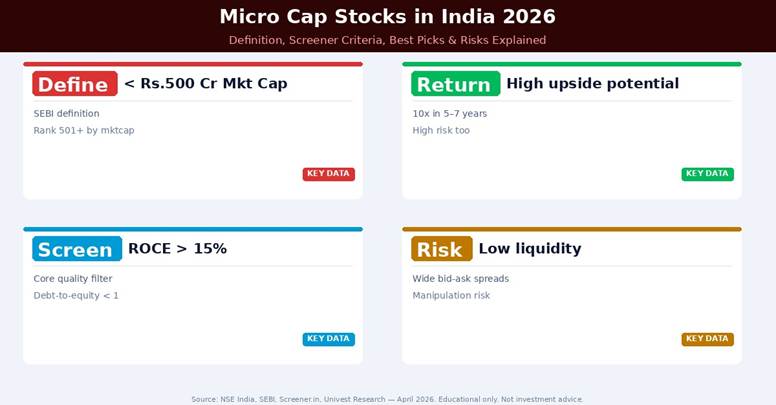
India’s micro cap stocks are where the most exciting — and most dangerous — opportunities in the market reside. These are companies with market capitalisations below Rs.500 crore, mostly flying under the radar of institutional investors and brokerage research coverage. Yet, some of India’s biggest wealth-creation stories of the past decade started as obscure micro-cap names before graduating to mid-cap and large-cap indices.
The attraction is obvious: a Rs.200 crore market cap company that grows into a Rs.2,000 crore company delivers a 10x return. The risks are equally real: poor governance, low liquidity, operator-driven price manipulation, and complete absence of analyst coverage make micro-caps a minefield for the uninformed investor.
This article covers everything you need to know about micro cap stocks in India — the SEBI definition, key screener criteria to identify quality micro-caps, examples, and the risks to manage.
What Are Micro Cap Stocks? — SEBI Definition
Click Here — Get Free Investment Predictions
According to SEBI’s categorisation guidelines, companies are classified by market capitalisation rank on NSE/BSE. Large-cap stocks are ranked 1–100, mid-cap stocks are ranked 101–250, and small-cap stocks are ranked 251 and below. Micro-cap stocks, while not separately defined by SEBI in a specific regulation, are widely understood as companies ranked below 501 by market capitalisation — typically with a market cap below Rs.500 crore.
On BSE, there are over 5,000 listed companies. Of these, roughly 4,000+ qualify as micro-caps by the above market cap threshold. The NSE’s Nifty Microcap 250 index tracks the 250 stocks ranked 501–750 by full market cap — providing an institutional-grade benchmark for this segment.
| Category | Market Cap Rank | Typical Mkt Cap | NSE Index | Volatility |
| Large Cap | 1–100 | > Rs.20,000 Cr | Nifty 50, Nifty Next 50 | Low–Moderate |
| Mid Cap | 101–250 | Rs.5,000–20,000 Cr | Nifty Midcap 150 | Moderate |
| Small Cap | 251–500 | Rs.500–5,000 Cr | Nifty Smallcap 250 | High |
| Micro Cap | 501+ | < Rs.500 Cr | Nifty Microcap 250 | Very High |
Market cap categorisation approximate as of April 2026. Actual thresholds shift with market movements. Source: SEBI, NSE Indices.
Key Screener Criteria for Quality Micro Cap Stocks
Tap to Access Best Research Pieces at Univest
The most common mistake in micro-cap investing is ignoring fundamentals in favour of momentum. Here are the key screener criteria that separate quality micro-caps from value traps and operator-driven stocks:
- ROCE > 15%: Return on Capital Employed above 15% indicates the company earns well above its cost of capital — a core quality filter
- Debt-to-Equity Ratio < 1: Micro-caps with high debt are particularly vulnerable during credit downturns — avoid highly leveraged names
- Promoter Holding > 45%: High promoter stake signals conviction in the business. Falling promoter holding (pledging or selling) is a major red flag
- Revenue Growth > 15% CAGR (3 years): Consistent top-line growth proves the business has market traction
- Positive Operating Cash Flow: Many micro-caps are profitable on paper but cash-flow negative — operating cash flow must be positive for 2+ consecutive years
- No Pledging of Promoter Shares: Pledging of promoter shares in small companies is a serious warning sign — it indicates the promoter is using stock as collateral for personal borrowing
- Minimum Trading Volume: Avoid stocks with average daily volume below 5 lakh shares — illiquidity makes exit difficult
Univest Screener — Filter Micro Cap Stocks by Quality
Risks of Investing in Micro Cap Stocks
- Low Liquidity: Micro-cap stocks often have wide bid-ask spreads and thin order books. In a market downturn, exits can be nearly impossible without causing significant price impact
- No Institutional Coverage: Most micro-caps have zero analyst coverage and minimal institutional ownership. Price discovery is poor, making fundamental analysis more critical — and harder
- Operator Risk: Low-volume, low-cap stocks are susceptible to price manipulation by market operators who artificially inflate prices and exit at retail investors’ expense
- Governance Risk: Smaller companies often have weaker internal controls, less transparent accounting, and higher related-party transaction risk
- Liquidity Event Risk: During market corrections (like the March 2020 COVID crash), micro-caps can fall 50–80% before large-caps fall 30%. Recovery timelines are also longer
How to Invest in Micro Cap Stocks Safely
- Allocate conservatively: Cap micro-cap allocation at 10–15% of your total equity portfolio — treat it as your ‘moonshot’ bucket, not your core
- Diversify within micro-caps: Spread across 10–15 names to manage individual company risk. Concentration in 2–3 micro-caps amplifies both upside and downside
- Use fundamental screens first: Apply the ROCE, D/E, promoter holding, and cash flow filters before looking at charts or momentum
- Invest with patience: Micro-cap rerating stories take time — typically 3–5 years to play out. Short-term trading in micro-caps is extremely risky
- Set strict stop-losses: Unlike large-caps, micro-caps can fall 30–40% in days on adverse news. Protect capital with clear exit levels
FAQs — Micro Cap Stocks India
What is a micro cap stock in India?
A micro cap stock in India is a company with a market capitalisation typically below Rs.500 crore, ranked below position 500 by full market cap on NSE or BSE. SEBI’s formal cap categorisation covers large-cap (rank 1–100), mid-cap (101–250), and small-cap (251+). Micro-cap is an informal but widely used subset of the small-cap category for companies at the lower end of the market cap spectrum.
What is the Nifty Microcap 250 index?
The Nifty Microcap 250 is an NSE index that tracks 250 micro-cap companies ranked 501–750 by full market capitalisation. It was launched to provide a formal benchmark for the micro-cap segment, enabling passive fund managers and ETF providers to create instruments tracking this space. As of 2026, a few mutual funds have launched Nifty Microcap 250 index funds.
Are micro cap stocks a good investment?
Micro cap stocks offer high return potential — some have delivered 20–50x returns over 7–10 year periods as they grew from micro to small to mid-cap companies. However, they also carry high risk of permanent capital loss through poor governance, operator manipulation, and business failure. They are suitable for investors with a high risk appetite, long investment horizon (5+ years), and willingness to conduct deep fundamental research.
How do I find quality micro cap stocks?
Use the Univest Screener to filter micro-cap stocks by ROCE > 15%, D/E < 1, promoter holding > 45%, and positive operating cash flow over 3 years. Cross-reference with NSE filings, company annual reports, and management interviews on YouTube or BSE analyst day recordings. Quality micro-caps are identified by consistent fundamental improvement, not just price momentum.
Download the Univest iOS App or Univest Android App for daily stock recommendations and free research.
Disclaimer: Investments in securities are subject to market risk. Please read all related documents carefully before investing. This content is for educational purposes only and does not constitute investment advice or stock recommendations. Past performance is not indicative of future returns. Consult a SEBI-registered financial advisor before making investment decisions.
Recent Articles
Top FII Holding Penny Stocks to Buy in India 2026 With High Growth Opportunities
Best NSE Penny Stocks in India – High Growth Opportunities for Investors
Best Sugar Penny Stocks to Invest in 2026
Reliance Penny Stocks in India | Reliance Penny Stocks List
Best Cement Penny Stocks to Invest in India 2026 for Long-Term Growth

Related Posts
Titan Share Price Target 2026 — Key Factors, Financial Performance & Analyst Forecast
Powerica IPO Listing at 7% discount at ₹366.00 Per Share
TCS Share Price Target 2026 — Key Factors, Financial Performance & Analyst Forecast
Amir Chand Jagdish Kumar IPO Listing at 5.66% discount at ₹200.00 Per Share
Sun Pharma Share Price Target 2026 — Key Factors, Financial Performance & Analyst Forecast
