
High Volume Stocks in India 2026 — Most Traded NSE Stocks by Daily Volume
Thu Apr 02 2026

Volume is the heartbeat of the stock market. When a stock trades millions or crores of shares daily, it signals strong retail and institutional interest — and for traders, it means tight spreads, easy entry, and quick exits. High volume stocks in India are tracked by everyone from day traders to swing traders and even long-term investors building large positions.
In the Indian market context, ‘high volume’ typically means stocks that consistently trade more than 50 lakh to 1 crore shares per day on NSE. At the very top of the volume chart sit penny-priced stocks like Vodafone Idea, Yes Bank, and Reliance Power — where the low price attracts massive retail participation. But high volume is also relevant in large-caps like Reliance and SBI, where institutional block deals drive enormous value turnover.
This article covers the top high volume stocks in India as of 2026, what volume signals for traders and investors, and how to use volume as a stock screening criterion.
What Does High Volume Mean in Stocks?
Click Here — Get Free Investment Predictions
Volume in the stock market refers to the total number of shares traded in a stock during a given period — a day, week, or month. High volume means many shares are changing hands, indicating strong market participation. Volume can be measured in two ways: shares traded (absolute volume) and value traded (volume × price, also called turnover).
For traders, high volume is critical for three reasons: it ensures liquidity (you can buy and sell without moving the price significantly), it validates price moves (a breakout on high volume is more significant than on low volume), and it reduces impact cost (the difference between the expected and actual execution price).
Top High Volume Stocks in India 2026 — By Shares Traded
Tap to Access Best Research Pieces at Univest
| Company | Ticker | Approx Avg Volume | CMP (Approx) | Sector |
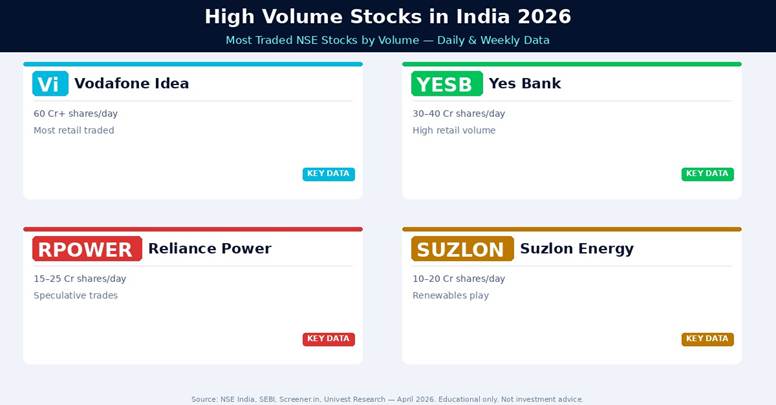
| Vodafone Idea | IDEA | 60 Cr+ shares/day | Rs.9–11 | Telecom |
| Yes Bank | YESBANK | 30–40 Cr shares/day | Rs.18–22 | Banking |
| Reliance Power | RPOWER | 15–25 Cr shares/day | Rs.30–50 | Power |
| Suzlon Energy | SUZLON | 10–20 Cr shares/day | Rs.58–70 | Renewable Energy |
| IRFC | IRFC | 5–10 Cr shares/day | Rs.130–170 | PSU Finance |
| Tata Motors | TATAMOTORS | 3–5 Cr shares/day | Rs.600–700 | Automobile |
| Reliance Industries | RELIANCE | 1–2 Cr shares/day | Rs.1,200–1,400 | Energy/Conglomerate |
| SBI | SBIN | 1–2 Cr shares/day | Rs.700–800 | PSU Banking |
| HDFC Bank | HDFCBANK | 1–2 Cr shares/day | Rs.1,600–1,800 | Private Banking |
| Infosys | INFY | 0.8–1.5 Cr shares/day | Rs.1,200–1,400 | IT Services |
Average daily volume is indicative based on NSE data as of Q1 2026. Actual volumes vary significantly. Source: NSE India, Univest Research.
What High Volume Signals for Traders vs Investors
For Traders (Short-Term)
Volume is a primary confirmation tool for technical traders. A breakout above a key resistance level on 2x or more the average daily volume (ADV) is considered a high-conviction signal. Conversely, a breakout on thin volume is considered suspect — likely to fail. Volume divergence (price making new highs but volume declining) is a bearish warning signal.
- Volume spike = strong conviction move — trade in direction of breakout
- Volume > 2x ADV on a news catalyst = institutional accumulation or distribution
- Volume dry-up after consolidation = potential coiling setup for next directional move
For Investors (Long-Term)
For long-term investors, high volume is less of a trading signal and more of a liquidity preference criterion. When building a large position in a portfolio, high-volume stocks allow phased entry without moving the market. Low-volume stocks can suffer from high impact cost — buying 10,000 shares of a thinly traded company may drive the price up 2–3% against you.
High Volume vs High Value Stocks — The Difference
High volume by shares doesn’t mean high turnover value. Vodafone Idea at Rs.10 trading 60 crore shares generates Rs.600 crore turnover. Reliance at Rs.1,300 trading 1 crore shares generates Rs.1,300 crore turnover. For institutional investors, value turnover matters more than share count. For retail traders, share count volume is the more immediate liquidity signal.
How to Use Volume as a Screener Filter
- Set a minimum volume filter: Avoid stocks trading below 10 lakh shares/day for intraday or short-term trades — impact cost will be too high
- Track Volume vs ADV ratio: Alert yourself when a stock’s volume exceeds 2x its 20-day ADV — this often precedes significant price movement
- Cross-reference with price action: Volume alone is noise. Volume + a breakout/breakdown = signal
- Check F&O participation: All 250+ NSE F&O stocks are inherently high liquidity — safer for traders than non-F&O stocks
FAQs — High Volume Stocks
Which stock has the highest trading volume in India?
As of 2026, Vodafone Idea (IDEA) consistently records the highest trading volume by share count on NSE, with over 60 crore shares traded on active days. Yes Bank, Reliance Power, and Suzlon also regularly feature among the highest-volume stocks. For value turnover, Reliance Industries and HDFC Bank top the list due to their high share prices.
Why do high volume stocks matter for traders?
High volume stocks matter for traders because they offer liquidity — the ability to buy and sell at a price close to the quoted price without significantly moving the market. They also provide tighter bid-ask spreads, lower impact cost, and faster order execution. For intraday traders, trading low-volume stocks can result in partial fills, high slippage, and difficulty exiting positions quickly.
Is high volume always a bullish signal?
No. High volume can accompany both bullish and bearish moves. A sharp drop on very high volume (panic selling) is one of the most bearish signals in technical analysis. Similarly, high volume on a breakout above resistance is bullish, while high volume on a breakdown below support is bearish. Volume must always be interpreted in the context of price direction.
What is Average Daily Volume (ADV)?
Average Daily Volume (ADV) is the mean number of shares traded per day over a specific period — typically 20 or 50 trading days. It serves as the baseline against which current volume is compared. A day’s volume that is 2x or 3x ADV is considered a volume spike and often signals unusual institutional activity, news impact, or index rebalancing.
Download the Univest iOS App or Univest Android App for daily stock recommendations and free research.
Disclaimer: Investments in securities are subject to market risk. Please read all related documents carefully before investing. This content is for educational purposes only and does not constitute investment advice or stock recommendations. Past performance is not indicative of future returns. Consult a SEBI-registered financial advisor before making investment decisions.
Recent Article
Multibagger Penny Stocks Below 5 rs in India 2026
Best Multibagger Midcap Stocks in India 2026
Best Tata Penny Stocks in 2026 With High Growth Potential
Top 10 Fundamentally Strong Penny Stocks 2026: for Long-Term Growth
Multibagger Penny Stocks for 2026 for Higher Returns
Debt-Free Penny Stocks in India 2026
Best High Promoter Holding Penny Stock List for 2026
Top 10 Fundamentally Strong Penny Stocks 2026: for Long-Term Growth

Related Posts
Highness Microelectronics IPO Listing at 6.04% Premium at ₹127.00 Per Share
Sai Parenteral IPO Listing at 2.04% Premium at ₹400.00 Per Share
Titan Share Price Target 2026 — Key Factors, Financial Performance & Analyst Forecast
Powerica IPO Listing at 7% discount at ₹366.00 Per Share
TCS Share Price Target 2026 — Key Factors, Financial Performance & Analyst Forecast
