
Bank Nifty Option Tips 2026: Strategies, Entry Rules & Risk Management
Updated: 6 Apr 2026 • 6:44 pm
Posted by:

Bank Nifty option tips are among the most searched trading queries in India in 2026 — and for good reason. Bank Nifty (NSE: BANKNIFTY) is the most liquid derivative instrument in Indian markets, with daily F&O turnover regularly exceeding Rs 10 lakh crore. Its high liquidity, tight bid-ask spreads, and sensitivity to RBI policy decisions and banking sector news make it the preferred instrument for professional options traders across India.
However, Bank Nifty options trading is also where most retail traders lose money fastest — primarily because they treat buying options as a lottery ticket rather than applying systematic strategy with defined risk parameters. SEBI's own data shows that 9 out of 10 retail F&O traders lose money, with the losses concentrated in weekly expiry options bought without a clear strategy.
This guide provides legitimate Bank Nifty option tips for 2026 — covering the correct strategies, entry rules, position sizing, and how to use SEBI-registered advisory to improve your Bank Nifty options trading outcomes. Note: these are educational tips, not guaranteed trade calls. All options trading carries risk of total premium loss.
Understanding Bank Nifty Options — The Basics
[Click Here – Get Free Investment Predictions on Univest]
Bank Nifty is the NSE's banking sector index, tracking 12 of India's most liquid banking stocks including HDFC Bank, ICICI Bank, SBI, Kotak Mahindra Bank, and Axis Bank. Bank Nifty options (both calls and puts) are available for weekly and monthly expiry. The weekly expiry is every Wednesday; the monthly expiry is the last Thursday of each month.
Each Bank Nifty option lot is 15 units of the index. At a Bank Nifty level of approximately 51,000, one ATM (at-the-money) option lot requires a margin of Rs 15,000–20,000 for buying and significantly more for selling. The premium paid for a weekly ATM option is approximately Rs 150–300 per unit, meaning one lot costs Rs 2,250–4,500 in premium — with total loss of premium if the trade doesn't work out by expiry.
Bank Nifty Options Market Context 2026
[Tap to Access Best Research Pieces on Univest]
- Bank Nifty Level: Bank Nifty trading near 51,000–52,000 as of early April 2026, with key support at 50,000 and resistance at 54,000.
- RBI Policy Tailwind: RBI cut rates by 50 bps in FY26 — supportive for banking stocks and Bank Nifty momentum over the medium term.
- Q4 FY26 Banking Results: HDFC Bank (April 18), ICICI Bank (April 26), Axis Bank (April 24), and Kotak Mahindra Bank (May 3) Q4 results will be major Bank Nifty volatility triggers.
- IV (Implied Volatility) Elevated: West Asia conflict has elevated IV in Bank Nifty options, increasing premium values. Option sellers benefit from elevated IV; buyers need a sharper directional move to profit.
- SEBI F&O Reforms 2025: SEBI tightened lot sizes and increased margin requirements for weekly options in 2025, reducing retail participation in speculative day-trading of options. Professional traders adapted; casual traders shifted out.
5 Bank Nifty Option Strategies That Work in 2026
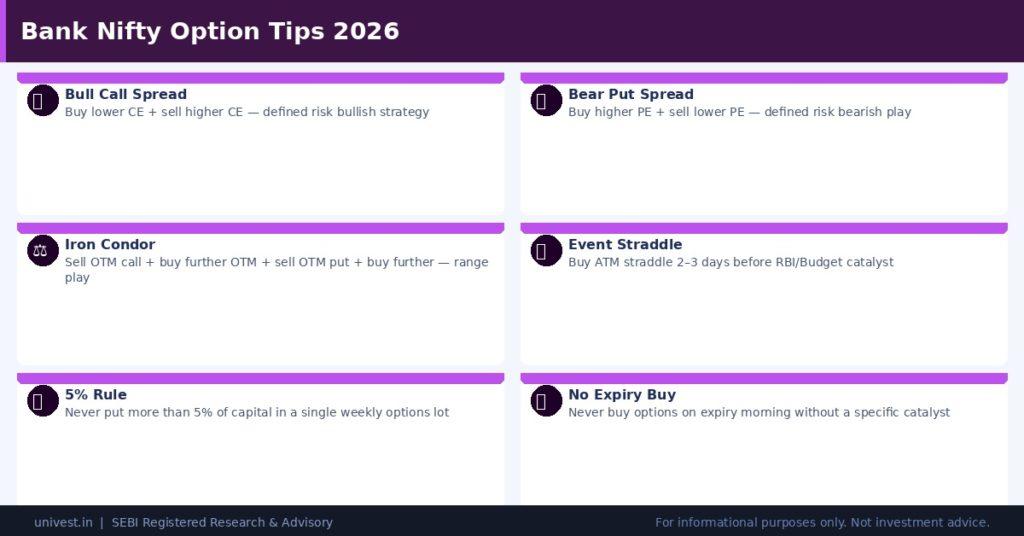
Strategy 1: Bull Call Spread (for Moderately Bullish Views)
A bull call spread involves buying a lower-strike call option and simultaneously selling a higher-strike call option — both with the same expiry. This reduces the premium paid (cost of the long call is partially offset by the premium received on the short call) while capping maximum profit. Example: Buy Bank Nifty 51,000 CE and sell 52,000 CE — if Bank Nifty rises to 52,000 by expiry, the maximum profit is Rs 1,000 per unit (15 units x Rs 1,000 = Rs 15,000 profit on the spread), less the net premium paid.
Bull call spreads are the recommended starting strategy for retail traders because they limit downside to the net premium paid while providing meaningful upside exposure. The risk-reward is defined at trade entry, removing the uncertainty of unlimited loss from naked calls.
Strategy 2: Bear Put Spread (for Moderately Bearish Views)
The mirror image of the bull call spread: buy a higher-strike put and sell a lower-strike put. Example: Buy Bank Nifty 51,000 PE and sell 50,000 PE. Maximum profit if Bank Nifty falls to 50,000; maximum loss is the net premium paid. This strategy is particularly relevant when Bank Nifty approaches a resistance zone ahead of major events (like RBI policy decisions or banking sector result surprises) and you expect a moderate pull-down.
Strategy 3: Short Straddle on Thursday Expiry (For Range-Bound Market)
A short straddle involves simultaneously selling an ATM call and an ATM put. The maximum profit is collected when Bank Nifty expires exactly at the sold strike. This is an options selling strategy — used by sophisticated traders — that generates premium income when Bank Nifty is expected to remain range-bound. Maximum profit equals the total premium collected; maximum loss is theoretically unlimited if Bank Nifty moves sharply in either direction.
IMPORTANT: Short straddles require high margin and carry unlimited loss potential. This strategy is not appropriate for beginners and should only be attempted by traders with clear understanding of Greek risk (delta, gamma, theta, vega). SEBI now requires enhanced margin for short option positions to protect retail traders from unlimited loss exposure.
Strategy 4: Iron Condor (Premium Collection in Range Markets)
An iron condor is a four-legged strategy: sell an OTM (out-of-the-money) call + buy a further OTM call + sell an OTM put + buy a further OTM put. This defines both the maximum profit (premium collected) and maximum loss (difference between strikes minus premium). For example, on a Bank Nifty at 51,000: Sell 52,000 CE + Buy 53,000 CE + Sell 50,000 PE + Buy 49,000 PE. This creates a "profit zone" between 50,000 and 52,000 where the trader profits from time decay.
The iron condor is the preferred strategy for experienced options sellers who want defined-risk premium collection. The strategy works well in weeks where no major macro events are expected and Bank Nifty IV is elevated (high IV = higher premium collected).
Strategy 5: Buying ATM Options Before Major Catalysts (Event-Driven)
When a major catalyst is expected — RBI monetary policy announcement, Union Budget, major banking results — buying ATM straddles (both ATM call and ATM put) 2–3 days before the event can profit from the sharp directional move that typically follows. This "long volatility" strategy profits when IV remains elevated and the index makes a large move post-event, regardless of direction.
The risk: if the event underwhelms and Bank Nifty barely moves, IV collapses post-event (the "IV crush") and the straddle loses value rapidly. Time this carefully — buy 2–3 days before the catalyst, not a week before (too much time decay risk).
Access SEBI-registered Bank Nifty option advisory with entry/stop-loss/target parameters — Check Univest Pro
Bank Nifty Options: Critical Risk Rules Every Trader Must Follow
- Never Trade More Than 5% of Capital in One Weekly Options Lot: Weekly Bank Nifty options can expire worthless in a single session. Limiting exposure per lot to 5% of trading capital means even a total loss does not derail your overall financial health.
- Exit Before RBI Announcements If Not Hedged: Bank Nifty moves 1–3% in minutes following RBI monetary policy announcements. If you hold a directional position and are not hedged with the opposite option, close the position before the announcement to avoid a gap move blowing through your stop-loss.
- Never Buy Options on Expiry Morning Without Catalyst: Buying options on Wednesday morning (weekly expiry day) without a specific near-term catalyst is a high-probability way to lose premium to theta decay. ATM options lose 40–60% of time value on expiry day if Bank Nifty does not move meaningfully.
- Do Not Average Down on Losing Options Positions: Unlike equity shares, options lose value from both adverse price movement AND time decay. Averaging down on a losing call or put position compounds both losses. If your options trade goes against you by 30–40%, exit — do not add more.
- Understand Greeks Before Selling Options: Options sellers (short straddles, iron condors) face gamma risk near expiry — the position can go from profitable to maximum loss in minutes if Bank Nifty makes a sharp move. Understand delta, gamma, theta, and vega before selling any options strategy.
How SEBI-Registered Advisory Improves Bank Nifty Options Trading
The difference between a SEBI-registered Bank Nifty options advisory (like Univest Pro) and an unregistered Telegram channel is accountability and research quality. Registered advisors must disclose their track record, provide complete trade parameters (entry, stop-loss, target), and operate under SEBI's investor protection framework.
Univest Pro's F&O advisory includes Bank Nifty option calls with: specific strike price, recommended entry premium, stop-loss in premium terms (not index levels), and target premium — making it straightforward to apply even for traders still learning options mechanics. The research rationale accompanying each call explains the technical setup, market context, and event catalyst — educating traders while generating advisory value.
Download the Univest iOS App or Univest Android App for SEBI-registered Bank Nifty option advisory with real-time alerts.
Conclusion
Bank Nifty option tips that genuinely work in 2026 are not about hot intraday calls — they are about systematic strategies (bull call spreads, iron condors, event-driven long volatility), disciplined position sizing (max 5% per trade), and following SEBI-registered advisory rather than unregulated Telegram channels. Bank Nifty options are powerful trading instruments that can generate significant returns for skilled traders and significant losses for undisciplined ones. Start with defined-risk strategies (spreads, iron condors), never sell naked options without full hedging, and always use a stop-loss.
Investments in securities are subject to market risk. Please read all related documents carefully before investing. This content is for educational purposes only and does not constitute investment advice. Past performance is not indicative of future results. Consult a SEBI-registered investment advisor before making any investment decision.
Frequently Asked Questions
Q1. What is Bank Nifty and why is it popular for options trading?
Bank Nifty is NSE's banking sector index tracking 12 major Indian banks. It is India's most popular options trading instrument because of its high liquidity (daily F&O turnover exceeding Rs 10 lakh crore), sensitivity to RBI policy, and weekly expiry structure. Its high daily volatility (1–3% on major event days) makes it attractive for options traders seeking directional and volatility-based profit opportunities.
Q2. Which Bank Nifty option strategy is best for beginners?
For beginners, the bull call spread or bear put spread are the most appropriate Bank Nifty option strategies because the maximum loss is limited to the net premium paid at entry. This defined-risk structure prevents the unlimited loss potential of naked short options. Avoid short straddles, short strangles, or naked option selling until you have at least 12 months of options trading experience and understand all the Greeks.
Q3. How much money do I need to trade Bank Nifty options?
To buy Bank Nifty options, you need approximately Rs 2,250–4,500 per lot (for weekly ATM options) plus margin requirements set by your broker. To comfortably trade with proper risk management (maximum 5% per trade), a minimum capital of Rs 50,000 is advisable. To sell Bank Nifty options (short straddle, iron condor), significantly higher capital (Rs 3–5 lakh+) is needed to meet SEBI's enhanced margin requirements for short option positions.
Q4. What time is best for Bank Nifty options trading in India?
The best trading windows for Bank Nifty options are: 9:15–9:45 AM (opening momentum with clear direction established), 11:30 AM–12:30 PM (mid-day momentum trades after morning volatility settles), and 2:30–3:30 PM (final hour directional moves before close). Avoid trading in the first 15 minutes if you cannot monitor prices continuously — the opening volatility can trigger stop-losses before the genuine trend establishes.
Q5. What is IV crush in Bank Nifty options?
IV crush is the sharp drop in implied volatility (IV) immediately after a major event (RBI policy, Union Budget, major earnings announcement). Before the event, IV is elevated as traders buy options to position for the expected move — this inflates option premiums. After the event, uncertainty resolves and IV collapses, causing options to lose value rapidly even if the index moves as expected. Option buyers need the move to exceed the IV-inflated premium to profit.
Q6. How do I follow a SEBI-registered Bank Nifty advisory?
To access SEBI-registered Bank Nifty options advisory: subscribe to Univest Pro (available from Rs 6/day) through the Univest app or website. Each F&O call includes strike price, entry premium range, stop-loss in premium terms, and target premium. Verify the SEBI registration number on sebi.gov.in before subscribing to any advisory service claiming to provide Bank Nifty options tips.
Q7. Why do most retail traders lose money in Bank Nifty options?
SEBI data shows 90%+ of retail F&O traders lose money. The primary reasons: (1) buying out-of-the-money options on expiry day, where theta decay almost guarantees loss, (2) no defined stop-loss, allowing small losses to become catastrophic ones, (3) following unregistered Telegram channels with unverified track records, (4) over-leveraging by buying multiple lots without adequate capital, and (5) trading without understanding option Greeks, particularly theta (time decay) and gamma (acceleration near expiry).
Q8. Is Bank Nifty options trading legal in India?
Yes, Bank Nifty options trading is completely legal in India and is conducted on NSE — a SEBI-regulated exchange. F&O trading requires a demat and trading account with a SEBI-registered broker. Using SEBI-registered advisory services for trade ideas is also legal and provides investor protection. What is illegal is using unregistered advisors who charge for guaranteed-return tips — SEBI actively prosecutes such entities under the Securities and Exchange Board of India Act.
Recent Article
Mphasis Q4 Results 2026: Date, Revenue Estimates, Key Catalysts & Share Price Target
Mastek Q4 Results 2026: Date, Revenue Estimates, Key Catalysts & Share Price Target
Cyient Q4 Results 2026: Date, Revenue Estimates, Key Catalysts & Share Price Target
KPIT Technologies Q4 Results 2026: Date, Revenue Estimates, Key Catalysts & Share Price Target
Zensar Technologies Q4 Results 2026: Date, Revenue Estimates, Key Catalysts & Share Price Target
Recent Articles

Is Pulz Electronics the Best Stock in Its Sector? A Look at the Numbers
22 October 2026

Is D-Link India the Best Stock in Its Sector? A Look at the Numbers
22 October 2026

Is Intec Capital the Best Stock in Its Sector? A Look at the Numbers
22 October 2026

Is Cella Space the Best Stock in Its Sector? A Look at the Numbers
22 October 2026
Note: This blog is for information purpose only. Investments and trading are subject to market risks, read all scheme related documents carefully.
Reviews






Recent Posts
Is Pulz Electronics the Best Stock in Its Sector? A Look at the Numbers
Is D-Link India the Best Stock in Its Sector? A Look at the Numbers
Is Intec Capital the Best Stock in Its Sector? A Look at the Numbers
Is Cella Space the Best Stock in Its Sector? A Look at the Numbers
Is Zeal Global Services the Best Stock in Its Sector? A Look at the Numbers

Uniresearch Global Pvt Ltd
Research Analyst
SEBI Registration Number — INH000013776
Uniresearch is a subsidiary of Univest Communication Technologies Private Limited
Company Address: Registered Address: Ground Floor, Unitech Commercial Tower 2, Block B, Greenwood City, Unit 1-3, Sector 45, Gurugram, Haryana 122003
Write to us : support@univest.in, compliance@univest.in
Verify on SEBI registry →RESEARCH ANALYST
Get SEBI Registered
advice on the stocks
trending today.
Get 3 FREE Trade Ideas

for Startups Accelerator 2024

Trusted by 1Cr Indians

Awarded No.1 by Economic Times