
BSE FMCG Index Falls 1% as Sanstar, Dhampur Bio Organics, Mukka Proteins Lead Broad Based Losses
- July 8, 2026
- Posted by: Kunal Singla
- Category: News
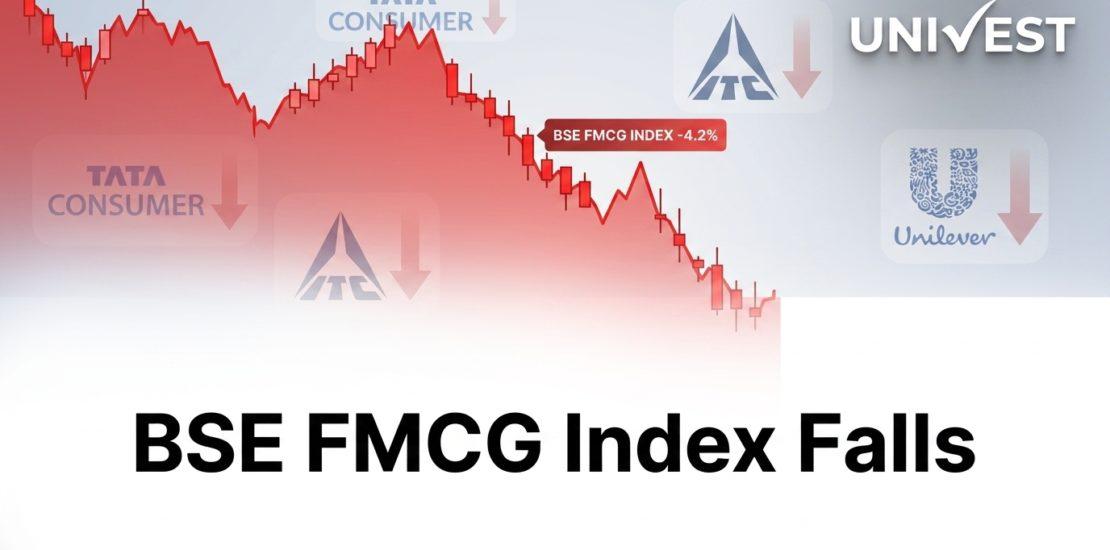
BSE FMCG index down 1% on 8 Jul 2026. Sanstar down 3.14%, DBOL down 2.87%, Mukka Proteins down 2.06%. ITC, HUL, Dabur, Colgate also fall 1.1-1.8% intraday.
The BSE FMCG index slipped about 1 percent in intraday trade on Wednesday, 8 July 2026, as a broad list of consumer staples and agri linked names came under pressure. Sanstar, Dhampur Bio Organics and Mukka Proteins led the losses, with the weakness extending across large caps such as ITC, HUL and Dabur.
Sanstar fell 3.14 percent to Rs 117.35, while DBOL declined 2.87 percent to Rs 111.65, as smaller agri processing names within the BSE FMCG index saw sharper cuts than the large cap staples.
Click Here – Get Free Investment Predictions
BSE FMCG Index: Top Stock Losers Today
| Company | CMP | Chg(%) | Volume |
|---|---|---|---|
| Sanstar | Rs 117.35 | -3.14 percent | 7.93k |
| DBOL | Rs 111.65 | -2.87 percent | 2.57k |
| Mukka Proteins | Rs 23.28 | -2.06 percent | 24.64k |
| EID Parry | Rs 735.30 | -2.04 percent | 226.92k |
| ITC | Rs 283.65 | -1.82 percent | 694.35k |
| Sundrop Brands | Rs 634.00 | -1.77 percent | 2.13k |
| United Spirits | Rs 1,414.20 | -1.74 percent | 27.71k |
| TATA Cons. Prod | Rs 1,105.35 | -1.73 percent | 14.53k |
| Nurture Well | Rs 26.92 | -1.64 percent | 199.62k |
| Magadh Sugar | Rs 511.00 | -1.62 percent | 502 |
| Kaveri Seed | Rs 890.30 | -1.59 percent | 706 |
| HUL | Rs 2,175.00 | -1.59 percent | 26.53k |
| United Brewerie | Rs 1,340.20 | -1.48 percent | 4.32k |
| Dabur India | Rs 446.60 | -1.42 percent | 22.55k |
| India Glycols | Rs 1,060.00 | -1.29 percent | 2.51k |
| Dodla Dairy | Rs 1,130.00 | -1.23 percent | 520 |
| Vadilal Ind | Rs 6,410.00 | -1.21 percent | 119 |
| Colgate | Rs 2,053.30 | -1.15 percent | 1.40k |
| Vintage Coffee | Rs 159.65 | -1.15 percent | 80.33k |
| Gopal Snacks | Rs 269.05 | -1.12 percent | 585 |
Get FMCG and Consumer Stock Guidance from a SEBI Registered Investment Advisor at Univest
Why the BSE FMCG Index Is Under Pressure Today
The broad based decline across the BSE FMCG index spans both smaller agri processing companies and marquee consumer staples names, suggesting sector wide profit booking rather than a single company specific trigger. Rising crude oil prices following renewed US Iran tensions have also lifted input cost concerns for packaging and logistics heavy FMCG businesses, adding to the pressure.
Large caps such as ITC, HUL and Dabur India fell in a relatively tighter band of 1.4 to 1.8 percent, while smaller names like Sanstar and Dhampur Bio Organics saw sharper declines, reflecting typically higher volatility in lower market cap FMCG adjacent stocks.
What Should Investors Watch in FMCG Stocks
Investors tracking the BSE FMCG index should watch rural demand trends, raw material cost inflation, and Q1 FY27 volume growth commentary from large FMCG companies. A sustained crude oil rally could keep input costs elevated for packaging intensive FMCG businesses in the near term.
Download the Univest iOS App or Univest Android App to track FMCG stocks live and get daily research updates.
Conclusion
The BSE FMCG index fell about 1 percent on 8 July 2026, with Sanstar, Dhampur Bio Organics and Mukka Proteins leading a broad based decline that also pulled down ITC, HUL and Dabur. Investors should track input costs and Q1 FY27 volume trends, and consult a SEBI registered advisor before investing in FMCG stocks.
Disclaimer: Data and figures in this article are sourced from publicly available information. These may or may not be accurate. Please verify all data with the official NSE (nseindia.com) and BSE (bseindia.com) websites before making any investment decision. Investments in securities are subject to market risk. This content is for educational purposes only and is not investment advice by Univest (SEBI RA INH000013776).
Frequently Asked Questions FAQs
Why did the BSE FMCG index fall today?
Ans. The BSE FMCG index fell about 1 percent on 8 July 2026, led by Sanstar, Dhampur Bio Organics and Mukka Proteins, amid broad based profit booking and rising input cost concerns from higher crude oil prices.
Which stock fell the most on the BSE FMCG index today?
Ans. Sanstar was the top loser on the BSE FMCG index, falling 3.14 percent to Rs 117.35 on 8 July 2026.
Did large cap FMCG stocks also fall today?
Ans. Yes, large caps including ITC, HUL and Dabur India fell between 1.4 and 1.8 percent, though the declines were milder than smaller agri processing names on the BSE FMCG index.
What is the ITC share price today?
Ans. ITC share price was trading at Rs 283.65 on 8 July 2026, down 1.82 percent, as part of the broader decline across the BSE FMCG index.
Why are smaller FMCG stocks more volatile than large caps?
Ans. Smaller companies like Sanstar and Dhampur Bio Organics typically have lower trading volumes and market capitalisation, which can amplify price swings compared to large cap staples like HUL and ITC.
Should investors buy FMCG stocks after today’s fall?
Ans. A single day decline is not a standalone buy signal. Investors should track rural demand trends, input costs and Q1 FY27 results, and consult a SEBI registered investment advisor before investing.
