
AI Stocks India: Build, Deploy, Defend, A Complete Guide to India’s AI Investment Landscape
- June 24, 2026
- Posted by: Ankit Jaiswal
- Category: Market
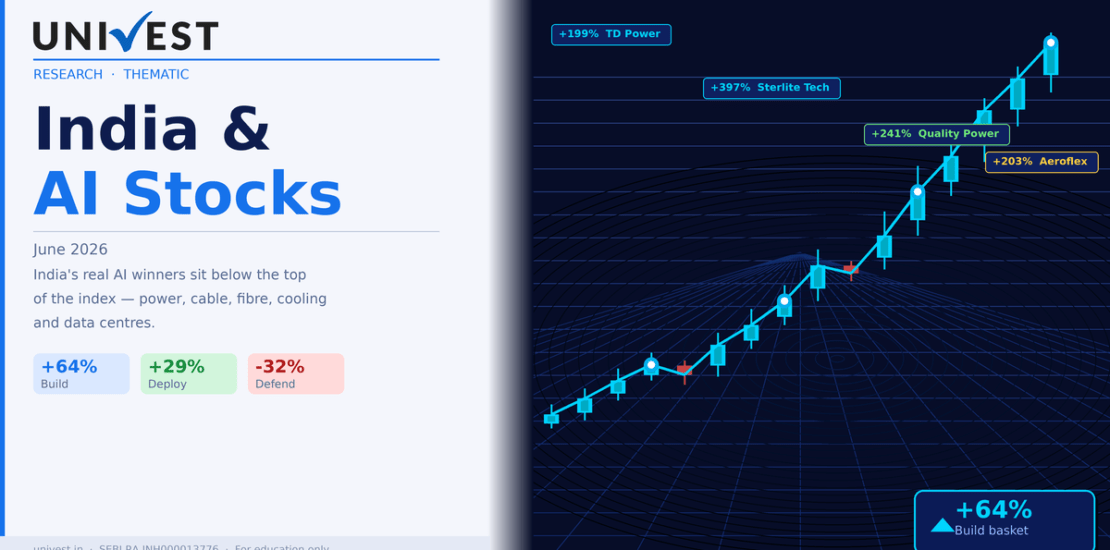
AI stocks India: Build basket median +64%, Deploy +29%, Defend (IT) -32% since recently24. 47 Build names, 34 up. Five US hyperscalers’ 2027E capex = 23% of India’s GDP. India wins the orders.
The best AI stocks India has to offer are not the names that dominate the headline indices. India’s Nifty 50 returned approximately -15% in US dollar terms since the AI theme accelerated in late , making it appear like one of the world’s biggest losers from the AI revolution. That is the wrong conclusion. Sort India’s listed universe into three buckets, Build (companies enabling the AI infrastructure), Deploy (companies using AI to improve their own businesses), and Defend (companies AI threatens directly), and the AI stocks India picture changes completely. The Build basket of AI stocks India delivered a median total shareholder return of approximately +64% over this period. The Deploy basket returned approximately +29%. The Defend basket, dominated by IT services companies, fell approximately -32%. The same country, the same period, three completely different return profiles, depending entirely on which AI stocks India investors found themselves holding. This guide maps all three baskets in full, drawing on Q4 FY26 earnings data. Ankit Jaiswal, Senior Research Analyst at Univest provides the framework and the names.
Why does India look like an AI loser at the index level, even as some of its AI stocks India are delivering exceptional returns? Because the Nifty 50 is heavy in the one bucket AI threatens (IT services, which occupied roughly 14% of the index when the AI theme began) and light in the two buckets it rewards (Build and Deploy names, which together represented only about 2.2-9.8% of the Nifty 500 at the start of the theme). Screening for AI stocks India by index weight will miss the winners entirely. To find them, you need to look one layer below the top of the index, into capital goods, cable and fibre manufacturers, cooling specialists, data centre builders, fintech platforms, and defence companies. These are the specific AI stocks India that held the actual invoices from US hyperscalers, not just the announcements. Five US tech giants, Amazon, Microsoft, Alphabet, Meta, and Oracle, are running combined capital expenditure of approximately $1,050 billion by estimates, representing roughly 23% of India’s entire GDP. Roughly three-quarters of this spend is AI infrastructure: power, cable, cooling, and fibre. These are categories where Indian companies are already winning firm, multi-year export orders.
Click Here – Get Free Investment Predictions
AI Stocks India: The Build Basket , Picks and Shovels of the AI Economy
The Build bucket is the most de-risked category of AI stocks India, because it is already in the order book. These companies do not need AI adoption to accelerate further; they need to execute the orders they have already signed. Build covers five sub-categories: power and the grid, wire and cable and fibre, cooling and thermal, silicon packaging, and the data centre itself. The Build basket delivered a median return of approximately +64% since late , with 34 of 47 listed names in positive territory. Power overtook chips as the binding constraint on AI data centre expansion globally, and US data centre demand has reached India’s capital goods floor, often in the form of multi-year, contracted orders.
Power and the Grid: Where AI Stocks India Started Winning Export Orders
The transformer backlog for US data centres sits at approximately 228 GW of pending orders, representing roughly 12 years of the current order pace, and it is not closing. These AI stocks India in the power and transformer segment are now winning direct US export orders. CG Power booked a Rs 900 crore US data centre transformer export order in its Q4 FY26 earnings period, and management confirmed on the earnings call that the tap is open for follow-on orders. Hitachi Energy India holds a record order book that grew 53.6% year-on-year, supplying roughly 15% of every Indian data centre’s capital expenditure. GE Vernova T&D India has delivered a total return of approximately +224% since late , and Quality Power, which won a US big-three hyperscaler order for grid-stability reactors, has returned approximately +241% in the same period. These companies stand among the most striking AI stocks India return stories of the current cycle. TD Power Systems returned approximately +199%, with FY26 order inflows up 51% year-on-year.
Wire, Cable and Fibre: The Layer India Sells at Scale
A single 1 MW AI rack needs up to 200 kg of copper, and an AI data centre needs approximately 10 times the fibre of a conventional one. Every megawatt of AI compute still reaches the building on medium and high-voltage cable, and this is the layer India sells at scale into the global AI build-out. Among AI stocks India in this sub-category, Sterlite Technologies stands out with order inflows that doubled in the most recent year, led by North American data centre customers, producing a total return of approximately +397%. HFCL won a single optical fibre contract worth Rs 10,159 crore, roughly equal to its own market capitalisation at the time. Apar Industries is the only HVDC transformer oil supplier to all three Indian grid giants, while also directly wiring US data centre power at $25-30 million per site. Polycab India and RR Kabel benefit from India’s accelerating domestic grid spend, where every Rs 100 of grid investment generates approximately Rs 15-20 of cable demand. KEI Industries reported extra-high-voltage cable sales growth of 82% year-on-year and was running near full capacity.
Cooling and Thermal: India’s Newest AI Stocks
Liquid cooling jumped from 14% to 33% of AI data centres in a single year. The chips in modern AI racks run too hot for conventional air conditioning. This created a new category of AI stocks India investors had not previously focused on. Aeroflex Industries is the exclusive Indian manufacturer of liquid cooling skids for a major US cooling company, scaling from 2,000 to 15,000 units per year and delivering a total return of approximately +203%. Navin Fluorine is the sole plant globally manufacturing Chemours AI-server immersion cooling fluid, returning approximately +128%. KRN Heat Exchanger reported that data centres constituted 18.7% of Q4 revenue, with Schneider Electric as its top buyer, and returned approximately +158%. Shree Refrigerations, which makes oil-free chillers needed by any cooling approach, returned approximately +106% with material sales expected to scale significantly from coming fiscal years.
Click Here – Get Free Investment Predictions
AI Stocks India: Key Build Companies at a Glance , The Best AI Stocks India From the Build Basket
| Company | AI Linkage | Return Since recently24 (approx.) |
|---|---|---|
| CG Power | US DC transformer export order Rs 900 Cr; capacity 4x in a year | +39% |
| TD Power Systems | DC on-site generators + INNIO tie-up; order inflow +51% FY26 | +199% |
| GE Vernova T&D India | Data-centre premium pricing; demand across 4 regions | +224% |
| Hitachi Energy India | Supplies ~15% of every Indian DC’s capex; order book +53.6% YoY | +205% |
| Quality Power | US big-three hyperscaler order for grid-stability reactors | +241% |
| Sterlite Technologies | Order inflows doubled, led by North American data centres | +397% |
| HFCL | Single optical fibre contract Rs 10,159 Cr (≈ market cap) | +40% |
| Apar Industries | Wires US DC power ($25-30m/site); only HVDC transformer-oil supplier to all 3 grid giants | +79% |
| Polycab India | Every Rs 100 grid spend = Rs 15-20 cable demand; India grid accelerating | +50% |
| Aeroflex Industries | Exclusive Indian liquid-cooling skid maker for US cooling giant; 2,000→15,000 units/yr | +203% |
| Navin Fluorine | Sole plant for Chemours AI-server immersion cooling fluid | +128% |
| Netweb Technologies | AI revenue +459.6% YoY; opened FY27 with book > entire FY26 revenue | +86% |
| KEI Industries | EHV cable sales +82% YoY; near full capacity | +22% |
AI Stocks India: The Deploy Basket , Companies Using AI to Build Better Businesses
The Deploy bucket of AI stocks India includes companies that companies that are using artificial intelligence inside their own operations to reduce costs, improve margins, or launch new products. This basket returned approximately +29% as a median, with 21 of 31 named companies in positive territory. The defining question for Deploy AI stocks India is not whether the company uses AI, but whether it gets to keep the productivity saving or hands it back to customers. Platforms that own proprietary data behind a login, fintech companies replacing human voice agents with AI, and CDMOs that benefit from AI-designed molecules requiring complex synthesis are among the strongest Deploy AI stocks India stories from the most recent earnings cycle.
In financials, Paytm has committed to investing only in AI going forward, and its wage bill fell 16% while the company swung to a Rs 552 crore profit, producing a total return of approximately +75% for the period. Bajaj Finance has moved a third of its outbound voice operations to AI at approximately one-third of the cost, processing 600,000 loan applications in a single day. Among consumer internet AI stocks India, Nykaa uses AI to crack the cold-start problem for new customers and runs AI skin-scan product recommendations, returning approximately +46%. CarTrade, which was widely feared as an AI disruption victim, saw traffic grow instead: its proprietary vehicle data sits behind login screens that no large language model can crawl, returning approximately +202%. In office real estate, global capability centres (GCCs) now drive approximately half of India’s office leasing demand, with the AI firms blamed for killing offices actually taking the best grade-A space. Mindspace REIT returned approximately +50% on this narrative, and Brookfield REIT saw 50% of its FY26 leasing come from GCCs. In biotech, AI is making drug discovery faster and cheaper, but the synthesis of AI-designed molecules is, if anything, more complex. India’s CDMOs benefit from this: Sai Life Sciences returned approximately +59% and Laurus Labs approximately +202% in this period, as AI-designed molecules are harder to manufacture and sustain R&D spend in India’s chemistry capabilities.
Explore AI Stocks India Live on the Univest Screener
| Company | AI Deploy Story | Return Since recently24 (approx.) |
|---|---|---|
| Paytm | ‘Any new investment, only in AI’; wage bill -16%; swung to Rs 552 Cr profit | +75% |
| Bajaj Finance | 1/3 of outbound voice now AI at ~1/3 the cost; 600k loan apps pushed in a day | +34% |
| Nykaa | AI cold-start for new customers; AI skin-scan product recommendations | +46% |
| CarTrade | Traffic grew despite AI threat; proprietary data behind logins no LLM can crawl | +202% |
| Laurus Labs | AI-designed molecules are more complex to synthesise = sustained CDMO R&D demand | +202% |
| Mindspace REIT | GCCs now ~50% of leasing; AI firms taking grade-A space | +50% |
| Sai Life Sciences | AI-native CDMO; AI-designed molecules = harder synthesis = R&D dollars hold | +59% |
| Brookfield REIT | ~50% of FY26 leasing from GCCs: engineering, analytics, R&D, financial ops | +35% |
| ideaForge | Jam-proof GPS-denied drones; record Rs 530 Cr book; crossed demo to inducted | +29% |
| Zen Technologies | AI anti-drone system proven in Operation Sindoor; Rs 40 Cr follow-on orders | +18% |
AI Stocks India: The Defend Basket , IT Services Under Pressure
The Defend bucket contains the AI stocks India investors have already paid heavily for misjudging. IT services and BPM companies sell exactly what AI cheapens fastest: work by the hour and by the seat. The basket returned approximately -32% since late , with only 2 of 27 named companies in positive territory. The core problem is price deflation: a $100 million IT project now closes at approximately $80 million. Several large IT names are handing the AI productivity saving directly back to clients as a matter of policy, rather than retaining it in their own margins. TCS has returned approximately -50% over this period, Infosys approximately -42%, HCLTech approximately -31%, and LTIMindtree approximately -36%. Within the Defend basket, however, there are two important distinctions. Companies simply deflating (guiding to low-single-digit revenue growth while passing savings to clients) are different from companies counter-attacking. Coforge built a record $1.75 billion order book through the AI disruption and returned approximately +17%. Mphasis has 64% of its bookings now AI-led. Sagility uses AI to win onshore US healthcare payer work that could never previously be offshored, returning approximately +35%. The relevant question for Defend AI stocks India is not whether to avoid the bucket entirely, but whether to separate the deflators from the counter-attackers and the niche specialists.
Five Rules for Investing in AI Stocks India
Univest Research’s Q4 FY26 thematic note sets out five principles for approaching AI stocks India. First, India’s AI exposure is real but not where the index points. The frontline indices overweight the threatened bucket (IT services) and underweight the rewarded buckets (Build and Deploy). Screening by index weight misses the winners. Second, Build is the most de-risked exposure because it is already in the order book. Transformer, cable, fibre, and cooling companies like CG Power, HFCL, Sterlite, Hitachi Energy India, and Netweb are converting AI demand into firm, multi-year orders today. This is a cleaner signal than a slide deck of announced future gigawatts. Third, Deploy is a margin story: watch who keeps the saving. Paytm and Bajaj Finance are retaining AI-driven cost savings in their own P&L through proprietary data and outcome-based contracts; others hand it back to customers. Fourth, Defend is being repriced before the revenue is hit. The market has already marked IT services down hard. Within it, separate the names that are handing savings back (low-single-digit growth guidance) from those winning AI-led deals at full price. Fifth, mind the size and the single-order risk. Many Build AI stocks India are small- and mid-cap companies where a single large contract is the central thesis, and where a delay or cancellation creates significant stock-level volatility. Position sizing should reflect this concentration risk.
Conclusion: AI Stocks India in the Build, Deploy, Defend Framework
AI stocks India are not a single story. They are three different stories. Build AI stocks India, covering power, cables, fibre, cooling, and data centre builders, have delivered a median +64% return and are backed by firm, contracted multi-year orders from US hyperscalers who are spending the equivalent of 23% of India’s GDP on infrastructure annually by some estimates. Deploy AI stocks India, covering platforms, fintech, CDMOs, GCC landlords, and defence, have delivered a median +29% return, with the winners being those who keep the AI-generated cost saving inside their own P&L. Defend AI stocks India, covering IT services and BPM, have delivered a median -32% return as the market prices AI deflation ahead of actual revenue impact. The India AI story is not about owning Nvidia or TSMC. It is about finding the companies at the bottom of the AI capex funnel: the transformers, the cables, the cooling skids, and the GPU distributors that hold the actual invoices. Track all AI stocks India live on the Univest Screener. This note is for educational purposes only. Consult a SEBI-registered financial advisor before investing.
Download the Univest iOS App or Univest Android App to track AI stocks India across Build, Deploy and Defend sectors live on Univest.
Disclaimer: All data sourced from Q4 FY26 company earnings releases, investor presentations, and publicly available industry data. Returns cited are historical total shareholder returns (recently24 to mid-recently26) sourced from Uniresearch Global Pvt Ltd thematic research. This article is for educational purposes only and does not constitute investment advice. Companies named are for illustrative purposes only. Investments in securities are subject to market risk. Consult a SEBI-registered financial advisor before investing. Univest (Uniresearch Global Pvt Ltd, SEBI RA INH000013776).
Frequently Asked Questions
What are the best AI stocks India to watch?
Ans. The best AI stocks India fall into three categories: Build (power, cable, fibre, cooling, data centres), Deploy (platforms using AI, fintech, CDMOs), and Defend (IT services under pressure). Among Build AI stocks India, companies like CG Power (US DC transformer export order Rs 900 crore), Sterlite Technologies (order inflows doubled, led by North American data centres, +397% return), Hitachi Energy India (order book +53.6% YoY, +205%), Quality Power (+241%), and Aeroflex Industries (liquid cooling +203%) have delivered exceptional returns. The Build basket delivered approximately +64% median total shareholder return since late .
Why is India considered an AI loser when it has so many AI stocks?
Ans. India appears to be an AI loser at the index level because the Nifty 50 is heavily weighted toward IT services (approximately 14% of the Nifty 50 when the AI theme accelerated), which AI threatens directly. The real AI stocks India are in capital goods, cable, fibre, cooling, CDMOs, and defence, sectors that were only 2.2% of the Nifty 500 when the theme began. In USD total return terms, India returned approximately -15% while South Korea returned +269% (Samsung/SK Hynix memory), Taiwan +141% (TSMC foundry), and the US +35% (Nvidia, Broadcom, hyperscalers). But one layer below the index, the Build basket of Indian AI stocks returned +64% median.
What is the Build, Deploy, Defend framework for AI stocks India?
Ans. Build, Deploy, Defend is a framework for sorting AI stocks India into three buckets based on their relationship to the AI economy. Build = companies that enable the AI build-out (power gear, transformers, cable, fibre, cooling, silicon packaging, data centres). These are the picks and shovels. Deploy = companies that use AI now to cut cost or launch products (platforms, lenders, GCC landlords, CDMOs, defence). Defend = companies AI attacks directly (IT services and BPM, which sell work by the hour). Since late , Build returned +64% median, Deploy +29%, and Defend -32%. The bucket you are in has mattered far more than your sector or size.
Which Indian power and cable stocks benefit from AI data centre demand?
Ans. Indian power and cable stocks benefiting from AI data centre demand include CG Power (Rs 900 crore US DC transformer export order, capacity expanding 4x), Hitachi Energy India (supplies ~15% of every Indian data centre’s capex, order book +53.6% YoY), GE Vernova T&D India (+224%), Quality Power (+241%, won US hyperscaler grid-stability reactor order), TD Power Systems (+199%), Apar Industries (wires US DC power, only HVDC transformer-oil supplier to all 3 grid giants), KEI Industries (EHV cable sales +82% YoY), Sterlite Technologies (+397%, order inflows doubled), and Polycab India (+50%). This is one of the key considerations for evaluating AI stocks India.
Which Indian IT stocks are most at risk from AI?
Ans. Indian IT stocks most at risk from AI are in the Defend basket. TCS has returned approximately -50% since late as a $100 million deal now closes at approximately $80 million. Infosys has returned approximately -42%, handing AI savings back to clients as policy with revenue guidance of just 1.5-3.5%. HCLTech returned approximately -31%, with net deflation estimated at 2-3% of revenue. LTIMindtree returned approximately -36%, acknowledging AI as a ‘$20-a-month commodity’. The entire Defend basket has returned approximately -32% median, with only 2 of 27 named companies in positive territory. This is one of the key considerations for evaluating AI stocks India.
Which Indian AI stocks have the most upside based on order books?
Ans. Indian AI stocks with strong order book visibility include Netweb Technologies (AI revenue +459.6% YoY, opened the current fiscal year with an order book larger than its entire prior year revenue), HFCL (single optical fibre contract worth Rs 10,159 crore, approximately equal to its market capitalisation), Hitachi Energy India (record order book +53.6% YoY), CG Power (Rs 900 crore US DC transformer export order with management confirming the opportunity is open-ended), and Sterlite Technologies (order inflows doubled, led by North American data centres). These companies convert AI infrastructure demand into firm, booked orders, which is the most de-risked form of AI exposure in Indian equities. This is one of the key considerations for evaluating AI stocks India.
How does AI benefit India’s cooling sector stocks?
Ans. Liquid cooling jumped from 14% to 33% of AI data centre adoption in a single year as modern AI chips run too hot for conventional air. This created a new cluster of AI stocks India investors had not previously focused on. Aeroflex Industries is the exclusive Indian manufacturer of liquid cooling skids for a US cooling giant and is scaling from 2,000 to 15,000 units per year (+203% return). Navin Fluorine is the sole plant globally making Chemours’ AI-server immersion cooling fluid (+128%). KRN Heat Exchanger reported data centres at 18.7% of quarterly revenue with Schneider Electric as its top buyer (+158%). Shree Refrigerations makes oil-free chillers needed by any cooling approach (+106%).
What is the risk in Build AI stocks India?
Ans. The main risks in Build AI stocks India are: (1) single-order concentration risk , many Build names are small- and mid-cap companies where one large contract is the central investment thesis, and a delay, cancellation, or client change would materially impact the stock; (2) execution risk , winning an order and delivering it on time and on budget are different things, particularly for companies rapidly scaling capacity; (3) valuation risk , strong returns since late mean some names may have priced in several years of growth already; and (4) geopolitical risk , if US data centre capex slows due to AI adoption headwinds or regulatory changes, Indian export order flows would be affected. Investors should size positions accordingly and consult a SEBI-registered financial advisor.
