
PSU Stocks Under Rs 200 to Watch in 2027: SAIL, RITES, NFL and RCF
SAIL Rs 164.11, RITES Rs 187.02, NFL Rs 64.72, RCF Rs 103.94 (20 Nov 2026). Government holds 65% to 75% in each.
Updated: 23 Nov 2026 • 10:39 am
Posted by:
Quick Answer
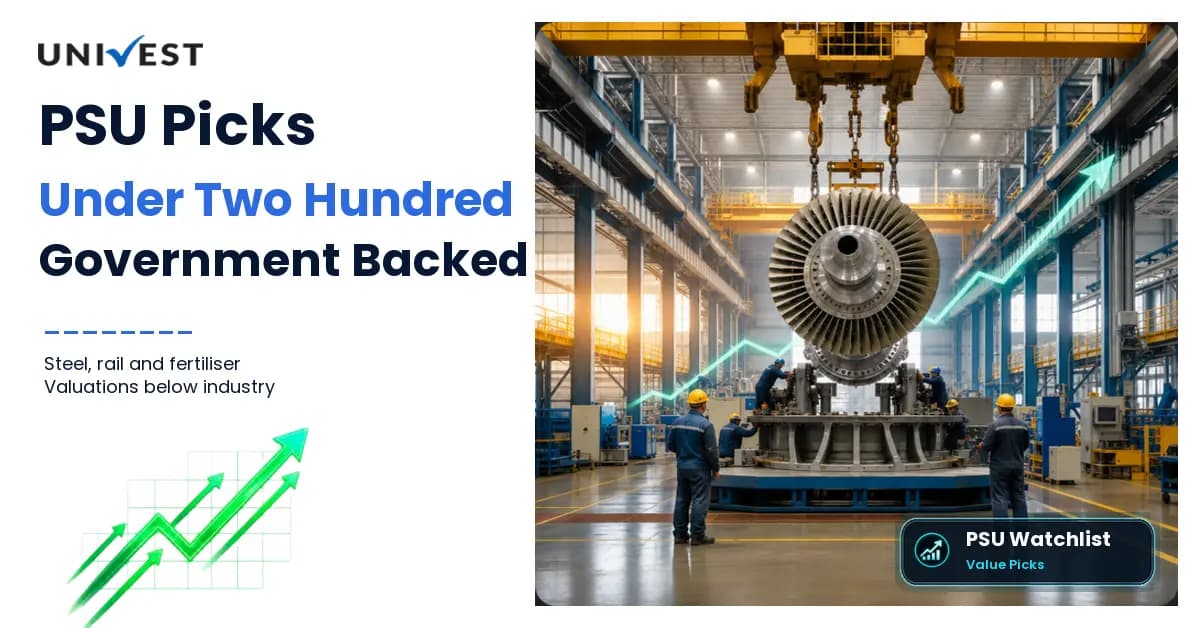
SAIL, RITES, National Fertilizers (NFL) and Rashtriya Chemicals & Fertilizers (RCF) are four PSU stocks under Rs 200 with the government holding between 65% and 75% of each. SAIL's September 2026 quarter profit jumped to Rs 1,750.47 crore from Rs 418.72 crore, and RCF's rose 24.3% to Rs 130.94 crore. RITES is debt-free, and NFL and RCF trade close to their book value. Fertiliser profits swing from quarter to quarter with subsidy timing, so full-year numbers give the fairer picture.
Public sector companies attract investors for their government backing, steady order flow and long record of dividend payments. Many of them also trade at modest valuations compared with private peers in the same industry.
FREE Analyst Review on Diversified Stocks – Click Here
The PSU stocks under Rs 200 in this list were chosen on four filters: a share price below Rs 200, government holding above 50%, a profit in FY26, and a P/E below the industry average. Prices are as of the 20 November 2026 NSE close, and financials come from company exchange filings.
5 Hot Diversified Stocks in the Buying Zone – Get Them for FREE
Which PSU Stocks Under Rs 200 Have Strong Fundamentals?
The PSU stocks under Rs 200 with strong fundamentals right now are Steel Authority of India (SAIL), RITES, National Fertilizers and Rashtriya Chemicals & Fertilizers. The President of India holds 65.00% of SAIL, 72.20% of RITES, 74.71% of NFL and 75.00% of RCF. All four trade at a P/E below their industry average.
| Company | Sector | CMP (Rs) | Market Cap (Rs Cr) | P/E | Industry P/E | ROE | Debt-to-Equity |
|---|---|---|---|---|---|---|---|
| Steel Authority of India (SAIL) | Steel | 164.11 | 67,947 | 12.12 | 20.47 | 8.96% | 0.50 |
| RITES | Engineering Consultancy | 187.02 | 8,987 | 20.00 | 35.64 | 15.24% | 0.00 |
| National Fertilizers | Fertilisers | 64.72 | 3,174 | 7.81 | 24.84 | 13.96% | 1.57 |
| Rashtriya Chemicals & Fertilizers | Fertilisers | 103.94 | 5,734 | 12.14 | 24.84 | 9.00% | 0.70 |
SAIL, NFL and RCF all trade at 1.09 times book value, which means the market values them close to the net assets on their balance sheets. RITES trades at a higher 3.38 times book value, reflecting its debt-free, asset-light consulting model and a return on equity of 15.24%. NFL trades at the lowest P/E in the group at 7.81, against a fertiliser industry average of 24.84.
1. SAIL: Q2 Profit Up More Than Four Times as Margins Recover
Steel Authority of India reported net profit of Rs 1,750.47 crore in the September 2026 quarter, against Rs 418.72 crore a year earlier, a rise of 318.1%. Revenue grew 19.8% to Rs 32,229.88 crore, and operating margin widened to 13.93% from 9.34%. Combined first-half FY27 profit already stands at Rs 3,394.52 crore, more than FY26's full-year profit of Rs 3,372.80 crore.
SAIL is India's largest state-owned steel producer, with integrated plants at Bhilai, Bokaro, Rourkela, Durgapur and Burnpur. At Rs 164.11, it trades at a P/E of 12.12 against a steel industry average of 20.47, and close to its book value of Rs 151.36 per share. The debt-to-equity ratio is a moderate 0.50. Steel prices drive SAIL's earnings, so watch domestic steel realisations each quarter. SAIL is the largest of these PSU stocks under Rs 200, with a market capitalisation of Rs 67,947 crore.
2. RITES: Debt-Free Rail Consultant With a 15.24% ROE
RITES, the transport infrastructure consultancy under the Ministry of Railways, has zero debt and an operating margin of 29.26% in FY26. Annual revenue rose 9.7% to Rs 2,524.57 crore in FY26, and net profit rose 7.3% to Rs 454.44 crore.
The company earns from railway and metro consultancy, rolling stock exports, leasing of locomotives and turnkey projects, both in India and in overseas markets. At Rs 187.02, it trades at a P/E of 20.00, well below the industry average of 35.64. Be careful with the latest quarter: September 2026 quarter profit of Rs 97.06 crore was 11.0% lower than a year earlier, so the pace of order execution is the number to track.
Find Government-Owned Stocks Under Rs 200 on the Univest Screener
3. National Fertilizers: Lowest P/E in the Group at 7.81
National Fertilizers, a leading urea producer with plants in Punjab, Haryana and Madhya Pradesh, grew FY26 net profit by 15.0% to Rs 211.49 crore on revenue of Rs 21,567.86 crore, which rose 8.4%. The company has stayed profitable every year since FY23, after a loss of Rs 95.12 crore in FY22.
At Rs 64.72, NFL trades at a P/E of 7.81, the lowest in this list, and at 1.09 times book value. Its return on equity is 13.96%. Be careful with quarterly numbers: September 2026 quarter profit was only Rs 6.12 crore, compared with Rs 113.38 crore in the June quarter, because fertiliser earnings depend on subsidy timing and gas costs. The debt-to-equity ratio of 1.57 is also the highest in this group. That low multiple makes NFL the value pick among PSU stocks under Rs 200, provided quarterly profits stabilise.
4. RCF: FY26 Profit Up 76.3% and Q2 Profit Up 24.3%
Rashtriya Chemicals & Fertilizers grew FY26 net profit by 76.3% to Rs 427.45 crore from Rs 242.45 crore, as operating margin improved to 6.47% from 5.02%. The September 2026 quarter added Rs 130.94 crore of profit, up 24.3% year-on-year and 78.1% over the June quarter.
RCF produces urea, complex fertilisers and industrial chemicals from its Trombay and Thal plants in Maharashtra, which gives it a second revenue stream beyond subsidised fertilisers. At Rs 103.94, the stock trades at a P/E of 12.14 against an industry average of 24.84, with a debt-to-equity ratio of 0.70. Quarterly revenue slipped 4.8% year-on-year to Rs 5,085.74 crore, so watch whether sales volumes pick up in the rabi season. With chemicals and fertilisers under one roof, RCF is the most diversified of these PSU stocks under Rs 200.
Download the Univest iOS App or Univest Android App to track these PSU stocks live and get daily stock research.
Why PSU Stocks Under Rs 200 Attract Investors
Government ownership gives these companies access to large state contracts, assured feedstock in some cases, and a lower risk of sudden business failure. PSU stocks under Rs 200 also let investors with small budgets build a position across several state-owned businesses.
Most of these companies trade with the wider public sector pack, so the BSE PSU is a useful benchmark to judge whether a move in one stock is part of a sector-wide trend.
How These PSU Stocks Compare
| Company | Government Holding | FY26 Net Profit (Rs Cr) | Q2 FY27 Net Profit (Rs Cr) | P/B Ratio |
|---|---|---|---|---|
| SAIL | 65.00% | 3,372.80 | 1,750.47 | 1.09 |
| RITES | 72.20% | 454.44 | 97.06 | 3.38 |
| National Fertilizers | 74.71% | 211.49 | 6.12 | 1.09 |
| RCF | 75.00% | 427.45 | 130.94 | 1.09 |
Points to Be Careful About
- Policy dependence: Fertiliser profits depend on government subsidy rates and payment timing.
- Commodity cycles: SAIL's earnings move with global and domestic steel prices.
- Disinvestment: Government stake sales through offers for sale can weigh on prices in the short term.
- Quarterly swings: NFL and RITES both reported softer September quarters, so judge them on full-year trends.
How to Invest in PSU Stocks Under Rs 200
- Use the Univest Screener to filter government-owned companies priced below Rs 200.
- Compare each company's P/E with its own industry average, not with the market.
- Check the last four quarters to see whether profits are stable or lumpy.
- Read the shareholding pattern for government and LIC holdings.
- Buy through a SEBI-registered broker such as Univest, in tranches.
Conclusion
SAIL, RITES, National Fertilizers and RCF give investors four different ways to own PSU stocks under Rs 200: steel, rail consultancy and two fertiliser producers. SAIL stands out for its sharp profit recovery, RITES for its debt-free balance sheet, NFL for the lowest P/E and RCF for strong full-year growth. Government holding between 65% and 75% adds stability, but subsidy timing and commodity prices can cause quarter-to-quarter swings. Track the next two quarterly results and consult a SEBI-registered advisor before investing.
Disclaimer: Data and figures in this article are sourced from publicly available information. These may or may not be accurate. Please verify all data with the official NSE (nseindia.com) and BSE (bseindia.com) websites before making any investment decision. Investments in securities are subject to market risk. This content is for educational purposes only and is not investment advice by Univest (SEBI RA INH000013776).
Frequently Asked Questions on PSU Stocks Under Rs 200
Which are the best PSU stocks under Rs 200 in 2027?
Ans. SAIL, RITES, National Fertilizers and Rashtriya Chemicals & Fertilizers are four PSU stocks under Rs 200 with government holding above 65% and P/E ratios below their industry averages. SAIL grew September 2026 quarter profit to Rs 1,750.47 crore from Rs 418.72 crore, RCF grew FY26 profit by 76.3%, RITES is debt-free and NFL trades at a P/E of 7.81. Each serves a different sector, which spreads risk across steel, railways and agriculture.
Is SAIL a good PSU stock to buy under Rs 200?
Ans. SAIL reported a 318.1% jump in September 2026 quarter profit to Rs 1,750.47 crore, and its first-half FY27 profit of Rs 3,394.52 crore has already crossed the full-year FY26 figure. The stock trades at Rs 164.11, a P/E of 12.12 against a steel industry average of 20.47, and near its book value of Rs 151.36. Its earnings move with steel prices, so it suits investors who can hold through commodity cycles.
Why did National Fertilizers report a low profit in the September 2026 quarter?
Ans. National Fertilizers reported a profit of Rs 6.12 crore in the September 2026 quarter, compared with Rs 113.38 crore in the June quarter. Fertiliser companies often see uneven quarterly profits because government subsidy payments, gas prices and sales volumes vary across seasons. On a full-year basis, NFL grew FY26 profit by 15.0% to Rs 211.49 crore and has stayed profitable every year since FY23. Investors should judge it on annual results rather than a single quarter.
Is RITES a debt-free PSU stock?
Ans. Yes, RITES has a debt-to-equity ratio of 0.00, making it a debt-free PSU. It is a transport consultancy under the Ministry of Railways and earns from consulting, rolling stock exports, leasing and turnkey projects. FY26 net profit rose 7.3% to Rs 454.44 crore, with an operating margin of 29.26%. The stock trades at a P/E of 20.00 against an industry average of 35.64. Its September 2026 quarter profit was 11.0% lower year-on-year, so order execution is the key metric to watch.
Do PSU stocks under Rs 200 pay dividends?
Ans. Many PSU companies have a long record of paying dividends because the government, as the largest shareholder, relies on dividend income. SAIL, RITES, NFL and RCF have all paid dividends in past years, although the amount varies with profits. Dividend payouts are decided by each board after annual results, so they are not fixed. Investors who want regular income should check the latest dividend announcements on the NSE and BSE websites before buying.
What are the risks of investing in PSU stocks?
Ans. The main risks are government policy changes, subsidy delays, commodity price cycles and stake sales by the government. Fertiliser companies depend heavily on subsidy rates, while steel makers like SAIL depend on global steel prices. PSU stocks can also lag private peers on efficiency. Keeping PSU stocks to a portion of the portfolio and choosing companies with low debt and steady annual profits helps reduce these risks.
Recent Articles

Hull Moving Average Explained: Formula, Why It Reduces Lag, How to Read Slope Changes and How It Compares With SMA and EMA on a Chart
23 November 2026

Bullish and Bearish Divergence Explained: How Price and Indicators Disagree, Regular vs Hidden Divergence, Confirmation Rules and Common Mistakes
23 November 2026
Dead Cat Bounce Explained: What It Looks Like, How to Tell It From a Real Reversal, the Role of Volume and How Traders Avoid the Trap
23 November 2026

Theta Decay Explained: How Time Decay Erodes Option Premium, Why It Speeds Up Near Expiry, a Worked Example and How Buyers and Sellers Should Respond
23 November 2026
Note: This blog is for information purpose only. Investments and trading are subject to market risks, read all scheme related documents carefully.
Reviews






Recent Posts
Hull Moving Average Explained: Formula, Why It Reduces Lag, How to Read Slope Changes and How It Compares With SMA and EMA on a Chart
Bullish and Bearish Divergence Explained: How Price and Indicators Disagree, Regular vs Hidden Divergence, Confirmation Rules and Common Mistakes
Dead Cat Bounce Explained: What It Looks Like, How to Tell It From a Real Reversal, the Role of Volume and How Traders Avoid the Trap
Theta Decay Explained: How Time Decay Erodes Option Premium, Why It Speeds Up Near Expiry, a Worked Example and How Buyers and Sellers Should Respond
Long Put Strategy Explained: Payoff, Break Even, Maximum Profit and Loss, How It Hedges a Stock Holding and the Risks of Buying Puts Near Expiry
Popular this week
Long Call Strategy Explained: Payoff, Break Even, Maximum Loss, How Time Decay and Implied Volatility Affect It and When Buying a Call Makes Sense

Uniresearch Global Pvt Ltd
Research Analyst
SEBI Registration Number — INH000013776
Uniresearch is a subsidiary of Univest Communication Technologies Private Limited
Company Address: Registered Address: Ground Floor, Unitech Commercial Tower 2, Block B, Greenwood City, Unit 1-3, Sector 45, Gurugram, Haryana 122003
Write to us : support@univest.in, compliance@univest.in
Verify on SEBI registry →RESEARCH ANALYST
Get SEBI Registered
advice on the stocks
trending today.
Get 3 FREE Trade Ideas

for Startups Accelerator 2024

Trusted by 1Cr Indians

Awarded No.1 by Economic Times