
Banswara Syntex Analyst Review 2027: Steady Profit, Stock at About Half of Book Value
Updated: 23 Nov 2026 • 10:59 am
Posted by:
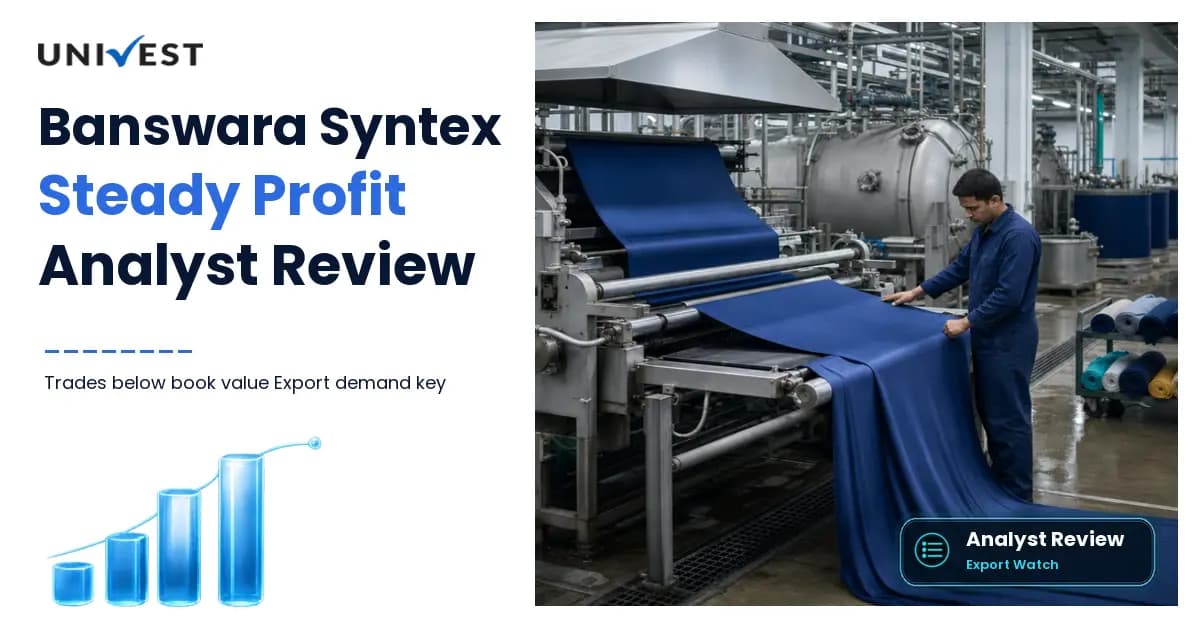
Banswara Syntex Stock Snapshot (21 Nov 2026)
- Current Market Price (CMP): ₹99.42
- 52-Week High / Low: ₹144 / ₹92.88
- Market Capitalisation: ₹347 crore
- P/E Ratio vs Industry P/E: 9.2 vs not available
- Latest Quarter (Q2 FY27) Revenue: ₹358.8 crore
- Latest Quarter (Q2 FY27) Net Profit: ₹7.7 crore
Quick Answer: The Banswara Syntex analyst review 2027 shows steady but modest earnings. Q2 FY27 revenue was about ₹358.8 crore and net profit rose about 9% to ₹7.7 crore from ₹7.1 crore a year earlier. We could not find a named brokerage target, so any Banswara Syntex share price target 2027 view rests on results and valuation. The stock closed at ₹99.42 on 21 November 2026, near its 52-week low, at about 9 times earnings and 0.58 times book value.
The Banswara Syntex analyst review 2027 covers an integrated textile company based in Banswara, Rajasthan, that makes yarn, fabric and garments for Indian and global buyers. Readers searching for a Banswara Syntex share price target 2027 want to know whether the low valuation offers value or reflects deeper problems.
FREE Analyst Review on Textile Stocks – Click Here
Banswara Syntex closed at ₹99.42 on 21 November 2026, about 31% below its 52-week high of ₹144 and about 7% above its low of ₹92.88. This Banswara Syntex analyst review 2027 explains the results and what shapes the Banswara Syntex stock outlook 2027.
5 Hot Textile Stocks in the Buying Zone – Get Them for FREE
What Analysts Say in the Banswara Syntex Analyst Review 2027
| Brokerage | Rating | Target Price | Date |
|---|---|---|---|
| No named target found | N/A | N/A | As of November 2026 |
Banswara Syntex has no regular brokerage coverage that we could verify.
In this Banswara Syntex analyst review 2027, readers should rely on company results, export trends and valuation. Small textile companies often trade on asset value and dividends rather than growth forecasts.
Q2 FY27 Results in the Banswara Syntex Analyst Review 2027
| Metric | Q2 FY27 | Q2 FY26 | Change |
|---|---|---|---|
| Revenue | About ₹358.8 crore | N/A | N/A |
| Net profit | ₹7.7 crore | ₹7.1 crore | Up about 9% |
| Net margin | About 2.2% | N/A | N/A |
Profit grew modestly in a tough market for textile exporters. The net margin of about 2% is thin, which is common for integrated textile mills with high raw material and power costs.
FY26 revenue was about ₹1,370 crore with net profit of about ₹31 crore. In this Banswara Syntex analyst review 2027, Q2 profit is broadly in line with last year's quarterly run rate, so the business is holding steady rather than growing fast.
How Banswara Syntex Makes Money
Banswara Syntex is integrated across the textile chain.
- Yarn: synthetic and blended spun yarn, sold outside and used in-house.
- Fabric: suiting, shirting and technical fabrics for brands and garment makers.
- Garments: trousers, jackets and other apparel, largely for export.
- Exports: a meaningful share of sales goes to Europe, the US and other markets.
Being integrated helps the company control quality and capture more value from each stage. But it also means large fixed assets and working capital, which keep returns modest. That trade-off is central to this Banswara Syntex analyst review 2027.
The stock trades at about 0.58 times book value and about 9 times earnings. Foreign investors hold about 7.9%, which is notable for a company of this size.
Textile stocks have been weighed down in 2026 by uneven global demand and US tariff concerns, and many have lagged the Nifty 50. Banswara has slipped toward its 52-week low despite steady profit.
India's textile sector has long-term supports, including export incentives, textile parks and global buyers seeking alternatives to China. Integrated players with established export customers are better placed than small, single-stage units to win such business. Banswara's long history with overseas buyers is an advantage here.
The challenge is converting that position into higher margins. Synthetic fibre and yarn prices move with crude oil and global demand, and power costs in Rajasthan affect mill economics. Garment exports face strong competition from Bangladesh, Vietnam and other countries. Small improvements in pricing or efficiency can make a big difference on a 2% margin.
For value-focused investors, the gap between book value and share price is the main point of interest in this Banswara Syntex analyst review 2027. Closing that gap would usually need either better returns on equity or steps such as higher dividends that return more cash to shareholders.
Working capital is another factor to track. Integrated mills hold large stocks of fibre, yarn and fabric, and export customers often take time to pay. When sales slow, inventory can build up and tie up cash, raising borrowing needs. Steady inventory turns and collections are a sign of a well-run textile business, even in a weak market.
Capacity use also shapes profit. Spinning and weaving units have high fixed costs, so running them closer to full capacity spreads those costs across more output. A pickup in orders from global brands would help on this front and could lift margins faster than revenue.
Growth Triggers in the Banswara Syntex Analyst Review 2027
- Steady profit: Q2 profit up about 9%.
- Low valuation: about 9 times earnings and 0.58 times book.
- Integration: yarn to garments under one roof.
- Export base: long-standing overseas customers.
- Sourcing shift: global buyers diversifying, which supports any Banswara Syntex share price target 2027 case.
Key Risks in the Banswara Syntex Analyst Review 2027
- Thin margins: net margin about 2%.
- Export demand: weak orders from Europe and the US.
- Tariffs: trade measures can hurt garment exports.
- Raw material costs: synthetic fibre prices follow crude.
- No coverage: no brokerage estimates, a key point in the Banswara Syntex analyst review 2027.
Compare Banswara Syntex With Other Textile Stocks on the Univest Screener
Banswara Syntex Analyst Review 2027: Stock at a Glance
| Metric | Value |
|---|---|
| Share Price (21 Nov 2026) | ₹99.42 |
| 52-Week High / Low | ₹144 / ₹92.88 |
| Market Capitalisation | About ₹347 crore |
| P/E (TTM) | About 9.2 |
| Price to Book | About 0.58 |
| FY26 Revenue | About ₹1,370 crore |
| FY26 Net Profit | About ₹31 crore |
The P/E of about 9 and price to book of about 0.58 are low. In this Banswara Syntex analyst review 2027, the discount reflects thin margins and modest returns on capital rather than losses.
Shareholding Trend
| Holder | Sep 2026 |
|---|---|
| Promoters | 54.13% |
| Foreign Investors (FII) | 7.94% |
| Public and Others | 37.93% |
The Toshniwal family promoter group holds about 54.1%. The Banswara Syntex analyst review 2027 sees the foreign holding of about 7.9% as a sign that some global investors value the company's export franchise.
What to Watch After the Banswara Syntex Analyst Review 2027
- Export orders: demand from Europe and the US.
- Margins: any rise from about 2%.
- Raw material prices: polyester and viscose trends.
- Dividends: payout levels.
- Coverage: any Banswara Syntex share price target 2027 that emerges.
Final Word on the Banswara Syntex Analyst Review 2027
The Banswara Syntex analyst review 2027 shows an integrated textile company with steady profit, an export base and a low valuation. Thin margins and weak export demand explain the discount to book value.
The Banswara Syntex stock outlook 2027 depends on export recovery and margin gains. Univest does not give a buy or sell call.
Disclaimer: This article is for educational and informational purposes only and is not investment advice or a recommendation to buy, sell or hold any security. Brokerage ratings and target prices quoted here are opinions of third-party research houses; Univest does not endorse them and gives no buy or sell call. Investments in the securities market are subject to market risks. Read all related documents carefully before investing. Research Analyst: Uniresearch Global Pvt. Ltd., SEBI Registration No. INH000013776.
Frequently Asked Questions
What does the Banswara Syntex analyst review 2027 show?
It shows steady but modest earnings. Q2 FY27 revenue was about ₹358.8 crore and net profit rose about 9% to ₹7.7 crore. Net margin is about 2%.
What is the Banswara Syntex share price target 2027?
We could not find any named brokerage target for Banswara Syntex. The stock has no regular coverage. Readers should track results, exports and valuation.
What does Banswara Syntex make?
Banswara Syntex makes yarn, fabrics and garments in an integrated setup in Rajasthan. It sells to Indian buyers and exports to Europe, the US and other markets. Its fabrics include suiting and shirting.
Why does Banswara Syntex trade below book value?
The stock trades at about 0.58 times book value. Thin margins and modest returns on capital keep the valuation low. Better margins or higher payouts could help close the gap.
Is Banswara Syntex stock undervalued based on the Banswara Syntex analyst review 2027?
At about 9 times earnings and 0.58 times book, the stock looks low on standard measures. However, profit growth is slow and margins are thin. Value depends on export demand improving.
Who owns Banswara Syntex?
The promoter group holds about 54.1%. Foreign investors hold about 7.9%. Public and other investors hold the rest.
What should investors watch after the Banswara Syntex analyst review 2027?
Watch export orders, margins and synthetic fibre prices. Track dividend payouts and any capacity changes. New brokerage coverage would also help.
Recent Articles

Hull Moving Average Explained: Formula, Why It Reduces Lag, How to Read Slope Changes and How It Compares With SMA and EMA on a Chart
23 November 2026

Bullish and Bearish Divergence Explained: How Price and Indicators Disagree, Regular vs Hidden Divergence, Confirmation Rules and Common Mistakes
23 November 2026

Dead Cat Bounce Explained: What It Looks Like, How to Tell It From a Real Reversal, the Role of Volume and How Traders Avoid the Trap
23 November 2026
Theta Decay Explained: How Time Decay Erodes Option Premium, Why It Speeds Up Near Expiry, a Worked Example and How Buyers and Sellers Should Respond
23 November 2026
Note: This blog is for information purpose only. Investments and trading are subject to market risks, read all scheme related documents carefully.
Reviews






Recent Posts
Hull Moving Average Explained: Formula, Why It Reduces Lag, How to Read Slope Changes and How It Compares With SMA and EMA on a Chart
Bullish and Bearish Divergence Explained: How Price and Indicators Disagree, Regular vs Hidden Divergence, Confirmation Rules and Common Mistakes
Dead Cat Bounce Explained: What It Looks Like, How to Tell It From a Real Reversal, the Role of Volume and How Traders Avoid the Trap
Theta Decay Explained: How Time Decay Erodes Option Premium, Why It Speeds Up Near Expiry, a Worked Example and How Buyers and Sellers Should Respond
Long Put Strategy Explained: Payoff, Break Even, Maximum Profit and Loss, How It Hedges a Stock Holding and the Risks of Buying Puts Near Expiry
Popular this week
Long Call Strategy Explained: Payoff, Break Even, Maximum Loss, How Time Decay and Implied Volatility Affect It and When Buying a Call Makes Sense

Uniresearch Global Pvt Ltd
Research Analyst
SEBI Registration Number — INH000013776
Uniresearch is a subsidiary of Univest Communication Technologies Private Limited
Company Address: Registered Address: Ground Floor, Unitech Commercial Tower 2, Block B, Greenwood City, Unit 1-3, Sector 45, Gurugram, Haryana 122003
Write to us : support@univest.in, compliance@univest.in
Verify on SEBI registry →RESEARCH ANALYST
Get SEBI Registered
advice on the stocks
trending today.
Get 3 FREE Trade Ideas

for Startups Accelerator 2024

Trusted by 1Cr Indians

Awarded No.1 by Economic Times