
5 EMS Stocks in India with Strong Future Roadmaps as PLI for Electronics and China Diversification Drive Record Order Books
- August 26, 2026
- Posted by: Kunal Singla
- Category: Market
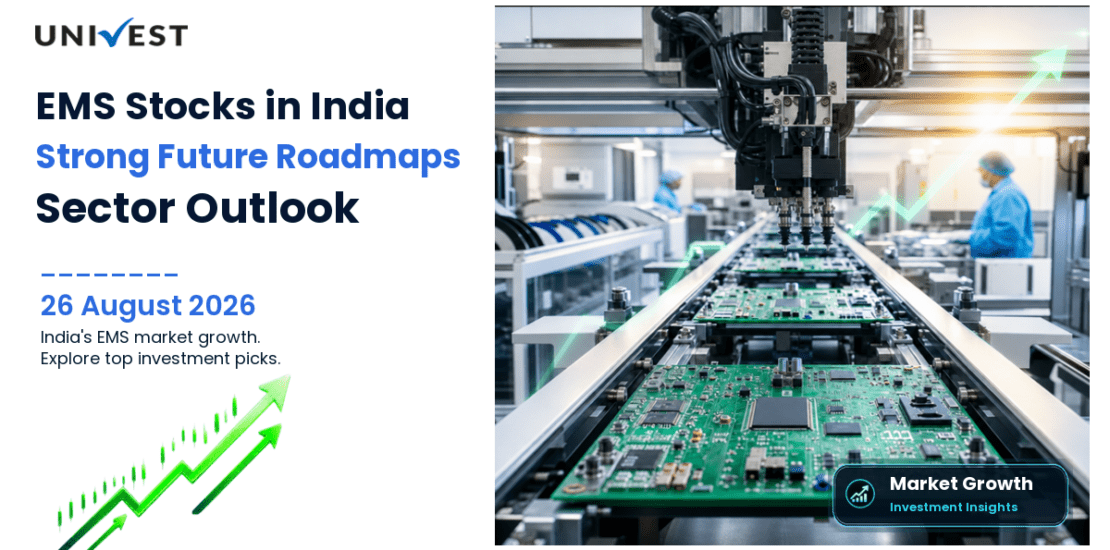
India EMS market FY26: Rs 1 lakh Cr+. Dixon Technologies MCap Rs 88,901 Cr — largest. Dixon ROE 30.76% — highest. Dixon PE 42.70 — most value. Sector PE 50-65. India electronics production target: Rs 24 lakh Cr by 2026. 5 picks: DIXON, KAYNES, AMBER, SYRMA, PGEL.
Quick Answer
Five EMS stocks in India with strong future roadmaps are Dixon Technologies, Kaynes Technology India, Amber Enterprises India, Syrma SGS Technology, and PG Electroplast. India’s Electronics Manufacturing Services sector is the fastest-growing manufacturing segment in India, driven by PLI incentives for mobile phones, IT hardware, and white goods, and global brands diversifying supply chains away from China. Dixon Technologies leads as India’s largest EMS stock by market cap at Rs 88,901 crore with the highest ROE at 30.76%. The sector trades at a premium PE of 50-65 reflecting the high growth expectations priced in.
India’s EMS sector is the most direct beneficiary of the government’s PLI (Production Linked Incentive) scheme for electronics. Mobile phone PLI has made India the world’s second-largest smartphone manufacturer, with Apple, Samsung, and other global brands now assembling in India. IT hardware PLI is bringing laptop and server manufacturing. White goods PLI is expanding AC and washing machine capacity. EMS stocks are the primary contract manufacturing partners executing all of these government-backed production expansions.
For investors, EMS stocks command premium PE multiples (sector average 50-65) because their growth visibility is exceptional. New PLI approvals, new global client additions, and expanding product ranges are compounding revenue at 40-60% annually for leading EMS stocks. All price and fundamental data is as of 25 August 2026.
Click Here – Get Free Investment Predictions
What Are EMS Stocks in India?
EMS (Electronics Manufacturing Services) stocks are shares in companies that manufacture electronic products and assemblies under contract for original brand owners (OEMs). India’s listed EMS sector includes companies that assemble mobile phones (Dixon, Amber), consumer electronics (TVs, washing machines, ACs — Amber, Dixon), industrial electronics (Kaynes, Syrma SGS), and PCB assemblies (PG Electroplast). EMS stocks operate on a contract-manufacturing model where they add value through assembly, testing, and supply chain management without owning the end brand. Revenue grows with client volumes and new product line additions.
Budget 2026-27 Impact on EMS Stocks
Click Here – Get Free Investment Predictions
- PLI for mobile phones: Rs 41,000 crore over 5 years: India’s mobile phone PLI has attracted Apple, Samsung, Motorola, and domestic brands. EMS stocks like Dixon and Amber are primary manufacturing partners.
- PLI for IT hardware (laptops, tablets, servers): The IT hardware PLI is opening a new Rs 5-7 lakh crore annual production addressable market for EMS stocks with PCB and assembly capabilities.
- PLI for white goods (ACs, LEDs): Rs 6,238 crore PLI for white goods is driving domestic AC and refrigerator manufacturing, directly benefiting EMS stocks with AC assembly capabilities.
- Semiconductor packaging PLI: While full chip fabrication is a longer journey, PLI for OSAT (outsourced semiconductor assembly and testing) creates new revenue opportunities for technically capable EMS stocks.
- China Plus One sourcing mandates from global brands: US tariff policy on Chinese electronics is mandating global brands to diversify sourcing to India. Each brand’s India sourcing decision creates direct revenue for EMS stocks manufacturing in India.
5 EMS Stocks in India to Watch in 2026
| Company | CMP (Rs) | Market Cap (Rs Cr) | P/E Ratio | ROE (%) |
|---|---|---|---|---|
| Dixon Technologies India | 14,540 | 88,901 | 42.70 | 30.76% |
| Kaynes Technology India | 3,841 | 25,827 | 93.32 | 5.65% |
| Amber Enterprises India | 7,377 | 26,017 | 210.53 | 4.66% |
| Syrma SGS Technology | 1,460 | 28,147 | 70.07 | 11.10% |
| PG Electroplast | 598 | 17,115 | 83.22 | 6.45% |
Data as of 25 August 2026. For 52-week high/low, verify at nseindia.com before making any investment decision.
1. Dixon Technologies India (NSE: DIXON)
Dixon Technologies is India’s largest and most diversified EMS stock, manufacturing mobile phones, LED TVs, washing machines, security systems, lighting, and increasingly IT hardware and EMS for telecom equipment. Founded in 1993 and headquartered in Noida, the company assembles for Samsung, Xiaomi, Nokia, Motorola, HUL, and others. Market cap is Rs 88,901 crore at CMP Rs 14,540. PE is 42.70, the most attractive among these EMS stocks given its scale and ROE. ROE is 30.76% — the highest of all EMS stocks — and D/E is 0.21. Dixon’s revenue has grown from Rs 2,000 crore in FY18 to Rs 35,000+ crore in FY26 — a compounding rate of 45%+ annually. For investors in EMS stocks who want India’s largest, fastest-growing, most capital-efficient contract electronics manufacturer, Dixon Technologies is the unambiguous sector leader.
2. Kaynes Technology India (NSE: KAYNES)
Kaynes Technology is the most technology-differentiated EMS stock in India, focusing exclusively on industrial, automotive, medical, and aerospace electronics — higher-complexity, higher-margin categories than consumer electronics. Founded in 1988 and headquartered in Mysore, the company manufactures PCB assemblies, box builds, and complete electronic systems for clients including aerospace OEMs, defence PSUs, and automotive majors. Market cap is Rs 25,827 crore at CMP Rs 3,841. PE of 93.32 is elevated, reflecting the market’s pricing of Kaynes’ niche technology position. ROE of 5.65% is low as the company invests heavily in new capacity. D/E is 0.07 — near debt-free. For investors in EMS stocks who want high-technology industrial electronics exposure with a clean balance sheet, Kaynes is the premium-complexity play.
Check the Univest Screener for Live Fundamental Data on These Stocks
3. Amber Enterprises India (NSE: AMBER)
Amber Enterprises is India’s largest AC component and sub-assembly manufacturer — the EMS stock most directly positioned to benefit from India’s white goods PLI scheme and rising domestic AC penetration. Founded in 1990 and headquartered in Rajpura, Punjab, the company manufactures AC indoor and outdoor units, PCBA, heat exchangers, and motors for Daikin, Mitsubishi, Voltas, Panasonic, and others. Market cap is Rs 26,017 crore at CMP Rs 7,377. PE of 210.53 is the highest among these EMS stocks, reflecting a sharp earnings dip in a transition year. ROE is 4.66% and D/E is 0.62. Amber’s historical ROE has been 12-15% — the current depression reflects capacity investment and product mix transition. For investors in EMS stocks who believe in India’s AC adoption megatrend and understand the current earnings transition, Amber is a high-optionality white goods EMS play.
4. Syrma SGS Technology (NSE: SYRMA)
Syrma SGS Technology is the EMS stock with the strongest combination of mid-sector ROE (11.10%) and near-zero debt (D/E 0.14), making it the most financially balanced mid-cap electronics manufacturer. Founded in 2005 and headquartered in Chennai, the company manufactures electronic systems for automotive, industrial, healthcare, and defence clients from its Tamil Nadu and Noida plants. Market cap is Rs 28,147 crore at CMP Rs 1,460. PE is 70.07. Syrma’s parent SGS Tekniks was acquired to create an integrated EMS capability, and the combined entity is winning orders from Indian defence and automotive OEMs. For investors in EMS stocks seeking a mid-cap with the best balance of ROE, debt, and industrial electronics growth potential, Syrma SGS is the most proportionately valued option.
Download the Univest iOS App or Univest Android App to track live prices and expert research.
5. PG Electroplast (NSE: PGEL)
PG Electroplast is a fast-growing EMS stock that has transformed from a plastic components manufacturer into a full-scale electronics assembly company, manufacturing LED TVs, set-top boxes, ACs, and electronic control units. Founded in 1975 and headquartered in Greater Noida, the company supplies to Thomson, Vu, Daikin, and other consumer electronics brands. Market cap is Rs 17,115 crore at CMP Rs 598. PE is 83.22, ROE is 6.45% (in investment phase), and D/E is 0.20. PG Electroplast’s LED TV manufacturing capacity and growing AC assembly business position it as the most accessible-entry-PE EMS stock for consumer electronics. Revenue has grown 60%+ annually over three years, reflecting the rapid business model transformation. For investors in EMS stocks who want a smaller-cap with high revenue growth in consumer electronics assembly, PG Electroplast offers participation at lower per-share entry cost.
What Factors Affect EMS Stocks?
- PLI scheme disbursement timelines: EMS stocks’ PLI incentive income depends on meeting production targets. Timely PLI disbursements support working capital and improve effective margins for these EMS stocks.
- New global brand client additions: Each new international brand (Apple, Google, Sony) adding India to its manufacturing base creates direct revenue for EMS stocks with the right technical capabilities. Track quarterly press releases for new client wins.
- Semiconductor component availability: EMS stocks’ production is directly linked to chip and semiconductor availability. Global semiconductor shortages (as in 2021-22) delay production and revenue recognition.
- China-India tariff differential: When US tariffs on Chinese electronics are high, India-manufactured electronics have a cost advantage. Monitor US trade policy as a key driver for EMS stocks’ global client win rate.
- Capacity utilisation and new plant ramp-up: EMS stocks with new plants coming online must reach 70%+ utilisation before they become earnings accretive. The ramp-up phase (6-18 months) typically depresses ROE and elevates PE.
Benefits of Investing in EMS Stocks
- PLI scheme guaranteeing 4-6% production incentive: EMS stocks eligible for PLI schemes receive 4-6% of incremental production as cash incentive from the government, providing a direct margin support mechanism.
- India becoming world’s second-largest mobile phone manufacturer: India’s mobile phone production has grown from USD 3 billion in 2017 to USD 50+ billion in FY26. EMS stocks are the primary manufacturing vehicle for this transformation.
- China-plus-one sourcing creating structural demand: Global brands are permanently diversifying manufacturing from China. Each USD 1 billion shifted from China creates direct revenue for Indian EMS stocks.
- Component localisation improving margins: As EMS stocks localize more components (chargers, cables, PCBs), the value addition per assembly increases, improving margins from the initial screwdriver-assembly phase.
- Export revenue growing from India manufacturing hub: Devices assembled in India are being exported to Europe, Africa, and Middle East under India’s FTAs, creating export revenue that diversifies beyond domestic demand for EMS stocks.
Risks to Consider Before Investing
- Customer concentration in PLI-driven businesses: Dixon’s major clients (Samsung, Apple supply chain) contribute a disproportionate revenue share. Loss of a large client for any EMS stock creates significant quarterly revenue shortfall.
- Low margin model requiring scale to earn returns: EMS stocks typically earn EBITDA margins of 4-8%. Reaching profitability requires high throughput volume. New EMS entrants with insufficient scale lose money, pressuring pricing across the sector.
- Technology transition risk: EMS stocks must continuously adapt to new product form factors. The shift from feature phones to smartphones, from LEDs to OLED TVs, and from air-cooled to inverter ACs all require new tooling investment.
- Working capital intensity of EMS model: EMS stocks typically carry 60-90 days of component inventory and have 30-60 day client payment terms. High working capital requirement means fast-growing EMS stocks need continuous equity or debt capital.
- Global chip shortage risk: EMS production is blocked entirely when specific semiconductor components are unavailable. Chip shortage periods (as seen globally in 2021-22) create revenue recognition gaps for EMS stocks.
How to Choose EMS Stocks
- Revenue CAGR above 30%: EMS stocks growing revenue at 30%+ annually are winning new clients and products faster than the sector average. Dixon’s 45%+ CAGR over 7 years is the benchmark to compare against.
- Product mix complexity (industrial vs consumer): EMS stocks serving industrial, defence, and medical electronics (Kaynes, Syrma) earn higher margins than consumer assembly plays (Dixon consumer, Amber white goods). Complexity commands a premium.
- PLI eligibility and disbursement status: EMS stocks receiving PLI incentives have a 4-6% embedded margin subsidy. Track the percentage of revenue eligible for PLI disbursement as a quality earnings support metric.
- Client diversification above 5 major OEMs: EMS stocks with 5+ major OEM clients are more resilient to any single client’s volume reduction. Dixon’s 15+ client portfolio is the most diversified among these EMS stocks.
- EBITDA margin above 5%: EMS stocks consistently delivering EBITDA margins above 5% are managing working capital, scale, and client mix efficiently. Below 3% signals margin under-pressure or new capacity ramp-up.
How to Invest in EMS Stocks in India
Step 1: Open a SEBI-registered demat account. Univest offers zero-brokerage broking with integrated research, so you can screen, research, and invest in EMS stocks from one platform.
Step 2: Use the Univest Screener to filter the sector by PE, ROE, D/E, and revenue growth. This gives you a ranked snapshot of all listed EMS companies.
Step 3: Review financial statements of your shortlist. Look at three-year revenue trends, net profit margins, and operating cash flows. Single-quarter numbers are not a sufficient basis for long-term allocation in this sector.
Step 4: Decide on position size based on your risk tolerance. High-growth EMS stocks carry more volatility than diversified blue-chips. Diversify across two or three names rather than concentrating in one.
Step 5: Set price alerts and monitor quarterly results. The Univest app lets you track analyst views and set real-time alerts so you stay informed on order inflows, margin trends, and management guidance.
Conclusion
The five EMS stocks covered here, Dixon Technologies, Kaynes Technology, Amber Enterprises, Syrma SGS, and PG Electroplast, represent India’s electronics manufacturing sector from diversified consumer EMS leaders to high-complexity industrial specialists. PLI incentives, China-plus-one sourcing, and India’s electronics production ambition create multi-year structural tailwinds. High sector PE and working capital intensity are the key risks. Consult a SEBI-registered investment advisor before making any investment decisions.
Disclaimer: Data and figures in this article are sourced from publicly available information. These may or may not be accurate. Please verify all data with the official NSE (nseindia.com) and BSE (bseindia.com) websites before making any investment decision. Investments in securities are subject to market risk. This content is for educational purposes only and is not investment advice by Univest (SEBI RA INH000013776).
FAQs on EMS Stocks in India 2026
Which are the top 5 EMS stocks in India in 2026?
Ans. The top 5 EMS stocks in India as of August 2026 are Dixon Technologies (DIXON), Kaynes Technology (KAYNES), Amber Enterprises (AMBER), Syrma SGS Technology (SYRMA), and PG Electroplast (PGEL). Dixon leads on ROE (30.76%) and market cap (Rs 88,901 crore). The sector PE of 50-65 reflects the high growth expectations priced in.
What is PLI scheme and how does it benefit EMS stocks?
Ans. The Production Linked Incentive (PLI) scheme provides EMS stocks with 4-6% of incremental production value as a cash incentive from the government for approved categories. For mobile phones, white goods, IT hardware, and other electronics, EMS stocks meeting the production targets receive the PLI disbursement annually. This effectively subsidises margin for compliant EMS stocks, improving their competitiveness against Chinese and Vietnamese manufacturers.
Why does Dixon Technologies have such high ROE among EMS stocks?
Ans. Dixon’s 30.76% ROE reflects its scale leadership, product diversity, and capital-light model. Dixon has the largest revenue among Indian EMS stocks, which creates fixed cost absorption advantages. Its mobile phone business (PLI-eligible) provides subsidy income. The company manages working capital efficiently across its diverse product portfolio. No single factor explains 30% ROE — it is the cumulative benefit of scale, product mix, and operational discipline.
What is Kaynes Technology’s industrial electronics focus?
Ans. Kaynes Technology deliberately avoids consumer electronics in favour of industrial, automotive, aerospace, and medical electronics. These categories have much higher technical specifications, longer product development cycles, and higher switching costs. An aerospace electronics contract lasts 10-15 years. An automotive dashboard assembly qualifies for a vehicle model run of 5-7 years. This creates revenue visibility that consumer EMS stocks lack, justifying Kaynes’ premium PE.
Why is Amber Enterprises’ PE so high for an EMS stock?
Ans. Amber’s PE of 210.53 reflects a temporary earnings compression from AC industry inventory corrections and capacity investment. Amber’s historical PE was 40-60x. The market is pricing in recovery to normalized earnings as the investment phase completes. AC penetration in India is only 10% of households (versus 90%+ in China) — the structural growth runway justifies a higher earnings multiple if Amber captures it. The current PE reflects both the trough earnings and the market’s faith in multi-year growth.
How does China-plus-one benefit Indian EMS stocks?
Ans. US tariffs on Chinese electronics (25%+ under Section 301) make China-assembled products significantly more expensive in the US market. Global brands that want US market access are shifting assembly to tariff-exempt countries. India, with no Chinese tariff status and a growing supply chain ecosystem, is receiving a significant share of this reallocation. Each brand that shifts assembly creates direct revenue for the Indian EMS stock that wins the manufacturing contract.
How do I invest in EMS stocks in India?
Ans. To invest in EMS stocks, open a demat account with a SEBI-registered broker, filter by revenue CAGR, PLI eligibility, client diversification, EBITDA margin, and product mix complexity. Monitor quarterly new client announcements and PLI disbursement disclosures. Consult a SEBI-registered investment advisor before investing.
