
4 Railway Stocks with Strong Growth Plans in India (2026)
- August 20, 2026
- Posted by: Ankit Jaiswal
- Category: Market
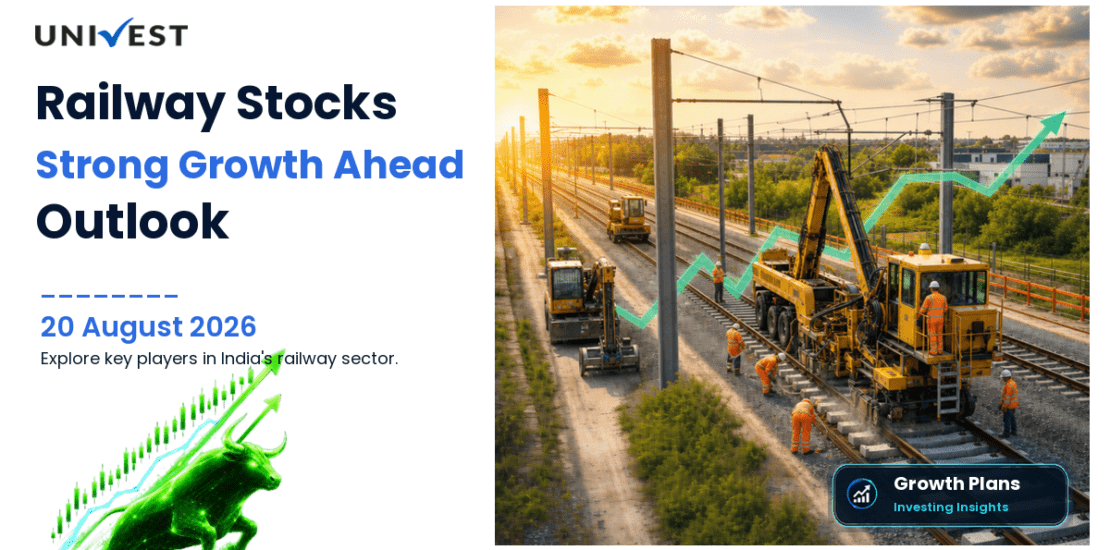
IRFC MCap Rs 1,11,213 Cr dividend yield 2.47%. RVNL MCap Rs 46,517 Cr order book Rs 90,000 Cr. IRCTC MCap Rs 39,072 Cr ROE 32.34%. Titagarh MCap Rs 11,210 Cr. India railways capex Rs 2.62 lakh Cr FY26.
Quick Answer
Indian Railway Finance Corporation (IRFC), Rail Vikas Nigam Limited (RVNL), IRCTC, and Titagarh Rail Systems are four railway stocks with strong growth plans backed by India’s Rs 2.62 lakh crore annual railway capital expenditure programme. The government has made railway modernisation a national priority, investing in Vande Bharat train sets, the KAVACH collision avoidance system, dedicated freight corridors, and station redevelopment. All four railway stocks are direct beneficiaries of this investment. Investors should note that railway stocks are heavily government policy-linked and their earnings can be affected by budget allocation changes and contract award timelines.
Railway stocks in India represent the financing, construction, services, and manufacturing segments of Indian Railways’ massive modernisation programme. IRFC finances Indian Railways’ capital expenditure; RVNL builds railway infrastructure; IRCTC provides catering, ticketing, and tourism services; and Titagarh Rail Systems manufactures wagons and metro coaches. As of 20 August 2026, all four railway stocks are executing their strongest growth phases, driven by India’s Rs 2.62 lakh crore annual railway budget allocation.
India’s railway capex has grown from Rs 50,000 crore in FY15 to Rs 2.62 lakh crore in FY26, a 5x increase over a decade. This investment multiplier creates sustained earnings growth across all four railway stocks, from IRFC’s regulated financing margins to RVNL’s construction revenue, IRCTC’s ticketing volumes, and Titagarh’s rolling stock orders.
Click Here – Get Free Investment Predictions
What Are Railway Stocks?
Railway stocks are shares of companies that operate in or serve the Indian Railways ecosystem. The category spans financing companies (IRFC), infrastructure construction companies (RVNL, IRCON), services companies (IRCTC for ticketing and catering), and manufacturing companies that produce rolling stock (Titagarh Rail Systems, BEML).
Railway stocks’ most important leading indicator is the annual Union Budget railway capital expenditure allocation, supplemented by ministry-level project approvals and contract award notifications throughout the year. Higher government capex directly translates to orders for construction and manufacturing railway stocks and financing mandates for IRFC.
Why Do These Four Railway Stocks Have Strong Growth Plans?
Indian Railways is one of the highest-priority national infrastructure investments of the current government. The PM GatiShakti National Master Plan identifies railways as a strategic enabler for India’s logistics competitiveness. Dedicated Freight Corridors (DFC) and passenger corridor modernisation are both receiving unprecedented budget support, creating multi-year order pipelines for all four railway stocks.
The KAVACH collision avoidance system rollout (40,000+ route km), Vande Bharat train set programme (400+ train sets by FY27), and 1,309 station redevelopment programme create sustained demand for rolling stock manufacturers (Titagarh), infrastructure builders (RVNL), and financing institutions (IRFC). IRCTC benefits from rising passenger volumes as more comfortable trains drive higher occupancy rates.
4 Railway Stocks with Strong Growth Plans
| Company | CMP (Rs) | Market Cap (Rs Cr) | PE Ratio | ROE (%) |
|---|---|---|---|---|
| Indian Railway Finance Corporation Ltd. (IRFC) | 86.85 | 1,11,213 | 15.47 | 12.35% |
| Rail Vikas Nigam Ltd. (RVNL) | 229.61 | 46,517 | 51.88 | 8.91% |
| Indian Railway Catering and Tourism Corporation Ltd. (IRCTC) | 487.70 | 39,072 | 28.05 | 32.34% |
| Titagarh Rail Systems Ltd. (TITAGARH) | 846.15 | 11,210 | 59.50 | 6.51% |
Data as of 20 August 2026, NSE. Prices are indicative and change in real time.
1. Indian Railway Finance Corporation Limited (IRFC)
Founded in 1986 and headquartered in New Delhi, IRFC is India’s dedicated railway financing institution, borrowing from capital markets and lending to Indian Railways Ministry at a regulated margin. IRFC has funded over 90% of Indian Railways’ rolling stock acquisitions since FY20, deploying Rs 1.5 lakh crore+ of capital. Among railway stocks, IRFC is the most predictable: its earnings depend entirely on the regulated lending-borrowing spread, with zero credit risk (Indian Railways obligations are Government of India-backed).
IRFC’s growth plan involves continuing to fund Indian Railways’ Rs 2.62 lakh crore annual capex programme, including KAVACH systems, Vande Bharat train sets, and DFC rolling stock. It may also expand its mandate to fund metro rail and urban transport projects. At PE 15.47 (below the sector average of 24.09) and ROE 12.35%, IRFC is the most conservatively valued large-cap railway stock. Dividend yield 2.47% provides steady income. D/E 7.69 is normal for a government financing institution.
2. Rail Vikas Nigam Limited (RVNL)
Founded in 2003 and headquartered in New Delhi, RVNL is a Navratna PSU and the largest railway infrastructure construction company in India, executing line doublings, electrification, new line construction, gauge conversion, and station redevelopment projects. RVNL has executed 70,000+ km of rail infrastructure projects and currently has an order book of Rs 90,000+ crore, the highest in its history among listed railway stocks.
RVNL’s growth plan targets Rs 1.5 lakh crore order book by FY28 by expanding into high-speed rail preparation, metro rail, and international railway infrastructure. The company is also bidding for non-railway infrastructure to diversify. PE of 51.88 (above the sector average of 24.82) reflects the premium for RVNL’s near-100% order visibility from Indian Railways. ROE of 8.91% is improving as project margins normalise. D/E of 0.49 is conservative.
Explore the Univest Screener to Compare These Stocks Live
3. Indian Railway Catering and Tourism Corporation Limited (IRCTC)
Founded in 1999 and headquartered in New Delhi, IRCTC holds exclusive rights to Indian Railways’ online ticket booking, on-train catering, and railway tourism packages. The ticketing platform processes 15 lakh+ transactions daily, the highest-volume commercial e-commerce platform in India by transaction count. Catering serves 10 lakh+ meals daily to railway passengers. Among railway stocks, IRCTC is the highest-quality and most unique: a digital platform, food services company, and tourism operator simultaneously with a statutory monopoly in online ticketing.
IRCTC’s growth plan involves growing convenience fee revenue per booking, scaling catering through station redevelopment projects, and growing premium railway tourism (Maharajas Express, Vista Dome coaches). ROE of 32.34% is the highest among all four railway stocks and reflects the near-monopoly earnings power of its online ticketing franchise. PE of 28.05 (below sector average 34.67) is attractive for a monopoly-franchise railway stock. D/E of 0.02 is negligible.
4. Titagarh Rail Systems Limited (TITAGARH)
Founded in 1894 and headquartered in Kolkata, Titagarh Rail Systems is one of India’s largest wagon and metro coach manufacturers, supplying freight wagons, specialised flatbed wagons, metro rail cars, and passenger coaches to Indian Railways, DCLPL (DFC operator), and urban metro operators. The company won the Mumbai Metro Line 3 metro car contract and is one of few domestic manufacturers qualified to supply metro cars to international standards. Among railway stocks, Titagarh is the most rolling stock-focused, directly manufacturing the vehicles that run on India’s rail network.
Titagarh’s growth plan is driven by Indian Railways adding 50,000+ freight wagons annually and metro rail expansion in 25+ Indian cities. Its order book of Rs 12,000+ crore provides significant near-term visibility. PE of 59.50 (above sector average of 44.34) reflects the market’s expectation of earnings growth as the order book executes. ROE of 6.51% is depressed by metro car development costs. D/E of 0.25 is conservative.
Download the Univest iOS App or Univest Android App to track live prices and get daily research on railway stocks.
What Are the Key Growth Drivers for Railway Stocks in India?
Rs 2.62 lakh crore annual railway budget creating record order pipelines: India’s railway capex has grown 5x over the past decade. This investment translates directly into orders for rolling stock manufacturers (Titagarh), infrastructure builders (RVNL), and financing mandates (IRFC), creating the strongest visible demand for railway stocks in India’s history.
Vande Bharat train set programme targeting 400+ semi-high-speed trains by FY27: Each Vande Bharat 16-coach train set requires Rs 120-130 crore of manufacturing investment, creating Rs 50,000+ crore of rolling stock demand that benefits manufacturing-oriented railway stocks.
KAVACH collision avoidance rollout requiring massive signalling investment: Installing KAVACH across 40,000+ route km requires transponders and communication equipment every 250 metres, representing Rs 25,000-30,000 crore of sustained orders for signalling and electronics suppliers over 5-7 years.
Dedicated Freight Corridor driving wagon and locomotive procurement: The DFC requires purpose-built 25-tonne axle load wagons and electric locomotives. DCLPL plans 10,000+ special wagons for DFC operations, creating direct manufacturing demand for railway stocks in rolling stock production.
Urban metro expansion in 25+ cities creating metro rail manufacturing demand: Each new metro line requires 30-50 train sets (Rs 10-15 crore per car). Titagarh Rail Systems’ metro car manufacturing qualification positions it as a direct beneficiary of India’s urban metro expansion programme among railway stocks.
What Risks Should Investors Consider Before Buying Railway Stocks?
Government budget allocation cyclicality in election years: Railway capex varies with annual Union Budget decisions. Election year fiscal conservatism can slow new project approvals, affecting order inflow for construction and manufacturing railway stocks with 12-18 month lag effects.
Land acquisition and clearance delays for infrastructure railway stocks: RVNL’s project execution depends on Railway Ministry land clearances, environmental approvals, and state government permissions. Multi-year execution delays suppress revenue recognition for infrastructure-focused railway stocks.
IRFC’s loan recovery dependence on Indian Railways’ fiscal health: While IRFC’s loans are Government-of-India backed, any significant deterioration in railway operating ratios could create fiscal pressure affecting repayment timelines for this railway stock.
Technology obsolescence risk for rolling stock manufacturing railway stocks: Global trends toward hydrogen, battery-electric, and autonomous rail operations create technology transition risk for wagon and coach manufacturers that do not invest in next-generation propulsion systems.
How to Choose the Right Railway Stock?
IRFC for predictable government-backed financing income: IRFC offers the most stable earnings among railway stocks with regulated margins and zero credit risk. Its PE 15.47 and 2.47% yield make it the most income-oriented railway stock for conservative investors.
IRCTC for monopoly digital platform at reasonable PE: IRCTC has the highest ROE (32.34%) and the most defensible franchise (exclusive online ticketing monopoly). Its PE 28.05 below sector average is attractive for a near-monopoly platform railway stock.
RVNL for direct railway infrastructure construction exposure: Investors who want to benefit from the physical buildout of India’s rail network should consider RVNL, whose Rs 90,000+ crore order book provides 3+ years of revenue visibility.
Titagarh for rolling stock manufacturing with metro diversification: Titagarh suits investors seeking manufacturing exposure with both freight wagon and metro car product diversity within the railway stocks category.
How to Invest in Railway Stocks in India?
Step 1: Track Union Budget railway capex allocation as the most important annual signal. Higher railway capex allocation is the strongest positive catalyst for all four railway stocks. The February Budget announcement sets the tone for the entire year.
Step 2: Monitor monthly railway freight and passenger statistics from Ministry of Railways. Rising freight traffic signals healthy DFC and wagon demand; rising passenger numbers signal better IRCTC ticketing revenues and catering demand.
Step 3: Track IRCTC’s ticketing volumes and convenience fee revenue quarterly. IRCTC’s convenience fee per booking and total ticket volumes are its most valuable revenue metrics. Any government-approved fee increase is a direct positive catalyst for this railway stock.
Step 4: Monitor RVNL and Titagarh contract award announcements on the exchange filing portal. Large contract wins above Rs 500 crore are the primary near-term positive catalysts for construction and manufacturing railway stocks.
Conclusion
IRFC, RVNL, IRCTC, and Titagarh Rail Systems are four railway stocks with strong growth plans backed by India’s unprecedented Rs 2.62 lakh crore railway investment programme. IRFC provides the most stable government-backed financing income; IRCTC has the highest ROE and monopoly franchise quality; RVNL offers direct infrastructure construction exposure; Titagarh provides rolling stock manufacturing upside. All four railway stocks carry government policy and execution risks. Consult a SEBI-registered investment advisor before investing in railway stocks.
Disclaimer: Data and figures in this article are sourced from publicly available information. These may or may not be accurate. Please verify all data with the official NSE (nseindia.com) and BSE (bseindia.com) websites before making any investment decision. Investments in securities are subject to market risk. This content is for educational purposes only and is not investment advice by Univest (SEBI RA INH000013776).
Frequently Asked Questions
Which railway stocks are best to buy in India?
Ans. IRCTC is the highest quality railway stock with ROE 32.34% and monopoly ticketing franchise at PE 28.05. IRFC offers the safest income at PE 15.47. RVNL has the largest infrastructure order book. Titagarh offers rolling stock manufacturing growth. Please consult a SEBI-registered advisor.
What is KAVACH and how does it affect railway stocks?
Ans. KAVACH is India’s Automatic Train Protection system that prevents collisions by automatically braking when trains approach each other on the same track. Installing it across 40,000+ route km requires transponders every 250 metres, trackside equipment, and radio towers, representing Rs 25,000-30,000 crore of sustained procurement over 5-7 years. This creates significant orders for signalling technology companies and system integrators working with Indian Railways.
How does IRFC make money?
Ans. IRFC raises funds from capital markets and lends to Indian Railways Ministry at a regulated spread of approximately 0.3-0.5% above its borrowing cost. Since Indian Railways is backed by the Government of India, IRFC has zero credit risk. This model makes its earnings highly predictable and stable among railway stocks — closer to a government bond issuer than an NBFC in terms of risk profile.
What is IRCTC’s online ticketing monopoly?
Ans. IRCTC holds the exclusive statutory right to sell Indian Railways’ reserved tickets online through irctc.co.in. No other entity can legally sell reserved railway tickets online. This statutory monopoly processes 15 lakh+ transactions daily and generates convenience fees (Rs 30-60 per booking) on approximately 80% of all reserved tickets sold in India, creating recurring fee income independent of which train or route passengers choose.
How does Titagarh Rail Systems benefit from metro expansion?
Ans. India has 19+ active metro networks with 25+ more in planning or construction. Each metro line requires 30-50 train sets costing Rs 10-15 crore per car. Titagarh’s qualification to supply metro cars to UITP (Union Internationale des Transports Publics) international standards makes it one of the few domestic manufacturers eligible for metro rolling stock procurement, positioning it as a direct beneficiary of India’s urban metro expansion programme.
What is India’s Dedicated Freight Corridor and how does it affect railway stocks?
Ans. The Dedicated Freight Corridor (DFC) is a network of high-speed, high-capacity freight-only railway lines connecting India’s major industrial and port centres. The DFC enables heavier 25-tonne axle load trains compared to the 22.9-tonne standard on conventional tracks, requiring purpose-built wagons and electric locomotives. Titagarh Rail Systems and BEML manufacture DFC-compatible wagons. The DFC’s operational success will increase freight volumes on Indian Railways, benefiting IRCTC (through expanded freight ticketing) and IRFC (through potential DFC financing mandates) among listed railway stocks.
