
NFO vs Existing Mutual Fund Explained: What a New Fund Offer Is, the Rs 10 NAV Myth, Risks and How to Decide Whether to Invest
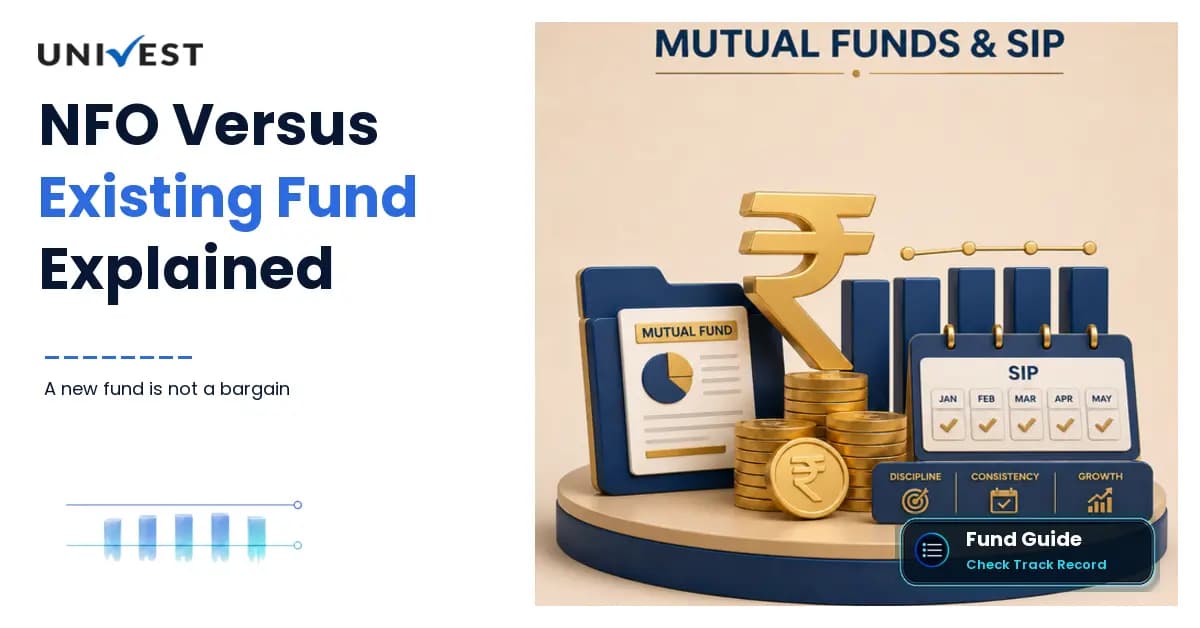
NFO = first sale of units of a new scheme, usually at Rs 10 per unit. A low NAV does not make it a bargain. No track record exists. Compare with existing funds on cost, record and strategy.
Updated: 18 Nov 2026 • 3:19 pm
Posted by:
Quick Answer
NFO vs existing mutual fund explained simply: a new fund offer, or NFO, is the first sale of units in a new scheme, usually at Rs 10 a unit. The low unit price does not make it a bargain or better, because returns depend on the portfolio and not the NAV. An existing fund has a track record you can check, so most investors should compare an NFO with similar funds before investing.
NFO vs existing mutual fund explained for investors who see a new fund offer advertised: the Rs 10 price looks attractive, but it says nothing about performance.
This guide covers what an NFO is, the common myth, the risks and a checklist to decide. It is educational and not a recommendation.
Click Here – Get Free Investment Predictions
NFO vs Existing Mutual Fund Explained: The Basics
A new fund offer is the initial subscription window in which an asset management company collects money for a new scheme. Units are usually sold at a face value of Rs 10. After the offer closes, the fund buys its portfolio, units are allotted and the scheme starts trading at its daily NAV. An existing fund is a scheme that is already running and has a history.
| Feature | NFO | Existing fund |
|---|---|---|
| Track record | None | Available, can be checked |
| Unit price | Usually Rs 10 | Current NAV |
| Portfolio | Built after the offer closes | Visible in the factsheet |
| Cost and risk data | Estimates only | Actual expense ratio and returns |
| Entry | Only during the offer period | Any business day |
The Rs 10 NAV Myth
Many investors think a Rs 10 NFO is a better deal than a fund with a NAV of Rs 100. This is wrong. NAV is the value of one unit and not a measure of value. If you invest Rs 10,000 in each, both give the same percentage return when the portfolios move equally. A fund at Rs 100 is not more expensive, and a fund at Rs 10 is not a bargain.
Risks of an NFO
- No track record to judge how the fund and manager perform across market cycles.
- The portfolio is not known in advance, so you rely on the stated plan.
- Many NFOs copy existing strategies, so a similar fund with a record may already exist.
- Early costs and a slow deployment of cash can drag returns at the start.
- Marketing can emphasise the story, not the evidence.
When an NFO May Make Sense
Use the Univest Screener to check live fundamentals before you act on any idea.
- The scheme offers a truly different strategy or asset class that existing funds do not cover.
- It is an index fund or ETF with a low expense ratio, where the index defines the portfolio.
- The fund house and manager have a strong record in a similar category.
Checklist Before You Invest
- Read the scheme information document for the investment objective, strategy and benchmark.
- Compare the expense ratio with similar existing funds.
- Look for an existing fund in the same category with a record of three to five years or more.
- Check the fund manager and fund house experience.
- Match the risk level to your goal and time horizon.
- Decide the amount and avoid investing only because of the offer period.
A new fund tracking the Nifty 50, for example, can be judged by its cost and tracking quality against existing index funds.
Common Mistakes
- Choosing an NFO because of the Rs 10 price.
- Ignoring the expense ratio and exit load.
- Investing a large amount without checking alternatives.
- Expecting past performance from the fund house to carry over.
During the subscription period you apply and receive units at allotment, usually after the issue closes. The units then appear in your folio. Check the dates given in the scheme document before you apply.
Download the Univest iOS App or Univest Android App to get daily stock research and market updates.
Conclusion
An NFO is the first sale of a new scheme, usually at Rs 10, and the low price carries no value advantage. An existing fund offers a visible record and costs.
Invest in an NFO only if it fills a clear gap, and compare it with existing funds first.
Disclaimer: Data and figures in this article are sourced from publicly available information. These may or may not be accurate. Please verify all data with the official NSE (nseindia.com) and BSE (bseindia.com) websites before making any investment decision. Investments in securities are subject to market risk. This content is for educational purposes only and is not investment advice by Univest (SEBI RA INH000013776).
Frequently Asked Questions
What is an NFO in mutual funds?
Ans. A new fund offer is the first period in which a fund house raises money from investors for a new scheme, usually at Rs 10 per unit.
Is an NFO a better deal because the NAV is Rs 10?
Ans. No. NAV is the price of one unit, not a measure of value. Returns depend on the portfolio, and the percentage gain is what matters.
Is an NFO better than an existing fund?
Ans. Not necessarily. An existing fund has a track record and known costs, so many investors prefer them unless the NFO offers something different.
Can I invest in an NFO after the offer closes?
Ans. Not at the offer price. After the offer closes, units can be bought at the daily NAV of the scheme.
What should I check before investing in an NFO?
Ans. Read the scheme information document, compare the expense ratio and strategy with existing funds, and check the fund manager and risk level.
Are NFOs riskier?
Ans. They carry added uncertainty because there is no track record, and the market risk of the underlying assets stays the same.
Do NFO units get any special benefit?
Ans. Usually not. Some schemes have no entry benefit at all, so the offer is simply a way to start a new fund.
Recent Articles

Ultra Short and Low Duration Funds Explained: Duration Rules, Returns, Risks, Taxation and How They Differ From Liquid Funds
18 November 2026

Tracking Error vs Tracking Difference Explained: How Index Funds and ETFs Are Judged, Formulas, What a Good Figure Is and How to Compare Funds
18 November 2026

Mutual Fund Riskometer Explained: The Six Risk Levels, How SEBI Sets Them, Potential Risk Class for Debt Funds and Its Limits
18 November 2026

Step-Up SIP Explained: How It Works, Calculation With Example, Benefits Over a Regular SIP and How Much to Increase Each Year
18 November 2026
Note: This blog is for information purpose only. Investments and trading are subject to market risks, read all scheme related documents carefully.
Reviews




Recent Posts
Ultra Short and Low Duration Funds Explained: Duration Rules, Returns, Risks, Taxation and How They Differ From Liquid Funds
Tracking Error vs Tracking Difference Explained: How Index Funds and ETFs Are Judged, Formulas, What a Good Figure Is and How to Compare Funds
Mutual Fund Riskometer Explained: The Six Risk Levels, How SEBI Sets Them, Potential Risk Class for Debt Funds and Its Limits
Step-Up SIP Explained: How It Works, Calculation With Example, Benefits Over a Regular SIP and How Much to Increase Each Year
Money Market Funds Explained: What They Invest In, Returns, Risk, Taxation and How They Differ From Liquid Funds and Savings Accounts

Uniresearch Global Pvt Ltd
Research Analyst
SEBI Registration Number — INH000013776
Uniresearch is a subsidiary of Univest Communication Technologies Private Limited
Company Address: Registered Address: Ground Floor, Unitech Commercial Tower 2, Block B, Greenwood City, Unit 1-3, Sector 45, Gurugram, Haryana 122003
Write to us : support@univest.in, compliance@univest.in
Verify on SEBI registry →RESEARCH ANALYST
Get SEBI Registered
advice on the stocks
trending today.
Get 3 FREE Trade Ideas

for Startups Accelerator 2024

Trusted by 1Cr Indians

Awarded No.1 by Economic Times