
Margin Trading Facility (MTF): How Leveraged Delivery Buying Works, What It Costs and the Risks
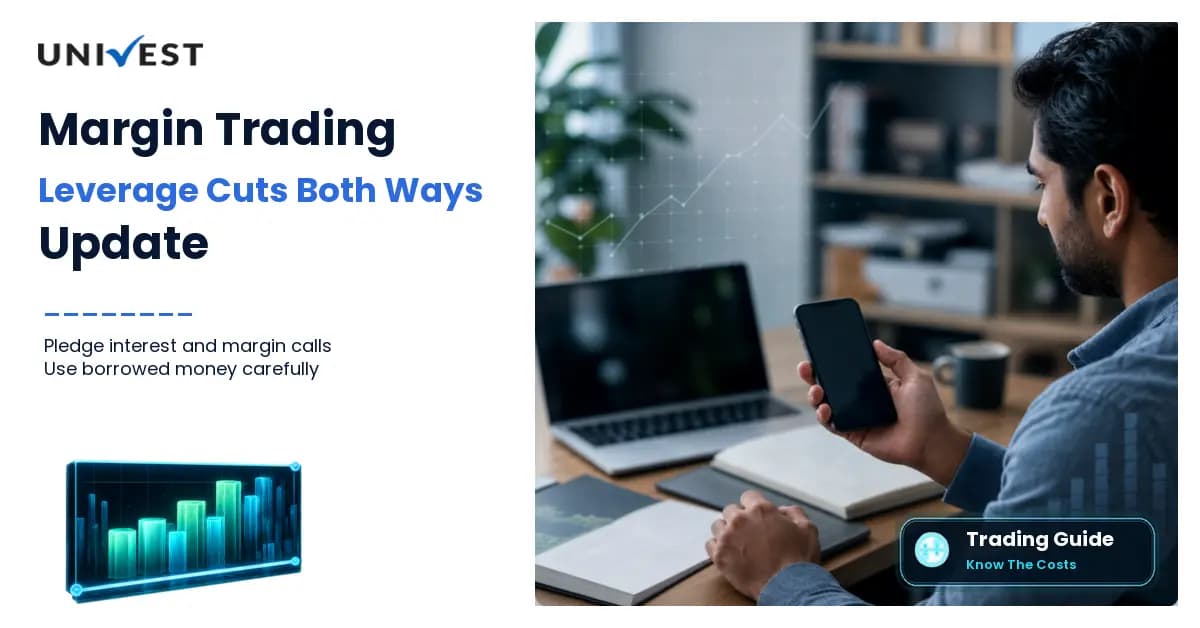
MTF lets you buy approved stocks by paying part of the value; the broker funds the rest. Funded shares must be pledged to the broker. Interest is charged daily. Losses are magnified by leverage.
Updated: 17 Nov 2026 • 11:09 am
Posted by:
Quick Answer
A margin trading facility, or MTF, lets you buy shares by paying only part of their value while the broker funds the rest, for stocks on the exchange's approved list. The shares bought must be pledged to the broker as collateral, and interest is charged daily on the funded amount. If the share price falls and your margin drops below the required level, the broker issues a margin call and can sell the shares if you do not add funds. MTF magnifies both gains and losses.
A margin trading facility is a broker loan for buying shares. You pay a portion of the purchase value, the broker finances the rest, and you hold the shares for as long as you maintain margin and pay interest. It is a legitimate, regulated product, and also one of the fastest ways for an investor to turn a normal correction into a large loss.
This explainer covers how a margin trading facility works, which stocks qualify, the pledge rules, how interest adds up, when margin calls hit and how to use it, if at all, with discipline.
Click Here – Get Free Investment Predictions
What Is a Margin Trading Facility?
Under SEBI's framework, eligible brokers can fund client purchases of approved securities in the cash market. The client pays an initial margin, the broker pays the balance, and the position is carried forward beyond the settlement day. Unlike intraday leverage, which must be squared off the same day, an MTF position can be held for longer, subject to continued margin and interest.
How a Margin Trading Facility Works Step by Step
- You choose MTF as the product type when placing a buy order on an eligible stock.
- You pay the required margin in cash or through pledged collateral; the broker funds the rest.
- On settlement, the shares are credited to your demat account and pledged to the broker. You must authorise the pledge, usually through a depository OTP, within the set time.
- Interest is charged on the funded amount every day the position is open.
- If the stock falls and margin drops below the requirement, the broker sends a margin call.
- If you do not add funds, the broker can square off part or all of the position.
What Margin Trading Facility Costs: A Worked Example
Illustration: you buy shares worth Rs 1,00,000 under MTF. The required margin is 25%, so you pay Rs 25,000 and the broker funds Rs 75,000. At an assumed 15% annual interest rate, the daily cost is about Rs 31, or about Rs 925 a month.
| Scenario after one month | Stock move | Gain or loss on Rs 25,000 own money (after about Rs 925 interest) |
| Stock rises | +10% | About +Rs 9,075, or +36% |
| Stock flat | 0% | About -Rs 925, or -3.7% |
| Stock falls | -10% | About -Rs 10,925, or -44% |
The example shows the core of MTF: a 10% stock move becomes a roughly 40% move on your own capital, and interest keeps eating into returns while the stock goes nowhere. Rates vary by broker and by funded amount, so check the exact MTF interest schedule.
Research Fundamentals Before Using Leverage on the Univest Screener
Which Stocks Qualify for a Margin Trading Facility
Only stocks on the approved list qualify for a margin trading facility, typically liquid shares that meet exchange criteria on trading frequency and impact cost. Brokers can apply their own stricter lists and higher margins. Required margins usually reflect the stock's volatility, so riskier stocks need more of your own money. Margin rules are set within SEBI margin rules and exchange requirements, which brokers cannot relax.
The MTF Pledge Requirement
Shares bought through a margin trading facility must be pledged to the broker in the depository system. If you do not authorise the pledge within the broker's deadline, the broker can sell the shares. The pledge means you own the shares and receive dividends and corporate benefits, but you cannot sell or transfer them freely until the funding is repaid. Existing holdings pledged as collateral are valued after a haircut, which reduces how much margin they provide.
Risks of the Margin Trading Facility
- Leverage magnifies losses as much as gains.
- Margin calls can arrive during sharp falls, forcing sales at low prices.
- Interest accumulates daily, so long holding periods in flat stocks lose money.
- Broad market falls can hit many MTF positions at once, adding selling pressure.
- Concentrating MTF in one or two stocks increases the chance of a forced exit.
Kunal Singla, Associate Director at Univest, suggests treating MTF exposure as part of total risk: if a 15% fall in the funded stocks would breach your loss limit, the position is too large regardless of how attractive the stock looks.
How to Use MTF With Discipline
- Use it only for short to medium holding periods with a clear exit plan.
- Keep leverage low: borrow far less than the maximum allowed, using the method in Univest's guide to position sizing.
- Set a stop loss and honour it before a margin call forces the decision.
- Keep spare cash to meet margin calls without selling other holdings.
- Track interest cost monthly against the position's gain.
Download the Univest iOS App or Univest Android App to follow research with defined stop loss levels before taking any leveraged position.
Final Word on the Margin Trading Facility
A margin trading facility can help an experienced investor act on a strong conviction without selling other holdings, but it converts ordinary volatility into large swings on your own money and charges interest every day. Use it sparingly, keep leverage well below the maximum, and plan your exit before the market plans it for you.
Disclaimer: Data and figures in this article are sourced from publicly available information. These may or may not be accurate. Please verify all data with the official NSE (nseindia.com) and BSE (bseindia.com) websites before making any investment decision. Investments in securities are subject to market risk. This content is for educational purposes only and is not investment advice by Univest (SEBI RA INH000013776).
Frequently Asked Questions on Margin Trading Facility
What is a margin trading facility in the stock market?
Ans. A margin trading facility, or MTF, lets you buy approved shares by paying only part of their value while your broker funds the rest. The shares are pledged to the broker as collateral, and you pay interest on the funded amount every day the position stays open. Unlike intraday leverage, MTF positions can be held beyond the trade day as long as you maintain the required margin.
How is MTF interest calculated?
Ans. MTF interest is charged daily on the amount funded by the broker, usually as an annual rate divided by 365. For example, at an assumed 15% a year on Rs 75,000 of funding, the cost is about Rs 31 a day, or roughly Rs 925 a month. Rates vary by broker and sometimes by the size of funding, so check the broker's published schedule before using the facility.
What happens if I cannot meet a margin call in MTF?
Ans. If the value of your MTF position falls and your margin drops below the required level, the broker sends a margin call asking you to add funds or collateral. If you do not do so within the broker's deadline, the broker can sell part or all of the pledged shares to recover the funding. Forced sales often happen at unfavourable prices during sharp market falls.
Do I get dividends on shares bought through MTF?
Ans. Yes. Shares bought through a margin trading facility are credited to your demat account and then pledged to the broker, so you remain the owner and receive dividends and other corporate benefits. However, you cannot sell or transfer the shares freely until the funding and interest are repaid, and the broker can sell them if you fail to meet margin requirements.
Which stocks can I buy under a margin trading facility?
Ans. Only stocks on the exchange-approved list for margin trading qualify, generally liquid shares that meet criteria on trading frequency and impact cost. Brokers can apply stricter lists and higher margins of their own. The required margin usually rises with the stock's volatility, so you put up more of your own money for riskier shares and less for large, liquid stocks.
Is MTF a good idea for beginners?
Ans. MTF is generally not suitable for beginners. Leverage turns a 10% fall in a stock into a much larger loss on your own money, interest adds a daily cost, and margin calls can force sales at the worst time. Beginners are better served by building experience with fully paid investments, defined stop losses and small position sizes before considering any form of borrowing to invest.
Recent Articles

HDFC AMC Share Price Rises 3% on 17 November 2026 as Asset Manager Stocks Gain After Record Industry AUM
17 November 2026

Vedanta Aluminium Share Price Rises 2.35% to Rs 394 on 17 November 2026: Where VAML Stands Five Months After Listing
17 November 2026

Gold Price November 2026: Down About Rs 9,000 From the 5 November Peak as MCX Gold Trades Near Rs 1.35 Lakh
17 November 2026

Nifty November Rally: Up About 10% This Month, Best Run Since 2020 as Nifty Trades at 25,400 on 17 November
17 November 2026
Note: This blog is for information purpose only. Investments and trading are subject to market risks, read all scheme related documents carefully.
Reviews



Recent Posts
HDFC AMC Share Price Rises 3% on 17 November 2026 as Asset Manager Stocks Gain After Record Industry AUM
Vedanta Aluminium Share Price Rises 2.35% to Rs 394 on 17 November 2026: Where VAML Stands Five Months After Listing
Gold Price November 2026: Down About Rs 9,000 From the 5 November Peak as MCX Gold Trades Near Rs 1.35 Lakh
Nifty November Rally: Up About 10% This Month, Best Run Since 2020 as Nifty Trades at 25,400 on 17 November
Nvidia Earnings Tonight and Anthropic's Listing Week: What the AI Trade Means for Indian IT Stocks on 17 November 2026
Popular this week
Retail Inflation October 2026 Hits 6.09%, Above RBI's 6% Limit for the First Time in Two Years: What It Means for Markets

Uniresearch Global Pvt Ltd
Research Analyst
SEBI Registration Number — INH000013776
Uniresearch is a subsidiary of Univest Communication Technologies Private Limited
Company Address: Registered Address: Ground Floor, Unitech Commercial Tower 2, Block B, Greenwood City, Unit 1-3, Sector 45, Gurugram, Haryana 122003
Write to us : support@univest.in, compliance@univest.in
Verify on SEBI registry →RESEARCH ANALYST
Get SEBI Registered
advice on the stocks
trending today.
Get 3 FREE Trade Ideas

for Startups Accelerator 2024

Trusted by 1Cr Indians

Awarded No.1 by Economic Times